Command Palette
Search for a command to run...
自分の間違いから学ぶ:自己蒸留のための学習可能な微小反射軌跡の構築
自分の間違いから学ぶ:自己蒸留のための学習可能な微小反射軌跡の構築
Zhilin Huang Hang Gao Ziqiang Dong Yuan Chen Yifeng Luo Chujun Qin Jingyi Wang Yang Yang Guanjun Jiang
概要
自己蒸留は、モデル自身のロールアウトを訓練信号として用いることで大規模言語モデルの推論能力を向上させる。通常、この手法は特権的な目標分布に対するKLダイバージェンスを最小化する暗黙的なロジットレベルの整列を通じて実現される。しかし、この教師信号は制御されていないサンプリングによって生成されるため、モデルの具体的な誤りに関する診断的な洞察や、個々の失敗パターンに対する修正ガイダンスを提供しない。その結果、モデルは推論がどこで、なぜ失敗するかを特定するきめ細かい修正を受けるのではなく、特権的な分布の模倣を学習することになる。本論文では、自己蒸留を暗黙的な分布整列から明示的な軌道構築へと進展させるTrajectory-Augmented Policy Optimization (TAPO)を提案する。RL訓練中、モデルは同一のクエリに対して正解と不正解のロールアウトの両方を生成する。TAPOはこの対照的な構造を活用し、micro-reflective corrections(新しい訓練軌道)を構築する。これらはモデルの誤った推論を失敗点までそのまま保持した上で、同一のサンプリンググループから得られた正解参照によって導かれた自然言語による診断と修正推論を挿入する。各軌道は学習者自身のプレフィックスと解に根ざしているため、KLベースの手法が課す位置ごとの整列と比較して、修正信号はモデルのon-policy分布をより高い程度で保持する。これらの軌道を統合するため、TAPOはモデルの能力境界における難易度対応型候補選択と、勾配汚染を防止するための分離型アドバンテージ推定を導入する。AIME 2024、AIME 2025、HMMT 2025における実験は、TAPOが同等の訓練ステップ数においてGRPOに対して一貫した性能向上を達成することを示している。追加分析により、TAPOが初回推論とエラー修正の有効性の両方を強化することが示されている。
One-sentence Summary
Trajectory-Augmented Policy Optimization (TAPO) advances self-distillation beyond implicit logit alignment by contrasting correct and incorrect rollouts to construct micro-reflective trajectories that preserve pre-failure reasoning, insert natural-language diagnoses, and append corrected steps, thereby enabling models to learn targeted error corrections rather than generic distributional imitation.
Key Contributions
- This paper introduces Trajectory-Augmented Policy Optimization (TAPO), a self-distillation framework that replaces implicit logit alignment with explicit trajectory construction. TAPO anchors training sequences to the model's erroneous reasoning prefixes and appends natural-language diagnoses alongside corrected steps derived from within-group correct solutions.
- The framework addresses integration challenges in advantage-based reinforcement learning through three targeted mechanisms. Difficulty-aware Candidate Selection establishes an emergent curriculum by targeting problems within the model's capability boundary, Decoupled Advantage Estimation prevents gradient contamination from inflated group rewards, and OOD Token Suppression stabilizes optimization when processing out-of-distribution corrective tokens.
- Evaluations across the AIME 2024, AIME 2025, and HMMT 2025 benchmarks demonstrate consistent performance gains over GRPO and distributional alignment baselines under identical training steps. Direct Solution Rate and Effective Reflection Rate analyses confirm that the micro-reflective training signal enhances both first-pass reasoning accuracy and autonomous error correction without requiring explicit reflection prompts at inference.
Introduction
Large language models have advanced significantly in complex reasoning through reinforcement learning with verifiable rewards, where self-distillation methods use dense token-level supervision to align model outputs with verified solutions. Prior approaches, however, rely on implicit distributional alignment that treats reasoning targets as uncontrolled probability distributions and suppresses errors instead of teaching recovery pathways. To overcome these limitations, the authors leverage the model's own incorrect rollouts to construct explicit micro-reflective trajectories that diagnose mistakes and demonstrate natural-language corrections. By integrating these targeted signals into a standard advantage-based reinforcement learning framework, they enable models to internalize autonomous error correction while preserving exploratory diversity and maintaining training stability.
Dataset

- Dataset composition and sources: The authors build a 45,000 example cold-start dataset drawn from approximately 40,000 queries in the DeepScaleR collection.
- Key details for each subset: The data splits into 30,000 supervised fine-tuning examples and 15,000 instruction-following fine-tuning examples. All initial responses are sampled from the Qwen3-8B-Instruct base model.
- Processing and filtering rules: The authors partition sampled responses into correct and incorrect groups. They only generate micro-reflective corrective trajectories from incorrect responses, enforcing a strict limit of one trajectory per query. The pipeline structures outputs to reliably produce specific XML-style tags for the analysis and reconstruction phases.
- Usage in the model: The authors jointly train the two example formats during a cold-start phase to initialize the model before reinforcement learning. This combined mixture equips the policy with both instruction-following reliability and foundational self-error analysis capabilities, preventing severe out-of-distribution tokens and stabilizing corrective signal propagation during subsequent training.
Experiment
The evaluation assesses TAPO on challenging mathematical reasoning benchmarks using both direct and cold-start initialization settings to compare against standard reinforcement learning baselines. Main results and capability internalization analyses validate that TAPO genuinely internalizes error-correction capabilities, significantly improving both first-pass reasoning strength and reflective recovery rates rather than merely augmenting training data. Ablation and training dynamics experiments confirm that preserving valid reasoning prefixes, employing contrastive advantage estimation with negative samples, and suppressing out-of-distribution tokens are essential for stable optimization and distributional alignment. Collectively, these findings demonstrate that cold-start pre-alignment and carefully structured corrective trajectories enable robust policy learning that substantially outperforms conventional methods, particularly on complex mathematical tasks.
The authors evaluate the capability internalization of TAPO versus GRPO by measuring Direct Solution Rate and Effective Reflection Rate. The data indicates that TAPO consistently outperforms the baseline across all benchmarks, demonstrating enhanced first-pass reasoning and more effective error correction. TAPO achieves higher Direct Solution Rate than the baseline method across all benchmarks. The Effective Reflection Rate is superior for TAPO compared to GRPO. Improvements in both reasoning and correction metrics are consistent across different datasets.

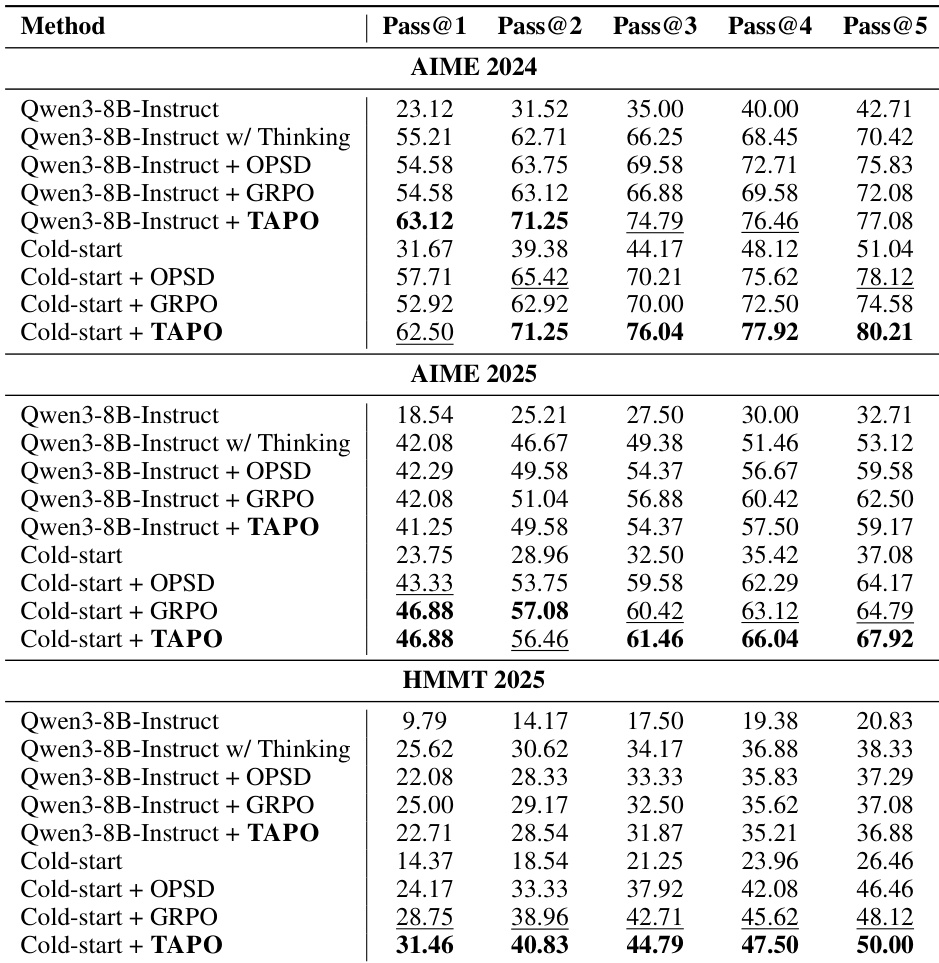
The authors evaluate TAPO against baselines like GRPO and OPSD on mathematical reasoning benchmarks using both direct training and cold-start initialization settings. Results indicate that TAPO with cold-start initialization consistently achieves the highest Pass@1 scores across all benchmarks, demonstrating superior first-pass reasoning. In contrast, direct training yields mixed results, where TAPO excels on AIME 2024 but underperforms GRPO on more challenging benchmarks without the pre-alignment provided by the cold-start phase. TAPO with cold-start initialization outperforms GRPO and OPSD across all benchmarks, achieving the best Pass@1 scores. The cold-start phase is critical for TAPO, as direct training leads to performance drops on harder benchmarks compared to GRPO. TAPO sustains its performance gains across varying Pass@k values, indicating robust capability enhancement rather than variance reduction.
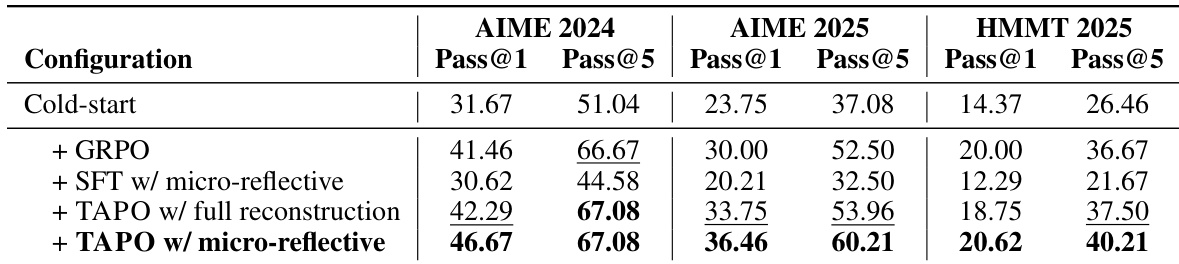
The authors evaluate the TAPO method against a cold-start baseline and various ablation variants across three mathematical reasoning benchmarks. The results demonstrate that the full TAPO configuration consistently outperforms the baseline and all partial configurations. The inclusion of all integration components yields the highest performance metrics across all Pass@k settings. The full TAPO configuration consistently achieves the highest scores across all benchmarks and Pass@k metrics. Ablation studies reveal that removing components such as OOD token suppression or negative samples results in lower performance compared to the full method. The cold-start baseline exhibits the lowest accuracy, serving as the foundation for incremental improvements as components are added.

The authors evaluate the TAPO method against baselines like Cold-start, GRPO, and SFT across three mathematical reasoning benchmarks. Results indicate that TAPO with micro-reflective trajectory construction consistently achieves the highest performance, surpassing both standard reinforcement learning and supervised fine-tuning approaches. The ablation studies highlight that preserving partial reasoning paths during correction is more effective than full reconstruction, demonstrating the value of incremental error correction. TAPO with micro-reflective construction consistently outperforms GRPO and SFT baselines across all tested benchmarks. Preserving valid reasoning prefixes during correction yields better results than regenerating full solutions from scratch. The method demonstrates robust improvements on challenging benchmarks, particularly showing significant gains on the hardest dataset.
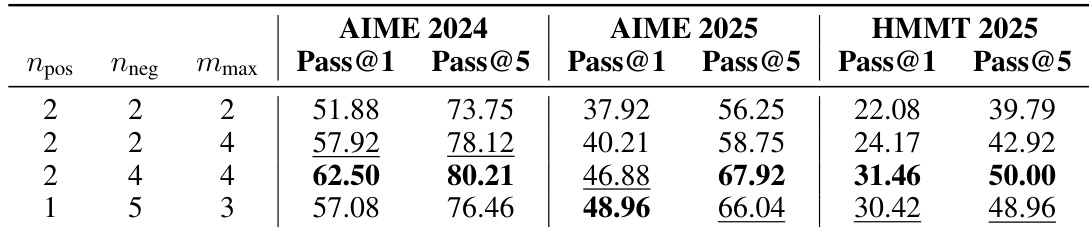
The authors investigate the impact of the ZPD threshold parameters and maximum construction count on model performance. The default configuration demonstrates robust effectiveness, securing the top Pass@1 performance on AIME 2024 and HMMT 2025, along with the best Pass@5 results across all benchmarks. The default parameter configuration achieves the highest Pass@1 scores on AIME 2024 and HMMT 2025. A stricter threshold setting proves most effective for the AIME 2025 benchmark. Reducing the maximum construction count leads to a noticeable decline in performance, highlighting the importance of construction volume.
The authors evaluate TAPO against multiple reinforcement learning and supervised baselines across mathematical reasoning benchmarks, employing direct training, cold-start initialization, ablation studies, and hyperparameter tuning to validate its core design principles. Results demonstrate that TAPO consistently outperforms competing methods in both initial reasoning accuracy and subsequent error correction, with cold-start initialization proving critical for sustaining performance on complex tasks. Component analysis confirms that preserving partial reasoning paths during refinement and integrating all architectural elements yields the most robust improvements compared to full reconstruction or partial configurations. Ultimately, the experiments establish that TAPO delivers reliable capability enhancement through its structured initialization and incremental correction mechanisms.