Command Palette
Search for a command to run...
言語モデルの推論におけるリセットを用いた信用配分
言語モデルの推論におけるリセットを用いた信用配分
Ankur Samanta Akshayaa Magesh Ayush Jain Youliang Yu Daniel Jiang Kavosh Asadi Kaveh Hassani Paul Sajda Jalaj Bhandari Yonathan Efroni
概要
検証可能な報酬を用いた現代のリインforcementラーニング(RLVR)手法は、中間ステップ全体に対して単一の最終結果報酬を一様に伝播させることで、言語モデルのポストトレーニング(再学習)を実施している。長期かつ多段階の推論タスクにおける言語モデルに対し、このアプローチはすべてのステップに同じ信用(クレジット)を割り当てるため、観測された結果に対してどのステップが最も責任を負っていたかが不明確になる。結果を最も直接的に形成するステップから学習することで、ポリシー更新により意味のある信号が提供され、効率的な学習が可能となる。このようなメカニズムは生物学的システムにも見られ、高インパクトの意思決定ポイントが再設定され、その状態からシミュレートされた反実仮想(counterfactual)の「もし~だったら」という結果から学習が行われる。これらの洞察に触発され、本研究では、改善可能な状態の反実仮想の結果から学習することで信用割り当てを改善する、リセットを用いたRLポストトレーニング手法を検討する。リセットとは、以前に訪問した状態へ再進入し、継続部分を再サンプリングすることで、その状態での意思決定に対して結果の違いを結びつけるプロセスである。本論文では、リセット状態が厳密により良い行動を許容する場合、つまり改善の大きな可能性がある場合に限り、リセットが信用割り当てに有用であると論じる。我々は、言語モデル向けの2つのリセットベースのRLVRポストトレーニング手法、Random-Reset Policy Optimization (RRPO) および Self-Reset Policy Optimization (SRPO) を提案する。両手法とも、失敗したトラジェクトリから取得したリセット状態に対して複数のサフィックス(接尾辞的)継続を再サンプリングし、ポリシー勾配をこれらのサフィックストークンのみに適用する。この共有プレフィックス部分グループは、結果の違いが分岐したサフィックストークンに信用を割り当てる反実仮想のロールアウトグループと見なせる。RRPOとSRPOの違いは、リセット状態の選択方法にある。RRPOは推論ステップ全体から均一ランダムにリセット状態を選択するのに対し、SRPOは最初の誤りステップの自己局所化(self-localization)によってリセット状態を選択する。SRPOは外部のステップレベルフィードバックを必要とせず、失敗した構造化推論トレースにおいて言語モデルが最初の誤った思考を自己局所化する能力が、自己修正を駆動するのに十分な精度であるという知見を利用する。自己局所化によるエラーの検出が、ランダムなリセットと比較してもたらす恩恵を定量的に評価するため、ポリシー最適化の基盤アルゴリズムであるConservative Policy Iteration (CPI) の枠組みを用いる。CPIは、ランダムなリセットを通じてオンポリシーな状態サンプルを抽出し、アドバンテージを推定した後、保守的なポリシー更新を適用する。本研究では、このアルゴリズムをCPI-with-random-resets (CPI-RR) と呼ぶ。我々は、そのパフォーマンスを、信用割り当てのためのオラクルへのアクセスを前提とする別のCPIアルゴリズムと比較する。このオラクルは、改善可能な状態に対するメンバーシップテストであり、ある状態が閾値τよりも大きなアドバンテージを持つ行動を許容するかどうかを判定する。このオラクルを用いた変種を CPI-CARO と呼ぶ。CPI-CAROは、オラクルを用いてリセット状態を改善可能な状態のみから抽出し、ポリシー更新をその状態に対してのみ適用する。我々は、CPI-CARO が CPI-RR と比較して、標本計算量(sample complexity)を 1/pπ2 倍に削減し、反復あたりの改善量を 1/pπ 倍増大させることを示す。ここで pπ は、オンポリシーにおいて改善可能な状態に到達する確率を表す。数学、科学、戦略的思考、常識的推論を含む10個のベンチマークからなるスイートにおいて、SRPO は自己修正や共有プレフィックス継続を用いる GRPO や最新のRLベースラインを上回る性能を示した。さらに、コーディング領域における SRPO のテストでは、GRPO および RRPO よりも高い正答率へ収束し、2~3倍の速度で学習することを確認した。高品質な自己局所化は、より高い修正率とより優れたサフィックスグループをもたらす。クリーンなプレフィックスは誤りのあるプレフィックスと比較して約2倍頻繁に修正されており、これは、明確な自己局所化が信用割り当てオラクルに対する不確かではあるが効果的な代理指標であることを示している。このローカライズ品質への感受性は、より効率的な学習を可能にするため、リセットベースのRLにおける自己局所化の改善に向けたさらなる研究を促す動機となっている。
One-sentence Summary
Researchers from multiple institutions propose Self-Reset Policy Optimization (SRPO), a reinforcement learning method that improves credit assignment in language model reasoning by resetting and resampling from self-identified erroneous steps to create counterfactual suffix groups that attribute outcome differences to specific decisions, achieving 2–3× faster learning and higher accuracy than GRPO across math, science, and coding benchmarks.
Key Contributions
- Introduces Random-Reset Policy Optimization (RRPO) and Self-Reset Policy Optimization (SRPO), two reset-based reinforcement learning methods that improve credit assignment by resampling suffix continuations from a reset state in a failed trajectory and applying the policy gradient only to those suffix tokens.
- A theoretical analysis using Conservative Policy Iteration shows that resetting from improvable states via a credit-assignment oracle (CPI-CARO) reduces sample complexity by 1/pπ² and increases per-iteration improvement by 1/pπ compared to random resets (CPI-RR), where pπ is the on-policy probability of reaching such states.
- Experiments across a 10-benchmark reasoning suite (math, science, strategic, commonsense) and a coding domain demonstrate that SRPO outperforms GRPO and contemporary RL baselines, converges to a higher pass rate, and learns 2–3× faster than GRPO and RRPO; higher-quality self-localizations yield nearly twice the correction rate of erroneous ones.
Introduction
Standard reinforcement learning with verifiable rewards (RLVR) methods for post-training language models assign a single outcome reward uniformly to every token in a reasoning trajectory. This uniform assignment ignores the fact that some reasoning steps are directly responsible for the final success or failure, diluting the learning signal and preventing targeted refinement of faulty steps. The authors address this limitation by introducing reset-based credit assignment methods that return to an intermediate state and resample counterfactual continuations, so that outcome differences can be attributed to specific decisions. They propose two algorithms, Random-Reset Policy Optimization (RRPO) and Self-Reset Policy Optimization (SRPO), and analyze them within the Conservative Policy Iteration (CPI) framework. Their main contribution is demonstrating that a credit-assignment oracle targeting improvable states yields provable improvements over random resets, and that SRPO, which uses the model itself to localize errors with no external supervision, consistently outperforms standard GRPO and RRPO across models and reasoning benchmarks.
Method
The authors proposea post-training RLVR method that frames resets as a credit-assignment primitive. They operate at a thought-level granularity, formalizing the generation process as a Thought MDP where each action is a semantically coherent reasoning step (a "thought") delimited by a stop pattern. This abstraction allows the model to self-determine boundaries during generation, making every thought an atomic, self-contained unit for credit assignment without requiring retroactive parsing.
To construct training rollouts, the authors build a buffer combining a base group of G i.i.d. rollouts from the prompt x0 (standard GRPO) and a shared-prefix group of G rollouts from a reset state x∗. As shown in the figure below, different configurations of these groups can be utilized, ranging from the standard GRPO baseline to various SRPO splits such as 1x4, 2x4, and 1x8.
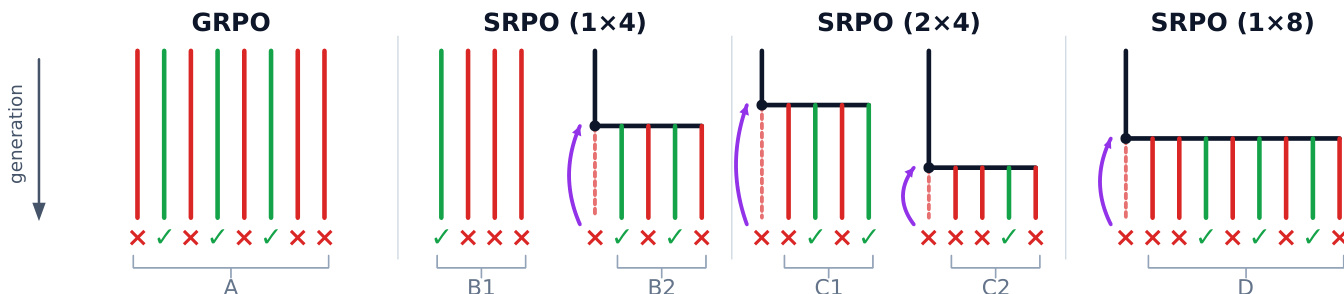 The shared-prefix group is generated by first drawing rollouts until an incorrect "seed" is found. The methods differ in how the reset index h∗ is chosen to form the reset state x∗=(x0,y~1:h∗−1). In Random Reset Policy Optimization (RRPO), h∗ is drawn uniformly, realizing a uniform reset. In Self-Reset Policy Optimization (SRPO), the model performs explicit self-localization to identify the index of the first incorrect thought in the seed. The same policy that generated the seed is prompted to analyze its own reasoning trace, effectively acting as a credit-assignment oracle to find the verified-correct prefix preceding the error.
Refer to the framework diagram for a detailed view of the SRPO process. In the initial iteration, the model generates a sequence of thoughts. Upon verifying accuracy, a localization step identifies the first erroneous thought (e.g., y~4). The process then resets to the verified-correct prefix (keeping y~1:3) and samples multiple alternative suffixes (Suffix 1 through Suffix 4). The gradients for the shared prefix are masked out, ensuring credit is assigned only to the resampled suffixes based on their final outcomes.
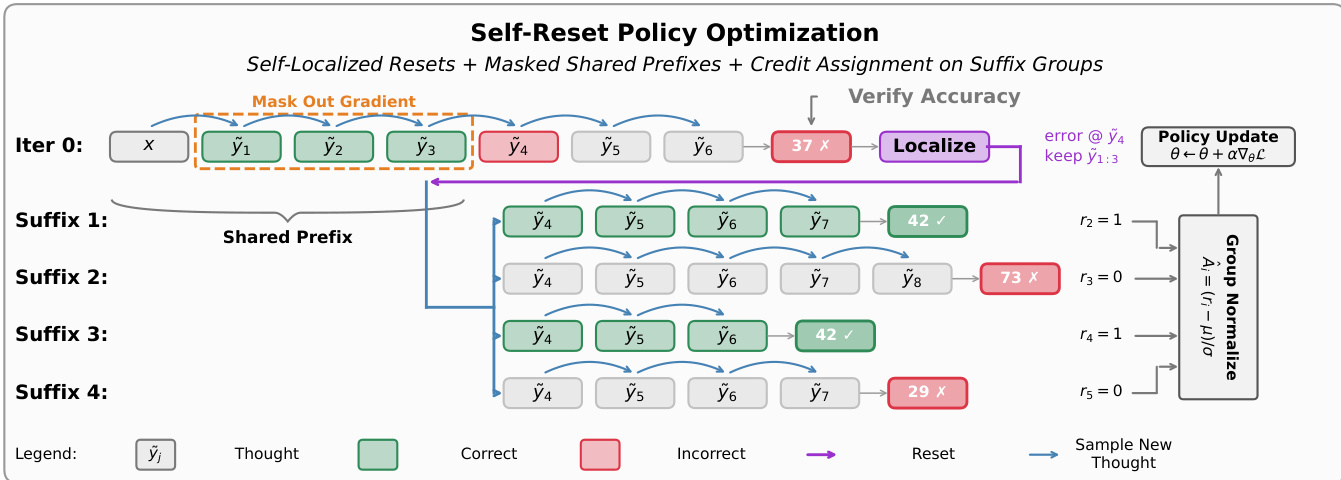
Finally, the authors reinforce these rollouts using group-relative advantages. For each group, advantages are self-normalized based on the group's empirical mean and standard deviation, measuring each rollout's outcome relative to the rest of its group. For the shared-prefix group, the loss applies this advantage only to the suffix tokens, masking the shared prefix. This prefix masking serves as the parametric analog of the theoretical policy update on the reset state, ensuring the credit signal lives on thoughts rather than tokens. The policy is updated via a single on-policy gradient step over the combined buffer without PPO clipping or KL regularization.
Experiment
Resets re-enter a previously visited state to resample continuations, attributing credit to the decisions made from that state, and are most useful when the reset state has significant potential for improvement. The work introduces two reset-based RL post-training methods—RRPO, which selects reset states uniformly at random, and SRPO, which uses the model’s own self-localization of the first erroneous step—and shows that SRPO consistently outperforms random-reset and no-reset baselines across math, science, strategic, commonsense, and coding benchmarks while learning faster. Self-localization acts as an imperfect but effective proxy for a credit-assignment oracle, with clean prefixes correcting nearly twice as often as erroneous ones, making localization quality the primary bottleneck and motivating further work on improving it. The methods rely on verifiable rewards and multi-step reasoning structures, and the theoretical analysis establishes sample-complexity gains from resetting only at improvable states.
The authors compare the computational efficiency and resource usage of GRPO, RRPO, and SRPO under a fixed rollout budget. Results show that while reset-based methods like RRPO and SRPO require more total training time than GRPO, SRPO is more efficient than RRPO in terms of total hours and token consumption. Additionally, the reset-based strategies exhibit slower generation speeds and longer response lengths compared to the standard GRPO baseline. SRPO requires less total training and validation time than RRPO, making it the more efficient reset-based method. RRPO consumes the most tokens and generates the longest responses, while SRPO maintains moderate resource usage. GRPO achieves the highest generation speed, whereas reset-based methods experience slower token generation due to their sampling overhead.

The authors evaluate different reset-based sampling strategies for SRPO under a fixed compute budget across ten reasoning benchmarks. The 1x4 split, which balances base-policy coverage with shared-prefix depth, achieves the best performance on the majority of tasks for both evaluated models. Consequently, this configuration is adopted as the default SRPO setup for remaining experiments. The 1x4 sampling strategy outperforms 2x4 and 1x8 splits on most benchmarks for both Qwen2.5-14B-Instruct and OLMo-3-7B-Instruct. Increasing suffix depth to 1x8 or prefix diversity to 2x4 generally yields lower performance compared to the balanced 1x4 split. RRPO with a 2x4 split occasionally achieves top scores on specific tasks but is generally outperformed by the 1x4 SRPO configuration.
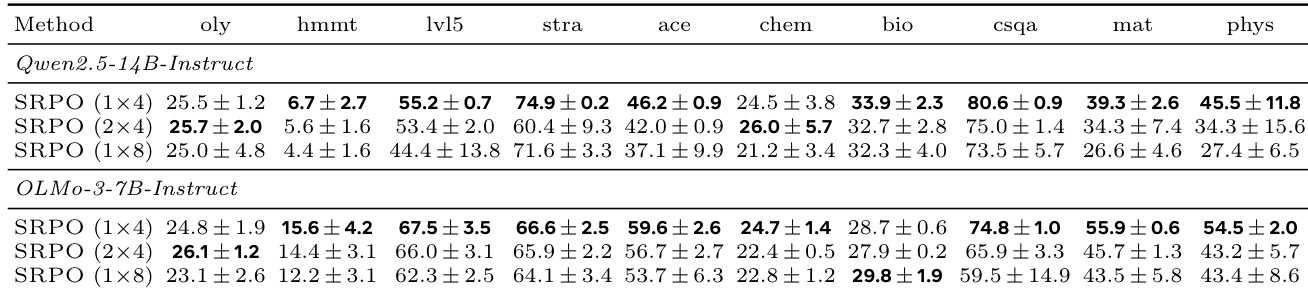
The authors evaluate different sampling strategies for Self-Reset Policy Optimization under a fixed compute budget to determine the optimal balance between base-policy coverage and shared-prefix depth. Results indicate that the 1x4 split, which combines independent base rollouts with resampled suffixes from a single self-localized prefix, achieves the best performance across the majority of reasoning benchmarks. Consequently, this configuration is adopted as the default for subsequent experiments. The 1x4 sampling strategy outperforms alternatives like 2x4 and 1x8 on most benchmarks by effectively balancing base rollouts and shared-prefix depth. Increasing prefix diversity or maximizing suffix depth generally leads to lower performance compared to the balanced 1x4 approach. The 1x4 configuration achieves the highest scores in tasks such as strategy, math, and science reasoning, demonstrating its robustness across different domains.

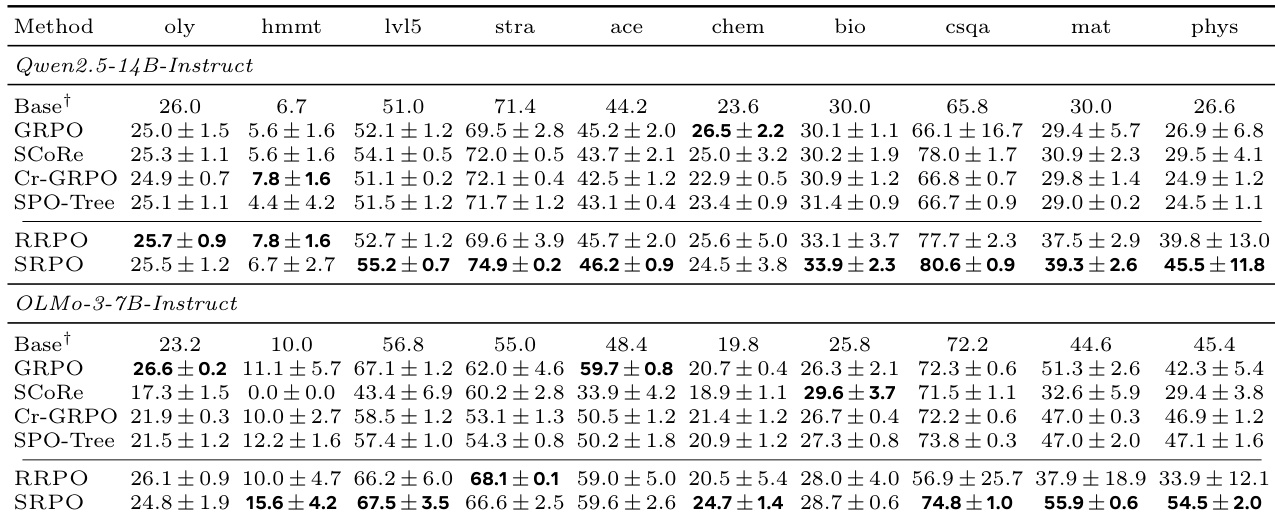
The authors compare SRPO and RRPO against GRPO and related baselines across ten reasoning benchmarks using two language models. SRPO emerges as the strongest method, achieving the best results on the majority of tasks for both models, while RRPO performs comparably to GRPO. These gains on diverse benchmarks indicate strong out-of-distribution generalization from training solely on math problems. SRPO outperforms all other evaluated methods on most benchmarks for both Qwen2.5-14B-Instruct and OLMo-3-7B-Instruct. RRPO demonstrates performance levels similar to GRPO across the tested reasoning tasks. The performance improvements from SRPO extend beyond the training domain, showing effective generalization to science, strategic, and commonsense reasoning.
The the the table compares the general reasoning performance of SRPO variants, specifically analyzing the impact of clipping, across two language models on ten diverse benchmarks. The results indicate that the unclipped SRPO configuration generally achieves superior performance across the majority of math, science, and strategy tasks compared to the clipped variant. The SRPO variant without clipping achieves the best results on most benchmarks for both the Qwen and OLMo models. Clipping appears beneficial only for a minority of specific tasks, such as Olympiad math and HMMT for the larger model. The method demonstrates robust performance across science and commonsense domains, reflecting strong generalization from the math-focused training data.
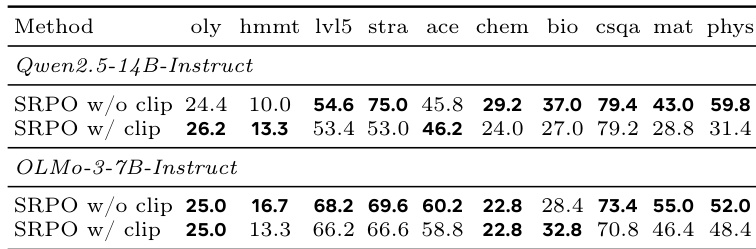
The experiments first compare the computational efficiency of GRPO, RRPO, and SRPO, finding that while reset-based methods incur higher training time and slower generation speeds, SRPO is more resource-efficient than RRPO. A subsequent ablation on sampling strategies establishes the 1x4 split as optimal for SRPO, as it balances base-policy coverage and shared-prefix depth to achieve the best performance across most reasoning benchmarks. Broader evaluations against baselines show that SRPO consistently outperforms all other methods on diverse reasoning tasks, demonstrating strong out-of-distribution generalization from math-only training, whereas RRPO performs comparably to GRPO. Finally, an analysis of clipping reveals that the unclipped SRPO variant generally yields superior results across the majority of domains.