Command Palette
Search for a command to run...
Vero:汎用視覚推論のためのオープンなRLレシピ
Vero:汎用視覚推論のためのオープンなRLレシピ
Gabriel Sarch Linrong Cai Qunzhong Wang Haoyang Wu Danqi Chen Zhuang Liu
概要
チャート、科学、空間理解、そしてオープンエンドなタスクにわたって機能する視覚推論エージェントを構築するには、何が必要でしょうか?最も強力な視覚言語モデル(VLM)は、広範な視覚推論が手の届く範囲にあることを示唆していますが、そのクローズドなデータと強化学習(RL)パイプラインにより、その利点を研究、再現、拡張することは困難です。我々は、多様な視覚推論タスクにおいて既存のオープンウェイトモデルに匹敵するか、それを上回る、完全にオープンなVLMファミリーであるVeroを紹介します。我々は、6つの広範なタスクカテゴリにわたってRLデータと報酬をスケールし、59のデータセットからなる60万サンプルのデータセットVero-600Kを構築し、異種の回答を処理するタスクルーティング報酬を設計しました。我々の30ベンチマークスイートであるVeroEval全体で、Vero-600Kは制御された比較において既存のRLデータセットを上回ります。5つの初期モデルに適用した場合、Veroの変種は初期モデルと比較して平均2.9〜5.4ポイント向上します。注目すべきは、Instructモデルを学習したVero-Qwen3I-8Bが、追加の蒸留なしでQwen3-VL-8B-Thinkingを平均3.8ポイント上回ることです。体系的なアブレーションにより、異なるタスクカテゴリが異なる推論パターンを引き出し、広範な向上はそれらを単独で学習するのではなく、共同で学習することに依存することが明らかになりました。すべてのデータ、コード、モデルは公開されています。
One-sentence Summary
Researchers at Princeton University introduce Vero, a family of fully open vision-language models that match or exceed existing open-weight models across diverse visual reasoning tasks by scaling reinforcement learning data and rewards across six task categories via the Vero-600K dataset and task-routed rewards, achieving 2.9–5.4 point average gains over five starting models and surpassing Qwen3-VL-8B-Thinking by 3.8 points without distillation.
Key Contributions
- Introduces Vero, a fully open family of vision-language models trained with single-stage reinforcement learning on Vero-600K, a 600K-sample dataset from 59 datasets across six task categories, using task-routed rewards for heterogeneous answer formats.
- Across the 30-benchmark suite VeroEval, Vero-600K outperforms existing RL datasets under controlled comparisons; applying Vero variants to five starting models yields average gains of 2.9–5.4 points, with Vero-Qwen3I-8B surpassing Qwen3-VL-8B-Thinking by 3.8 points on average without distillation.
- Systematic ablations show that different task categories elicit distinct reasoning patterns, such as elevated backtracking in STEM tasks versus visual-search-like behavior in grounding tasks, and that broad gains depend on jointly learning these categories with balanced, uniform exposure, recasting multi-task RL as a distribution-design problem.
Introduction
Vision-language models are increasingly expected to handle a broad range of visual tasks, from chart interpretation to spatial reasoning and open-ended questions. Reinforcement learning has become a key driver of progress, yet the strongest existing models rely on proprietary pipelines with undisclosed reward designs and training data, making it difficult to systematically study what drives performance. Fully open efforts tend to focus on narrow domains like visual math, and training on a single task category does not generalize well to other visual capabilities.
The authors introduce Vero, a family of fully open VLMs trained with a single-stage RL recipe that requires no proprietary data, warm start, or staged training. They build Vero-600K, a 600K-sample dataset spanning six task categories from 59 datasets, paired with task-routed reward functions. Through systematic ablations, they find that data diversity is the critical ingredient, with different task categories eliciting distinct reasoning patterns that transfer poorly in isolation. Their recipe yields consistent gains across model families, improving overall benchmark scores by +2.9 to +5.4 points over post-trained models, and up to +12.9 points when applied directly to a pretrained-only base model. The authors release all data, code, and models to support open research.
Dataset

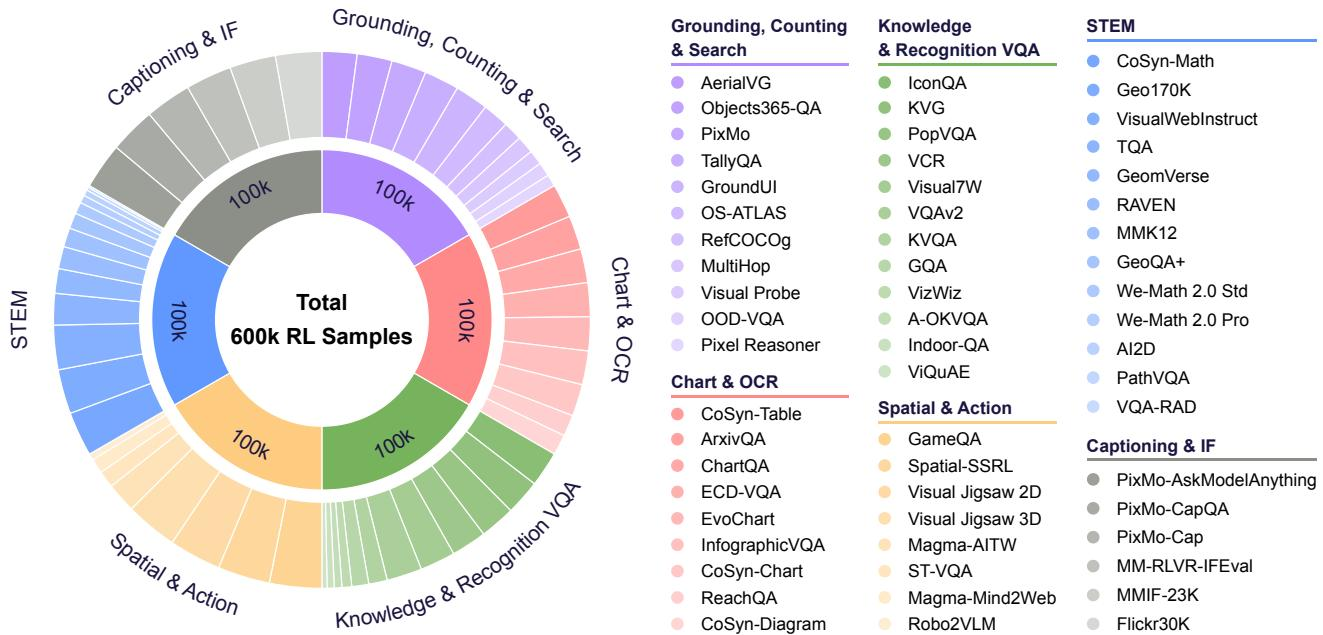
The authors construct Vero-600K, a multi-task reinforcement learning training set containing 600K samples drawn from 59 datasets. The data is organized into six task categories, each targeting a distinct visual reasoning capability. The categories are:
- STEM (13 datasets): Mathematical diagram reasoning, scientific figure interpretation, and medical image understanding, with mostly numeric or symbolic answers.
- Spatial & Action (8 datasets): Embodied reasoning, UI navigation, and 3D spatial understanding, requiring reasoning about spatial transformations and action sequences.
- Knowledge & Recognition (12 datasets): Visual question answering combining object, scene, and entity recognition with external or commonsense knowledge.
- Chart & OCR (9 datasets): Extracting and reasoning over structured information in documents, charts, tables, and infographics.
- Grounding, Counting & Search (11 datasets): Spatially localizing objects via bounding boxes, counting entity instances, and searching among visual distractors.
- Captioning & Instruction Following (6 datasets): Open-ended image description and following prompt instructions.
The data curation pipeline involves three steps:
-
Dataset sourcing and selection: The authors start with over 250 candidate datasets from instruction tuning and RL collections (e.g., FineVision) and recently released task-specific sources. They apply heuristic filtering, discarding datasets with fewer than 1K examples, average image resolution below 200K pixels (retaining five low-resolution datasets for question quality), or binary questions. They then manually inspect about 50 examples per candidate against three criteria: correctness (less than 5% annotation error), unambiguity (single verifiable answer), and verifiability (answer format compatible with reward functions). Of about 100 datasets passing heuristic screening, 59 are retained. For a few datasets, they rewrite questions to fix prompt clarity or drop high-error subsets.
-
Data filtering: After dataset-level filtering, individual examples are further filtered. Question filtering uses Qwen3-VL-235B-A22B-Instruct to remove ambiguous, image-irrelevant, or unverifiable questions, scoring each datapoint on relevance, ambiguity, language, verifiability, and numeric precision. Answer filtering normalizes ground-truth answers using text-only Qwen3-235B-A22B-Instruct. Numeric answers are stripped of units and currency symbols, converted to decimal form, and evaluated as expressions. Multiple-choice answers are normalized to a single canonical letter. Except for captioning and instruction following, samples with multi-value answers, non-reducible symbolic expressions, or ambiguous descriptions are removed. Answer filtering is not applied to Spatial & Action or Grounding tasks, as their answers are already standardized.
-
Data mixtures: The authors investigate four task category weighting schemes (uniform, difficulty-weighted, image-size-weighted, reasoning-length-weighted). Uniform sampling achieves the highest benchmark average gain (+5.8 points over the base model) and is used for training.
The authors also introduce VeroEval, an evaluation suite of 30 benchmarks spanning the six categories, with three to eight benchmarks per category. Benchmarks are selected based on difficulty (favoring those where frontier models have room for improvement), annotation quality, and intra-category diversity.
Method
The authors construct Vero-600K, a multi-task reinforcement learning training set comprising 600K samples across six task categories. The data curation pipeline involves multiple stages of sourcing, filtering, and mixing to ensure high-quality training data.
As shown in the figure below:
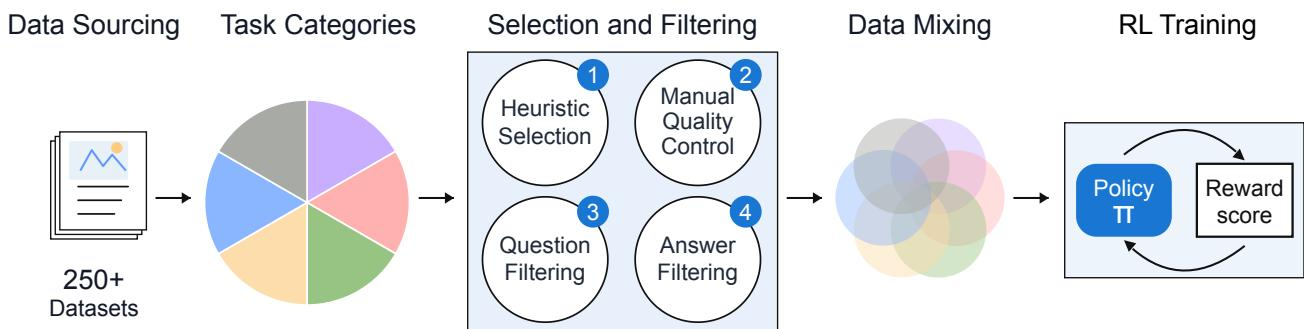
The process begins with dataset sourcing from over 250 candidate datasets. The authors apply heuristic selection to discard datasets with fewer than 1K examples, low average image resolution, or binary questions. This is followed by manual quality control, where approximately 50 examples per dataset are inspected for correctness, unambiguity, and verifiability. To further refine the data, the authors employ LLM-based question filtering to remove ambiguous or unverifiable prompts, and answer filtering to normalize ground-truth answers for stable reward computation. The retained data are then combined into a uniformly weighted mixture across task categories. Representative examples from the six task categories are shown below, highlighting the diversity of visual inputs and answer types covered by the training set.
As shown in the figure below:

For the training process, the authors utilize Reinforcement Learning, building on Group Relative Policy Optimization (GRPO) and integrating algorithmic advances from GSPO. GSPO replaces independent per-token importance ratios with a sequence-level ratio. For each response y in a group of G rollouts, the sequence-average log-probability difference Δˉi=∣yi∣1∑t(logπθ(yi,t)−logπθold(yi,t)) is used to form a token-level ratio si,t(θ)=exp(sg(Δˉi)+logπθ(yi,t)−sg(logπθ(yi,t))), where sg denotes stop-gradient. The GSPO objective is defined as:
J(θ)=G1i=1∑G∣yi∣1t=1∑∣yi∣min(si,t(θ)Ai,clip(si,t(θ),1−εlow,1+εhigh)Ai)where Ai=(ri−μg)/(σg+ϵ) is the normalized group advantage. The authors adopt an asymmetric clip-higher strategy, remove the KL penalty to allow less-restricted updates, and apply a soft overlong penalty that linearly ramps before the context limit.
The total reward for a response y is formulated as:
R(y,y∗)=(1−α)Racc(y,y∗)+αRfmt(y)+Roverlong(y)where α=0.2. The format reward Rfmt requires the response to follow a specific structure with non-empty thinking content and properly formatted answer blocks. The overlong penalty Roverlong uses a linear ramp in a buffer zone to discourage excessively long responses.
For the accuracy reward Racc, the authors design ten task-routed reward functions corresponding to the different task types in the dataset.
As shown in the figure below:
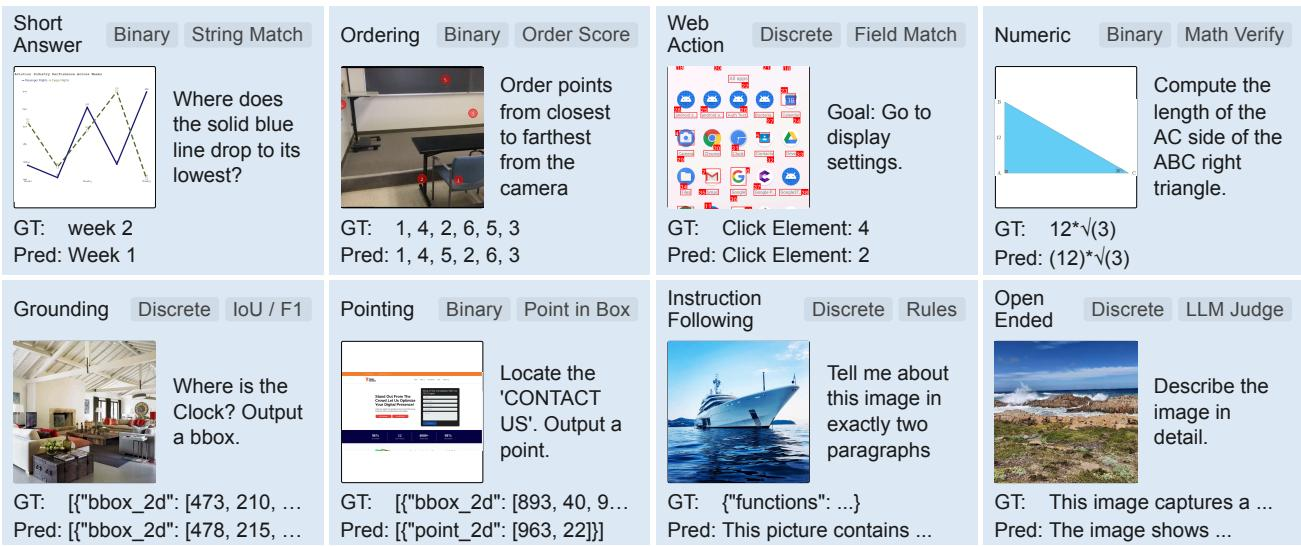
These verifiers include binary rewards such as string match, multiple choice, list string match, numeric verification via symbolic parsing, ordering, and point-in-box checks. Graded rewards are also utilized, including IoU/F1 scoring for grounding, field matching for web actions, rule-based checks for instruction following, and an LLM-as-judge approach for open-ended responses. This task-routed design enables accurate reward computation across diverse answer formats.
Experiment
The evaluation uses a diverse suite of visual reasoning benchmarks with task-specific decoding setups and LLM/VLM judges. Vero, a fully open single-stage RL recipe with a 600K-sample multi-task dataset and task-routed rewards, consistently outperforms prior open and proprietary baselines across six task categories, with gains of +2.9 to +12.9 over initial models and no distillation required. Ablations show that GSPO with multi-route rewards beats GRPO and DAPO, and that diverse task mixing eliminates the negative cross-task transfer seen with single-domain training, while analysis of reasoning traces reveals distinct cognitive and skill-level profiles per category. Visual chat quality is preserved and improved by including open-ended instruction-following tasks with judge-based rewards, with strict judge guidelines mitigating reward hacking.
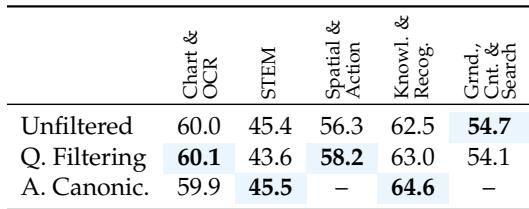
Filtering noisy datasets by removing ambiguous samples generally improves model performance across most task categories, though the effect varies by category. Question filtering tends to boost scores in spatial, knowledge, and grounding tasks, while answer canonicalization helps in knowledge and grounding categories but can slightly hurt OCR and chart tasks. Question filtering improves average scores for spatial, knowledge, and grounding tasks compared to unfiltered data. Answer canonicalization yields gains in knowledge and grounding categories, but slightly reduces performance on chart and OCR tasks. The unfiltered baseline performs best on STEM tasks, while both filtering approaches either match or underperform it in that category.
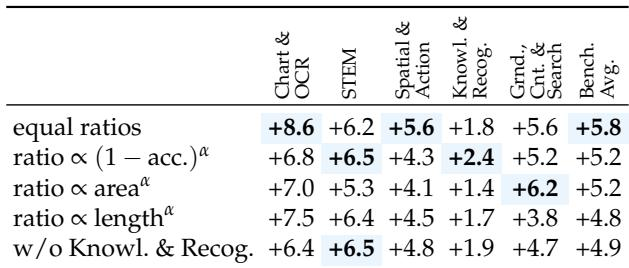
Uniform task ratios in the training mixture yield the highest average benchmark gains, outperforming difficulty-, image-area-, and reasoning-length-weighted schemes. Removing the Knowledge & Recognition category reduces overall performance, underscoring the value of including broad task diversity. The results support that balanced, broad multi-task training drives consistent cross-category improvement. Equal task ratios achieve the best average score gain, exceeding all weighted alternatives. Difficulty-weighted and area-weighted schemes tie for second, with lower average gains than uniform. Reasoning-length-weighted ratios produce the weakest average improvement among the tested weighting schemes. Dropping Knowledge & Recognition lowers the average gain, indicating its contribution to overall performance. Uniform ratios yield the largest gains in chart/OCR and grounding/counting/search categories, while difficulty weighting helps STEM the most.
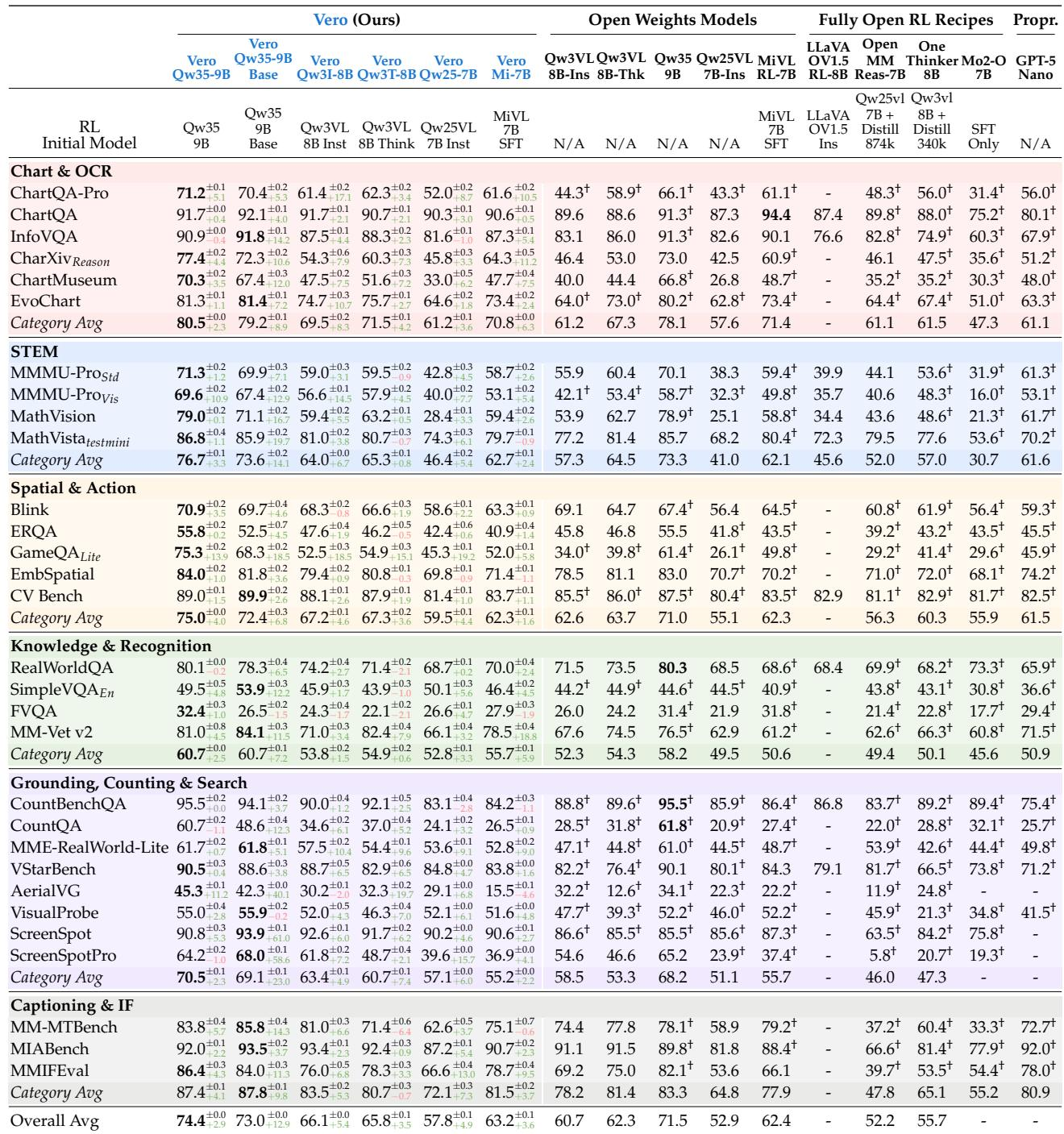
Vero, a fully open RL recipe, achieves state-of-the-art results across six task categories on VeroEval, improving over multiple base models without distillation. The largest gains come from applying RL directly to a pretrained-only base model, while consistent improvements are seen across all initial models tested. Vero-Qwen35-9B reaches the highest overall average, improving by +2.9 over its initial model and winning 25 of 30 benchmarks. Applying RL directly to the pretrained-only Qwen3.5-9B-Base yields the largest overall gain (+12.9), with notable boosts in Grounding, Counting & Search and Captioning & IF. Vero-Qwen3I-8B outperforms Qwen3-VL-8B-Thinking by +3.8 overall despite using no distillation, and beats OneThinker-8B by +10.4 overall. Vero training improves all six category averages for the top model, with the largest category gains in Captioning & IF and Spatial & Action. Vero-MiMo-7B, trained on MiMo-VL-7B-SFT, improves by +3.6 overall and surpasses a proprietary RL baseline on STEM, Knowledge & Recognition, and Captioning & IF.
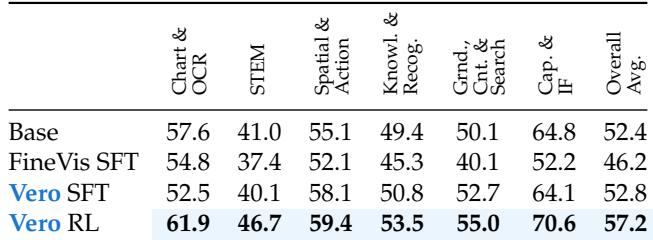
Ablation experiments on Qwen2.5-VL-7B-Instruct show that reinforcement learning with a multi-route reward design outperforms both supervised fine-tuning and simpler reward methods across diverse visual reasoning tasks. Among RL algorithms, GSPO achieves the highest average score and maintains more stable entropy compared to GRPO and DAPO, indicating better exploration and less policy collapse. The multi-route reward design outperforms math_verify across task categories, especially where answer formats are diverse. SFT on the proposed dataset improves over strong SFT baselines, but RL yields more consistent gains across all task categories. GSPO achieves a higher average score than GRPO and DAPO, and its entropy remains substantially more stable during training.
Filtering noisy datasets by removing ambiguous samples generally improves model performance, with question filtering boosting spatial, knowledge, and grounding tasks and answer canonicalization helping knowledge and grounding but slightly hurting OCR and chart tasks, while the unfiltered baseline remains best for STEM. Uniform task ratios in the training mixture yield the highest average benchmark gains over weighted schemes, and removing the Knowledge & Recognition category lowers overall performance, supporting balanced, broad multi-task training. Vero, a fully open RL recipe, achieves state-of-the-art results across six task categories without distillation, with the largest gains from applying RL directly to a pretrained-only base model and consistent improvements across all initial models tested. Ablations on Qwen2.5-VL-7B-Instruct show that RL with a multi-route reward design outperforms SFT and simpler reward methods, with GSPO achieving the highest average score and more stable entropy compared to GRPO and DAPO.