Command Palette
Search for a command to run...
パーセプトロン
概要
One-sentence Summary
This tutorial demonstrates how the optical memory effect and correlations from multiple light scattering enable non-invasive imaging through strongly scattering media, emphasizing practical experimental protocols for applications ranging from astronomy to medicine.
Key Contributions
- The paper demonstrates how statistical correlations generated by multiple light scattering can be harnessed for non-invasive imaging through turbid media, directly addressing the fundamental challenge of signal scrambling. By shifting the focus from ballistic signal attenuation to wave correlation analysis, the approach circumvents traditional opacity limits that restrict conventional optical techniques.
- It introduces a simplified theoretical framework that derives the bulk diffusion equation for light intensity, providing an intuitive bridge between microscopic wave scattering events and macroscopic diffusion models. This pedagogical treatment clarifies how intensity spreads and decays across varying layer thicknesses using standard statistical mechanics principles.
- The work establishes practical experimental guidelines for building correlation-based imaging systems, detailing how source coherence levels and speckle pattern characteristics dictate successful laboratory implementation. These recommendations translate abstract diffusion theory into actionable optical setup configurations for real-world scattering experiments.
Introduction
Imaging through turbid or opaque media remains a critical challenge across astronomy, medicine, and microscopy because multiple scattering scrambles light and destroys spatial information. While invasive clarification methods or physical obstacle removal are often impractical, existing non-invasive techniques struggle to maintain resolution through layers thicker than a few millimeters due to rapid light diffusion. The authors leverage the optical memory effect and speckle intensity correlations to bypass these limitations, offering a self-contained tutorial that details both the theoretical foundation and practical experimental setup for reconstructing hidden images.
Dataset

-
Dataset composition and sources: The authors compile experimental measurements of light scattering patterns captured through a minimal optical setup. Data is sourced from a controlled laboratory apparatus featuring a coherent or fluorescent light source, a test object, a thin ground glass diffuser, and a high dynamic range camera positioned in the far field to record speckle patterns.
-
Key details for each subset: The demonstration dataset consists of raw speckle images of a simple test object (three dots arranged in a triangle). The authors collect multiple independent measurements by rotating the diffuser or recording successive frames to capture different scattering realizations. Images are filtered to ensure the entire object fits within the optical memory effect range, which is required for successful autocorrelation reconstruction.
-
How the paper uses the data: The authors use this collection to validate an iterative phase retrieval pipeline rather than for machine learning training. The dataset is not divided into traditional splits or mixtures; instead, the full set of processed autocorrelations is fed directly into the reconstruction algorithm to recover the original object shape.
-
Processing and strategy details: No cropping or metadata construction is applied. The authors implement a multi-step signal cleaning pipeline: they estimate and subtract a nonuniform background by averaging multiple frames, compute the autocorrelation of the background-corrected signals, and average the results to suppress low-intensity artifacts. Noise mitigation involves replacing the central Dirac delta spike with a neighboring pixel value and clamping negative values to zero or adding a constant offset. The pipeline also requires careful estimation of an unknown proportional background through trial values before phase retrieval begins.
Method
The authors leverage the wave nature of light to address the challenge of imaging through strongly scattering media, where conventional optical methods fail due to the loss of spatial coherence. The key insight is that light propagating through such media undergoes multiple scattering events, resulting in a complex interference pattern known as speckle. This speckle pattern, while appearing random, contains structured information about both the scattering medium and the incident illumination. The spatial intensity distribution of the transmitted light follows an exponential distribution, with fluctuations that manifest as bright speckles surrounded by dark regions. These fluctuations arise from the random phase accumulation across different scattering paths, and their statistical properties are governed by the central limit theorem, leading to a uniform distribution of phase and an exponential distribution of intensity.

As shown in the figure below, the speckle pattern is not entirely uncorrelated; instead, it exhibits a phenomenon known as the optical memory effect. This effect describes the correlation between speckle patterns produced by incident plane waves with slightly different wavevectors. The correlation depends on the angular difference between the incident beams, quantified by ∣Δka∣, and the thickness of the scattering medium, L. For small angular deviations where ∣Δka∣L≪1, the speckle patterns remain highly correlated, meaning they appear similar in structure and are rotated by the same amount as the change in incidence angle. However, when ∣Δka∣L≫1, the correlation rapidly diminishes, and the resulting speckle patterns become decorrelated. The angular range over which this correlation is significant is approximately λ/L, making it a short-ranged but strong correlation. This property enables the recovery of structural information from the scattered light, even when the object is hidden behind a scattering layer.
The core method relies on measuring the autocorrelation of the object, which can be directly obtained from the intensity distribution of the speckle pattern. Since the autocorrelation is a lossy operation, it cannot be inverted uniquely without additional constraints. The authors assume that the object O is real-valued and positive, which allows for the application of phase retrieval techniques to reconstruct the original object from its autocorrelation. The Gerchberg-Saxton algorithm is used as a foundational iterative approach to recover the missing phase information. It begins with an initial guess of the object, computes its Fourier transform, and replaces the amplitude with the modulus derived from the measured autocorrelation. The inverse Fourier transform then yields a reconstructed image that generally violates the object constraints. To enforce the constraints, pixels violating the real and positive conditions are set to zero, refining the guess in each iteration. However, this approach converges slowly and can stagnate.
To improve convergence, the hybrid input-output algorithm is employed, which modifies the update rule by allowing a controlled relaxation of non-conforming pixels rather than setting them to zero. Specifically, at each iteration, the algorithm updates the guess gk+1(x) based on whether the current pixel satisfies the constraints: if it does, the new value is retained; otherwise, it is adjusted by subtracting a fraction of the incorrect value scaled by a parameter β. This parameter can be tuned to balance convergence speed and stability. Empirical studies suggest that cycling between hybrid input-output iterations with decreasing β values leads to robust and efficient convergence. Although this method is computationally intensive due to the repeated Fourier transforms, modern GPU acceleration significantly reduces the computational burden, enabling practical implementation.
It is important to note that the reconstructed image cannot recover absolute positional information, as the autocorrelation only encodes relative positions. Additionally, the reconstructed image may be ambiguous between the original and its centrosymmetric counterpart. Despite these limitations, the approach offers a powerful tool for non-invasive imaging through scattering media, particularly when the object lies within the angular range of the optical memory effect.
Experiment
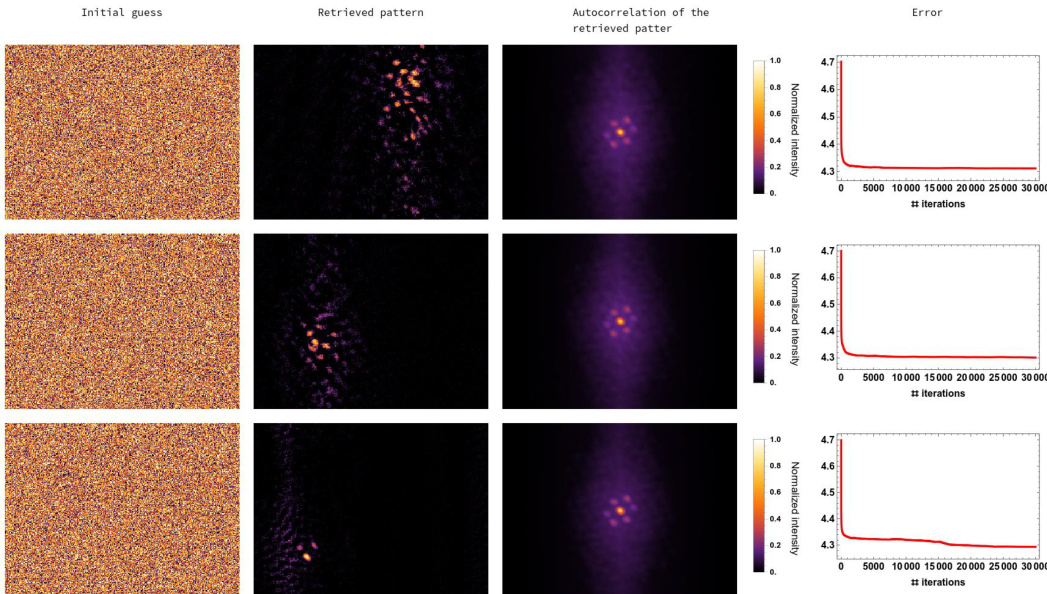
The experiments evaluated the Gerchberg-Saxton and hybrid input-output algorithms for phase retrieval by conducting multiple trials with random initial guesses to validate their convergence stability and pattern recovery accuracy. While the Gerchberg-Saxton method exhibited rapid early progress, it frequently stalled at local minima and could not resolve mirror symmetry or absolute position, validating the need for multiple shorter runs over extended single executions. Conversely, the hybrid input-output algorithm successfully recovered the target pattern in significantly fewer iterations by linearly scheduling a control parameter, demonstrating superior efficiency and robustness for practical phase retrieval applications.