Command Palette
Search for a command to run...
プロのように反復しよう!
概要
One-sentence Summary
By working in a completely general perturbative gauge, this study derives the most general gauge-invariant master functions linear in metric perturbations and their first derivatives for vacuum spherically-symmetric spacetimes, revealing two solution branches per parity that encompass the Regge-Wheeler, Cunningham-Price-Moncrief, and Zerilli formulations alongside a novel even-parity function and an infinite family of potential-dependent master functions governed by a non-linear ordinary differential equation.
Key Contributions
- This paper derives the most general master functions for vacuum spherically-symmetric spacetime perturbations that are linear in the metric perturbations and their first-order derivatives while satisfying a wave equation with a potential.
- The analysis identifies two distinct solution branches per parity, recovering the Regge-Wheeler and Cunningham-Price-Moncrief functions for odd parity and the Zerilli function alongside a newly identified even-parity master function. A second branch yields an infinite family of master functions parameterized by potentials that satisfy a non-linear ordinary differential equation.
- All derived master functions are shown to be gauge invariant and can be expressed in a fully covariant form.
Introduction
Perturbation theory for vacuum spherically symmetric spacetimes is foundational for modeling black hole dynamics, gravitational wave emission, and cosmological structure formation. By decomposing metric fluctuations into harmonic modes, researchers reduce complex Einstein equations into tractable one-dimensional wave equations governed by master functions. Prior research has historically relied on specific gauge choices or ad hoc combinations to isolate these equations, leaving the complete mathematical landscape of possible master functions and potentials largely unmapped. The authors leverage a fully general perturbative gauge to systematically derive the most general master functions linear in metric perturbations and their first derivatives. They identify two distinct solution branches for each parity, recovering established Regge-Wheeler and Zerilli results while introducing a previously unknown even-parity counterpart. A second branch reveals an infinite family of novel potentials satisfying a non-linear ordinary differential equation, each paired with a corresponding gauge-invariant master function. This covariant framework provides a rigorous and systematic alternative to previous heuristic methods.
Dataset
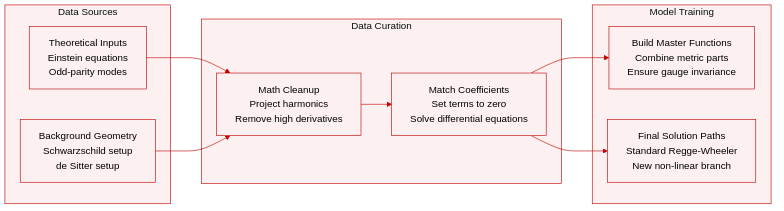
- Dataset composition and sources: The authors do not compile or reference an empirical dataset. The provided excerpt focuses on theoretical derivations in general relativity, specifically odd-parity metric perturbations, harmonic decomposition, and their associated field equations.
- Key details for each subset: No data subsets, sample sizes, or filtering criteria are described. The work is purely analytical and does not involve empirical data categorization or collection.
- How the paper uses the data: The authors do not train models or define training splits and mixture ratios. Instead, they construct master functions by enforcing mathematical consistency on linearized Einstein equations, systematically solving for coefficient functions and potential terms through derivative elimination and coefficient vanishing conditions.
- Cropping strategy, metadata construction, or other processing details: No data preprocessing, cropping, or metadata pipelines are applied. The analysis relies on symbolic mathematics, including harmonic projection, lower-derivative term isolation, and solving non-linear ordinary differential equations to identify valid potential branches and gauge-invariant master functions.
Method
The authors leverage relativistic perturbation theory to analyze metric perturbations in vacuum spherically-symmetric spacetimes, building upon a well-established framework for studying gravitational systems with high symmetry. The background spacetime is assumed to be a vacuum solution of the Einstein field equations, including the cosmological constant term, and is described by a metric gμν that satisfies Gμν=0. Perturbations are introduced as a linear deviation from this background, such that the physical metric gμν is expressed as gμν=gμν+hμν, where hμν is the metric perturbation and ∣hμν∣≪∣gμν∣. The perturbative framework is constructed using a Taylor expansion around the background spacetime, with the parameter λ serving as a formal expansion parameter, which is ultimately discarded for simplicity.
The perturbed quantities are derived in terms of the background metric and its covariant derivatives. For instance, the first-order perturbation of the Christoffel symbols is given by δΓμνρ=21gρσ(hμσ;ν+hνσ;μ−hμν;σ), where semicolons denote covariant differentiation with respect to the background metric. These perturbations are tensors under coordinate transformations on the background spacetime, enabling the construction of perturbed curvature tensors. The perturbation of the Ricci tensor is derived as δRμν=δΓμν;ρρ−δΓρμ;νρ, and the Einstein tensor perturbation δGμν is obtained from these expressions, resulting in a linearized form involving the trace-reversed metric perturbation hˉμν=hμν−21gμνh, where h=gμνhμν.
As shown in the figure below, the background metric is expressed as a warped product M2×rS2, where M2 is a two-dimensional Lorentzian manifold and S2 is a two-sphere. The metric components are separated into coordinates on M2, denoted by (t,r), and angular coordinates (θ,φ) on S2. The background metric takes the form:
where gab is the Lorentzian metric on M2, and ΩAB is the unit curvature metric on S2. The metric on M2 is further specified as gabdxadxb=−f(r)dt2+f(r)dr2, while the angular part is ΩABdΘAdΘB=dθ2+sin2θdφ2.
The geometric structure of the background allows for a multipolar expansion of the metric perturbations in terms of spherical harmonics, which decompose into even- and odd-parity components based on their transformation under parity. Scalar harmonics Yℓm, vector harmonics YAℓm and XAℓm, and tensor harmonics TABℓm, YABℓm, and XABℓm are used to expand the perturbations. The metric perturbation hμν is thus expressed as a sum over ℓ and m:
hμν=ℓ,m∑hμνℓm,odd+hμνℓm,even,where the even- and odd-parity components are represented in terms of scalar, vector, and tensor harmonics, with the coefficients depending only on the coordinates of M2.
The framework accounts for gauge freedom inherent in relativistic perturbation theory, arising from the choice of correspondence between the background and physical spacetimes. A gauge transformation is defined by a vector field ξμ, which induces a change in the metric perturbation hμν→hμν−2ξ(μ;ν). This transformation affects the harmonic components of hμν differently depending on parity. For even-parity perturbations, the transformation involves three gauge functions, while for odd-parity perturbations, only one gauge function appears. Combinations of the metric perturbations and their derivatives are constructed to be gauge-invariant, ensuring that physical quantities are independent of the choice of coordinates.
The analysis proceeds to identify master functions that satisfy wave equations in one spatial dimension, reducing the complexity of the perturbative Einstein equations. For odd-parity perturbations, the Regge-Wheeler and Cunningham-Price-Moncrief master functions are introduced, while for even-parity perturbations, the Zerilli-Moncrief master function is used. These master functions are linear combinations of the metric perturbations and their first-order derivatives, with coefficients that depend only on the radial coordinate r. The master equations take the form (□2−Ωeven/odd)Ψeven/odd=0, where □2 is the d’Alembertian associated with the metric gab of M2, and Ωeven/odd(r) is a potential determined by the perturbative Einstein equations. The potential can be expressed in terms of the tortoise coordinate r∗, leading to a standard wave equation form in (t,r∗) coordinates.
The study systematically constructs the most general master functions and equations under specific assumptions, including the linearity of the master functions in the metric perturbations and their first-order derivatives, time-independent coefficients, and the requirement that the master functions satisfy a wave equation. The results reveal two branches of solutions: the first branch corresponds to known master functions and potentials, while the second branch introduces new master functions and an infinite family of potentials, governed by non-linear differential equations. The analysis demonstrates that all master functions and equations are gauge-invariant, despite the absence of an imposed gauge condition, highlighting the geometric nature of the resulting wave equations.
Experiment
The theoretical evaluation examines even-parity metric perturbations by constructing a general master function ansatz and verifying the integrability of the linearized field equations. This procedure validates the mathematical consistency of the perturbative framework with the contracted Bianchi identities while systematically determining the allowable coefficients and wave potentials. The analysis reveals two distinct solution branches: the first recovers the classical Zerilli potential and its established gauge-invariant master function, whereas the second branch yields a novel gauge-invariant formulation governed by a non-linear potential equation. Collectively, these results confirm the robustness of the polar perturbation scheme and provide a complete characterization of even-parity gravitational dynamics.