Command Palette
Search for a command to run...
符号化技術の概要
概要
One-sentence Summary
This critical review examines blockchain technology in agriculture and food supply chains, highlighting ongoing initiatives that promise enhanced transparency while identifying technical, educational, and regulatory challenges that currently hinder its broader adoption among farmers and supply chain systems.
Key Contributions
- This paper provides a critical evaluation of ongoing blockchain initiatives across agricultural and food supply chains, establishing their current maturity levels and operational potential for transparent, intermediary-free transactions.
- The analysis identifies key technical and institutional barriers to adoption, including transaction latency in permissionless networks, scalability constraints from block size limits, privacy vulnerabilities on shared ledgers, and educational gaps among farmers.
- The assessment reveals that most experimental deployments remain confined to controlled laboratory environments and developed regions, underscoring the necessity for targeted training and technology transfer to bridge the digital divide in developing agricultural markets.
Dataset
-
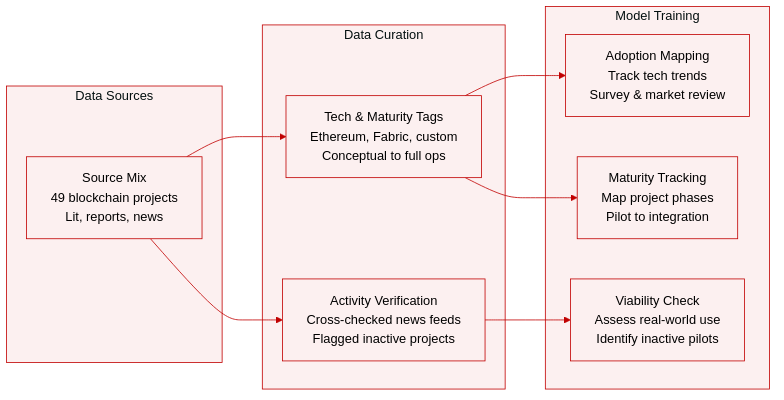
Dataset composition and sources: The authors assembled a curated collection of 49 blockchain initiatives, commercial projects, and academic studies focused on food traceability and supply chain applications. The data was gathered through a systematic survey that cross-referenced peer-reviewed literature, industry reports, news articles, and official project documentation.
-
Key details for each subset: Projects are categorized by underlying technology, with Ethereum leading at nine initiatives, followed by Hyperledger Fabric at six, seven custom-built solutions, and 17 projects with undisclosed architectures. The collection is segmented by development maturity, ranging from conceptual stages to full operational integration, with the majority in proof-of-concept or implementation phases. Temporal filtering places most initiatives between 2016 and 2018, reflecting the early adoption timeline. A commercial subset of 29 projects was further analyzed for viability, with the authors identifying approximately 24 percent as potentially inactive based on recent updates and public activity.
-
How the paper uses the data: Rather than functioning as a training corpus for machine learning models, the dataset serves as a structured reference for systematic review and market analysis. The authors apply the curated data to map technology adoption trends, evaluate project maturity trajectories, and assess the economic viability and real-world integration challenges of blockchain solutions. No training splits or mixture ratios are utilized, as the work focuses on empirical survey analysis rather than algorithmic training.
-
Processing and metadata construction: The authors constructed categorical metadata by manually extracting technology stacks, maturity levels, launch years, and operational status for each entry. Filtering rules prioritized projects with documented supply chain applications, distinguishing between research-oriented pilots and large-scale commercial deployments. Activity verification involved cross-checking project timelines against news feeds and official updates to flag potentially discontinued initiatives, ensuring the final collection reflects verified, traceable cases.