Command Palette
Search for a command to run...
その平方 Y × Y が最小でないコンパクトな最小空間 Y
その平方 Y × Y が最小でないコンパクトな最小空間 Y
J. P. BOROŃSKI
DeepDream の最小実装
概要
よく知られた未解決問題が否定的に解決される:極小同相写像を許容する2つのコンパクト空間XとYが与えられたとき、直積空間X × Yもまた極小同相写像を許容するか?さらに、そのような空間が恒等写像に同相なトーラスの同相写像の極小集合として実現されることが示される。我々の構成における重要な要素は、Aarts & Oversteegenの手法とDownarowicz & Snoha & Tywoniukによるスロバキア空間の構成を組み合わせたことにインスパイアされた逆極限アプローチである。このアプローチにより、以下の結果も証明できる。Mをコンパクトで有限次元の度量空間とし、φ : M × R → M を連続な非周期的極小フローとする。このとき、パラメータ c ∈ R の「一般的な」選び方に対して、同相写像 h(x) = φ(x, c) は、M から M への非可逆な極小写像 f : M → M をほぼ1-1拡大として持つ。
One-sentence Summary
This paper answers a longstanding open question in topological dynamics by constructing a compact minimal space Y whose Cartesian square Y × Y does not admit a minimal homeomorphism, utilizing an inverse limit approach that combines techniques of Aarts and Oversteegen with the Slovak spaces construction by Downarowicz, Snoha, and Tywoniuk to realize such spaces as minimal sets of torus homeomorphisms homotopic to the identity and to prove that for any continuous aperiodic minimal flow on a compact finite-dimensional metric space, a generic parameter yields a homeomorphism admitting a noninvertible minimal map as an almost 1-1 extension.
Key Contributions
- Constructs compact spaces whose Cartesian product fails to admit a minimal homeomorphism despite each factor individually supporting one, thereby providing a negative resolution to a long-standing open question regarding product minimality.
- Adapts the inverse limit technique of Aarts and Oversteegen to embed null sequences of pseudo-arcs into minimal continua, which enforces factorwise rigidity and restricts the resulting homeomorphism groups to almost cyclicity.
- Proves that any compact, finite-dimensional metric space admitting a continuous, aperiodic minimal flow generically yields time-c homeomorphisms that admit noninvertible minimal maps as almost one-to-one extensions, with examples realized as minimal sets of torus homeomorphisms homotopic to the identity.
Introduction
In topological dynamics, understanding how minimality behaves on compact metric spaces is fundamental to classifying dynamical systems and predicting their structural stability. For decades, researchers struggled to determine whether minimality is preserved under Cartesian products, as well as which spaces admit minimal noninvertible maps. Prior efforts were constrained to narrow examples like the Cantor set or torus, leaving the broader classification unresolved and preventing the construction of definitive counterexamples. The authors resolve both open questions negatively by constructing a new class of compact spaces that admit minimal homeomorphisms but whose Cartesian powers inherently lose minimality. They also demonstrate that any finite-dimensional metric space supporting an aperiodic minimal flow automatically admits a minimal noninvertible map. To achieve this, the authors leverage a refined inverse limit approach that combines techniques from Aarts and Oversteegen with Slovak space constructions, strategically inserting pseudo-arcs to enforce factorwise rigidity and generate the required counterexamples.
Method
The authors present a method for constructing minimal dynamical systems on compact metric spaces by modifying existing flows or homeomorphisms through a process of inverse limit construction, which involves "blowing up" points in the phase space to create noninvertible or more complex systems. The core of the approach relies on the existence of a minimal flow or homeomorphism on a space, and then systematically replacing points in the orbit of a chosen point with compactified intervals or pseudo-arcs to form a new space. This process preserves minimality while introducing noninvertibility or other structural properties.
The framework begins with a continuous, aperiodic minimal flow ϕ:M×R→M on a compact, finite-dimensional metric space M. The construction proceeds by selecting a point x0∈M and iteratively compactifying the space at points in its negative orbit, x−n=Fn(x0), where F=ϕ(t0,⋅) is a time-t0 map. For each n, the space Xn is obtained from Xn−1 by removing the point x−n and compactifying the resulting hole using a closed interval In=[−1,1]. This compactification is achieved by defining a metric D on Rd∖{0} that incorporates a function c(y)=y1/∑i=1dyi2, which captures the "angular" direction of a point. The completion of this metric space yields an interval as the remainder, which is identified with In. The resulting sequence of spaces Xn forms an inverse system, and the inverse limit X∞ is shown to be homeomorphic to the original space M due to the monotonicity of the bonding maps.
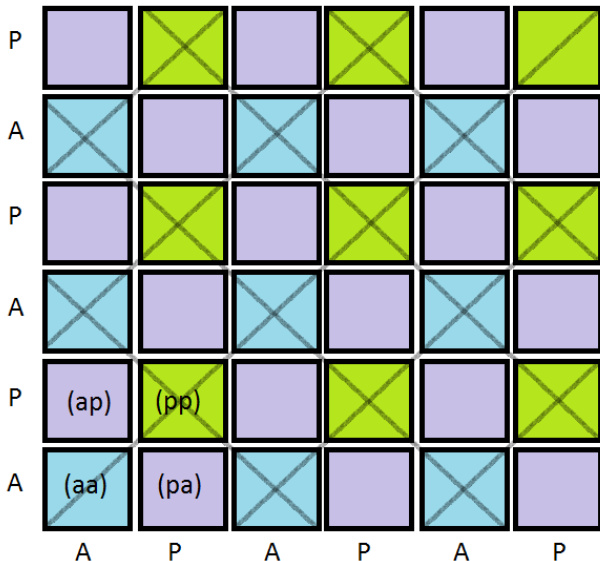
As shown in the figure below, the structure of the space W×W is "tiled" with four types of squares: (aa), (pp), (pa), and (ap). Here, P represents a maximal pseudo-arc within the special composant W, and A represents an arc connecting two such pseudo-arcs. This tiling is central to the proof of Theorem 3.2, which demonstrates that the Cartesian product of a certain minimal space Y with itself cannot admit a minimal homeomorphism. The figure illustrates the hierarchical structure of this tiling, with the (aa) squares being the smallest components and the (pp) squares being the largest. The key insight is that homeomorphisms must preserve this structure, meaning they can only map (aa) squares to (aa) squares, (pp) squares to (pp) squares, and (ap) squares to (ap) or (pa) squares. This restriction leads to a contradiction when assuming the existence of a minimal homeomorphism on Y×Y, as it forces the homeomorphism to be a product of homeomorphisms on Y, which cannot be minimal due to the rational dependence of the underlying rotation numbers.
The authors then extend this technique to construct a minimal but noninvertible map on the Klein bottle, a manifold that does not admit a minimal flow. This is achieved by applying the "blow-up" procedure to a skew product homeomorphism F(x,y)=(x+α,y+r(x)) on the torus T2. The homeomorphism F is chosen such that it preserves a specific relation ∼ defined by (x,y)∼(x+1/2,1−y), which allows it to induce a homeomorphism G on the Klein bottle K=T2/∼. By applying the same inverse limit construction as in Theorem 2.1 to the orbit of a point z∈K, the authors obtain a minimal but noninvertible map h on K that is an almost 1-1 extension of G. This demonstrates that the method is not limited to spaces supporting flows and can be applied to a wider class of manifolds.