Command Palette
Search for a command to run...
DeepPose: ディープニューラルネットワークによる人物姿勢推定
DeepPose: ディープニューラルネットワークによる人物姿勢推定
Alexander Toshev Christian Szegedy
概要
本論文では、ディープニューラルネットワーク(DNN)に基づく人物姿勢推定手法を提案する。姿勢推定は、身体関節に対するDNNベースの回帰問題として定式化される。我々は、このようなDNN回帰器のカスケードを提示し、高精度な姿勢推定を実現する。本アプローチは、姿勢を全体的に推論する利点を持ち、深層学習の最近の進歩を活用した、シンプルでありながら強力な定式化を特徴とする。多様な実世界画像を用いた4つの学術的ベンチマークにおいて、最先端またはそれ以上の性能を達成した詳細な実験分析を提示する。
One-sentence Summary
Google researchers propose DeepPose, a method for human pose estimation that formulates the task as a regression problem over body joints using a cascade of deep neural network regressors, achieving holistic reasoning and state-of-the-art or better accuracy on four challenging real-world benchmarks.
Key Contributions
- Human pose estimation is formulated as a DNN-based regression to joint coordinates from full images, enabling holistic reasoning.
- A cascade of DNN regressors iteratively refines the initial estimate using higher-resolution sub-images, increasing joint localization precision.
- On four academic benchmarks, the approach achieves state-of-the-art or better performance, and cross-dataset evaluations demonstrate strong generalization.
Introduction
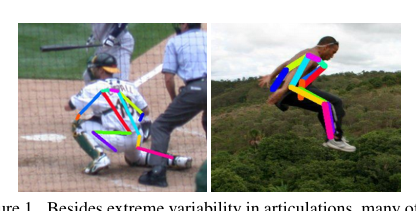
Human pose estimation involves localizing body joints in images, a task complicated by occlusions, small joints, and the need for contextual reasoning. Prior part-based models offer efficient inference but rely on local detectors that capture only limited interactions between body parts, limiting accuracy in challenging scenarios. Holistic approaches have attempted to overcome these limitations but have struggled with real-world performance. The authors introduce a deep neural network that formulates pose estimation as a direct regression of joint coordinates from the full image, enabling the model to capture global context without explicit part detectors or model topology. A cascade of such DNN-based regressors then refines predictions using higher-resolution sub-images. This method achieves state-of-the-art results on multiple benchmarks and demonstrates strong cross-dataset generalization.
Method
The authors treat the problem of pose estimation as a regression task, training a function ψ(x;θ)∈R2k that maps an image x to a normalized pose vector, where θ denotes the model parameters. To handle variations in pose size, joint coordinates are normalized with respect to a bounding box b enclosing the human body, defined by its center bc, width bw, and height bh. The normalization transforms the joint coordinates yi as follows:
N(yi;b)=(1/bw001/bh)(yi−bc)
The pose prediction in absolute image coordinates is recovered by applying the inverse normalization to the network output.
The core of the method is a convolutional Deep Neural Network (DNN) based on the architecture by Krizhevsky et al. The network consists of seven layers, including five convolutional layers, local response normalization layers, pooling layers, and two fully connected layers. The convolutional and fully connected layers contain learnable parameters and utilize rectified linear units for non-linearity. The network accepts a fixed input size of 220×220 pixels and outputs 2k joint coordinates.
Refer to the framework diagram for a schematic view of the DNN-based pose regression and the subsequent refinement stages.
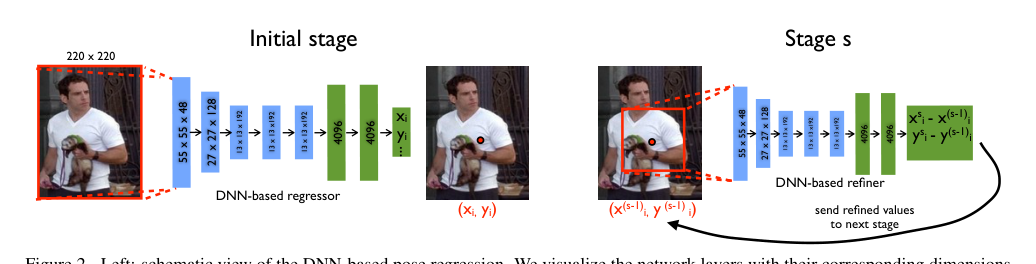
The initial stage of the pipeline estimates a rough pose using the full image context. The network parameters are optimized by minimizing the L2 distance between the predicted pose vector and the ground truth normalized pose vector. To prevent overfitting given the large number of parameters and relatively small datasets, the authors employ data augmentation techniques, including random image crops, left-right flips, and Dropout regularization.
While the initial regression leverages global context, the fixed input resolution limits the network capacity to capture fine details necessary for precise joint localization. To address this, the authors propose a cascade of pose regressors. At the first stage, an initial pose is estimated. In subsequent stages s≥2, additional DNN regressors are trained to predict the displacement of joint locations from the previous stage to the true location. Each subsequent stage focuses on relevant image parts by cropping sub-images around the predicted joint locations from the preceding stage. This allows the regressors to process higher resolution inputs and learn features at finer scales, ultimately refining the pose estimation.
For training the cascade stages, the authors condition the training of each stage on the model from the previous stage. Instead of relying solely on the actual predictions from the previous stage, they augment the training data by generating simulated predictions. This is achieved by randomly displacing the ground truth joint locations using a 2-dimensional Normal distribution, where the mean and variance are derived from the observed displacements in the training data. The network parameters for each stage are then optimized using the L2 loss on this augmented dataset.
Experiment
The evaluation is conducted on the FLIC and LSP datasets using PCP and PDJ metrics to assess limb and joint detection accuracy. The experiments validate that the DNN-based cascade model consistently outperforms prior methods, particularly on challenging limbs like lower legs, and that refinement stages significantly improve high-precision localization. The approach generalizes well across datasets and handles diverse poses, occlusions, and appearances, with the cascade correcting initial coarse estimates.
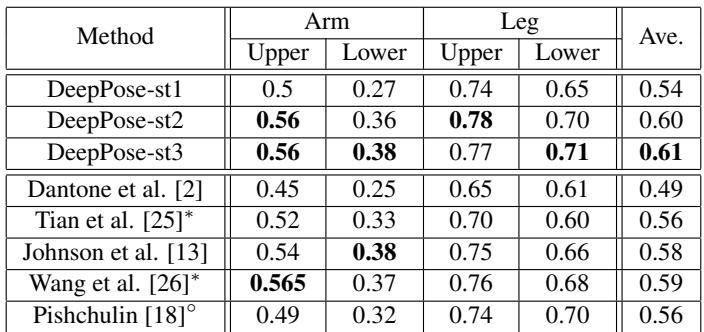
On the LSP dataset, DeepPose's cascade progressively refines joint predictions, with the largest improvement coming from the first refinement stage. The final model establishes state-of-the-art accuracy, outperforming all compared methods across all limb groups, with a particularly strong lead on leg joints. The approach handles the challenging articulations of sports images, demonstrating robust generalization. A single refinement stage raises average PCP from 0.54 (single-stage) to 0.60, nearly matching the final cascade's 0.61, showing that most high-precision gains occur after one additional stage. DeepPose-st3 achieves the highest average PCP of 0.61, outperforming the nearest competitor Johnson et al. (0.58), with the advantage most evident on lower legs (0.71 vs. 0.66) and upper legs (0.77 vs. 0.75). Though Tian et al. employ a looser PCP definition, DeepPose-st2 and st3 still exceed their reported average (0.56) using the standard stricter metric, underscoring the method's effectiveness.
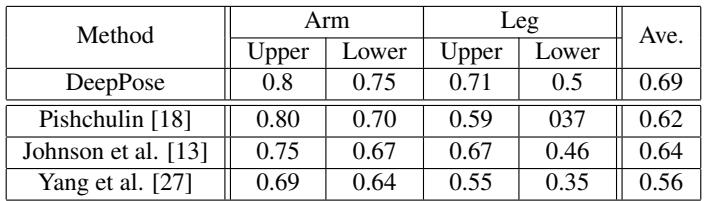
DeepPose reaches state-of-the-art accuracy on the Image Parse dataset with an average PCP of 0.69, surpassing all compared methods. It leads on all four challenging limbs except upper arms, where it ties the best prior result. The largest improvements are on legs, particularly lower legs, highlighting strong cross-dataset generalization. DeepPose matches the best upper arm score (0.80) and achieves the highest accuracy on lower arms (0.75), upper legs (0.71), and lower legs (0.50) among all methods. Lower leg estimation stands out with a score of 0.50, notably above the next best result of 0.46.
DeepPose is evaluated on the LSP and Image Parse datasets using a cascade of refinement stages that progressively improve joint predictions. The first additional stage provides the largest accuracy gain, and the final model achieves state-of-the-art results on both datasets, with particularly strong performance on leg joints. Cross-dataset generalization is robust, as the method consistently outperforms prior approaches on challenging limbs like lower legs.