Command Palette
Search for a command to run...
YOLOv5 用の EigenCAM
概要
One-sentence Summary
By analyzing approximately 2300 uniformly sampled high-resolution spectra obtained with the echelle spectrograph of the 2.5-m du Pont telescope at Las Campanas Observatory, the authors present new radial velocities, improved pulsation periods, and reference epochs for eleven field RR Lyrae ab-type variables.
Key Contributions
- High-resolution spectra obtained with the echelle spectrograph of the 2.5-m du Pont telescope at Las Campanas Observatory yield a dataset of approximately 2,300 observations uniformly distributed across the pulsation cycles of 11 field RR Lyrae ab-type variables.
- Analysis of these observations produces significantly improved pulsation periods and reference epochs for each target, establishing accurate ephemerides for the complete sample.
- Complete radial velocity curves and photometric lightcurves phased to the new ephemerides are presented, providing the observational foundation for subsequent spectroscopic determinations of stellar atmospheric parameters and chemical compositions.
Introduction
RR Lyrae stars serve as reliable standard candles and critical tracers of Galactic structure and chemical evolution due to their consistent intrinsic luminosity and visibility across vast cosmic distances. Prior high-resolution spectroscopic studies have largely restricted observations to phases near light minimum, which overlooks how full pulsation cycles alter stellar atmospheres and introduce phase-dependent biases in derived chemical abundances. The authors leverage phase-resolved observations of 11 field RRab stars to deliver precise radial velocities and refined pulsation ephemerides. This systematic dataset captures thermodynamic variations across the entire pulsation cycle, addressing previous observational gaps and improving the reliability of RR Lyrae stars for mapping Milky Way formation and calibrating the cosmic distance scale.
Dataset
-
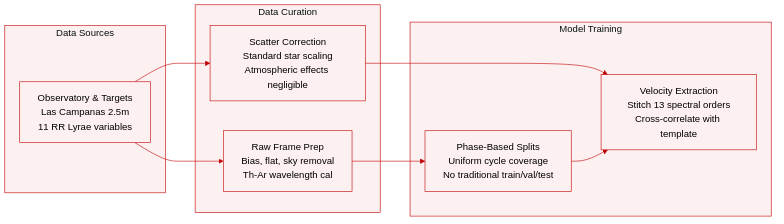
Dataset Composition and Sources: The authors compiled a spectroscopic collection of 11 field RR Lyrae ab-type variables, including AS Vir, BS Aps, and CD Vel. The observations were conducted between 2006 and 2009 using the echelle spectrograph on the 2.5 meter du Pont telescope at Las Campanas Observatory.
-
Subset Details and Size: The archive contains roughly 2300 high resolution spectra, averaging 200 per star. Each observation spans 3500 to 9000 Å with a resolving power near 27000. The exposures were distributed uniformly across each star pulsation cycle, with integration times ranging from 200 to 600 seconds to balance signal quality and minimize motion blur.
-
Data Usage and Processing Pipeline: The researchers apply the dataset to derive precise radial velocities and refine pulsation periods and reference epochs. Rather than traditional training splits, the data is organized by pulsation phase. The authors stitch 13 echelle orders covering 4000 to 4600 Å into a single normalized spectrum, then cross correlate each frame against a template built from the standard star CS 22874 009. They note the full collection will subsequently drive a follow up study to extract stellar atmospheric parameters and chemical compositions.
-
Calibration and Correction Steps: Raw frames undergo bias subtraction, flat fielding, and background removal before extraction into one dimensional spectra. Wavelength calibration relies on Thorium Argon lamp exposures and standard reference tables. To address optical scattering, the team observes standard stars through a narrow slit, calculates inter order background fractions, and applies a 5/3 scaling factor to match the wider extraction apertures used for the program stars. They also model atmospheric dispersion and sky background contributions, confirming these effects introduce negligible broadening to the final velocity measurements.
Method
The authors leverage a two-step approach to refine the pulsation ephemerides of RRab stars, beginning with the improvement of pulsation periods and followed by the precise determination of the reference epoch T0. To derive accurate pulsation periods, the Lomb-Scargle periodogram is employed on "grade A" V-band photometric data from the All Sky Automated Survey (ASAS), with a focus on a period range of 0.5–0.6 days to mitigate aliasing effects common in unevenly spaced time-series data. This method is particularly advantageous due to its efficiency and ability to process irregularly sampled data, a limitation that disqualifies template fitting approaches. The highest peak in the periodogram, which consistently exceeds 4σ above the noise level, is selected as the most probable pulsation period. Period errors are evaluated by cross-referencing results from the Lomb-Scargle method with those obtained from the Box-fitting least squares (BLS) algorithm, yielding errors within 0.000001–0.000007 days, significantly improving upon the ASAS catalog values.
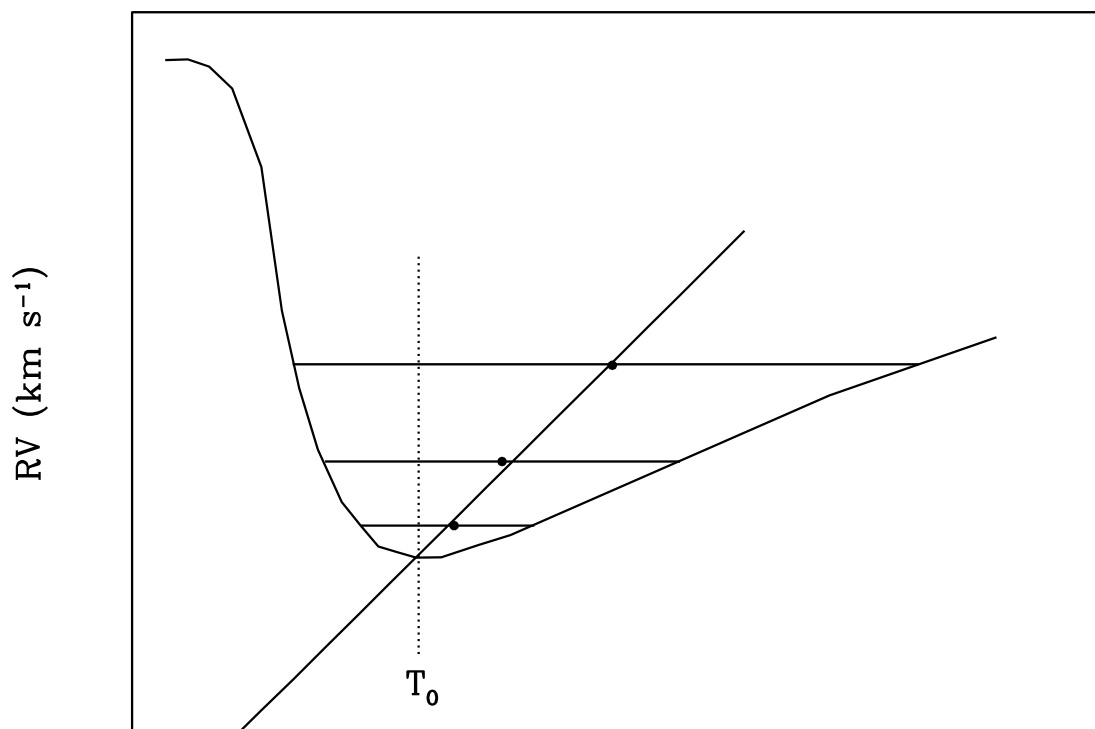
For the determination of the reference epoch T0, which corresponds to the time of visual light maximum (and radial velocity minimum), the Kwee-van Woerden method is applied. This technique is well-suited for identifying the minimum of asymmetric light curves, such as those observed in RR Lyrae stars, and is preferred over photometric data due to the availability of dense radial velocity (RV) measurements near the minimum. As shown in the figure below, the method involves selecting midpoints between the rising and descending branches of the RV curve near the minimum for each pulsation cycle, fitting a linear least-squares line to these points, and identifying the intersection with the RV curve to determine T0. Multiple epochs are computed for each star to assess error, and consistency is verified by comparing predicted T0 values, derived from the pulsation ephemeris T0+n×P, with the observed values. This process allows for the refinement of ephemerides and the subsequent folding of both RV and ASAS lightcurve data.