Command Palette
Search for a command to run...
Superposition Yields Robust Neural Scaling
Superposition Yields Robust Neural Scaling
Yizhou Liu Ziming Liu Jeff Gore
Abstract
The success of today's large language models (LLMs) depends on the observation that larger models perform better. However, the origin of this neural scaling law, that loss decreases as a power law with model size, remains unclear. We propose that representation superposition, meaning that LLMs represent more features than they have dimensions, can be a key contributor to loss and cause neural scaling. Based on Anthropic's toy model, we use weight decay to control the degree of superposition, allowing us to systematically study how loss scales with model size. When superposition is weak, the loss follows a power law only if data feature frequencies are power-law distributed. In contrast, under strong superposition, the loss generically scales inversely with model dimension across a broad class of frequency distributions, due to geometric overlaps between representation vectors. We confirmed that open-sourced LLMs operate in the strong superposition regime and have loss scaling inversely with model dimension, and that the Chinchilla scaling laws are also consistent with this behavior. Our results identify representation superposition as a central driver of neural scaling laws, providing insights into questions like when neural scaling laws can be improved and when they will break down.
One-sentence Summary
MIT researchers propose that representation superposition, in which LLMs represent more features than they have dimensions, is a key driver of neural scaling laws, and by controlling superposition via weight decay they show that loss generically scales inversely with model dimension under strong superposition, consistent with the Chinchilla scaling laws.
Key Contributions
-
Representation superposition is proposed as a central driver of neural scaling laws, and a weight-decay-controlled Anthropic toy model is introduced to tune the degree of superposition and study how loss scales with model dimension. This framework makes superposition an experimentally controllable variable for systematic scaling analysis.
-
Weak superposition produces power-law loss only when data feature frequencies are power-law distributed, whereas strong superposition generically yields loss that scales inversely with model dimension across broad frequency distributions because of geometric overlap between representation vectors. This explains why large language models can show robust neural scaling without special assumptions about data frequency distributions.
-
Open-source large language models are shown to operate in strong superposition and exhibit loss scaling inversely with model dimension, while Chinchilla scaling laws are also consistent with this behavior. The analysis also decomposes model-size loss into representation and parsing components and suggests that stronger superposition may improve training efficiency, while width-based scaling may eventually fail near vocabulary-size limits.
Introduction
The authors examine neural scaling laws in large language models, where loss improves predictably as model width, training data, and compute increase, guiding the design of more capable models. Prior work often explained this scaling through function approximation, manifold fitting, or feature learning, but it largely underexplored representation learning and superposition, a setting where models pack many features into a limited-width hidden space. The authors leverage a toy data-recovery model to study how the degree of superposition changes loss scaling. They show that weak superposition yields power-law behavior only when feature frequencies follow a power law, while strong superposition can produce robust scaling close to loss inversely proportional to model width due to interference between overlapping representations. They further find that actual LLMs align with the strong superposition regime, offering a mechanistic account of width-based scaling laws.
Method
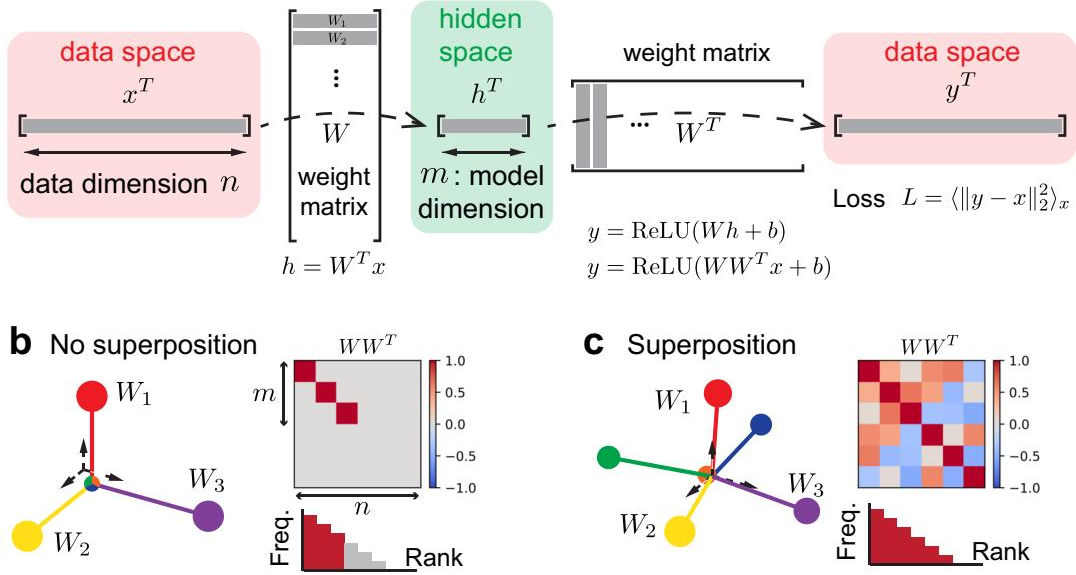
The authors leverage a toy model of representation learning to isolate the effect of superposition on scaling behavior. In this framework, data is represented as a high-dimensional vector x∈Rn, where each coordinate corresponds to one atomic latent feature. The activation of feature i is generated as
xi=uivi,ui∼Bernoulli(pi),vi∼U(0,2).Here, ui determines whether the feature is active, while vi determines the activation magnitude once the feature is active. The probability pi controls feature frequency or importance, and the model ranks features by decreasing frequency, with pi decreasing as i increases. The activation density is therefore
E=i=1∑npi.The model itself is an undercomplete reconstruction system rather than a transformer. It uses a weight matrix W∈Rn×m and a bias vector b∈Rn, with model dimension m much smaller than feature dimension n. The hidden representation is produced by
h=WTx,and the reconstruction is
y=ReLU(Wh+b).The training objective measures squared reconstruction error,
L=⟨∥y−x∥22⟩x,where the average is taken over the data distribution. In this formulation, the representation of feature i is the i-th row Wi of the embedding matrix. A feature is considered represented when ∥Wi∥2 is nonzero. Without superposition, only the first m most important features are represented by nearly orthogonal rows, while the remaining features are ignored. With superposition, more than m rows become nonzero, allowing many features to be encoded in a shared lower-dimensional space, but introducing interference among them.
The nonlinearity in the readout layer is central to the method. In a purely linear reconstruction system, superposition increases interference and generally worsens loss. With ReLU activations and negative biases, however, interference can partially cancel, enabling a form of error correction. This makes superposition useful when features are sufficiently sparse and feature frequencies are not too uneven, because many features can be represented with acceptable loss instead of being discarded.
To control the degree of superposition during training, the authors introduce a decoupled weight modification applied row-wise to W. At training step t, the update rule is
Wi,t+1={Wi,t−ηtγWi,t,Wi,t−ηtγWi,t(∥Wi,t∥21−1),γ≥0,γ<0,where ηt is the learning rate. Positive γ shrinks the embedding rows and promotes weak superposition, while negative γ encourages rows to approach unit norm and promotes strong superposition. This mechanism is implemented within an AdamW-style optimizer with a warm-up and cosine-decay learning rate schedule.
A diagnostic quantity used to measure the effective amount of superposition is the fraction of represented features,
ϕ1/2=n∣{i:∥Wi∥2>1/2}∣.Empirically, the row norms become bimodal, clustering near zero or one. Small weight decay yields strong superposition with ϕ1/2≈1, while large weight decay yields weak superposition with ϕ1/2∼m/n. This provides a controlled way to compare scaling behavior in different representation regimes.
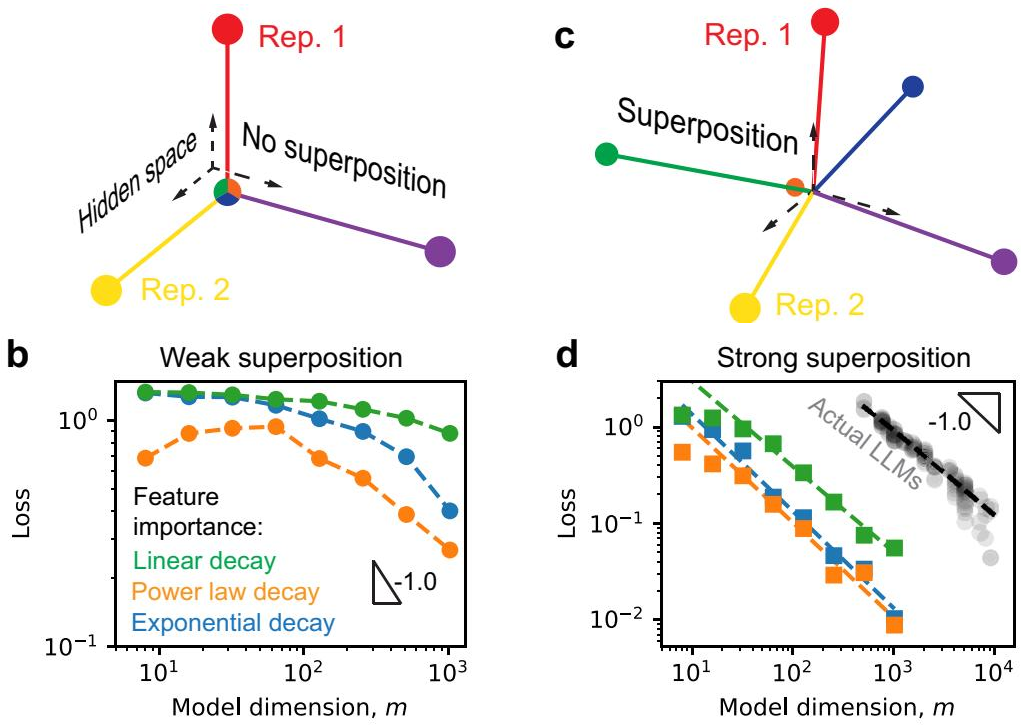
The resulting loss behavior depends on how superposition interacts with feature-frequency structure. In the weak superposition regime, the model mostly preserves the most frequent features, so the loss scaling is sensitive to the decay of pi with rank. A clean power-law dependence of loss on model dimension appears only when the feature frequencies themselves follow a power-law profile and the model dimension is large enough. In the strong superposition regime, the model encodes many more features simultaneously. Although representations overlap, the loss becomes much less sensitive to the underlying frequency distribution and tends to scale inversely with model dimension. The figure below compares the geometric representation regimes and their corresponding scaling behaviors for weak and strong superposition.
Experiment
Using a controlled toy model with power-law feature frequencies and varying model dimension, the experiments show that weak superposition loss is governed by the total frequency of ignored features and follows a predictable power law, while strong superposition loss arises from interference between representation vectors and tends toward robust one-over-width scaling when the vectors are isotropic or ETF-like. Analyses of LLM output layers find that tokens are represented in strong superposition, with token frequencies near flat and squared overlaps scaling approximately as one over model dimension, supporting the conclusion that geometric interference in superposed representations is a key mechanism behind neural scaling laws.