Command Palette
Search for a command to run...
IndicSynth: A Large-Scale Multilingual Synthetic Speech Dataset for Low-Resource Indian Languages
IndicSynth: A Large-Scale Multilingual Synthetic Speech Dataset for Low-Resource Indian Languages
Divya V. Sharma Vijval Ekbote Anubha Gupta
Abstract
Recent advances in synthetic speech generation technology have facilitated the generation of high-quality synthetic (fake) speech that emulates human voices. These technologies pose a threat of misuse for identity theft and the spread of misinformation. Consequently, the misuse of such powerful technologies necessi tates the development of robust and generalizable audio deepfake detection (ADD) and antispoofing models. However, such models are often linguistically biased. Consequently, the models trained on datasets in one language exhibit a low accuracy when evaluated on out-ofdomain languages. Such biases reduce the usability of these models and highlight the urgent need for multilingual synthetic speech datasets for bias mitigation research. However, most available datasets are in English or Chinese. The dearth of multilingual synthetic datasets hinders multilingual ADD and anti-spoofing research. Furthermore, the problem intensi fies in countries with rich linguistic diversity, such as India. Therefore, we introduce Indic Synth, which contains 4,000 hours of synthetic speech from 989 target speakers, including 456 females and 533 males for 12 low-resourced Indian languages. The dataset includes rich metadata covering gender details and target speaker identifiers. Experimental results demonstrate that IndicSynth is a valuable contribution to multilingual ADD and anti-spoofing research. The dataset can be accessed from https:// github.com/vdivyas/IndicSynth.
One-sentence Summary
SBILab, IIIT-Delhi introduce IndicSynth, a 4,000-hour synthetic speech dataset comprising 12 low-resource Indian languages with 989 target speakers, addressing the linguistic bias in audio deepfake detection and anti-spoofing models that underperform on out-of-domain languages.
Key Contributions
-
This paper introduces IndicSynth, a large-scale multilingual synthetic speech dataset of about 4,000 hours from 989 target speakers, including 456 females and 533 males, across 12 low-resourced Indian languages. The dataset provides speaker identifiers, gender metadata, and both mimicry and diversity subsets for audio deepfake detection and anti-spoofing research.
-
The dataset is evaluated with state-of-the-art speaker verification and audio deepfake detection models on Indian-language synthetic speech. Experiments show that the mimicry subset can deceive speaker verification systems through impersonation attacks, while existing deepfake detectors perform poorly on Indian-language test sets.
-
The linguistic authenticity of IndicSynth is validated through t-SNE visualizations and a state-of-the-art language identification model. These evaluations support the dataset as a resource for multilingual audio deepfake detection, anti-spoofing, gender bias, and defense against impersonation attacks.
Introduction
Recent advances in text to speech and voice conversion make it possible to generate realistic synthetic speech for assistive technology, media, education, and entertainment, but the same capability can be misused for impersonation, financial fraud, misinformation, and security breaches. Prior audio deepfake detection and anti spoofing research has depended heavily on synthetic speech datasets in high resource languages such as English and Chinese, which can limit model generalization to other languages and reduce practical global usefulness. Existing datasets also often lack target speaker identifiers and gender metadata needed for research on impersonation attacks and bias. The authors introduce IndicSynth, a large multilingual synthetic speech dataset covering 12 low resource Indian languages, with about 4,000 hours of audio from 989 target speakers and metadata for gender and speaker identity. The authors leverage this dataset, organized into mimicry and diversity subsets, to evaluate whether current deepfake detectors and speaker verification systems can handle realistic multilingual synthetic speech and to assess the dataset's linguistic authenticity.
Dataset

-
IndicSynth is a large-scale multilingual synthetic speech dataset with approximately 4,000 hours of audio across 12 low-resourced target languages: Bengali, Gujarati, Hindi, Kannada, Malayalam, Marathi, Odia, Punjabi, Sanskrit, Tamil, Telugu, and Urdu.
-
The dataset is built from the bonafide speech and transcripts in IndicSuperb, which is released under a Creative Commons CC0 license and provides real recordings for the same 12 languages.
-
The authors apply publicly available text-to-speech and voice conversion models to the bonafide IndicSuperb data to create synthetic speech, using bonafide target voices, source voices, and transcripts as the basis for generation.
-
IndicSynth has two main subsets:
- Mimicry subset: synthetic speech that closely imitates target speakers, intended to study speaker impersonation and anti-spoofing risks. It is generated by fine-tuning XTTS-v2 on IndicSuperb for 10 languages: Bengali, Gujarati, Kannada, Malayalam, Marathi, Odia, Punjabi, Tamil, Telugu, and Urdu.
- Diversity subset: synthetic speech with lower similarity to target speakers, intended to provide broader synthetic voice diversity and improve generalization of audio deepfake detection models. It is generated directly from TTS and voice conversion models without fine-tuning on IndicSuperb.
-
For the diversity subset, Bengali synthetic data is generated with the publicly available Coqui VITS model, which is trained on undisclosed Bengali data. The authors also use XTTS-v2 and FreeVC24 to generate synthetic data for the 12 target languages.
-
During dataset construction, the authors randomly select bonafide audios and transcripts from IndicSuperb. For voice conversion, they require the source and target speakers to have the same gender to support higher-quality synthetic speech generation.
-
IndicSynth includes model-specific and language-specific metadata files. For TTS-generated clips, metadata records the target speaker ID, bonafide target audio clip ID, target speaker gender, transcript, and generated synthetic audio clip ID. For VC-generated clips, metadata records the source speaker ID, bonafide source clip ID, target speaker ID, bonafide target clip ID, speaker genders, and synthetic clip ID.
-
The paper uses IndicSynth, together with bonafide IndicSuperb data, to support multilingual audio deepfake detection and anti-spoofing research. The mimicry subset is useful for evaluating vulnerabilities to impersonation attacks, while the diversity subset is useful for training or fine-tuning detection models on a wider range of synthetic voices.
-
The excerpt does not provide explicit subset sizes, training split ratios, mixture ratios, or cropping strategies beyond the random selection of bonafide audio and transcripts and the use of model-specific metadata.
Method
IndicSynth is generated through a modular synthetic speech pipeline that combines two complementary acoustic generation modules: text-to-speech based voice cloning and voice conversion. The authors leverage a publicly available bonafide multilingual corpus, IndicSuperb, as the foundation of the pipeline. This source corpus provides real speech recordings and their associated transcripts for the target languages. The framework then routes selected real audio samples and transcripts into separate synthesis paths, producing synthetic data that can support multilingual audio deepfake detection and anti-spoofing research.
Refer to the framework diagram:
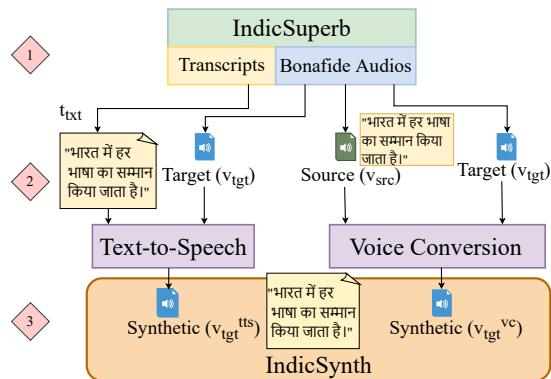
In the first path, the text-to-speech module acts as a voice cloning component. It receives a transcript and a bonafide target speaker recording as conditioning inputs. The model generates a synthetic utterance that speaks the provided transcript while attempting to reproduce the acoustic characteristics of the target speaker. This process can be written as:
vtgttts=TTS(ttxt,vtgt)In the second path, the voice conversion module uses two real recordings: a source utterance and a target utterance. The converted output preserves the linguistic content of the source recording while attempting to transfer the speaker identity to that of the target recording. This conversion process can be written as:
vtgtvc=VC(vsrc,vtgt)The two path design creates synthetic samples with different similarity properties. When the text-to-speech model is adapted to the same source domain, it can generate utterances that closely resemble the target speakers. In contrast, when generation models are applied without adaptation, the resulting synthetic voices show lower similarity to the target speakers and therefore provide greater speaker diversity.
The authors use this distinction to build mimicry oriented and diversity oriented synthetic data. For the mimicry subset, XTTS-v2 is fine tuned on the bonafide IndicSuperb data for several target languages. Fine tuning on the same source corpus helps the generated synthetic speech remain close to the target voice characteristics, making this subset useful for evaluating the vulnerability of speaker verification systems to impersonation style attacks.
For the diversity subset, the pipeline uses publicly available generation models without fine tuning on the bonafide target corpus. The method applies Coqui VITS for a Bengali diversity branch, XTTS-v2 for text-to-speech generation across the target languages, and FreeVC24 for voice conversion. During voice conversion, source and target speakers are selected randomly while maintaining the same speaker gender in each pair, which helps improve conversion quality and reduces artifacts.
The metadata generation process is also part of the method. For each synthesis model and target language, the system records traceability information such as speaker identifiers, source audio identifiers, target audio identifiers, speaker gender, transcript details, and synthetic output identifiers. This structure allows downstream users to understand which model generated each sample and which real recordings served as conditioning inputs.
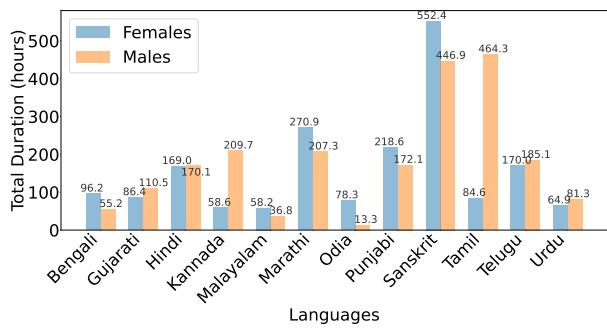
The final synthetic corpus is distributed across multiple low-resource languages and includes both male and female synthetic voices. The generation process selects bonafide audio and transcripts in a way that supports broad multilingual coverage while allowing the language and gender distribution of synthetic data to vary.
As shown in the figure below:
Experiment
The experiments evaluate IndicSynth by testing whether it exposes weaknesses in existing speech models and whether its synthetic recordings are linguistically realistic. Audio deepfake detection models trained mainly on English show clear performance drops on unseen Indic language settings, while language identification results and embedding visualizations indicate that most synthetic speech retains recognizable language traits. Speaker verification tests further show that the mimicry subset can closely resemble target speakers and create spoofing risks, with some gender- and language-dependent differences. Overall, the results support IndicSynth as a useful resource for studying model generalization, multilingual spoofing vulnerabilities, and stronger robustness.
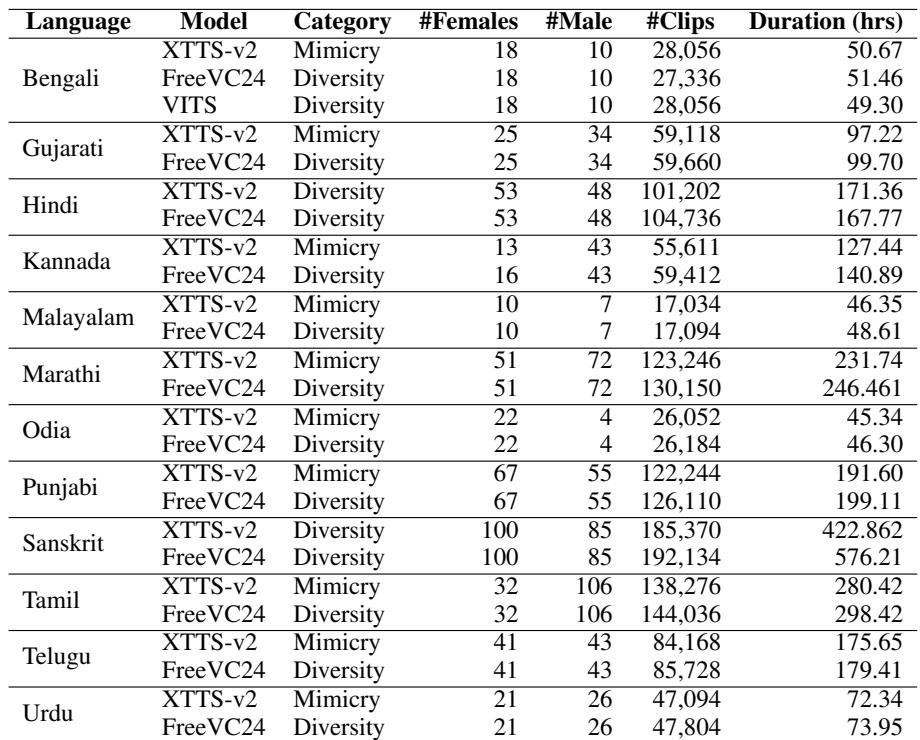
IndicSynth is presented as a multilingual synthetic speech collection built from real IndicSuperb recordings using TTS and voice conversion models. The overview distinguishes mimicry subsets that imitate target speakers from diversity subsets intended to cover broader synthetic voices for audio deepfake detection. Across the listed language subsets, clip counts and durations scale with the number of target speakers, while model variants such as XTTS-v2, FreeVC24, and VITS provide comparable output sizes within a language. Mimicry subsets are associated with synthetic voices that closely follow the target speaker, supporting studies of impersonation and speaker verification weakness. Diversity subsets are described as covering a wider range of synthetic voices, aligning with the goal of improving multilingual audio deepfake detection. The listed subsets include male and female target speakers, with the number of clips and total hours varying by language and generative model.
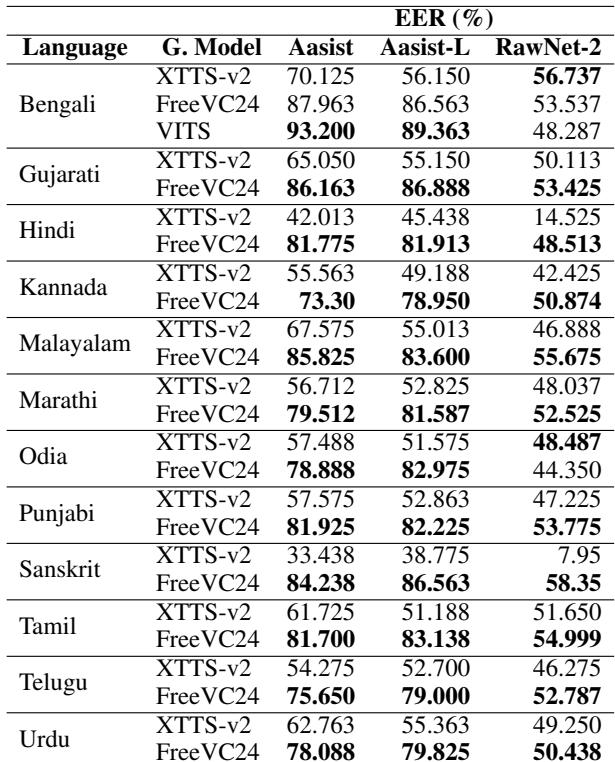
The evaluated audio deepfake detection models show much higher error rates on IndicSynth-IndicSuperb than on their previously reported English benchmark performance. Detection remains difficult across the available Indic languages and generative models, with all three models struggling to separate bonafide from synthetic speech without adaptation. RawNet2 appears relatively less affected than Aasist and Aasist-L in the shown results, but its error rates are still elevated. English-trained ADD models generalize poorly to unseen Indic synthetic speech without domain adaptation. High EER values across multiple languages and synthetic sources indicate weak discriminative performance on IndicSynth-IndicSuperb.
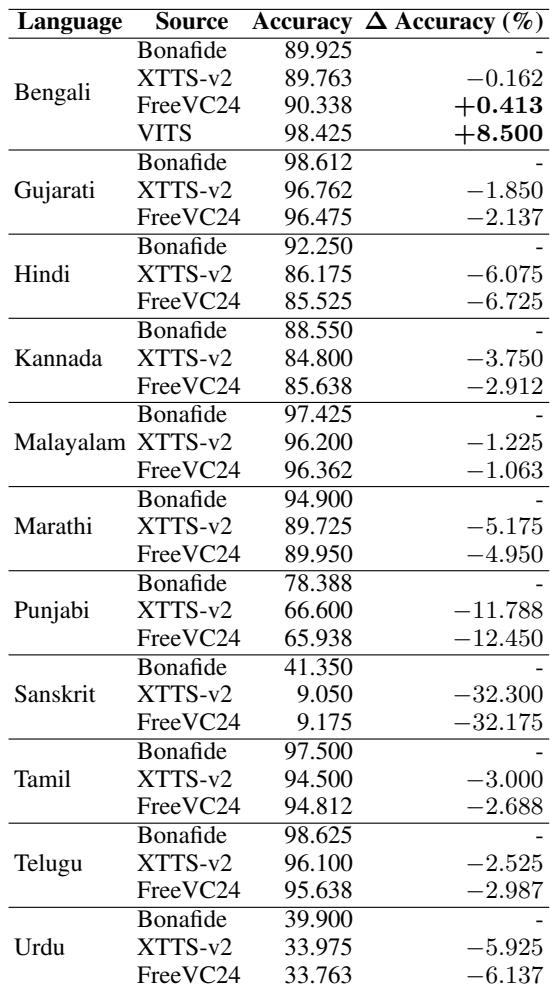
The evaluation uses language identification to test whether synthetic IndicSynth audio preserves the linguistic traits of target languages. Accuracy is above 80 percent for most bonafide and synthetic test sets, and the synthetic sets usually remain close to bonafide performance. Some Bengali synthetic sources even exceed bonafide accuracy, while Odia is assessed through embedding visualization because the language identification model does not support it. Language identification accuracy exceeds 80 percent for most bonafide and synthetic test sets. Most synthetic test sets show small accuracy differences relative to bonafide audio, typically under 10 percent. Bengali synthetic audio from FreeVC24 and VITS reaches higher accuracy than bonafide Bengali audio. Gujarati bonafide and synthetic results remain high, with only modest drops for tested synthetic models.
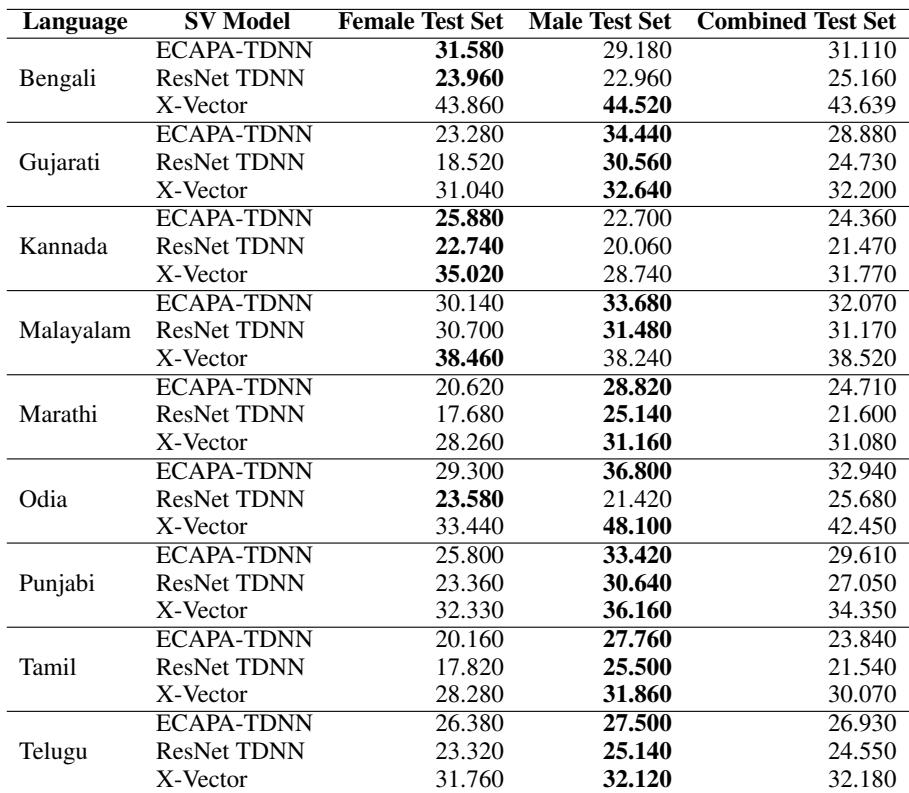
Speaker verification models show elevated equal error rates when negative trial pairs include IndicSynth mimicry audio paired with the target speaker's bonafide speech. This suggests that the synthetic mimicry speech closely resembles the target voice and can weaken the ability of tested models to distinguish genuine pairs from spoofed ones. The mimicry subset is therefore useful for assessing impersonation risk and improving the robustness of speaker verification systems. The tested speaker verification models exhibit substantial errors on mimicry-based negative trials across the reported languages. For the available model comparisons, X-Vector tends to show higher error rates than ECAPA-TDNN and ResNet TDNN. Gender-specific error patterns vary by language and model, suggesting that vulnerability to mimicry attacks is not uniform.
IndicSynth is evaluated as a multilingual synthetic speech benchmark covering both speaker-mimicry and broader diversity subsets generated by several TTS and voice conversion models. Experiments show that existing audio deepfake detectors generalize poorly to unseen Indic synthetic speech, exhibiting substantially higher errors than on English benchmarks regardless of language or generator. Language identification results indicate that the synthetic audio largely preserves target-language characteristics and remains close to bonafide speech, while speaker verification experiments reveal that mimicry attacks can closely resemble target voices and degrade model discrimination, with varying susceptibility across models and genders.