Command Palette
Search for a command to run...
Media Framing: A Typology and Survey of Computational Approaches Across Disciplines
Media Framing: A Typology and Survey of Computational Approaches Across Disciplines
Yulia Otmakhova Shima Khanehzar Lea Frermann
Abstract
Framing studies how individuals and societies make sense of the world, by communicating or representing complex issues through schema of interpretation. The framing of information in the mass media influences our interpretation of facts and corresponding decisions, so detecting and analysing it is essential to understand biases in the information we consume. Despite that, framing is still mostly examined manually, on a case-by-case basis, while existing largescale automatic analyses using NLP methods are not mature enough to solve this task. In this survey we show that despite the growing interest to framing in NLP its current approaches do identify aspects related to the framing of, rather than simply conveying, the message. To this end, we bring together definitions of frames and framing adopted in different disciplines; examine cognitive, linguistic, and communicative aspects a frame contains beyond its topical content. We survey recent work on computational frame detection, and discuss how framing aspects and frame definitions are (or should) be reflected in NLP approaches.
One-sentence Summary
A survey from The University of Melbourne and CSIRO Data61 unifies definitions of media framing across disciplines, examines cognitive, linguistic, and communicative aspects beyond topical content, and finds that current NLP approaches do identify aspects related to framing rather than simply conveying the message, though existing large-scale automatic analyses remain insufficient for the task.
Key Contributions
- The survey unifies definitions and typologies of frames from media studies, cognitive science, linguistics, and communication, showing that framing extends beyond topical content to cognitive, linguistic, and communicative aspects.
- It proposes ambivalence as a key criterion for identifying frames, where the same issue or event can activate alternative cognitive frames, and argues that computational framing methods should integrate semantic and cognitive resources to detect this property.
- It reviews recent computational framing approaches, analyzes how NLP systems represent sentiment, moral evaluation, narrative roles, connotation, and rhetorical devices, and identifies methodological gaps and future directions for automatic frame detection.
Introduction
Media framing shapes how audiences interpret events by emphasizing certain meanings and associations. Computational frame detection matters because it can help identify bias, persuasion, and influence in news and political communication.
Prior NLP work often focuses on topic-based or surface-level signals and tends to emphasize how a message is communicated. This leaves gaps around the semantic and cognitive mechanisms that create competing interpretations. As a result, many models still struggle to separate true framing from stance, emotion, or simple topical labeling.
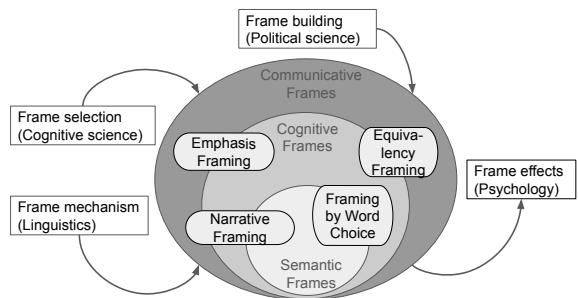
The authors connect framing research across NLP, cognitive linguistics, media studies, and social psychology. They organize framing into semantic, cognitive, and communicative levels, propose a typology of major framing types, and argue that ambivalence and competing cognitive frames are central to defining framing.
Dataset
-
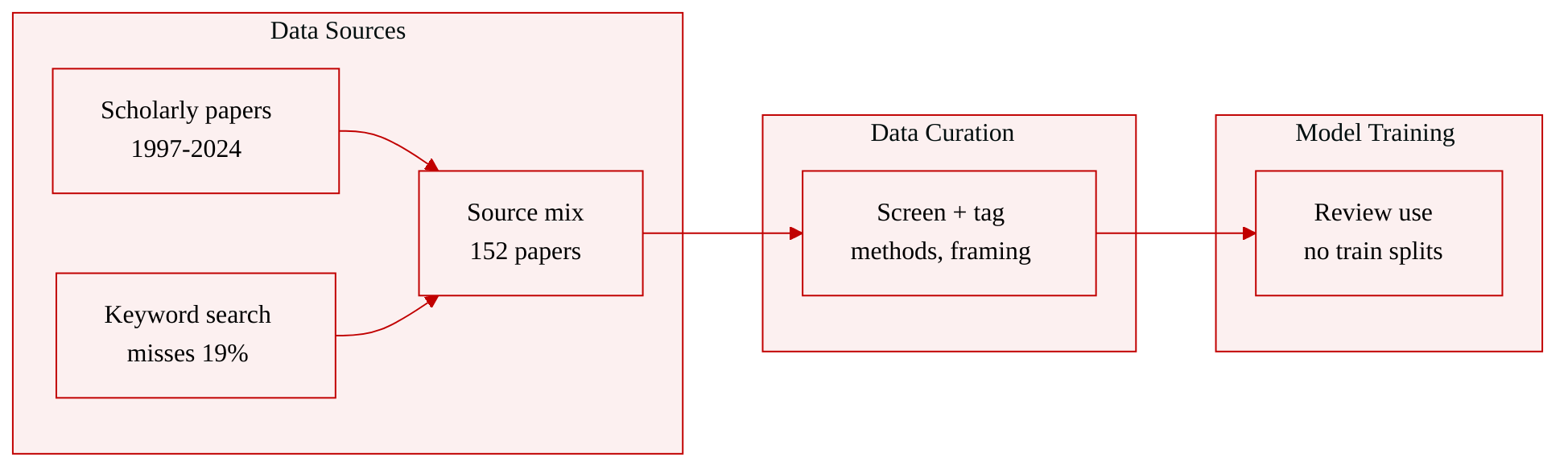
The authors assemble a survey dataset of scholarly articles on computational and quantitative media framing research. The corpus contains 152 papers published between 1997 and 2024.
-
The dataset is built using a systematic review style collection process rather than a supervised training corpus. The authors screen literature on media framing and retain papers that use computational or quantitative approaches.
-
Filtering is not limited to simple keyword presence. Only 19% of included papers omit the terms “frame” or “framing” from their title, and 8% omit them from both the title and abstract. This supports the claim that keyword-only search can miss relevant work.
-
The language composition is dominated by English, with 112 papers. The paper also reports smaller language groups, including 7 German papers, 2 each for Chinese, Dutch, Italian, Persian, Russian, and Spanish, 1 Bulgarian paper, and 18 multi-lingual studies.
-
The venue composition shows a strong NLP and computational linguistics focus. 77 papers, or 52%, appear in computational linguistics and NLP conference proceedings or workshops. Another 26 papers, or 18%, are in other machine learning and computer science venues. The corpus also includes about 12 social science papers, 11 media studies papers, 6 political science journal papers, and studies from other disciplines.
-
The paper organizes the dataset into framing-type subsets, but studies can belong to more than one subset, so the counts do not sum to 152. Emphasis framing is the largest category, with 106 papers, or 72%. Generic frames appear in 48 studies, and 31 of those rely on the Policy Frames Codebook, the Media Frames Corpus, or related derivatives, often using 15 generic frames.
-
Other reported subsets include 54 issue-specific framing studies, 4 equivalence framing studies, 26 word choice and labelling studies, and 25 narrative framing studies. A smaller subset of 11 papers covers multiple framing types.
-
The metadata constructed from the dataset includes publication year, keyword presence in title and abstract, language, venue type, framing type, and whether the study uses theory-based codebooks, topic-like frame proxies, narrative categories, or ad hoc frames.
-
The paper uses the dataset for descriptive analysis rather than model training. It is used to examine how media framing research is distributed across venues, languages, and framing types, and to assess coverage gaps such as the underuse of equivalence framing and the heavy reliance on topic-based proxies for emphasis framing.
-
No training split, validation split, test split, or mixture ratio is described. The dataset functions as a corpus for systematic review and meta-analysis of framing methods.
Method
The authors leverage a diagnostic survey pipeline to characterize computational approaches to media framing. The workflow is organized as a sequence of literature curation, annotation, classification, and coverage analysis modules. The first module designs a systematic retrieval strategy intended to reduce keyword bias. Rather than relying only on titles or abstracts containing “frame” or “framing”, the authors screen relevant literature across broader conceptual areas, including semantic frames, cognitive frames, framing effects, and framing in political communication. This approach is motivated by the observation that many relevant computational framing studies do not use framing terminology in visible metadata.
The second module builds a curated corpus of published work and applies structured annotation to each paper. The central design choice is to classify studies according to their theoretical orientation rather than only their task or dataset. A paper is treated as theoretically grounded when it uses theoretically motivated features, codebooks, or constructs to predict framing, or when it analyzes framing effects in a theoretically coherent way. A paper is treated as framing analysis when it compares framing across agents, time periods, or sources, even if it does not explicitly anchor the comparison in theory. A paper is treated as framing agnostic when it neither uses framing-specific theoretical cues nor applies framing analysis to real-world discourse, often performing topic or stance analysis instead. This creates a simple classification space:
yp∈{grounded,framing analysis,agnostic}.
The third module analyzes coverage across methodological perspectives. The authors examine whether computational work reflects linguistic, cognitive, psychological, and political theories of framing. They find that NLP research has strong but underconnected ties to semantic and cognitive resources, such as frame-based lexical knowledge, while relatively little work models the linguistic devices that turn semantic or cognitive frames into media frames. Similarly, cognitive schema or narrative script ideas are present in related NLP tasks, but they are rarely used as proxies for the associative variation induced by framing. Psychological approaches appear where framing effects are measured through reader reactions or external behavioral proxies, and political approaches appear when framing is modeled as an outcome shaped by context, actors, or diffusion processes.
The authors then use temporal venue-level analysis to test whether NLP research is becoming more theoretically oriented over time. They examine studies published in computational linguistics, machine learning, and adjacent computer science venues. The analysis separates grounded work from framing-analysis and framing-agnostic work, allowing the survey to distinguish methodological maturity from simple publication volume. Refer to the framework diagram below, which shows the trend in NLP venues over time.
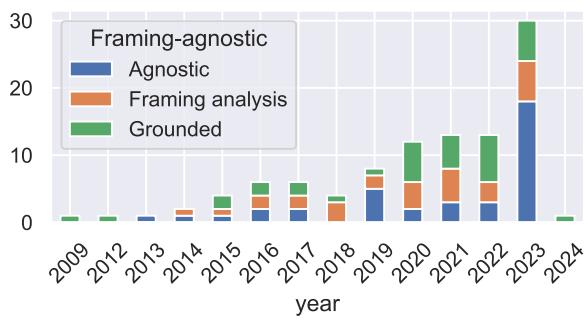
The visual pattern reveals growing interest in framing, but also a persistent imbalance. Although theoretically grounded studies increase across later years, a large portion of NLP publications remain either framing-analysis only or framing-agnostic. This supports the authors’ argument that the field lacks a unified computational interpretation of framing. Many papers still treat frames as output categories or dataset labels, rather than modeling the theoretical mechanisms through which frames are produced, transformed, and interpreted.
The final module compares these patterns across discipline-specific publication venues. The authors classify venues into broad categories, including media studies, NLP, other computer science or machine learning venues, political science, and social science. They then measure the relative share of grounded, framing-analysis, and agnostic papers within each venue type. This comparison is used to assess whether computational venues adopt framing theory differently from traditional framing analysis venues. As shown in the figure below, the distribution of theoretically grounded work is uneven across disciplines.
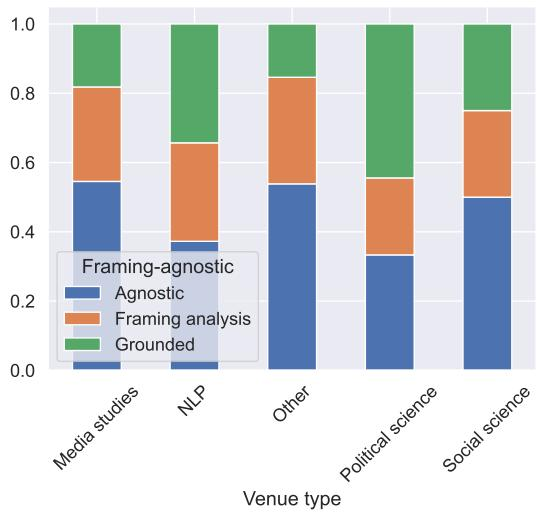
The cross-venue analysis suggests that traditional framing-analysis venues often exhibit stronger theoretical grounding than computational venues. By contrast, NLP-heavy venues contain a larger share of papers where framing is operationalized weakly, either as a downstream label set or as an issue-specific classification problem. This methodological diagnosis informs the authors’ later typology of framing types. They argue that NLP systems should distinguish between broad emphasis frames, issue-specific frames, semantic or cognitive frames, and framing effects, instead of collapsing all of these into a single detection task. The survey design therefore serves not only to review existing methods, but also to expose architectural gaps in how computational media framing research is currently structured.