Command Palette
Search for a command to run...
Toward an Architecture for Never-Ending Language Learning
Toward an Architecture for Never-Ending Language Learning
Andrew Carlson Justin Betteridge Bryan Kisiel Burr Settles Estevam R. Hruschka Jr Tom M. Mitchell
Abstract
We consider here the problem of building a never-ending language learner; that is, an intelligent computer agent that runs forever and that each day must (1) extract, or read, information from the web to populate a growing structured knowledge base, and (2) learn to perform this task better than on the previous day. In particular, we propose an approach and a set of design principles for such an agent, describe a partial implementation of such a system that has already learned to extract a knowledge base containing over 242,000 beliefs with an estimated precision of 74% after running for 67 days, and discuss lessons learned from this preliminary attempt to build a never-ending learning agent.
One-sentence Summary
Carnegie Mellon University and Federal University of Sao Carlos propose an architecture for a never-ending language learning agent that continuously extracts information from the web into a growing knowledge base and improves day over day, with a partial implementation that accumulated over 242,000 beliefs at 74% estimated precision after 67 days of operation.
Key Contributions
-
The paper introduces an architecture and design principles for a never-ending language learning agent that reads web text daily and improves extraction functions through semi-supervised bootstrap learning across complementary subsystems.
-
The paper describes a partial implementation with four subsystem components that combine multiple extraction methods and ontology-constrained multi-task learning, using type checks, mutual exclusivity, and domain constraints across 531 learned functions.
-
The 67-day implementation populated a knowledge base with over 242,000 facts at an estimated precision of 74%, supporting the value of diverse learning-compatible extractors and a knowledge base that stores candidate facts alongside confident beliefs.
Introduction
The authors address a long-standing AI goal: building a system that can continuously read the web and improve its understanding over time. Their application is a never-ending language learner that populates a growing knowledge base by extracting structured facts from text, tables, and lists. This matters because automatic web-scale knowledge acquisition can support many AI systems, from question answering to information extraction.
A key challenge is that bootstrap learning can accumulate labeling errors, a problem often called semantic drift. Earlier approaches also tended to separate extraction methods, lifelong learning strategies, and ranking techniques, limiting the ability to learn robustly at scale. The authors tackle these limitations through constrained semi-supervised learning, an ensemble of varied extractors, and a flexible knowledge-base representation.
Their main contribution is an architecture and prototype system, NELL, that learns categories, relations, and inference rules continuously. They also provide a web-scale evaluation, showing that after 67 days the system learned more than 242,000 facts with an estimated precision of 74%.
Dataset

-
Dataset source and composition: The authors construct an input ontology for experiments. It contains 123 categories and 55 relations. Categories cover locations, people, animals, organizations, and other groups. Relations capture relationships between categories, such as teamPlaysSport, bookWriter, and companyProducesProduct.
-
Category subset: Each category includes 10 to 15 seed instances and 5 seed patterns for CPL. The seed patterns are derived from Hearst patterns.
-
Relation subset: Each relation includes 10 to 15 seed instances and 5 negative instances. The negative instances are typically generated by permuting the arguments of the seed instances.
-
Data usage: The ontology is used as the seed data for the KB population process. CPL, CSEAL, and CMC are run once per iteration. RL is run after every batch of 10 iterations. Proposed output rules are filtered by a human, with manual approval taking only a few minutes.
-
Evaluation data: The authors estimate the precision of the final KB by randomly sampling beliefs from that KB. Human judges evaluate the samples, and disagreements are discussed in detail before a final decision is made.
-
Annotation and processing rules: Facts that were once true but are not currently true are treated as correct because the system does not handle temporal scope. Spurious adjectives, such as “today’s Chicago Tribune,” are allowed but are considered rare.
-
No additional cropping strategy, metadata construction, or separate dataset processing details are described in the provided excerpt.
Method
The authors present an iterative knowledge acquisition architecture built around a shared knowledge base that is continually expanded through multiple complementary reading and inference subsystems. The initial knowledge base contains an ontology of categories and relations, together with a small set of seed examples for each predicate. As the system processes external text resources and web resources, subsystems propose new category instances and relation instances. These proposals enter the knowledge base as candidate facts, while the most strongly supported proposals are promoted to belief status. The updated beliefs then become training data for the next iteration, enabling each subsystem to improve its extraction behavior over time. Refer to the framework diagram for the full data flow.
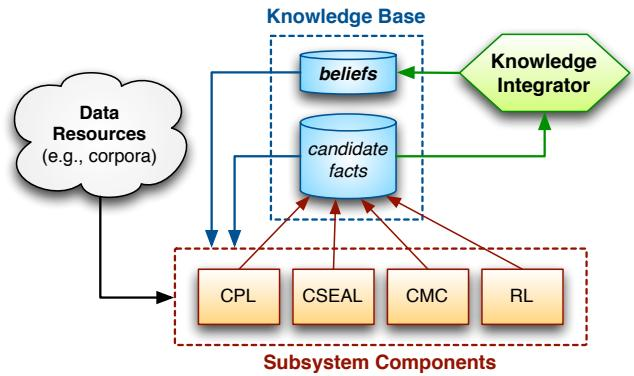
In the implemented system, the shared knowledge base separates low-confidence candidate facts from higher-confidence beliefs. Each subsystem component reads from the knowledge base, consults external resources, and submits proposed candidate facts along with a confidence estimate and source evidence. The Knowledge Integrator receives these proposals, evaluates their support, and decides which candidates become beliefs. This creates a closed loop in which extraction, evaluation, promotion, and retraining interact repeatedly. The overall process can be viewed as a coupled semi-supervised learning procedure and as an approximation to Expectation Maximization: the knowledge base estimates the reliability of many candidate facts, while the subsystems retrain themselves using the currently accepted beliefs.
The architecture uses several subsystem components with different strengths. The Coupled Pattern Learner extracts instances from free text by learning contextual patterns, such as phrases surrounding noun phrases or relation mentions. It relies on part-of-speech patterns and co-occurrence statistics between noun phrases and textual contexts. For each predicate, it learns extraction patterns and applies them to large text resources to discover new instances. Taxonomic constraints are used to suppress overly general patterns. Candidate probabilities are assigned heuristically as
1−0.5cwhere c is the number of promoted extraction patterns that produce the candidate.
The Coupled SEAL component performs semi-structured extraction from web resources. Given seed beliefs for a category or relation, it issues queries, fetches pages, and mines lists or tables that may contain additional instances of the corresponding predicate. It uses mutual exclusion relationships to create negative examples and to filter wrappers that are too broad. Candidates are assigned confidence using a similar heuristic, with the count reflecting the number of unfiltered wrappers that produce the instance.
The Coupled Morphological Classifier learns category classifiers from promoted beliefs. It trains a separate binary logistic regression model for each qualifying category and uses morphological features such as lexical form, capitalization, affixes, and part-of-speech signals. At each iteration, it classifies candidate noun phrases proposed by other components, subject to confidence thresholds and per-predicate capacity limits to preserve precision.
The Rule Learner performs first-order relational inference over the current knowledge base. It learns probabilistic Horn clauses that infer new relation instances from existing relation instances. This component allows the system to propagate knowledge from already believed facts without requiring direct extraction from text.
The Knowledge Integrator determines which candidate facts are strong enough to become beliefs. High-confidence candidates from a single source may be promoted directly, while lower-confidence candidates may be promoted when multiple independent sources agree. The integrator also enforces structural constraints. It respects mutual exclusion between categories, prevents promotion of category instances that conflict with mutually exclusive categories, and applies type checking to relation arguments so that arguments are at least candidates for the appropriate category types. This promotion policy keeps error propagation under control while allowing multiple complementary sources to reinforce weak evidence.
Experiment
Experiments evaluated whether NELL could continually learn a broad set of categories and relations while maintaining precision, and how its components contribute to promoted beliefs. Across a long running study, NELL steadily accumulated knowledge, with individual extractors promoting many beliefs, multi-source integration providing strong gains, and RL adding distinct rules through limited human approval. Precision remained promising overall, with many predicates performing well, though accuracy declined over time and errors were more common in noisy or overly general categories and relations. The findings support the multi-source learning design but also indicate that correlated errors and semantic drift motivate further supervision, such as active learning.
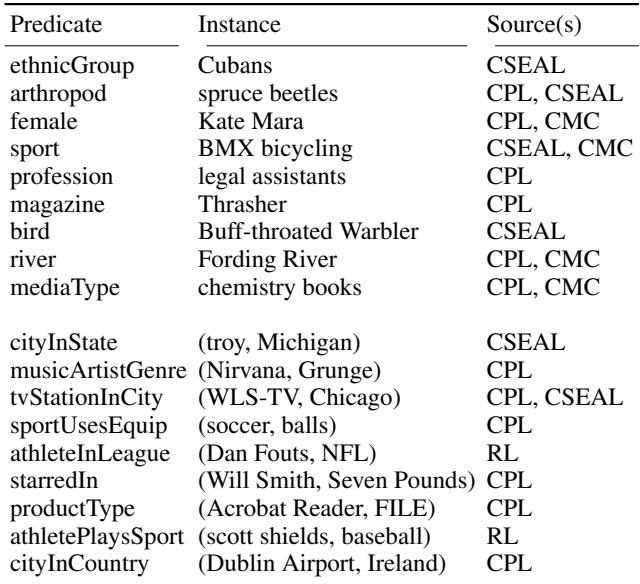
The table presents example beliefs promoted by NELL across diverse predicates, including ethnic groups, animals, occupations, sports, publications, and birds. Each example is tied to one or more source components, showing that promoted beliefs can arise from multiple extraction subsystems. The broader context describes ongoing belief growth over time, with promotions continuing steadily after an initial surge despite gradual precision decline. Promoted beliefs include specific entities across many semantic predicates. Some examples are supported by more than one extraction source. CPL appears in several of the shown examples, indicating it contributes to multiple belief types.
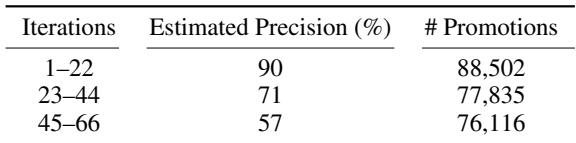
Estimated precision for promoted beliefs declined across the three execution periods while the number of promotions remained broadly comparable. Precision was highest in the earliest period and lowest in the final period, indicating that continued learning expanded the knowledge base without maintaining the same level of accuracy. Early promoted beliefs had the highest estimated precision. Promotion volume stayed relatively stable across periods despite decreasing precision. The overall estimated precision supported continued learning, but later promotions were less accurate.
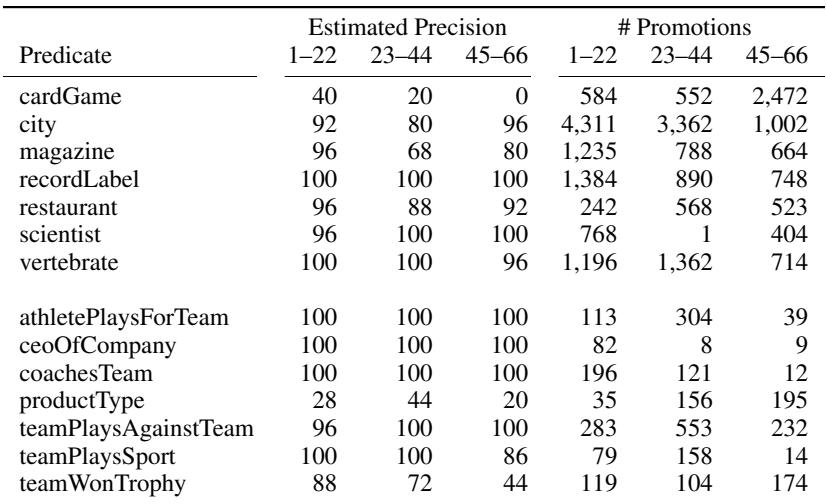
Across the selected predicates, estimated precision differs by predicate and by iteration period, showing that later promotions are not uniformly reliable. Some predicates, such as recordLabel, magazine, restaurant, and scientist, retain high estimated precision, while cardGame shows a much sharper decline even as its promotion count rises. These cases illustrate continued learning activity alongside a gradual loss of precision in certain predicates. recordLabel maintains high estimated precision across all reported periods. cardGame precision falls sharply in later periods while its promotion count rises substantially. city, magazine, restaurant, and scientist generally retain high precision despite changing promotion volume.
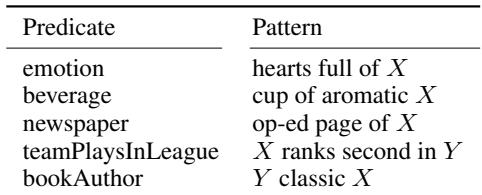
Example free-text patterns learned by CPL capture diverse predicates, from categories such as emotion and beverage to relations such as teamPlaysInLeague and bookAuthor. The patterns rely on compact surface contexts with placeholders for noun phrases, showing that simple lexical templates can support broad knowledge extraction. At the same time, this table-derived evidence fits the broader observation that CPL-generated patterns can cause subtle errors, including noun-phrase segmentation mistakes and gradual precision decline. CPL learns reusable textual patterns across both categories and relations. The patterns use placeholders for noun phrases, such as X and Y, to generalize surface expressions. Examples include container-like phrases for categories and comparison-like phrases for relations. Noun-phrase segmentation errors can make CPL patterns produce incorrect beliefs, such as misclassifying certain publications. The learned patterns show how broad extraction scales, but also why some later patterns may need human oversight to reduce semantic drift.
The table illustrates that learned features can have positive or negative impacts on category predictions. Positional cues matter strongly, because a word such as mountain can increase the probability of a mountain instance when it ends an expression but decrease the probability when it begins one. The examples also show that word endings and part-of-speech patterns help identify categories such as music artists and newspapers. Mountain has a positive effect when it is the final word but a negative effect when it is the first word. Music artist predictions are helped by ending in band and by noun phrase patterns with a determiner followed by plural nouns. A determiner adjective noun pattern lowers the probability for music artist, showing that not all common noun phrases indicate musical artists. Newspaper predictions are supported by ending in sun.
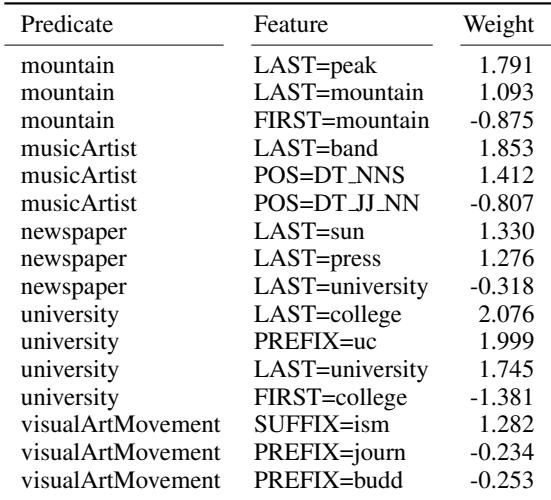
The experiments examine promoted beliefs, learned patterns, and feature impacts across diverse predicates, showing that extraction can scale by combining multiple sources and reusable surface templates. Promotion volume remains fairly stable over time, but estimated precision gradually declines and varies by predicate. The findings indicate that positional, lexical, and syntactic cues support broad category learning, while also introducing errors and semantic drift that may require oversight.