Command Palette
Search for a command to run...
Antom 3-in-1 Transformer: A Payment Foundation Model
Antom 3-in-1 Transformer: A Payment Foundation Model
Abstract
We report the development of Antom 3-in-1 Transformer, a payment foundation model that integrates sequence, tabular, and graph representations for payment risk detection. The model contains approximately 7B parameters, with approximately 1.7B activated per task route. Antom 3-in-1 Transformer is pretrained to learn reusable behavioral and relational representations, primarily on Ant International’s internal payment data. In a crossbusiness transfer experiment, pretraining improves the target business metric by 34.5% over the same architecture trained from scratch. With only 25% of the training labels, the pretrained model outperforms the full-label scratch baseline in Average Precision (AP) and [email protected]% on different merchant domains. In a four-month online experiment on Ant International’s billion-scale payment platform, the model reduced the overall loss rate by 37.88% relative to XGB-Online.
One-sentence Summary
Ant International et al. propose the Antom 3-in-1 Transformer, a 7B-parameter payment foundation model that integrates sequence, tabular, and graph representations for payment risk detection, activates 1.7B parameters per task route, and, after pretraining on internal payment data, yields a 34.5% cross-business gain and a 37.88% online loss-rate reduction relative to XGB-Online.
Key Contributions
- The paper presents Antom 3-in-1 Transformer, a payment foundation model that integrates sequence, tabular, and graph representations for payment risk detection, with about 7B parameters and about 1.7B activated per task route.
- Pretraining with sequence contrastive learning and self-supervised graph relationship learning yields reusable behavioral and relational representations, improving a target business metric by 34.5% over the same architecture trained from scratch and enabling a 25% label setting to outperform a full-label scratch baseline in AP and [email protected]% across merchant domains.
- Results from a four-month deployment on Ant International's billion-scale payment platform show that the model reduces overall loss rate by 37.88% relative to XGB-Online at the same 0.5% intervention budget.
Introduction
Large-scale payment platforms such as Ant International’s Antom must continuously detect fraud across markets and business scenarios where user behavior, transaction processes, and data distributions differ and fraudsters continually change tactics. Prior transaction foundation models, including TransactionGPT, PRAGMA, and PANTHER, learn rich representations of individual user histories, but they tend to model transactions from a single perspective, and PRAGMA notes difficulty capturing highly relational patterns across accounts and payment objects. The authors propose Antom 3-in-1 Transformer, a card-payment risk foundation model that jointly integrates transaction sequences, scenario-specific tabular features, and entity relationships, then uses large-scale pretraining and business adaptation to support cross-scenario reuse, label-efficient learning, and improved risk detection.
Method
The authors introduce the Antom 3-in-1 Transformer, a payment foundation model that integrates sequence, tabular, and graph representations for payment risk detection. As shown in the figure below:
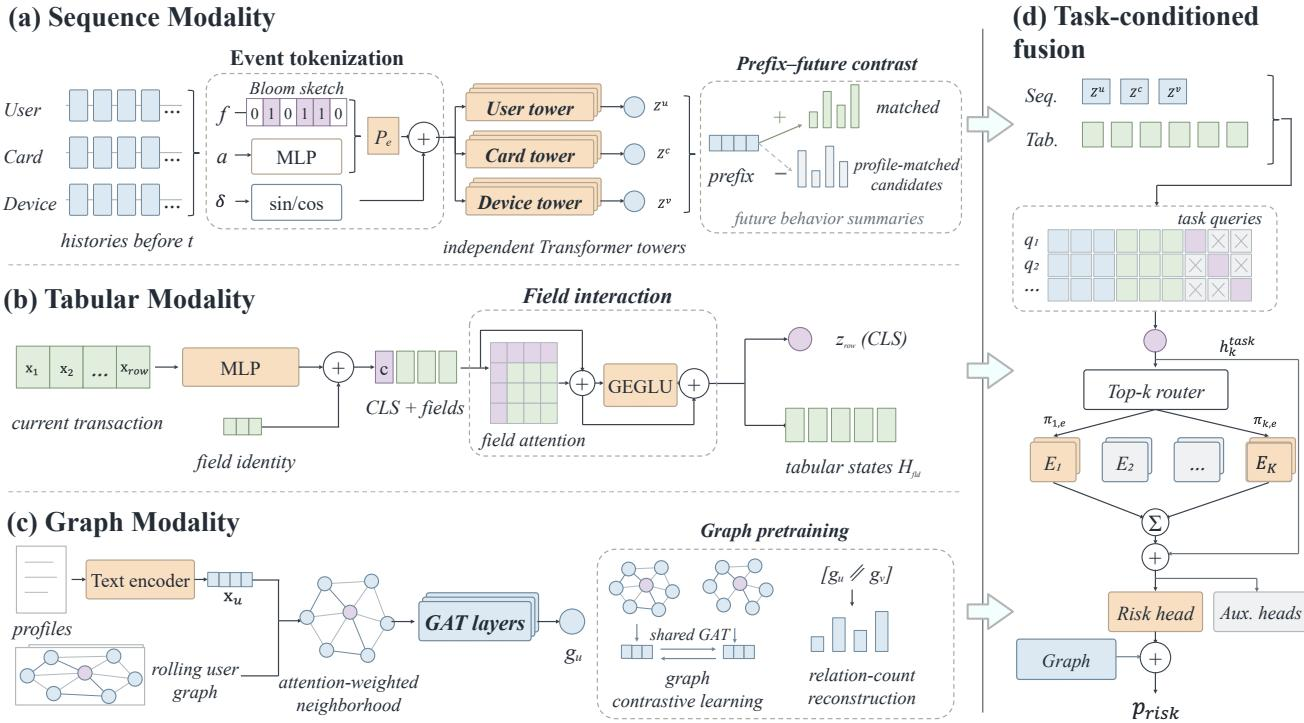
The architecture comprises three distinct modality encoders and a task-conditioned fusion module.
The sequence modality learns behavioral patterns from transaction histories. The sequence encoder models the transaction histories associated with the current payment. An event tokenizer embeds each event through its amount, categorical fields, and elapsed time, then uses a transformer to summarize the history. User, card, and device histories follow this procedure with separate independent Transformer towers. The sequence encoders are pretrained by prefix-future contrast, which matches each historical prefix with a statistical summary of its subsequent activity. Contrastive candidates with similar coarse activity profiles encourage the encoder to learn finer behavioral differences without risk labels.
The tabular modality models interactions among transaction attributes, business states, and engineered features through self-attention. The tabular encoder embeds features commonly used in payment risk assessment, including current transaction attributes and business statistics. The modeling procedure includes two stages: field tokenization embeds each value, and field interaction uses self-attention to combine information across fields. The resulting representations describe both individual fields and the transaction as a whole.
The graph modality captures relationships among users by aggregating their profile and connected neighborhoods. The graph encoder models users through their account profiles and their connections to other users. Rolling user graphs are constructed from transactions in dynamic time intervals. Each user node initializes from an embedding of its account. The graph encoder is pretrained by combining contrastive agreement between edge-perturbed views of the same user with reconstruction of relation counts. These objectives preserve neighborhood consistency and relational information without supervision.
For task-conditioned fusion, the model is optimized for a payment risk prediction task together with a set of auxiliary business tasks. Each task is associated with a learnable vector, referred to as a task query. Learnable task queries aggregate information through shared attention, and the resulting task representations are used for expert routing via a Top-k router. Downstream fine-tuning adapts the Antom 3-in-1 Transformer to supervised risk and auxiliary tasks. It updates the sequence encoder and trains the tabular encoder, task-conditioned fusion module, experts, and prediction heads. The graph encoder is frozen and supplies user representations aligned with each transaction time.
Experiment
The evaluation covers industrial online A/B testing, public transaction and graph benchmarks, low-label and cross-scenario adaptation, modality ablations, and case studies. Overall performance experiments validate strong risk-ranking quality and lower chargeback and loss rates compared with production and published baselines, while implementation tests confirm real-time serving within operational latency limits. Foundation capability studies show that pretraining improves label efficiency, supports transfer across businesses, and benefits payment routing, and component analyses confirm sequence pretraining, graph augmentation, and task-attention expert fusion contribute to robust risk prediction. Ablations indicate sequence, tabular, and graph modalities are complementary, and case studies show pretrained representations distinguish evasion and account-nurturing behaviors and capture rapid retry patterns.
In an online A/B test covering a substantial share of platform transactions, Antom 3-in-1 Transformer delivered the largest relative improvements in chargeback and loss rates compared with the XGB-Online baseline, while SAINT-style showed smaller gains. The model also demonstrated stronger risk ranking in the non-intervened stage, recalling a much higher share of risk transactions among its top-scored subset. These ranking advantages translated into lower realized loss rates under the shared intervention policy. Antom 3-in-1 Transformer achieved the largest reductions in chargeback and loss rates among the compared online systems, with both metrics falling by more than a third relative to XGB-Online. SAINT-style also improved over XGB-Online, but its chargeback and loss rate reductions were smaller than those of Antom 3-in-1 Transformer. In the top 0.5% recall stage, Antom 3-in-1 Transformer identified about four times as many risk transactions as XGB-Online and also outperformed SAINT-style.

In a two-stage card-payment evaluation, Antom 3-in-1 Transformer shows much stronger risk ranking than XGB-Online and SAINT-style at a 0.5% top-score threshold, with recall several times higher than the baselines. In Stage II, its realized chargeback rate is substantially lower than XGB-Online, and its relative reduction is roughly twice as large as SAINT-style's under both pooled and date-weighted comparisons. Stage I recall at the top 0.5% is roughly four times higher for Antom 3-in-1 Transformer than for XGB-Online and nearly double that of SAINT-style. Stage II chargeback reductions relative to XGB-Online are about twice as large for Antom 3-in-1 Transformer as for SAINT-style in both pooled and date-weighted results.

On the temporal test split of the synthetic dataset, Antom 3-in-1 Transformer achieves the highest AUROC, average precision, and recall among the top 0.5% and top 1% of scored transactions. Its recall at the strictest top 0.1% threshold is slightly below PRAGMA, and its F1 is also lower than PRAGMA despite stronger ranking. The model shows the largest advantage at the top 0.5% and top 1% fraud recall levels. Antom 3-in-1 Transformer leads all compared models on AUROC and average precision, with particularly large gains in fraud recall among the top 0.5% and top 1% of scored transactions. PRAGMA has a slightly higher recall at the top 0.1% threshold and a higher F1 than Antom 3-in-1 Transformer. Compared with transaction-model baselines, Antom 3-in-1 Transformer provides the strongest fraud detection at the top 0.5% and top 1% operational thresholds.

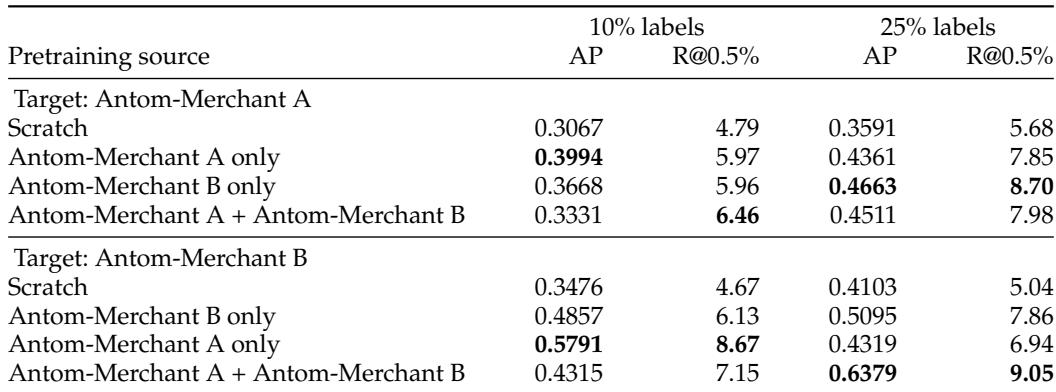
Pretraining improves cross-scenario transfer over scratch training for the reported target domain and label budgets. At 25% of labels, pretraining on Antom-Merchant B alone gives the strongest AP and recall for Antom-Merchant A, while at 10% labels same-domain pretraining leads AP and combined-source pretraining leads recall. Broader cross-scenario gains remain substantial even after excluding risk-dense accounts. All pretraining sources improve AP and [email protected]% over the scratch baseline on Antom-Merchant A at both 10% and 25% label budgets. At 25% labels, cross-source pretraining on Antom-Merchant B alone is the strongest source for Antom-Merchant A, outperforming same-domain and combined-source pretraining. Cross-scenario fine-tuning improves the target business metric by 34.5% and AUROC by 0.0518, with only a small reduction to 34.2% after removing risk-dense accounts.
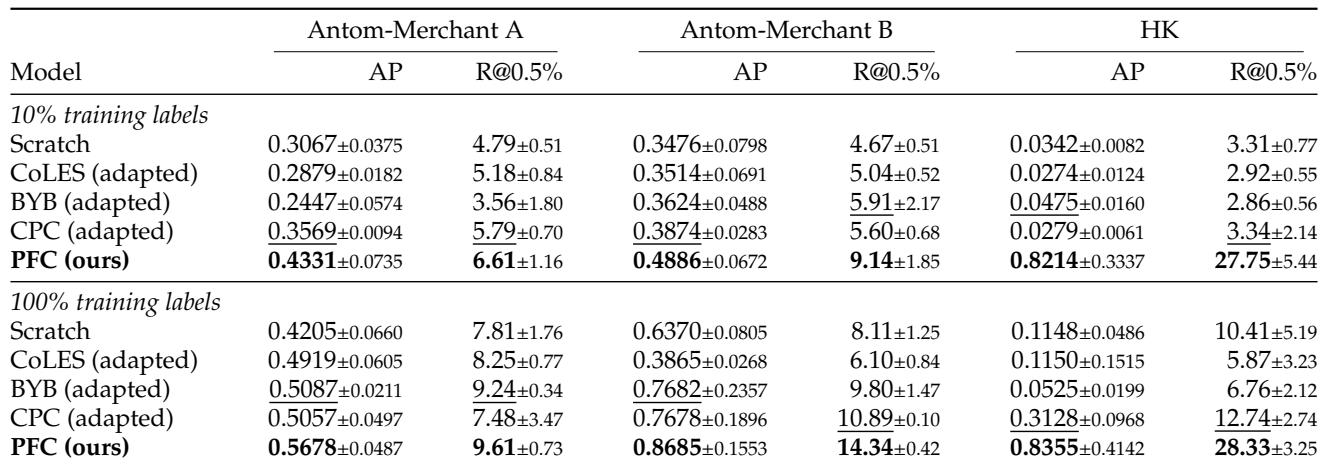
Sequence pretraining with PFC yields the strongest downstream fraud detection performance among the compared objectives. Across all three evaluation domains at 10% training labels, PFC improves both AP and [email protected]% over the scratch model and adapted self-supervised baselines. The largest reported gain appears on HK, where PFC reaches much higher AP and recall than training from scratch. PFC outperforms CoLES, BYB, and CPC on AP and [email protected]% in all three evaluation domains. With 10% of the HK labels, PFC reaches 0.8214% AP and 27.75% [email protected]%, compared with 0.0342% and 3.31% for scratch training.
The experiments evaluate Antom 3-in-1 Transformer in online A/B tests, two-stage card-payment assessments, and synthetic temporal benchmarks against XGB-Online, SAINT-style, and PRAGMA, finding that it consistently delivers stronger risk ranking, with chargeback and loss rates reduced by over a third online and roughly four times higher recall at the top 0.5% threshold. Cross-scenario transfer experiments show that pretraining improves over scratch training under limited labels, with cross-source pretraining on Antom-Merchant B being most effective at 25% labels and fine-tuning improving the target business metric by 34.5%. Sequence pretraining with PFC further yields the strongest downstream fraud detection across three domains, outperforming scratch and self-supervised baselines on AP and recall at 10% training labels.