Command Palette
Search for a command to run...
Self-Improvement Memory Enables Continual Recursive Self-Improvement
Self-Improvement Memory Enables Continual Recursive Self-Improvement
Xin Yu Fei Xia Jiaqi Pan Youbao Tang Chengzhi Liu Adams Yu Sicong Jiang Yanfei Chen Lingzhou Xue Ting Yu
Abstract
Harness optimization is often studied with a fixed policy model and benchmark. When either changes, the optimizer must decide which parts of an evolved harness to reuse or revise, but the harness alone may not explain why earlier edits were made or how they performed. In this work, we study Continual Recursive Self-Improvement (CRSI), a setting for continuing existing harness-optimization methods across compatible benchmarks or policy models. We propose Self-Improvement Memory (SIM) for the harness optimizer, rather than the task-solving policy. SIM groups edits by recurring harness problem and records their rationale, predicted and observed outcomes, and evaluation context. New attempts extend this history as optimization continues. In our experiments across four domains, SIM achieves higher final scores than harness-only and root-cause-only continuation in cross-dataset and pairwise cross-model comparisons. Across ten independent source runs in coding, paired continuations with SIM improve final scores by an average of 2.36 points over harnessonly continuation (p=0.003)
One-sentence Summary
Researchers from Google Cloud AI, Google DeepMind, Google Cloud AI Research, and The Pennsylvania State University propose Self-Improvement Memory (SIM), a harness-optimizer memory for Continual Recursive Self-Improvement that groups edits by recurring harness problem and records rationale, predicted and observed outcomes, and evaluation context, outperforming harness-only and root-cause-only continuation across four domains and improving coding continuations by 2.36 points over harness-only continuation (p=0.003).
Key Contributions
- Formalizes Continual Recursive Self-Improvement (CRSI), a setting for continuing existing harness-optimization methods across compatible benchmarks or policy models while retaining their proposal, evaluation, and selection procedures.
- Introduces Self-Improvement Memory (SIM), a structured record that groups harness edits by recurring harness problem and stores their rationale, predicted and observed outcomes, and evaluation context to condition both proposal and selection during continued optimization.
- Controlled experiments across four domains with matched starting harnesses, round counts, and candidate budgets show Full SIM outperforms harness-only and root-cause-only continuation in six cross-dataset and four Opus-to-Gemini settings. Across ten independent coding runs, SIM improves 9 of 10 runs and yields a mean advantage of 2.36 points over harness-only continuation (p=0.003).
Introduction
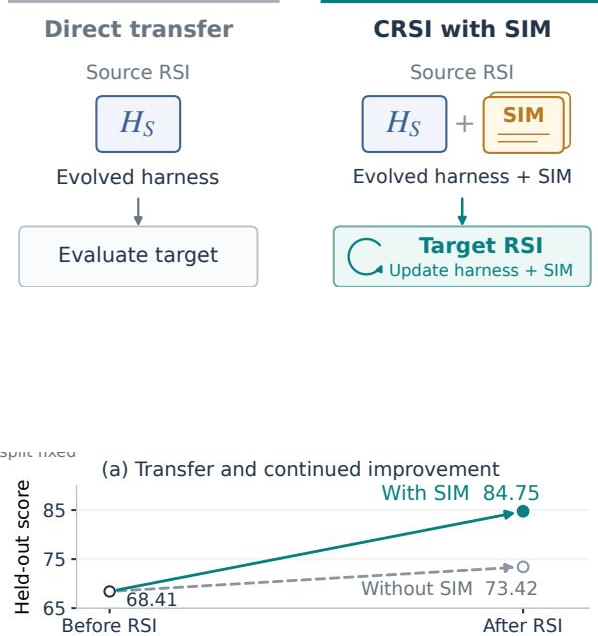
LLM agent performance depends on both the policy model and the harness that manages context, tools, and execution, so improving the harness can raise capabilities without updating model weights. Prior recursive self-improvement methods automate harness edits using execution feedback, but they usually optimize within a fixed setting. When the benchmark distribution or policy model changes, inherited edits can interact differently and even underperform the original seed harness, and the source optimization history is often lost. The authors formalize this setting as Continual Recursive Self-Improvement (CRSI) and propose Self-Improvement Memory (SIM), a structured record of harness problems, edits, rationales, predicted outcomes, and observed results that guides later proposal and selection. In controlled evaluations, Full SIM outperforms harness-only and root-cause-only continuation across cross-dataset and cross-model settings.
Method
The authors formulate the harness optimization problem by defining a setting σ=(M,X), where M is a fixed policy model and X represents disjoint evolve and held-out evaluation sets. The goal is to optimize an executable harness H that determines the model context, tools, and execution flow. The optimization process operates over N rounds. In each round t, an evaluator executes the current harness Ht on the evolve set and returns feedback Ft, comprising scores, traces, and errors.
A proposer P then utilizes this feedback along with the run history Dt to generate k candidate harnesses Ct. A selector S screens these proposals before execution and chooses the best candidate based on performance, complexity, domain specificity, and regression risk. If no candidate is accepted, the harness remains unchanged. This iterative process is formalized as:
Ct=P(Ht,Ft,Dt),Ht+1=S(Ht,Ft,Ct,FtC),where FtC contains feedback from the executed candidates.
To enhance this loop, the authors introduce a Self-Improvement Memory (SIM) module. SIM groups edits by the recurring harness problems they address, organizing them under root-cause hypotheses ci. Each memory entry mi stores the modification and its rationale aij, predicted and observed task outcomes oij, and provenance pij covering domain, benchmark, policy, and round. Both the proposer and selector read the complete SIM to inform their decisions, updating the loop equations to:
Ct=P(Ht,Ft,Dt;Mt),Ht+1=S(Ht,Ft,Ct,FtC;Mt).After selection, the chosen edit and its measured outcomes are recorded in SIM, preserving the history of attempts for each root cause.
Refer to the framework diagram
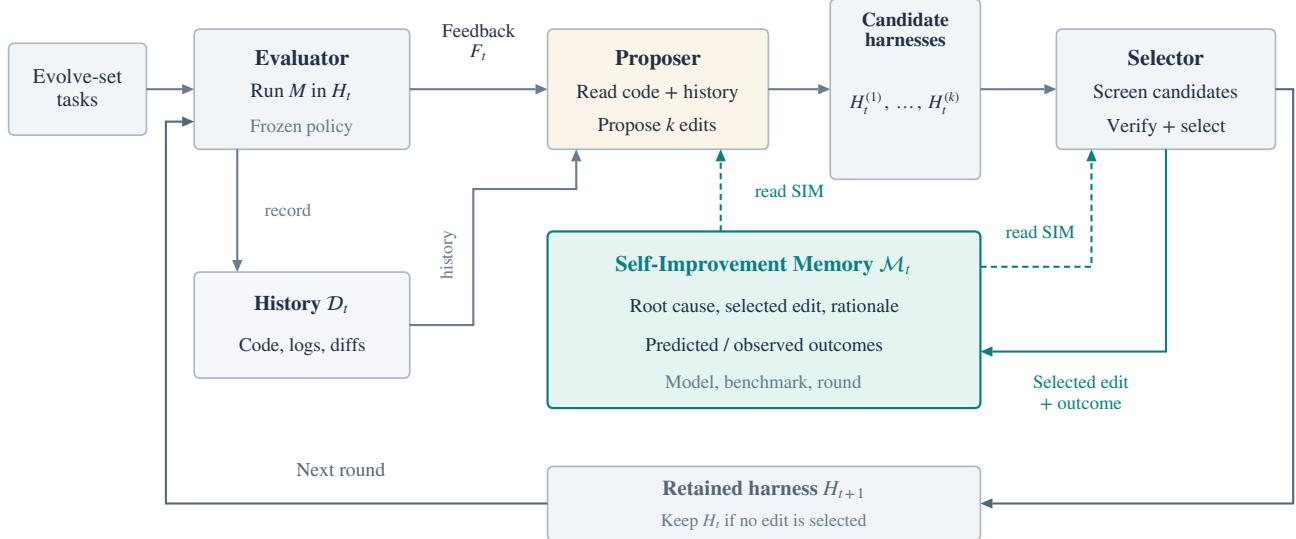
For continual reinforcement self-improvement, the system leverages the knowledge accumulated during source optimization. Source optimization begins with an empty SIM and produces a final retained harness HS and a populated memory MS. In the target optimization phase, the proposer and selector consult this memory to judge whether past edits and their rationales still apply to current failures. This allows the system to retain, revise, replace, or remove harness modifications while maintaining the historical context of earlier attempts. The authors evaluate different transfer conditions, ranging from a cold start to full SIM transfer, to measure how effectively the accumulated memory facilitates improvement on new benchmarks or policy models.
Experiment
The experiments evaluate SIM in continued recursive self-improvement across four domains (coding, text classification, agentic workspace, and engineering design) under cross-dataset, cross-model-family, and cross-model-generation transfers, comparing a source-evolved harness with no memory, root-cause-only memory, and the full SIM record against cold-start baselines. Across these settings, full SIM consistently yields the highest final scores, shows benefits beyond retaining root causes alone, and helps overcome cases where a transferred harness starts below a seed or where source improvement does not guarantee a better target start. Paired analyses with independently evolved coding harnesses show SIM improves continuation in nearly all runs, and qualitative traces indicate it supports reusing and revising inherited edits, preserving earlier diagnoses, adding target evidence, and making earlier target progress while retaining source capabilities.
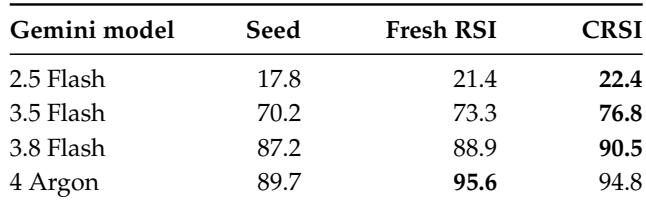
Across the evaluated Gemini generations, both Fresh RSI and CRSI raise held-out success rates well above the unevolved seed, and absolute scores increase from earlier Flash models to Gemini 4 Argon. CRSI leads Fresh RSI in the first generation and in two of the three later generations, but its advantage is not uniform. On the final and strongest model, Fresh RSI scores slightly higher than CRSI. CRSI outperforms Fresh RSI on the first three Gemini models, with the largest relative edge on Gemini 3.5 Flash. Fresh RSI slightly surpasses CRSI on Gemini 4 Argon, reversing the earlier trend. Both Fresh RSI and CRSI improve over the seed harness on every tested model, and success rates generally rise across successive model generations.
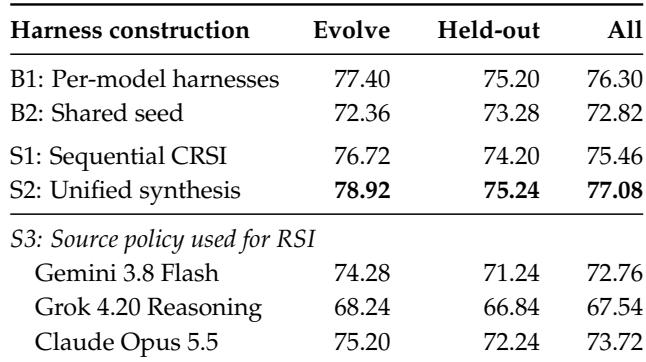
Unified synthesis using feedback from all three models reaches the highest mean text-classification scores, while its held-out performance is nearly identical to separately evolved per-model harnesses. Sequential CRSI improves over a shared seed but trails unified synthesis. Harnesses transferred from a single source policy are weaker and vary by source model. Unified synthesis leads overall and is comparable to per-model harnesses on held-out examples. Single-source policy transfer underperforms sequential CRSI and unified synthesis, with clear variation by source model.
Paired continuation runs show that carrying SIM into target rounds improves held-out coding scores compared with continuing without SIM. Starting from matched harnesses and budgets, SIM produced higher final scores in nearly all pairs, with a moderate mean advantage and a statistically significant paired difference. SIM finished higher in most paired runs, with only one pair favoring continuation without SIM. Across shared starting conditions, SIM runs reached a mean final score roughly two points higher than no-SIM runs. The paired advantage was statistically significant and consistent across repeated source runs.
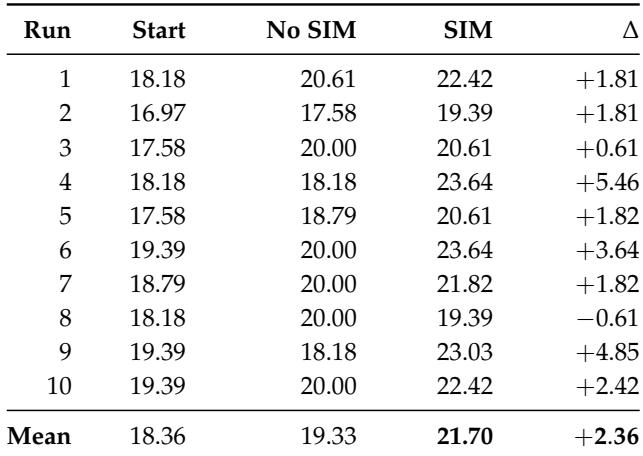
These experiments test evolved RSI harnesses across successive Gemini model generations, compare unified synthesis with per-model, sequential, and single-source transferred harnesses on text classification, and examine whether carrying SIM into later coding rounds helps. Both Fresh RSI and CRSI improve over the seed on every model, with success rates rising across generations, though CRSI's early lead fades and Fresh RSI performs slightly best on the strongest model. Unified synthesis matches separately evolved per-model harnesses and outperforms sequential and single-source transfer, while carrying SIM yields consistently higher held-out coding scores than continuing without it.