Command Palette
Search for a command to run...
ScienceBuddy: Recursive-in-Recursive Self-Improvement for Interactive Scientific Agents
ScienceBuddy: Recursive-in-Recursive Self-Improvement for Interactive Scientific Agents
Abstract
We introduce and release ScienceBuddy, an interactive scientific research workspace that brings continually improving scientific agents into researchers’ everyday workflows. ScienceBuddy supports researchers in carrying out scientific tasks while transforming their requests, feedback, and execution evidence into tasks and evaluation rubrics for continual learning. At its core is recursive-in-recursive self-improvement, a paradigm that couples harness evolution with model reinforcement learning: the inner recursion improves the harness with the model fixed, while the outer recursion trains the model under the improved harness. Harness evolution shapes training experience, and model learning creates new opportunities for harness adaptation. We present case studies of researcher interaction, harness refinement, and model learning, with the benchmark cases spanning four scientific task families. By releasing ScienceBuddy as a research product, we make this paradigm available to the scientific community and take a step toward discovery intelligence: scientific AI that advances through sustained collaboration with researchers and evolves alongside the research it supports.
One-sentence Summary
Researchers from phai-labs introduce ScienceBuddy, an interactive scientific workspace that enables continually improving agents through recursive-in-recursive self-improvement, coupling harness evolution with model reinforcement learning to transform feedback into tasks and evaluation rubrics, with case studies spanning four scientific task families and advancing discovery intelligence.
Key Contributions
- Introduces and releases ScienceBuddy, an interactive scientific research workspace that connects researcher dialogue, executable analysis, inspectable artifacts, and a pluggable harness, making the paradigm available to the scientific community.
- Presents recursive-in-recursive self-improvement, a co-design paradigm coupling evaluated harness evolution with rubric-supervised model reinforcement learning, where the reflector remains fixed to isolate each improvement mechanism.
- Case studies across four scientific task families show harness refinement improves first-response accuracy on feedback-accessible tasks, while model learning expands problem coverage under a fixed harness, with evidence of broader problem coverage and improved task execution.
Introduction
Scientific research relies on iterative analysis, inspection, and revision, and language model agents can support this by retrieving evidence, querying databases, and running computational workflows. However, while correcting answers within a conversation helps individual tasks, it does not systematically improve an agent’s broader procedures or capabilities. Prior work has explored reflection, harness optimization, and interaction-driven adaptation, but these methods typically treat procedural or model learning in isolation, leaving a gap in how collaboration itself can supply the tasks and assessment criteria for coordinated, sustained improvement.
The authors introduce ScienceBuddy, an interactive scientific research workspace that enables continual learning from researcher collaboration. The system separates an editable harness, which organizes behavior through instructions and skills, from the scientific infrastructure, making procedural changes explicit and evaluable. The key contribution is a recursive-in-recursive self-improvement paradigm: an inner loop uses a fixed auxiliary model to diagnose failures and propose bounded edits to procedures, while an outer loop trains the task model on fresh rollouts with rubric-based rewards. This bidirectional coupling allows harness revisions to shape training trajectories and model updates to alter procedure effectiveness, creating a cycle where improved systems return to researchers for further interaction. Case studies across four task families from LAB-Bench and Biomni-Eval demonstrate gains in first-response accuracy and problem coverage, releasing ScienceBuddy as a shared workspace for scientific assistance and capability evolution.
Method
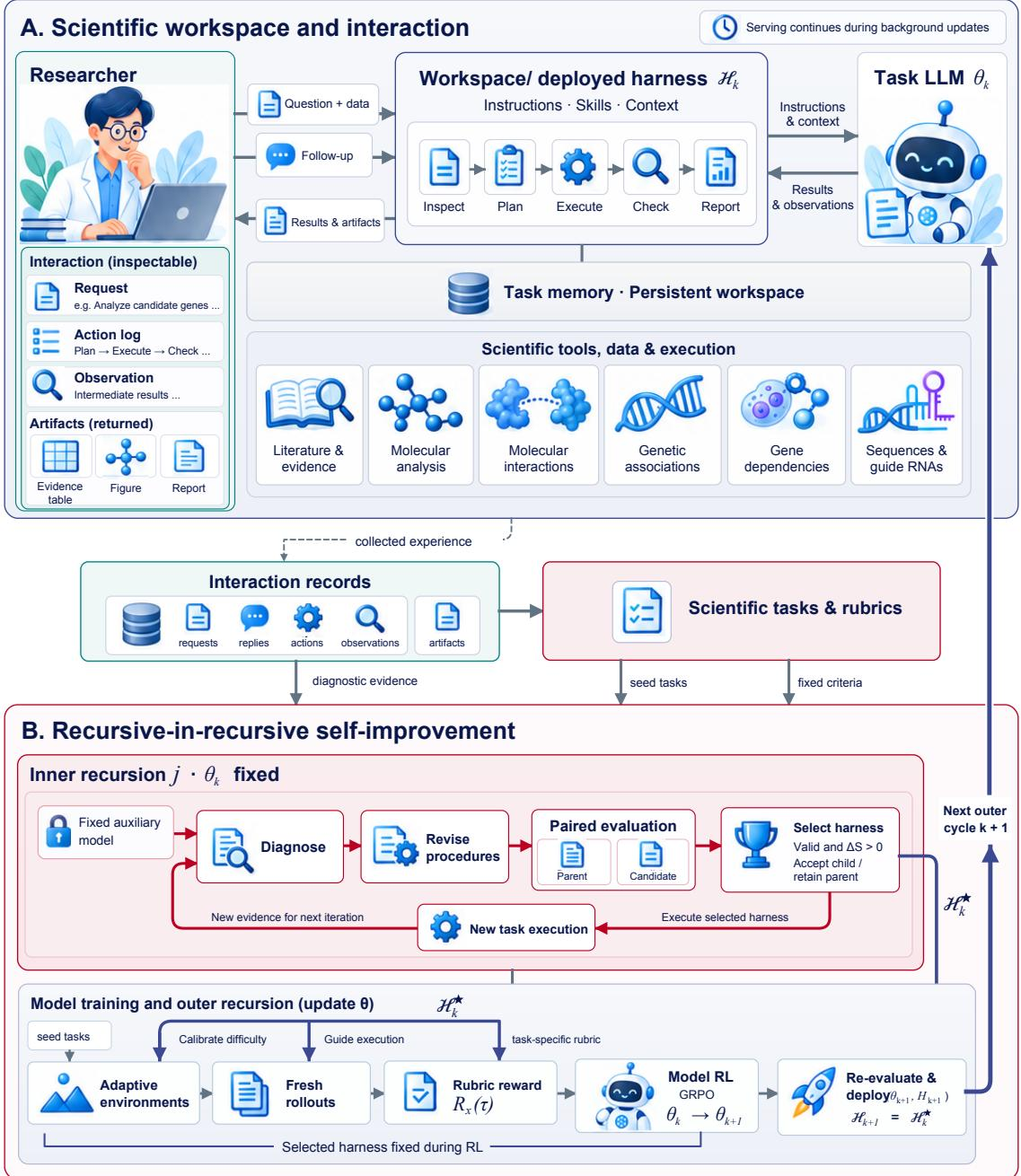
ScienceBuddy functions as an interactive scientific research workspace that integrates evidence access, computational analysis, and methodological guidance into a single conversational workflow. The system architecture separates the agent harness from the underlying infrastructure. The harness manages instructions, skills, and context management procedures, while the infrastructure handles researcher interactions, task execution, and persistent storage. This modularity allows the system to revise scientific problem-solving procedures explicitly while keeping the execution environment consistent.
As shown in the figure below, the workspace supports a recursive-in-recursive self-improvement process. Researchers submit questions and data, which the agent processes through a ReAct-style reasoning loop involving code execution and tool usage. The resulting trajectories and artifacts serve as diagnostic evidence for system updates.
The system formalizes researcher interactions to generate learning signals. Let x denote a research request, πθ the task model, and H the harness. The joint policy μθ,H determines actions at based on the history ht and harness context CH(ht).
μθ,H(a∣ht)={δdH(ht)(a),πθ(a∣CH(ht)),if a harness action is scheduled,otherwise,Collaboration records are transformed into self-contained Harbor tasks and evaluation rubrics. This process consolidates related turns into a scientific objective, deriving criteria for correctness and methodology from the full trajectory rather than relying solely on expert annotation.
Refer to the framework diagram illustrating the task derivation process.
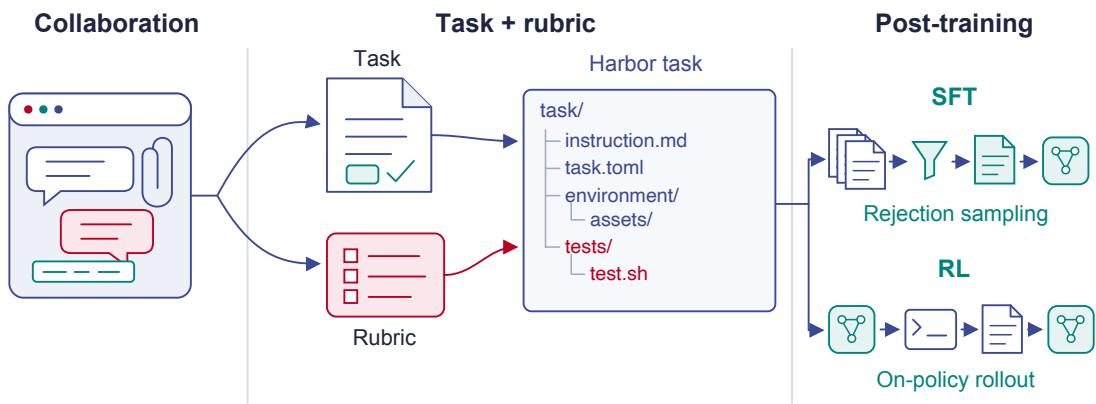
These tasks package instructions, assets, execution environments, and rubrics, supporting both Supervised Fine-Tuning via rejection sampling and Reinforcement Learning via on-policy rollouts.
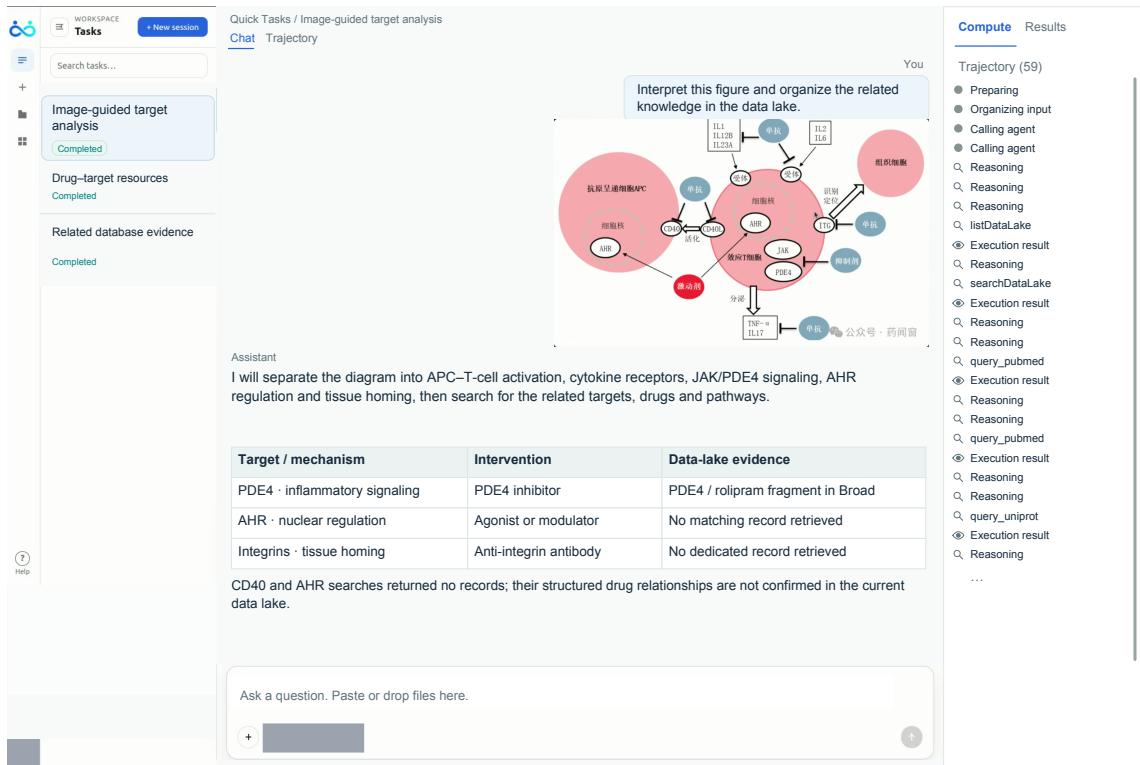
The workspace supports multimodal inputs, allowing researchers to supply documents, biological sequences, and images alongside natural language requests.
As shown in the figure below, an uploaded diagram can guide the identification of molecular targets and the organization of related knowledge, with the interface connecting visual interpretation to structured evidence tables.
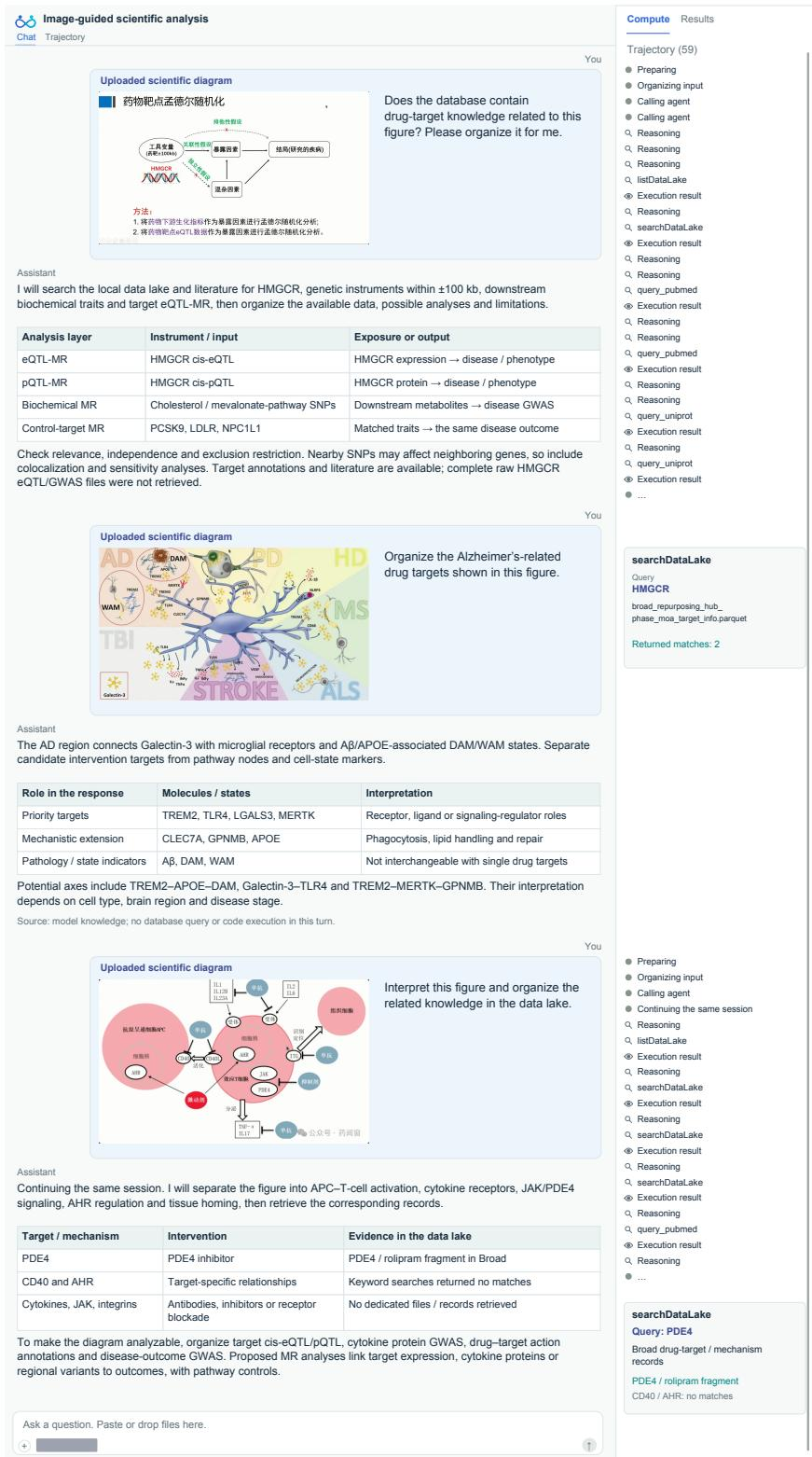
The system facilitates long-context agentic reasoning, where successive image-based requests direct target analysis across a continuing session. The agent interprets images through reasoning and retrieval, resuming sessions with prior exchanges available.
Refer to the figure below demonstrating long-context reasoning.
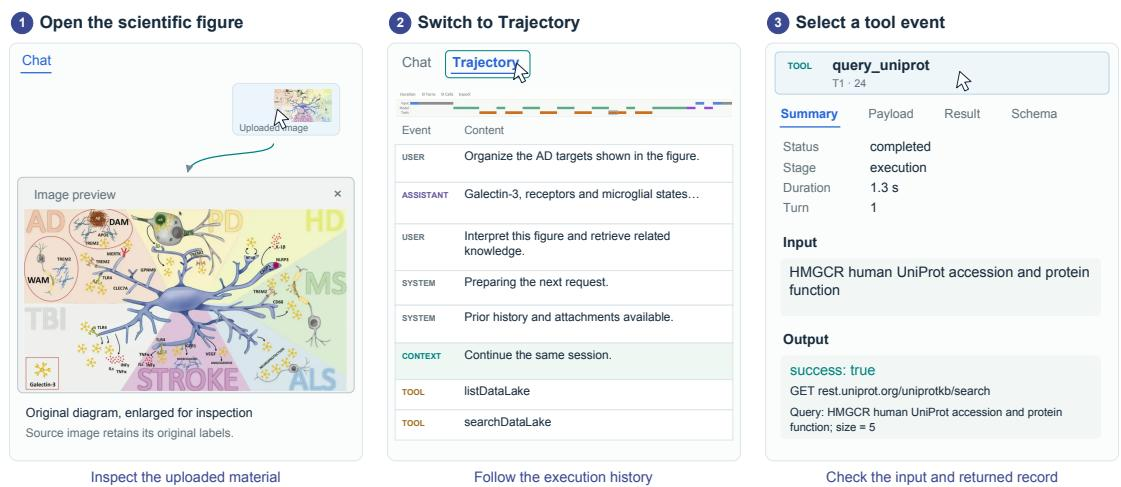
Researchers can also inspect the agent's work beyond conversational input. By switching to the Trajectory view and selecting specific tool events, users can examine metadata, inputs, and outputs to verify the basis of the agent's responses.
As shown in the figure below, these controls allow for detailed inspection of the execution history.
The training process couples harness adaptation with model updates through nested recursion. In the inner recursion, the task model parameters θk remain fixed. A fixed auxiliary model analyzes recent trajectories and rubric evaluations to identify unmet criteria. It proposes bounded procedural edits to the harness H, such as revising a skill or instruction:
Hk,j+1=U(Hk,j,Ek,j;θk)Candidates are accepted only if they satisfy edit constraints and improve the mean normalized rubric score Sˉk on development tasks:
Hk,j+1={Hk,j+1,Hk,j,Valid(Hk,j+1)∧Δk,j>0,otherwise.In the outer recursion, once a harness is selected, the system calibrates environment difficulty and generates fresh rollouts. The reward signal is derived from the task-specific rubric C(x):
Rx(τ)=∑c∈C(x)wc(x)∑c∈C(x)wc(x)vc(x,τ)The task model is updated using GRPO to maximize the expected trajectory reward:
θmaxJk(θ)=Ex∼qkEτ∼πθ,Hk⋆(⋅∣x)[Rx(τ)]After the model update θk+1, the harness and model are re-evaluated and deployed together, initiating the next cycle of researcher interaction and improvement.
Experiment
Four case studies evaluate ScienceBuddy through separate research questions: researcher interaction, coupled recursive-in-recursive improvement, harness adaptation, and model learning. Real researcher requests show how feedback translates into task objectives and evaluation criteria, enabling trajectory-derived rubrics. Across three co-evolution cycles alternating harness refinement and reinforcement learning, overall test accuracy rises from 42.2% to 73.3%, with gains across all task families and more previously incorrect problems becoming correct. Holding model weights fixed, harness adaptation improves validation accuracy by 20 percentage points; holding the harness fixed, model learning increases problem coverage from 48.3% to 67.8%, confirming both mechanisms independently broaden scientific task performance.