Command Palette
Search for a command to run...
Embedding NDRE Trajectories into Contrastive Learning for Label-Free, Physiology-Aware Crop-Stress Staging and DSS Outputs
Embedding NDRE Trajectories into Contrastive Learning for Label-Free, Physiology-Aware Crop-Stress Staging and DSS Outputs
Shafqaat Ahmad
Abstract
Timely detection of crop stress is critical for sustaining yields under increasing drought frequency, yet conventional vegetation index thresholds or image-based clustering often fail to capture stress progression, limiting their value for farm decision-making. To address this gap, we present EigenCL, a physiologyguided contrastive learning framework that stages crop stress from Sentinel-2 NDRE trajectories, with the goal of providing interpretable and transferable stress diagnostics for decision support systems (DSS). EigenCL was trained on 10,000 maize NDRE patches from drought-affected Iowa fields in 2020 and tested on Nebraska fields in 2023 without retraining, with validation incorporating soil-moisture records, U.S. Drought Monitor maps, and county-level yield statistics. The model produced four physiologically coherent stress clusters (Healthy, Mild, Moderate, Severe), significantly outperforming baselines including K-Means, SimCLR, ProtoCLR, and an ablation model (Silhouette = 0.748, DBI = 0.35, CHI = 49,624). Clusters aligned with maize growth stages, with severe stress peaking around tasseling–silking (VT–R1), a stage known to drive yield loss; moreover, EigenCL clusters correlated with soil moisture at 0–14-day lags (ρ up to 0.72) and matched yield anomalies in drought-affected counties. By embedding NDRE trajectory dynamics into contrastive learning, EigenCL enables early stress alerts and interpretable DSS outputs (e.g., heatmaps, scouting priorities, regional risk indices), extending beyond single-date NDRE thresholds and supporting scalable monitoring for climate-smart agronomy.
One-sentence Summary
Brandt Group of Companies proposes EigenCL, a physiology-guided contrastive learning framework that, after training on 10,000 maize NDRE patches from drought-affected Iowa fields in 2020 and zero-shot testing on Nebraska fields in 2023, embeds Sentinel-2 NDRE trajectory dynamics to stage crop stress into four physiologically coherent clusters (Healthy, Mild, Moderate, Severe) that significantly outperform K-Means, SimCLR, ProtoCLR, and an ablation (Silhouette=0.748, DBI=0.35, CHI=49,624), align with maize growth stages with severe stress peaking at tasseling–silking (VT–R1), correlate with soil moisture at 0–14-day lags (ρ up to 0.72), and match yield anomalies in drought-affected counties, thereby enabling early stress alerts and interpretable decision support outputs such as heatmaps, scouting priorities, and regional risk indices for climate-smart agronomy.
Key Contributions
- EigenCL is a physiology-aware contrastive learning framework that stages crop stress by anchoring similarity to the eigenvector structure of Sentinel-2 NDRE temporal trajectories, enabling label-free stress diagnostics.
- Trained on maize NDRE patches from Iowa in 2020 and tested without retraining on Nebraska fields in 2023, EigenCL produces four stress clusters and significantly outperforms baselines (Silhouette = 0.748, DBI = 0.35, CHI = 49,624), demonstrating cross-year and cross-region generalization.
- Multi-scale validation shows that the clusters align with maize growth stages, correlate with soil moisture at 0–14-day lags (ρ up to 0.72), match county-level yield anomalies, and support interpretable decision-support outputs such as heatmaps and regional risk indices.
Introduction
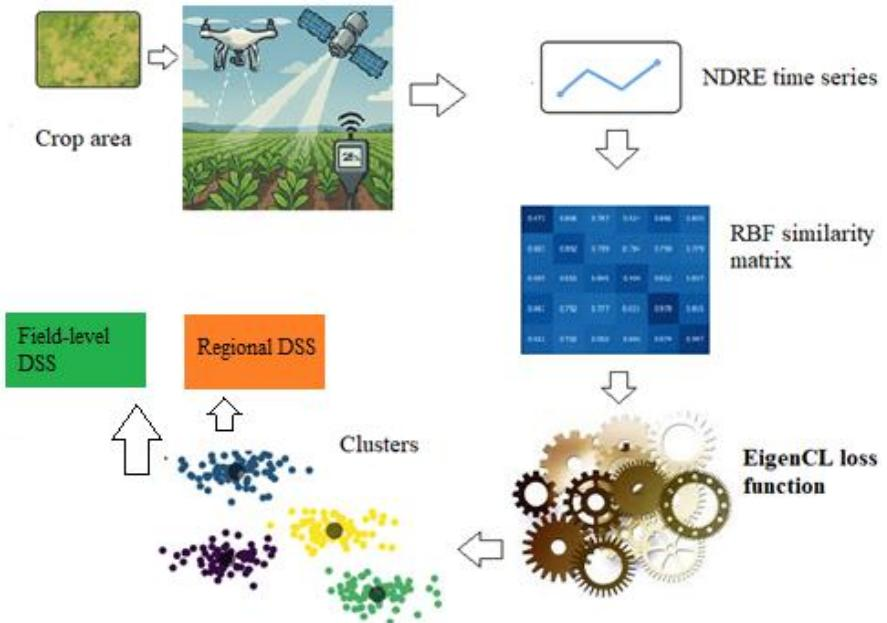
Early detection of crop stress is crucial for maintaining maize yields under increasingly variable climate conditions, especially during the tasseling–silking stage when stress can cut yields by half. Remote sensing offers scalable monitoring, but existing clustering methods typically rely on static vegetation indices or visual similarity, failing to capture the temporal progression of stress. While self-supervised learning reduces labeling costs, its generic similarity measures and augmentations can distort physiologically meaningful signals, limiting interpretability. The authors introduce EigenCL, a physiology-aware contrastive learning framework that anchors similarity to the eigenvector structure of NDRE temporal trajectories, emphasizing chlorophyll dynamics to produce stress clusters that generalize across years and regions and align with soil moisture, drought maps, and yield anomalies.
Dataset
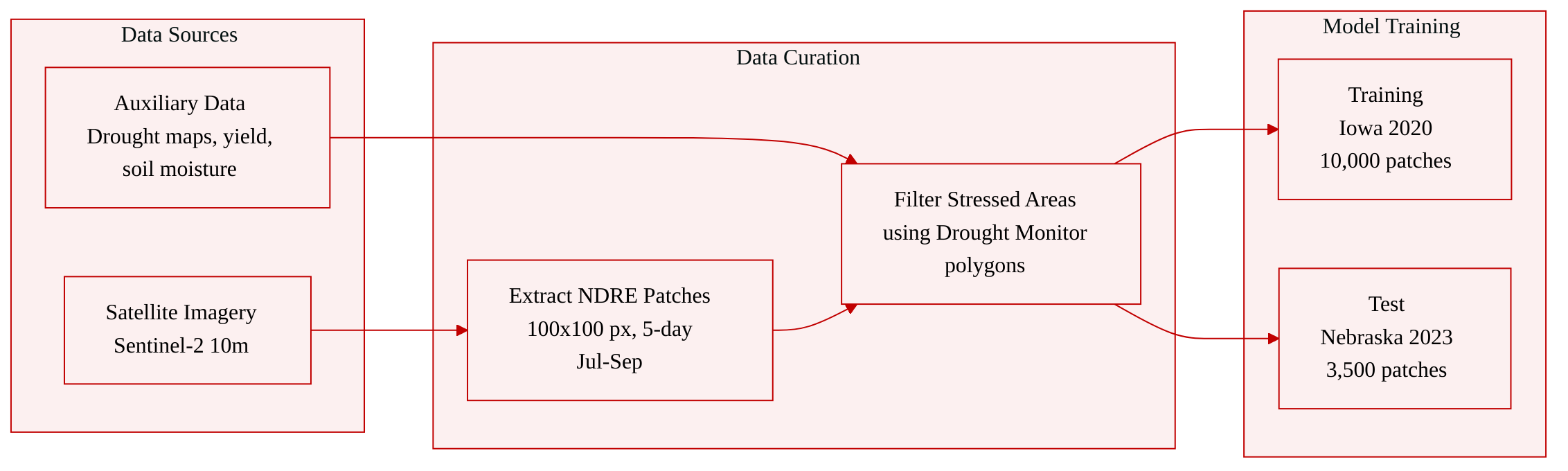
The authors describe a drought-focused maize dataset covering Iowa and Nebraska. The dataset combines satellite imagery, yield records, soil moisture observations, and drought maps.
- Satellite imagery: Sentinel-2 multispectral data at 10 m resolution are used to extract NDRE values. The authors sample 100 × 100 pixel patches at five-day intervals from July to September. They collect 10,000 patches for Iowa 2020 and 3,500 patches for Nebraska 2023.
- Yield records: County-level maize yield data for 2019 to 2024 come from USDA Quick Stats. These records are used to confirm that selected stress years had lower yields than surrounding seasons.
- Soil moisture: Daily soil moisture data are obtained from three Iowa Environmental Mesonet stations:
- TPOI4 in Buchanan County
- CNAI4 in Monona County
- NWLI4 in Buena Vista County The authors use daily values at 12-24-inch depth.
- Drought maps: U.S. Drought Monitor maps for 2020, 2022, and 2023 define drought-stressed zones. These polygons ensure validation occurs in objectively stressed areas rather than arbitrary fields.
Subset details
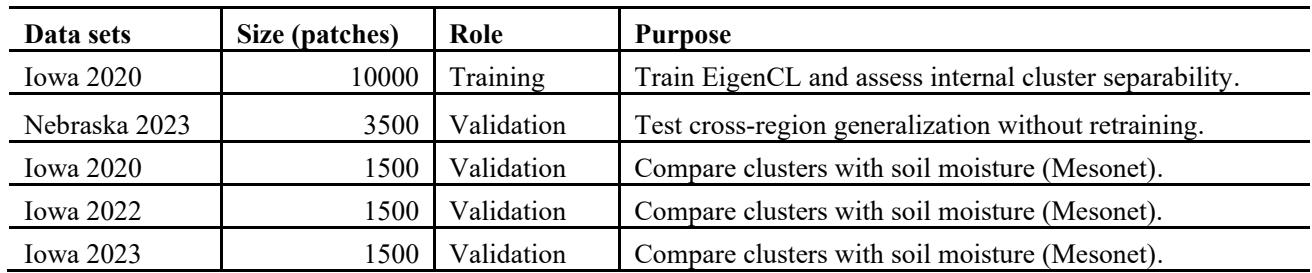
- Iowa 2020: Primary training set, selected because of widespread drought conditions. It includes 10,000 Sentinel-2 NDRE patches.
- Nebraska 2023: External test set, used to evaluate transferability across regions. It includes 3,500 patches sampled with the same protocol.
- Yield data: County-level records for 2019 to 2024, used as auxiliary evidence of stress-year yield reductions.
- Soil moisture data: Daily time series from three stations near sampled zones, at 12-24-inch depth.
- Drought polygons: Available for 2020, 2022, and 2023, used as spatial filters for stressed-area validation.
How the data are used
- The Iowa 2020 patches serve as the main training data.
- The Nebraska 2023 patches are used for external evaluation and transferability testing.
- Drought Monitor polygons are used to select and validate objectively stressed areas.
- USDA yield records are used to verify that selected stress years correspond to lower yields.
- Soil moisture data are used as supporting observations for the sampled zones.
Processing and filtering details
- NDRE is extracted from 10 m Sentinel-2 imagery.
- Each patch is 100 × 100 pixels.
- Patches are sampled at five-day intervals during July to September.
- Drought Monitor maps provide objective spatial filtering for stressed-area validation.
- The provided sections do not specify exact train/validation mixture ratios beyond Iowa 2020 as primary training and Nebraska 2023 as the external test set.
Method
The authors propose EigenCL, a physiologically aware contrastive learning framework for crop stress representation. Unlike standard contrastive approaches that rely primarily on visual augmentations and cosine similarity, EigenCL uses temporal NDRE patterns to define biological similarity. The pipeline consists of three main components: NDRE trajectory representation, a ResNet50 encoder with a nonlinear projection head, and a push-pull contrastive loss driven by eigenvector-based stress weights.
For each image patch, NDRE is computed as
NDRE=NIR+RENIR−REwhere NIR and RE are Sentinel-2 spectral bands. NDRE time series are extracted at a five-day cadence, and each patch is represented as a five-dimensional vector xi∈R5 encoding mean NDRE values across five acquisition dates.
To capture temporal similarity, the authors construct a Gaussian RBF similarity matrix from the NDRE time series. For clarity, this matrix can be written as
Kij=exp(−γ∥xi−xj∥2)where ∥xi−xj∥2 is the squared Euclidean distance between two five-date NDRE trajectories and γ=2σ21 is the kernel bandwidth. The principal eigenvector of this similarity matrix is then extracted. Each image patch receives a scalar eigenvector weight, which acts as a continuous and biologically meaningful proxy for stress severity. These weights are min-max normalized within each batch:
w^i=max(w)−min(w)max(w)−wiwhere wi is the raw eigenvector weight. The normalized weights w^i later drive the pull-push mechanism in contrastive learning.
On the visual side, NDRE raster patches are fed into a ResNet50 encoder to produce 2048-dimensional embeddings. A lightweight projection head consisting of a fully connected layer, batch normalization, and LeakyReLU activation maps these embeddings to zi∈Rd. The projected embeddings are L2-normalized, after which a cosine similarity matrix can be computed as
sim(zi,zj)=∥zi∥∥zj∥zi⊤zj.This cosine similarity is not the sole training objective. Instead, embedding proximity is guided by stress similarity derived from the NDRE eigenvector weights.
The authors define a physiologically informed similarity score from the normalized eigenvector weights:
Δij=∣w^i−w^j∣,Sij=exp(−σΔij)where σ is a smoothing hyperparameter. This formulation assigns high similarity to patches with similar stress trajectories and sharply penalizes divergent NDRE profiles.
The EigenCL training objective combines pull and push terms. For biologically similar pairs, the pull loss minimizes their angular distance in the embedding space:
Lpull=i=j∑Sijlog(1+τ1−sim(zi,zj))where τ is a temperature parameter. For biologically dissimilar pairs, the push loss applies a margin-based hinge repulsion:
Lpush=i=j∑λ(1−Sij)max(0,sim(zi,zj)−m)where λ is a weighting factor and m is a margin that encourages dissimilar embeddings to remain at least m apart. The final loss is normalized by the number of unique pairs in a batch:
LEigenCL=N(N−1)1(Lpull+Lpush)where N is the batch size.
Key hyperparameters are tuned through grid search using held-out validation data, with the objective of maximizing Pearson correlation between embedding distances and NDRE-based stress trajectories. The search also considers internal clustering metrics, including Silhouette Score, Davies-Bouldin Index, and Calinski-Harabasz Index, together with contrastive loss convergence and stability of NDRE-based cluster centroids. The final configuration uses λ=4.0, τ=0.075, and m=0.2; the smoothing parameter σ is tuned through the same procedure.
To evaluate transferability, the authors apply the trained EigenCL model without fine-tuning to Sentinel-2 NDRE patches from Nebraska during the 2023 growing season. The same five-date sampling protocol and the embeddings and cluster thresholds learned from the Iowa 2020 data are used, testing whether stress-aware representations transfer across regions with different drought timing and severity.
This biologically guided formulation ensures that embeddings reflect stress progression rather than visual similarity alone. Visually similar patches with divergent NDRE profiles are separated, while biologically aligned patches are clustered, supporting stress-aware representation learning.
Experiment
EigenCL was benchmarked against an ablation model, K-Means, and SimCLR for clustering NDRE time series, demonstrating superior separation and biological interpretability by capturing stress trajectory shapes rather than static magnitudes. The principal eigenvector proved essential, and the resulting embeddings supported accurate stress classification and showed consistent lagged agreement with soil moisture across years and regions. These clusters can be directly translated into operational decision rules for field-level alerts and regional risk assessment.
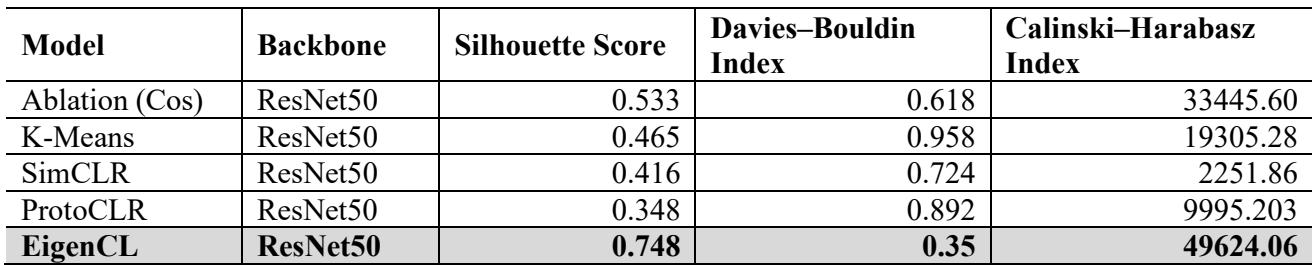
The study trained EigenCL on Iowa 2020 and tested cross-region transfer on Nebraska 2023, with additional soil moisture validation across multiple Iowa years. EigenCL achieved the best cluster separation (Silhouette Score 0.748) compared to an ablation variant and SimCLR, and its clusters aligned with soil moisture after optimal time lags. The resulting four stress levels can be directly translated into operational decision rules for farm and regional management. EigenCL outperformed all baselines on clustering metrics, reaching a Silhouette Score of 0.748, Davies-Bouldin Index of 0.350, and Calinski-Harabasz Index of 49,624.06. Removing eigenvector guidance reduced the Silhouette Score to 0.533, while generic contrastive learning (SimCLR) scored only 0.416, confirming the value of domain-aware supervision. Cross-region generalization was validated on Nebraska 2023 without retraining, showing practical transferability. Aligning soil moisture with NDRE clusters via optimal time lags improved agreement, most notably in 2023 (ARI 0.371 at 2-day lag vs. near-zero same-day). The clusters form a clear stress gradient from healthy to severe and enable actionable if-then rules, such as alerts when severe stress exceeds 20% of field patches.
EigenCL substantially outperforms all other clustering models on the Iowa dataset, achieving the highest Silhouette Score, lowest Davies-Bouldin Index, and highest Calinski-Harabasz Index. Its stress clusters align with soil moisture after an optimal time lag, and the resulting four-level stress classification can be directly translated into actionable decision rules for farm and regional management. EigenCL's Silhouette Score (0.748) is far above the next best model (0.533), indicating much tighter and better-separated clusters. The Davies-Bouldin Index for EigenCL (0.35) is nearly half that of the closest competitor (0.618), confirming more compact and distinct cluster structures. EigenCL's Calinski-Harabasz Index (49,624) is over an order of magnitude larger than SimCLR's (2,252) and substantially higher than all other models. Aligning EigenCL clusters with soil moisture labels using an optimal lag improves agreement dramatically, with ARI rising from near zero same-day to 0.371 in 2023 at a 2-day lag. The four stress levels (Healthy, Mild, Moderate, Severe) enable clear if-then rules, such as triggering urgent scouting alerts when Severe patches cover at least 20% of a field. Higher proportions of Severe clusters are associated with larger negative yield anomalies, linking EigenCL outputs to potential yield forecasting and risk management.
EigenCL embeddings support accurate downstream classification of stress levels. A k-nearest neighbors classifier attains 89.1% accuracy and a macro F1 of 0.87, outperforming logistic regression at 85.2% accuracy and 0.82 F1. The strong performance of a simple nearest-neighbor model suggests the embeddings capture well-separated stress clusters. k-nearest neighbors reaches 89.1% accuracy, exceeding logistic regression by 3.9 percentage points. Macro F1 is higher for k-NN (0.87) than for logistic regression (0.82), with corresponding gains in precision and recall.

The four EigenCL stress clusters show statistically distinct NDRE means, with all pairwise comparisons reaching high significance. A clear gradient emerges where the Healthy cluster has the highest NDRE, followed by Mild, then Moderate, and finally Severe with the lowest values, confirming the clusters capture a meaningful stress continuum. All cluster pairs exhibit significant NDRE differences (p < 0.0001), indicating each stress level is spectrally separable. NDRE decreases progressively from Healthy to Severe, with the largest mean difference observed between Healthy and Moderate clusters.

EigenCL stress clusters derived from NDRE show a consistent within-year gradient from Healthy to Severe, with NDRE decreasing as stress intensifies. Across years, all cluster centroids shifted to lower values from 2020 to 2023, indicating progressively reduced vegetation health and aligning with the drought conditions that strengthened the soil moisture–NDRE coupling in 2023. These clusters are translated into operational decision rules, where the proportion of area in Severe or Moderate categories triggers scouting, irrigation, or monitoring actions. Within each year, NDRE values decline substantially from the Healthy cluster to the Severe stress cluster. Cluster centroids are lower in 2023 than in 2020 for every stress level, reflecting a year-over-year deterioration in vegetation condition. The 2023 clusters showed the strongest alignment with soil moisture measurements, suggesting the stress categories directly captured water stress signals that year. Decision support rules use cluster proportions: a Severe cluster share above 20% triggers urgent scouting and possible irrigation within 24–48 hours. The downward shift in NDRE centroids across years coincides with the increased prevalence of drought stress and the improved agreement between soil moisture and NDRE.

The study trained EigenCL on Iowa 2020 data and evaluated it on Nebraska 2023 for cross-region transfer, with soil moisture validation across multiple Iowa years. EigenCL produced the most distinct stress clusters, and ablation confirmed that eigenvector guidance is essential, while generic contrastive learning yielded poor separation. The resulting four stress levels form a clear spectral gradient, align with soil moisture after optimal time lags, and translate directly into operational decision rules such as scouting alerts when severe stress exceeds a field-area threshold.