Command Palette
Search for a command to run...
Parallel Decoding Distillation for Fast Image and Video Generation
Parallel Decoding Distillation for Fast Image and Video Generation
Neta Shaul Chao Liu Arash Vahdat Julius Berner
Abstract
Generation in video difusion or flow models is computationally expensive due to the slow and iterative sampling process. Current state-of-the-art (SOTA) acceleration methods heavily rely on variational score distillation (VSD) and adversarial losses to distill difusion models into few-step generators. Albeit achieving high-quality video generation, these training losses are notoriously hard to optimize and sufer from mode collapse, leading to loss of video diversity and lack of motion. In this paper, we introduce Parallel Decoding Distillation (PDD), a simplified and scalable trajectory-based distillation method for fast inference of difusion and flow matching models. Our architecture and training procedure are compatible with any pre-trained mode and support sampling with a varying number of function evaluations (NFE). PDD accelerates generation by predicting multiple denoising steps per network evaluation. Conceptually, it learns a representation of the mean velocity without regressing its derivative using JVPs or finite-diference approximations. Our method achieves SOTA performance with 4-8 NFE on LTX-2.3 Text-to-Video/Audio, Wan 14B Text-to-Video, and Qwen-Image Text-to-Image. Moreover, PDD presents a significant improvement in generated video diversity.
One-sentence Summary
Parallel Decoding Distillation (PDD), proposed by NVIDIA and the Weizmann Institute of Science, is a trajectory-based distillation method that accelerates diffusion and flow matching models by predicting multiple denoising steps per network evaluation, learning a mean velocity representation without derivative regression, and achieving state-of-the-art performance with 4–8 NFE on LTX-2.3, Wan 14B, and Qwen-Image while significantly improving generated video diversity.
Key Contributions
- Parallel Decoding Distillation (PDD) is a trajectory-based distillation method that trains a parallel decoder to predict the mean velocities of multiple consecutive denoising intervals in one network evaluation, avoiding VSD, adversarial losses, JVPs, and finite-difference approximations.
- PDD is compatible with any pre-trained diffusion or flow model, supports variable NFE, and achieves state-of-the-art few-step performance on LTX-2.3 text-to-video/audio, Wan 14B text-to-video, and Qwen-Image text-to-image with 4–8 NFE.
- PDD significantly improves generation diversity and motion over distribution-based baselines, making it the first pure trajectory-based distillation method for few-step, high-resolution video generation.
Introduction
Diffusion and flow models have become the backbone of high-quality text-to-image and video generation, but their iterative sampling process often requires hundreds of network evaluations, creating prohibitive latency for real-time applications such as interactive editing and world modeling. Trajectory-based distillation methods can accelerate image generation, yet they struggle on large video models due to degraded quality and expensive training that relies on Jacobian-vector products or finite differences. Distribution-based alternatives, while more scalable to video, frequently suffer from mode collapse, reduced motion diversity, and sensitivity to hyperparameters. The authors introduce Parallel Decoding Distillation (PDD), a trajectory-based approach that instead of collapsing many steps into one, trains a parallel decoder to predict the mean velocities of multiple consecutive time intervals in a single forward pass. This design yields a simple regression objective that avoids adversarial losses, Jacobian-vector products, and multi-stage training, and it naturally supports variable numbers of function evaluations at inference. The method achieves state-of-the-art few-step generation on large-scale video and image models while preserving better sample diversity than distribution-based baselines.
Method
The authors begin by establishing the foundation of generative flow models, treating flow matching and diffusion models as deterministic processes defined by a velocity field vt and a source distribution p0. The flow process (Xt)0≤t≤1 follows the ordinary differential equation:
dtdXt=vt(Xt),X0∼p0.The objective is to learn a model vt that maps samples from the source distribution p0 to the target distribution p1. Sampling from a trained flow model involves solving this ODE numerically by discretizing the time interval into N smaller intervals and sequentially approximating the integral, typically using Euler or Runge-Kutta solvers.
To accelerate this inherently iterative sampling process, the authors propose Parallel Decoding Distillation (PDD). Instead of approximating integration steps one at a time, they learn a parallel decoding model that predicts multiple integration steps in a single network evaluation.
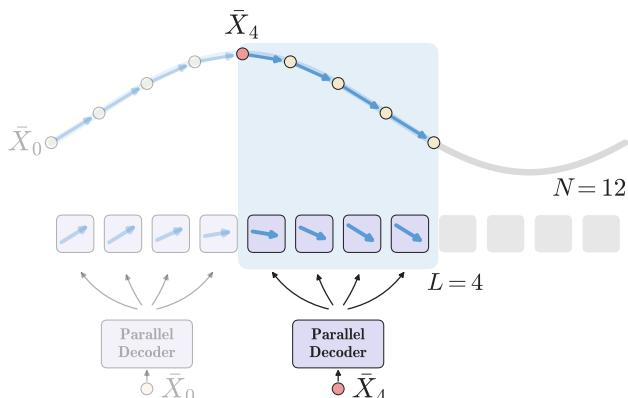
As illustrated in the figure above, the sampling trajectory is discretized into N intervals, which are grouped into blocks of size L. For a state Xn at time step tn, the parallel decoder uˉnθ(⋅∣Xn) is trained to predict the mean velocities of all intervals in the next block {n,…,n+L−1} using a single forward pass. The parallelized process within a block is defined as:
Xˉk+1=Xˉk+(tk+1−tk)uˉnθ(k∣Xn),for k∈{n,…,n+L−1}, with the initial condition Xˉn=Xn. Crucially, the parallelized process depends only on the initial state Xn, allowing the entire block to be simulated with a single evaluation of the parallel decoder. During generation, the authors apply a block-step rule to advance L intervals simultaneously:
Xˉn+L=Xn+k=n∑n+L−1(tk+1−tk)uˉnθ(k∣Xn).By repeating this rule N/L times, the model obtains a clean sample.
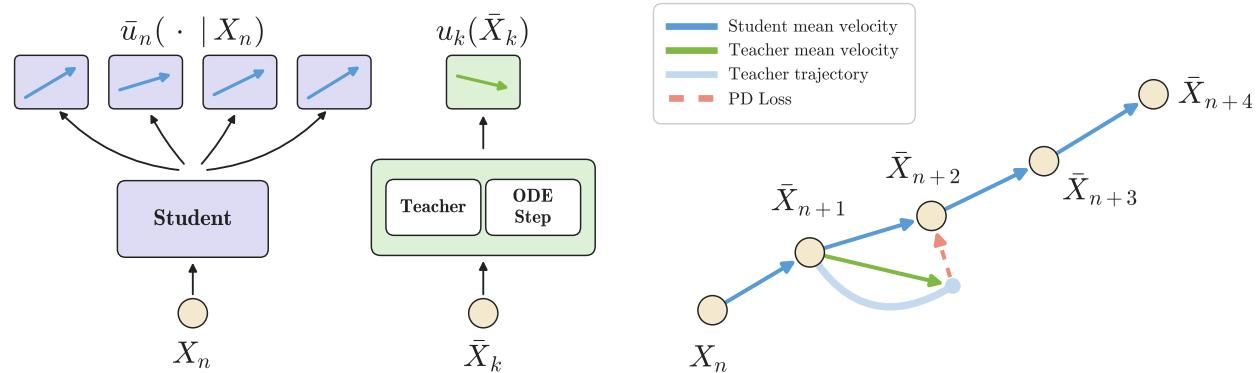
The training process is detailed in the figure above. The parallel decoder is trained by regressing onto a Runge-Kutta approximation of the mean velocity of the pre-trained teacher flow model. The authors employ on-policy training to estimate the teacher's mean velocity on the student's outputs. The training objective, or PD loss, is defined as:
LPD(θ)=E[∥uˉnθ(k∣Xn)−uk(sg(Xˉk))∥2],where uk is the teacher mean velocity approximated with a single Euler or Midpoint step, and sg(⋅) denotes the stop-gradient operator. As shown in the right panel of the figure, the student predicts mean velocities for the block, which yields the intra-block states Xˉk. One of these states is randomly selected, and the student's output velocity is matched to the teacher's mean velocity in the corresponding interval. This formulation makes the loss tractable even at large scales, as approximating the mean velocity requires only 1-2 evaluations of the teacher model.
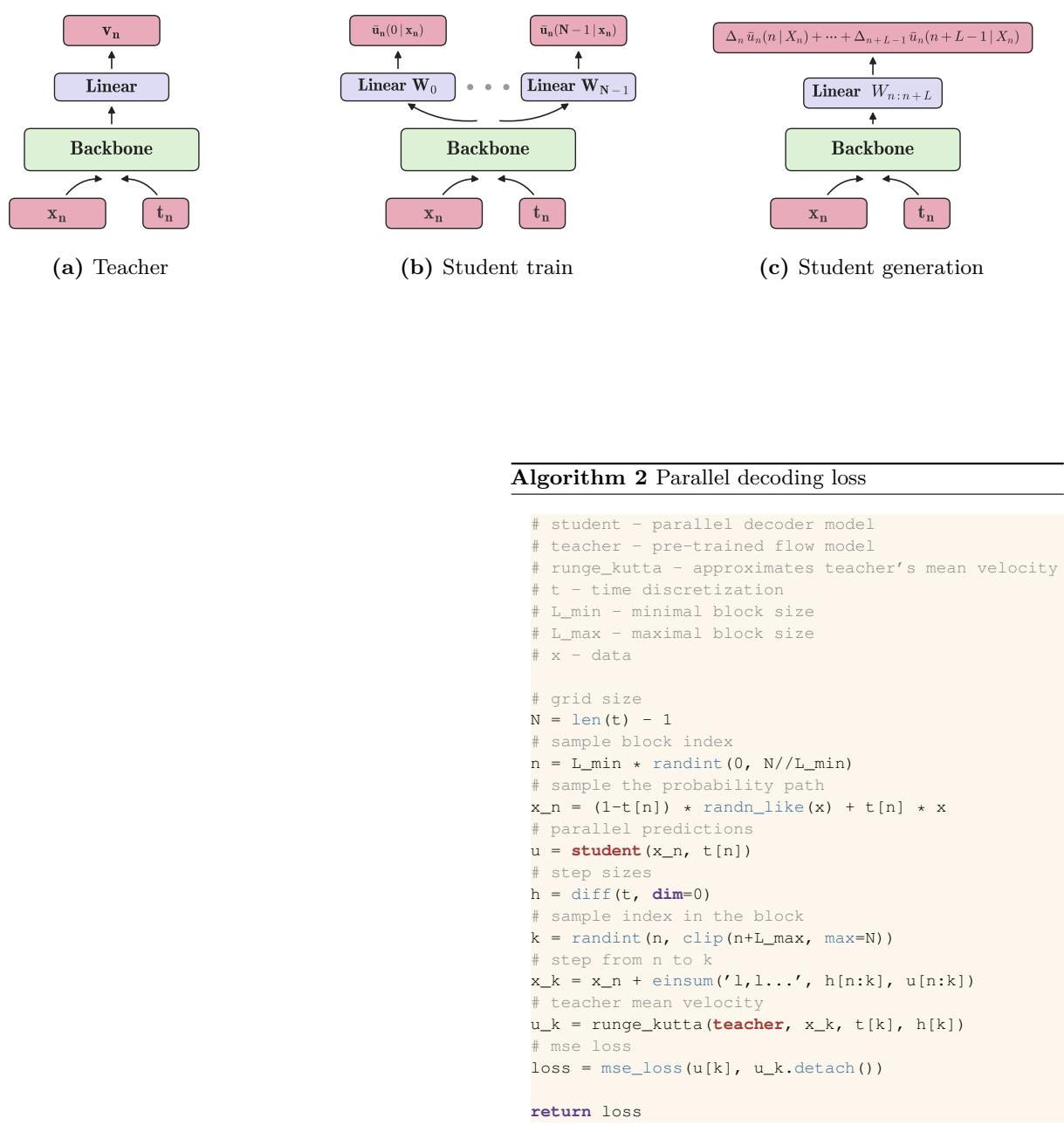
The architecture design is presented in the figure above. The parallel decoder utilizes the same backbone architecture Htθ as the pre-trained flow model but modifies the final output layer. Instead of a single linear layer predicting an instantaneous velocity, the authors learn N linear layers W0θ,…,WN−1θ, one for each time step in the grid. The parallel decoder's architecture is given by:
uˉnθ(k∣xn)=WkθHtnθ(xn).This design enables initialization from the final layer of the pretrained flow model and allows the model to predict any block size without introducing a second time coordinate.
An important optimization emerges during inference, known as layer fusion. While training requires all distinct student output directions to estimate the loss, generation only requires the weighted-average direction to skip L intervals. The authors define a fused linear layer:
Wn:n+Lθ=k=n∑n+L−1ΔkWkθ,Δk=tn+L−tntk+1−tk.Consequently, during inference, the shared backbone learns a representation of the mean velocity over the interval, and the authors avoid the extra compute of the enlarged final layer by holding only one fused linear layer per block in memory.
Experiment
The experiments evaluate PDD on class-conditional ImageNet generation, text-to-image synthesis with Qwen-Image, and text-to-video generation using Wan2.1 and LTX-2.3, confirming its broad applicability. PDD consistently enables flexible few-step inference, achieving competitive or superior quality relative to specialized baselines while better preserving diversity and motion. The method scales effectively to large multimodal models and can be trained without data, matching the performance of data-dependent distillation in only a few hundred iterations.
PDD distills flow-map trajectories with variable NFE, avoids Jacobian-vector products or finite differences, and uses a fused-linear head, simplifying training and inference. This design yields competitive video quality, higher motion, and better diversity on large-scale benchmarks, while performing well even with few training iterations and preventing mode collapse. PDD supports variable NFE and does not require JVP or finite-difference computations, unlike Eulerian/Lagrangian flow maps and Pi-Flow. Its inference head is a fused-linear module, eliminating the extra cost and complexity of a separate Gaussian mixture or linear policy head. On text-to-video models such as Wan2.1 and LTX-2.3, PDD achieves top video quality, higher motion, and greater diversity, often matching or surpassing baselines with only 4 to 8 steps and minimal training. PDD preserves sample diversity and adheres closely to the teacher distribution, while DMD leads to mode collapse and reduced diversity.

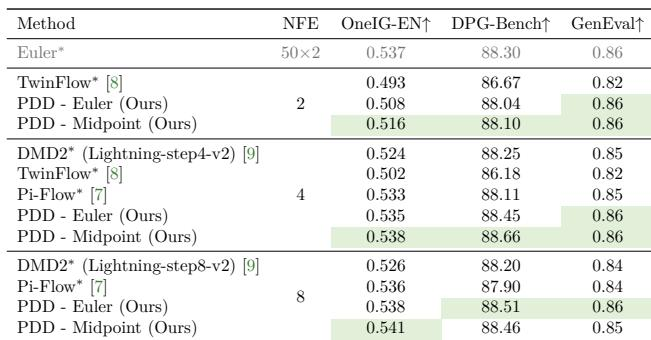
PDD achieves strong text-to-image performance with very few inference steps. The Euler variant with 2 function evaluations reaches a DPG-Bench score of 88.04 and a GenEval of 0.86, while the midpoint variant further lifts OneIG-EN to 0.516 and DPG-Bench to 88.10. Compared to distillation baselines like DMD2, PDD preserves competitive quality while avoiding the diversity loss observed in one-step methods. PDD-Euler (2 NFE) attains 88.04 on DPG-Bench and 0.86 on GenEval, outperforming the TwinFlow baseline and nearing the teacher's 88.30. The midpoint variant improves OneIG-EN from 0.508 to 0.516 and DPG-Bench to 88.10, matching the teacher's GenEval of 0.86. Pi-Flow with 4 NFE reaches 0.533 OneIG-EN and 88.11 DPG-Bench, while DMD2 (lightning-step4-v2) scores 0.524 and 88.25, showing PDD's comparable quality with half the evaluations. The paper notes that DMD2 suffers from diversity collapse, whereas PDD remains competitive while better preserving generation diversity and teacher fidelity.
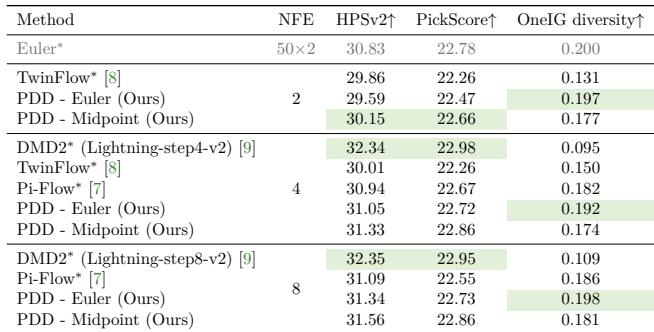
PDD distillation for Qwen-Image preserves diversity much better than DMD2 while remaining competitive in quality. At two NFE, PDD variants nearly match the teacher's diversity, whereas DMD2 achieves the highest quality scores but suffers from severe mode collapse with very low diversity. PDD-Euler and PDD-Midpoint at 2 NFE attain OneIG diversity of 0.197 and 0.177, close to the teacher's 0.200. DMD2 at 4 NFE reaches the highest HPSv2 (32.34) and PickScore (22.98) but collapses diversity to 0.095. PDD-Midpoint achieves a PickScore of 22.66, on par with the best few-step methods, while offering substantially higher diversity than DMD2 and TwinFlow.
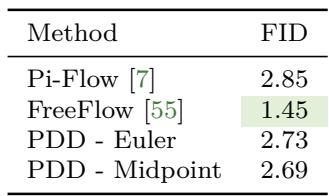
At a single NFE with the SiT-XL+REPA teacher on ImageNet-256, FreeFlow achieves the lowest FID (1.45). PDD models using Euler and midpoint discretizations reach FID scores of 2.73 and 2.69, respectively, both outperforming Pi-Flow's 2.85. The midpoint variant gives a slight improvement over the Euler version. FreeFlow leads with an FID of 1.45, while both PDD variants score above 2.6. PDD-Midpoint (2.69) marginally outperforms PDD-Euler (2.73). Both PDD models surpass Pi-Flow (2.85) at this single-step setting.
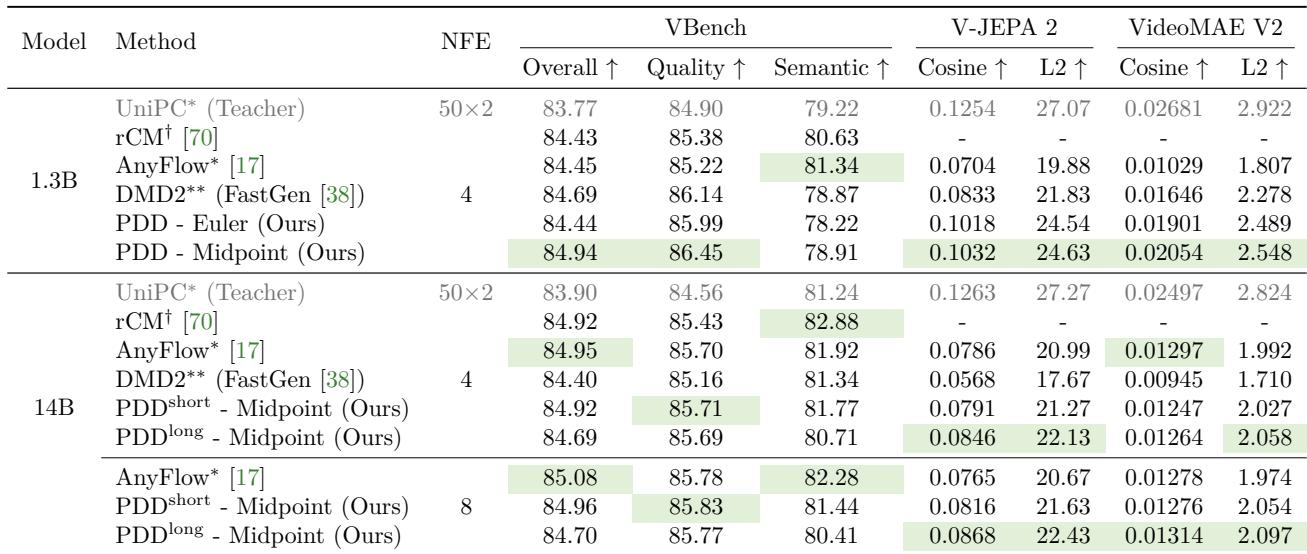
On the Wan2.1 1.3B model, PDD with the midpoint discretization achieves the highest VBench overall and quality scores while preserving more diversity than AnyFlow and DMD2, approaching the diversity of the teacher. DMD2 attains the top quality score but suffers from the lowest semantic score and a clear drop in diversity, consistent with mode collapse. For the 14B model, the short-training PDD checkpoint yields the best video quality and is runner-up in overall metrics, again with higher diversity than baselines. PDD-Midpoint (4 NFE) obtains the best overall VBench score (84.94) and quality score (86.45) on the 1.3B model, surpassing all baselines. PDD variants preserve higher diversity than AnyFlow and DMD2: V-JEPA 2 cosine distance is 0.1032 for PDD-Midpoint vs. 0.0704 for AnyFlow and 0.0833 for DMD2. DMD2 (4 NFE) achieves the highest quality score (86.14) but has the lowest semantic score (78.87) and reduced diversity, illustrating mode collapse. The teacher model (UniPC, 50x2 NFE) shows the highest diversity (V-JEPA 2 cosine 0.1254), and PDD comes closer to this teacher diversity than the other few-step methods. On the 14B model, the PDD (short) checkpoint provides the best video quality and is runner-up in overall VBench, while still maintaining higher diversity scores than baselines.
The experiments evaluate PDD's distillation on text-to-video (Wan2.1, LTX-2.3) and text-to-image (various teachers) tasks, validating its ability to simplify training by avoiding Jacobian-vector products and using a fused-linear head. Across settings, PDD with few inference steps (2-4 NFE) achieves competitive or superior quality and motion, while consistently preserving sample diversity close to the teacher and preventing the mode collapse observed in DMD2. It matches or exceeds baselines like Pi-Flow and AnyFlow, and performs well even with minimal training iterations.