Command Palette
Search for a command to run...
Accurate, Interdisciplinary and Transparent Structure-property Understanding with Deep Native Structural Reasoning
Accurate, Interdisciplinary and Transparent Structure-property Understanding with Deep Native Structural Reasoning
Abstract
Structure–property relationships are foundational to biology, chemistry and materials science, where function, reactivity and physical response emerge from spatial, chemical and periodic organization. Mechanistically explaining these relationships requires interpreting structural evidence through scientific principles and physical constraints, from stereochemistry and bonding to symmetry, energetics and periodic order. However, applying artificial intelligence to this process presents a joint challenge of representation and reasoning: models must preserve domain-native structural information while showing how specific evidence supports predictions under these constraints. Here we introduce SciReasoner, a multimodal scientific foundation model for native structural reasoning across proteins, small molecules and inorganic crystals. SciReasoner discretizes coordinates, topologies and periodic connectivities into a unified structure-aware vocabulary, treating structural tokens as addressable evidence units within autoregressive reasoning trajectories. We evaluate SciReasoner in settings where shortcut correlations are weakened and structure-grounded inference is essential. In homology-controlled Gene Ontology prediction, SciReasoner improves Cellular Component annotation for low-homology and orphan-like proteins, increasing Fmax from 0.42 to 0.55. In chemistry, it raises single-step retrosynthesis accuracy from 0.63 to 0.72 while generating fragment-level disconnection and precursor-verification traces. In materials science, its representations separate elemental and compound phases and resolve highand low-band-gap regimes. Across 86 benchmarks, SciReasoner achieves state-of-the-art performance on 67 tasks. Double-blind expert evaluation rates its reasoning traces as preferred or at least comparable to those of a frontier large language model in 98% of cases. By making structure an inspectable substrate for reasoning under scientific constraints, SciReasoner connects accurate prediction with interpretable scientific inference.
One-sentence Summary
Scientists at the Shanghai Artificial Intelligence Laboratory and partner institutions introduce SciReasoner, a multimodal scientific foundation model that discretizes structural coordinates into a unified token vocabulary to enable native structural reasoning over proteins, small molecules, and crystals, attaining state-of-the-art results on 67 of 86 benchmarks and generating reasoning traces that double-blind expert evaluators prefer or deem comparable to those of a frontier large language model in 98% of cases.
Key Contributions
- SciReasoner is a multimodal foundation model that discretizes 3D coordinates, molecular topologies, and periodic lattice connectivities into a unified structure-aware vocabulary, enabling autoregressive reasoning where structural tokens serve as addressable evidence units.
- In settings where shortcut correlations are weakened, SciReasoner substantially boosts performance. Cellular Component Fmax for low-homology proteins rises from 0.42 to 0.55, single-step retrosynthesis accuracy increases from 0.63 to 0.72, and state-of-the-art results are achieved on 67 of 86 benchmarks, with structural token attention enriched at functionally relevant interfaces.
- Double-blind expert evaluation rates its reasoning traces as preferred or tied with a frontier large language model in 98% of cases, demonstrating how structural tokens provide an inspectable substrate for scientific inference that links accurate prediction with interpretable, constraint-aware explanations.
Introduction
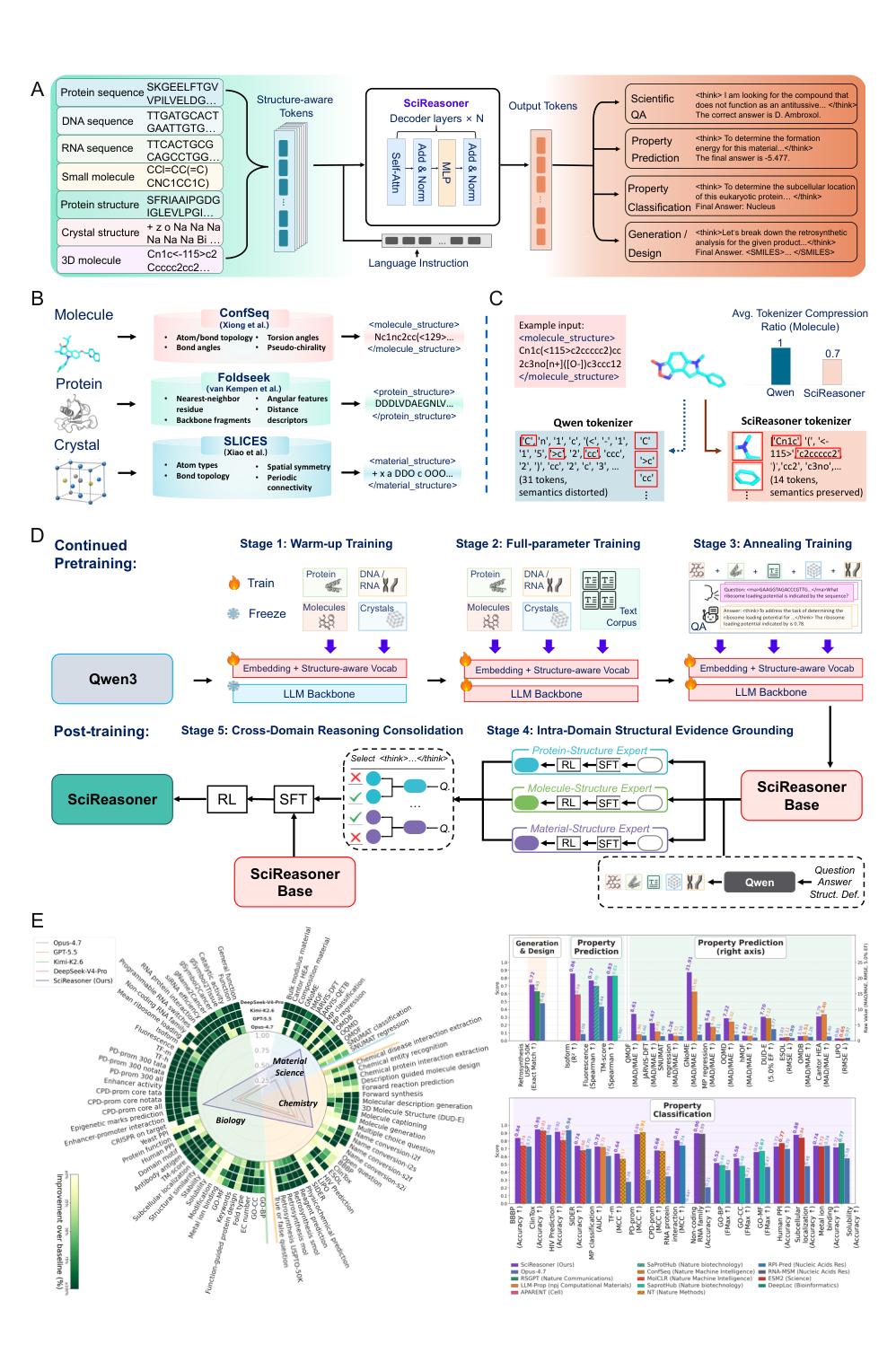
Understanding how spatial, chemical, and periodic organization gives rise to function is central to protein annotation, molecular design, and materials discovery, but explaining these relationships mechanistically demands more than simple pattern matching. Evidence is distributed across local motifs, non-local contacts, conformational geometry, and long-range order, requiring models that can treat biological, chemical, and materials structures as native objects and use them as explicit, inspectable evidence for scientific reasoning. Prior AI tools typically separate structural representation from evidence-linked inference: large language models compress structures into text, losing direct physical grounding, while domain-specific architectures output predictions without exposing intermediate rationale. The authors address this gap with native structural reasoning, a paradigm where structural tokens are not auxiliary descriptors but primary, addressable evidence units within reasoning trajectories. They instantiate this approach in SciReasoner, a multimodal foundation model that discretizes protein, small molecule, and crystal structures into a unified vocabulary of scientific tokens, then generates chains that interleave explanatory language with specific residues, fragments, or symmetry descriptors, making claims directly traceable to structural evidence.
Dataset
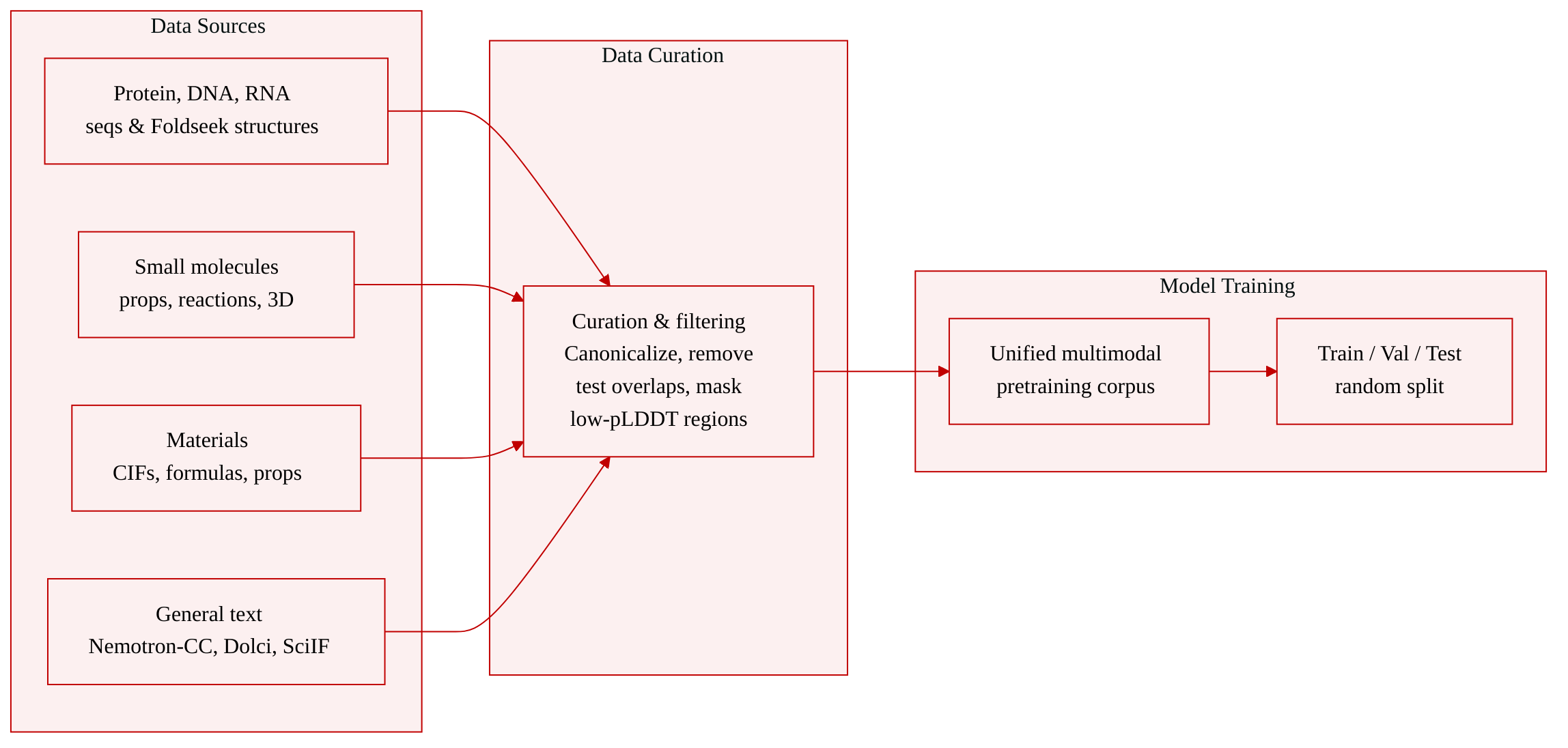
The authors construct a multi-modal scientific pretraining corpus from five domain subsets, combined with general text and instruction data. The dataset composition, sources, processing, and usage are summarized below.
Protein Data
- Sources: PDB–UniProt mappings via SIFTS; UniProtKB/Swiss-Prot annotations (functional descriptions, domains, PTMs, disease links, etc.); PubMed/PMC literature; AlphaFoldDB structures.
- Processing: Each protein is paired with its AlphaFold structure and converted to Foldseek 3Di tokens (one token per residue). Amino-acid sequences are wrapped in
<protein>tags, structural sequences in<protein_structure>tags. Residues with pLDDT < 70 are masked or replaced by a special token. To prevent data leakage, any protein with >30% sequence identity to a downstream benchmark test set is removed from pretraining. - Usage: Both sequences and structures are fed into the model to learn primary and tertiary information.
Small-molecule Data
- Sources:
- Textual: US Chemistry Olympiad problems, Europe PMC full-text/abstracts, ChemRxiv, bioRxiv, medRxiv, arXiv (chemistry/physical chemistry/medicinal chemistry filters).
- Property datasets: MoleculeNet, Therapeutics Data Commons, PubChem BioAssay, Tox21, ChEBI, CHEMDNER, ADMET, hERG, CYP, etc., converted into natural-language templates.
- Reaction/spectral: Open Reaction Database, USPTO reactions, Rhea, MOSES, MoNA, etc.
- 3D conformations: ChEMBL and BindingDB molecules, RDKit conformer generation, represented as connectivity plus internal coordinates inside
<molecule_structure>tags. - Processing: Molecular identifiers are canonicalized; entries whose molecules, labels, or reaction products overlap with held-out test sets are excluded.
- Usage: The corpus links molecular structures, property labels, and literature text, enabling learning of both chemical knowledge and geometric features.
Materials Data
- Sources: Materials Project, JARVIS-DFT, SNUMAT, hMOF, QMOF, OQMD, OMDB, JARVIS-QETB, GNoME, Cantor HEA, covering inorganic crystals, MOFs, organic materials, HEAs, and computationally discovered materials.
- Processing: Each material is represented with chemical formula, elemental composition, CIF crystal structure, and template-generated textual descriptions. The dataset is randomly split 80/10/10 at the material level. All validation and test samples are removed from the pretraining corpus.
- Usage: The model learns composition-level, geometry-level, and text-level representations of periodic systems.
DNA/RNA Data
- RNA: Sequences from RNAcentral, in FASTA format, wrapped in
<rna>tags, with available metadata (e.g., RNA family). - DNA: Genomic sequences from NCBI, sampled into 1,000-bp organism-level fragments, in FASTA, wrapped in
<dna>tags, retaining organism name and genomic coordinates. - Processing: Minimal filtering beyond the sampling; no further leakage prevention steps are mentioned.
- Usage: These provide nucleotide sequence context for biological language modeling.
General Text and Instruction Following Data
- Sources: Nemotron-CC v2 (multi-trillion-token Common Crawl derivative) for general web text; Dolci-Think-SFT-32B mathematics and instruction-following splits for reasoning-formatted supervision (each response includes a
thinkingdelimited trace); SciIF training split for scientific instruction adherence. - Processing: No additional filtering described; the authors directly incorporate these publicly available splits.
- Usage: Mixed with the domain corpora to inject general knowledge, multi-step reasoning, and instruction-following capabilities into the continued pretraining process.
Method
The authors design SciReasoner as a unified causal language model that processes interleaved structural and textual modalities. The system comprises three principal components: modality-specific offline structural compressors, a structure-aware vocabulary embedding layer that serves as a discrete cross-modal projection, and a unified large language model backbone fϕ initialized from Qwen3-14B. This architecture enables the model to generate responses conditioned on both structural evidence and natural language instructions in an autoregressive fashion.
To avoid the arbitrary fragmentation of physical topologies that would result from applying text-based sub-word tokenizers directly to scientific structures, the authors employ domain-specific offline encoders. For a raw structure input S (protein, small molecule, or crystal), a dedicated discrete encoder compresses it into a structural information sequence Xv. Specifically, Foldseek encodes protein three-dimensional structures into residue-level 3Di tokens, SLICES handles crystal structures, and ConfSeq processes molecular conformations. The encoded sequences are wrapped with corresponding structure tags. For protein data construction, the authors follow established protocols: they use SIFTS-based PDB–UniProt mappings to associate sequences with textual annotations and retrieve AlphaFold-predicted structures from AlphaFoldDB. Each structure is converted into Foldseek 3Di tokens aligned one-to-one with the amino acid sequence; the amino acid and structural sequences are then presented as separate tagged segments. Regions with low prediction confidence (pLDDT < 70) are masked or replaced by a special token to reduce noise. To prevent benchmark leakage, any text-linked protein record with more than 30% MMseq2 sequence identity to a held-out test set is excluded from continued pretraining.
The discrete structural sequence Xv is treated identically to linguistic tokens through a dedicated structure-aware vocabulary. A learnable embedding matrix Wv∈R∣Vv∣×dLLM projects each structural token into the dense continuous space via a simple embedding lookup:
Hv=Embedding(Xv,Wv)∈RLv×dLLM.
This discrete projection bypasses the computational cost of continuous spatial encoders and seamlessly aligns structural inputs with the LLM’s native semantic space. Simultaneously, the language instruction Xq is tokenized and embedded by the LLM’s native embedding layer to produce Hq. The structural and language embeddings are concatenated along the sequence dimension to form the unified prompt Hprompt=[Hv;Hq]. The LLM backbone fϕ then generates the response sequence Xa autoregressively, ensuring generation is strictly conditioned on both modalities.
Pretraining proceeds through a multi-stage curriculum that optimizes a single autoregressive causal language modeling objective (next-token prediction). Given structural input Hv and instruction Hq, the model produces target response Xa={xa,1,…,xa,T}, and the training loss is
LNTP=−∑t=1TlogPϕ(xa,t∣xa,<t,Hv,Hq).
The parameter set Θ is partitioned into the structure-aware vocabulary θvocab, LLM textual token embeddings θemb, prediction head θhead, and core transformer backbone θbackbone. The three stages are distinguished by parameter freezing, data mixture, and learning rate dynamics.
Stage 1 (Warm-up Training) focuses on anchoring the newly introduced structural tokens in the linguistic semantic space. The backbone θbackbone is frozen, and only θvocab, θemb, and θhead are trained on fundamental structure-to-text reconstruction tasks, using an independent optimizer and standalone learning rate schedule.
Stage 2 (Full-parameter Training) unfreezes all parameters (ϕ=Θ) and initializes a new shared optimizer with a Warmup-Stable-Decay (WSD) learning rate scheduler. The scheduler defines warmup (Tw), stable (Ts), and decay (Td) phases, with total steps Ttotal=Tw+Ts+Td. The learning rate η(t) follows:
\eta_{max} \cdot \frac{t}{T_w} & \text{if } 0 \leq t < T_w \\ \eta_{max} & \text{if } T_w \leq t < T_w + T_s \\ f_{\text{decay}}(t) & \text{if } T_w + T_s \leq t \leq T_{total} \end{cases}$$ Stage 2 spans the warmup phase and the initial segment of the stable phase ($0 \leq t < T_{stage2}$ with $T_w < T_{stage2} < T_w + T_s$). During this period, the model is trained on diverse, broadly-sourced paired structure–text datasets at a high constant learning rate, allowing the full network to assimilate domain-specific structural knowledge. Stage 3 (Annealing Training) maintains full-parameter optimization and inherits both the optimizer state and the WSD scheduler from Stage 2. It covers the remainder of the timeline ($T_{stage2} \leq t \leq T_{total}$), beginning with the constant learning rate and later triggering the decay phase. In this stage, the proportion of question–answer-style data is increased to achieve annealed training. After pretraining, the checkpoint $M_0$ behaves as a next-token continuator rather than an instruction-following reasoner. Post-training instantiates native structural reasoning through a coldstart supervised stage followed by reinforcement learning, organized into intra-domain structural evidence grounding and cross-domain reasoning consolidation. The coldstart phase aims to elicit instruction following and explicit chain-of-thought (CoT) reasoning. Because the backbone natively supports a switchable thinking interface, the authors construct a supervised corpus with two response modes. In thinking mode, the response is $X_a = \langle\text{think}\rangle \backslash n \, c \, \backslash n <\text{/think}> \backslash n \backslash n \, y$, where $c$ is the rationale and $y$ the final answer. In non-thinking mode, a `/no think` control token collapses the deliberation span to an empty placeholder, yielding a direct answer. The coldstart objective is a response-only supervised finetuning loss: $$\mathcal{L}_{SFT} = -\sum_{t=1}^T m_t \log P_\phi(x_{a,t} \mid x_{a,<t}, \mathbf{H}_v, \mathbf{H}_q),$$ where $m_t = 1$ only for tokens in the response segment. The coldstart procedure is itself split into two stages. First, tasks are partitioned into $J$ disjoint groups; $M_0$ is coldstarted independently on each group’s teacher-supplied CoT corpus, yielding specialized checkpoints $M_j^{cs}$ that internalize coherent reasoning styles. Later, after intra-domain grounding produces expert models $M_j^{expert}$, these experts regenerate CoT traces that pass verification, replacing the external supervision. The on-policy traces are pooled across groups and augmented with direct-answer data, and a single unified coldstart from $M_0$ is performed under the same $\mathcal{L}_{SFT}$, providing a well-matched initialization for cross-domain consolidation. Reinforcement learning is applied per sub-task using a difficulty-centred data curation strategy. From the training set, $N=8$ stochastic rollouts are generated from $M_0$ with adaptive temperature to ensure diversity. An empirical solve rate $\hat{p}(x) = \frac{1}{8}\sum_{i=1}^8 f_i(x)$ is computed, where $f_i(x) \in \{0,1\}$ indicates correctness. Examples with $0.125 < \hat{p}(x) < 0.875$ are retained, and $K=2000$ examples are selected by ranking according to distance $d(x) = |\hat{p}(x) - 0.5|$, prioritizing those closest to intermediate success. This mid-difficulty filtering ensures RL focuses on instances where exploration can flip outcomes. Training uses the DAPO algorithm, a PPO-style clipped objective with asymmetric clip-higher, dynamic sampling to remove degenerate groups, and token-level policy-gradient reduction. To accommodate diverse metrics, the binary reward is replaced by a reward softening scheme $R_i^{\text{soft}} = g(m_i(q, o_i, \mathcal{A}(q)))$, where $g$ is a monotone calibration function and $m_i$ is a task-specific quality metric. The intra-domain grounding stage runs this RL procedure independently per group starting from $M_j^{cs}$, producing experts $M_j^{expert}$ that supply the on-policy traces for the unified coldstart. Cross-domain reasoning consolidation then runs RL once more on the merged all-task pool starting from the unified coldstart checkpoint, consolidating the experts’ specialized competences into the final model $M_{final}$ without destructive interference. # Experiment SciReasoner is evaluated as a unified multimodal model that integrates sequence, structure, and text reasoning across proteins, DNA/RNA, small molecules, and materials, with experiments spanning diverse prediction, generation, and QA tasks. The studies demonstrate that its structure-aware tokenization and chain-of-thought reasoning yield interpretable, evidence-grounded predictions that surpass generalist LLMs and match or exceed domain specialists, especially in low-homology or structure-dependent settings where structural evidence redirects reasoning from superficial cues to physically meaningful features. Post-training with intra-domain grounding and cross-domain consolidation further improves reliability and reasoning quality, and human expert evaluation confirms that SciReasoner's traces are strongly preferred for their coherence, domain plausibility, and faithful evidence grounding.