Command Palette
Search for a command to run...
ComfyUI Littletinies Fairy Tale Illustration Generation Demo
Abstract
One-sentence Summary
By computationally analyzing 624 fairy tales from seven cultures, the authors replace decades of manual qualitative research with a large-scale inspection of gender bias that quantifies moral foundations and character events to reveal disproportionate representation and stereotypical portrayals where female characters are linked to care, loyalty, and sanctity alongside emotional and domestic activities, while male characters are associated with fairness, authority, and professional or violent pursuits.
Key Contributions
- This work introduces a large-scale computational analysis of gender bias using a dataset of 624 fairy tales from seven distinct cultural traditions. The methodology systematically quantifies narrative portrayals to supplement traditional qualitative assessments.
- The study develops an analytical framework that combines moral foundation theory with event and event chain extraction to decode narrative stereotypes. This approach interprets abstract moral scores through concrete character actions to improve analytical explainability.
- Empirical results identify a two-to-one ratio of male to female characters and reveal consistent cross-cultural stereotypical patterns. Female characters are predominantly associated with care, loyalty, sanctity, and domestic activities, while male characters align with fairness, authority, and professional or violent actions.
Introduction
Children's literature, especially fairy tales, serves as a primary tool for early language acquisition and worldview formation, making the detection of embedded gender bias essential for healthy child development. Prior investigations have largely relied on manual, qualitative analysis that is difficult to scale, while existing computational methods often struggle to translate abstract bias metrics into meaningful narrative interpretations. The authors bridge this gap by computationally analyzing a dataset of 624 fairy tales across seven distinct cultures. They leverage Moral Foundations Theory to quantify ethical framing and event chain extraction to map sequential character actions, revealing consistent stereotypical patterns where female characters are tied to care and domesticity while male characters are associated with authority and action. By integrating these techniques with Hofstede's cultural dimensions, the authors deliver a scalable, interpretable pipeline for automated bias detection and provide concrete recommendations for modernizing early literacy resources.
Dataset

- Dataset Composition and Sources: The authors curate the dataset from a public collection of 624 fairy tales originally crawled from Project Gutenberg. A subset of these stories includes cultural metadata, which enables cross-cultural bias analysis.
- Subset Details and Scale: The final dataset is structured at the character level, with each character assigned a single row. It contains 2,125 female characters and 4,405 male characters. Each entry includes the story title, cultural origin (marked as unknown when missing), character name, gender, appearance frequency, concatenated narrative sentences, extracted events in chronological order, and 11 moral foundation metrics.
- Data Processing and Metadata Construction: Sentence extraction isolates all mentions of a character and concatenates them into a single paragraph, regardless of their original placement. Gender classification relies on BookNLP co-reference resolution, where the authors tally male versus female pronouns linked to each character and assign gender based on the majority count, using a random tie-breaker when needed. Event extraction employs EventPlus paired with a semantic role labeling tool to filter events, retaining only those where the character serves as an argument. These events are lemmatized and stripped of stop words. For moral scoring, the eMFD dictionary provides five probability scores, five sentiment scores, and a moral-to-non-moral word ratio per sentence. The authors intentionally skip lemmatization for the eMFD input to preserve tense-specific moral associations.
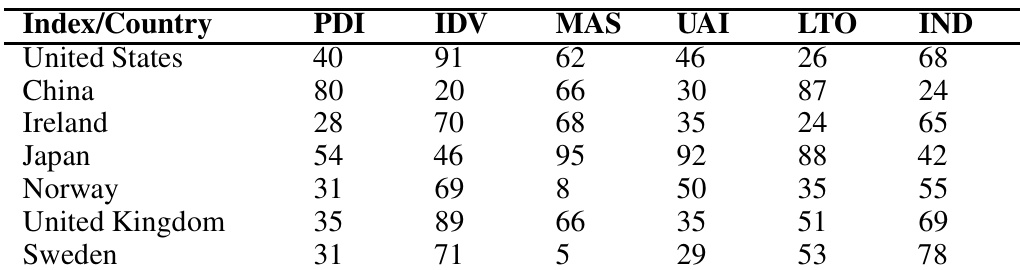
- Data Usage and Analysis Strategy: Rather than splitting the data for model training, the authors use it as a static corpus for statistical analysis. They construct separate event frequency dictionaries for male and female characters, then apply an odds ratio calculation to isolate events that disproportionately appear in one gender's narrative. This approach also extends to event chains and cross-cultural comparisons, where the authors map story origins to Hofstede's six cultural dimensions and compute correlations between cultural indices and gendered moral foundation scores.
Method
The authors leverage a two-stage analysis pipeline to examine moral foundations and temporal event structures in narrative texts. The first stage employs eMFD (extended Moral Foundations Dictionary), a dictionary-based tool designed to score sentences according to five moral foundation dimensions. This tool is constructed from human-coded annotations and has been widely applied in prior research to analyze moral content in social and technological contexts. By applying eMFD, the pipeline quantifies the moral dimensions expressed in each sentence, providing a foundation for subsequent event-level analysis.
The second stage of the pipeline utilizes EventPlus, a comprehensive temporal event understanding system that processes text to extract events, identify their triggers and types, detect event arguments, and determine event durations and temporal relations. EventPlus integrates multiple components to provide structured annotations of events and their temporal ordering within individual sentences. As shown in the figure below:
The authors assume that sentences belonging to a character are presented in chronological order, which is a strong assumption. This assumption is justified through empirical observation: a random sample of 14 fairy tales, two from each of seven cultural traditions, was manually reviewed. The analysis revealed that most stories follow a linear narrative structure, with minimal use of flashbacks—likely due to considerations for readability among child audiences. This assumption enables the aggregation of event timelines across sentences associated with a single character, allowing the system to sort events in temporal order based on their sentence positions.
Experiment
The study evaluates gender portrayals in fairy tales by applying moral foundation analysis and narrative event extraction to compare character depictions across cultural contexts. The moral foundation experiments validate that female characters are qualitatively linked to care, loyalty, and sanctity while receiving more positive framing, whereas male characters are associated with fairness and authority. Event-based experiments further validate stereotypical gender roles by showing that women are narratively confined to domestic, emotional, and low-agency scenarios, while men dominate professional, conflict-driven, and high-power storylines. Ultimately, these findings demonstrate a pervasive gender bias in traditional storytelling that is systematically amplified in cultures emphasizing hierarchy and uncertainty avoidance.
The authors analyze gender differences in moral foundations and event narratives in fairy tales, finding that female characters are more associated with care, loyalty, and sanctity, while male characters are linked to fairness and authority. Female characters are portrayed more positively in moral dimensions and are more frequently involved in life events, whereas male characters are depicted in professional and conflict-related contexts, reflecting stereotypical gender roles. Cultural differences influence these portrayals, with higher power distance and uncertainty-avoidance cultures showing more pronounced gender stereotypes, and higher individualism and indulgence cultures showing less stereotypical patterns. Female characters are more associated with care, loyalty, and sanctity, while male characters are linked to fairness and authority in moral foundation analyses. Female characters are portrayed more positively in moral dimensions and are more frequently involved in life events, while male characters are depicted in professional and conflict-related contexts. Cultural differences influence gender portrayals, with higher power distance and uncertainty-avoidance cultures showing more pronounced gender stereotypes.
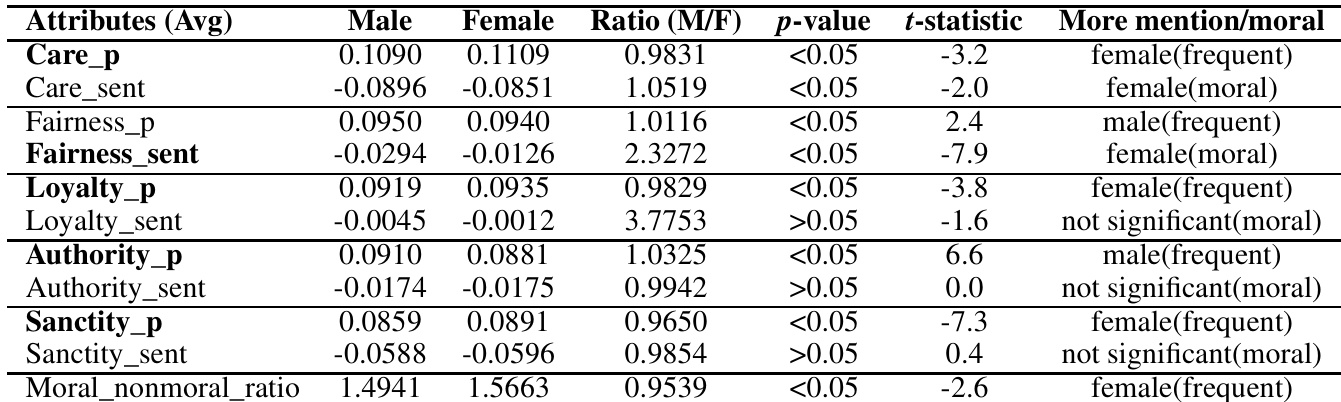
The authors analyze gender differences in moral foundations and event portrayals in fairy tales, finding that female characters are more associated with care, loyalty, and sanctity, while male characters are more linked to fairness and authority. Female characters are also more frequently mentioned with moral words and are more positively framed in moral dimensions, though some differences disappear when context is removed. These findings suggest gender bias in narrative portrayals, with female characters often depicted as emotional and passive, and male characters as professional and powerful. Female characters are more frequently associated with moral words and are more positively framed in moral dimensions compared to male characters. Gender differences in moral foundation mentions persist in event-only analysis, with female characters still linked to care and loyalty, but differences in sentiment become insignificant without contextual information. Female characters are more often portrayed in life events such as marriage and birth, while male characters are associated with professional and conflict-related events, indicating stereotypical gender roles in storytelling.
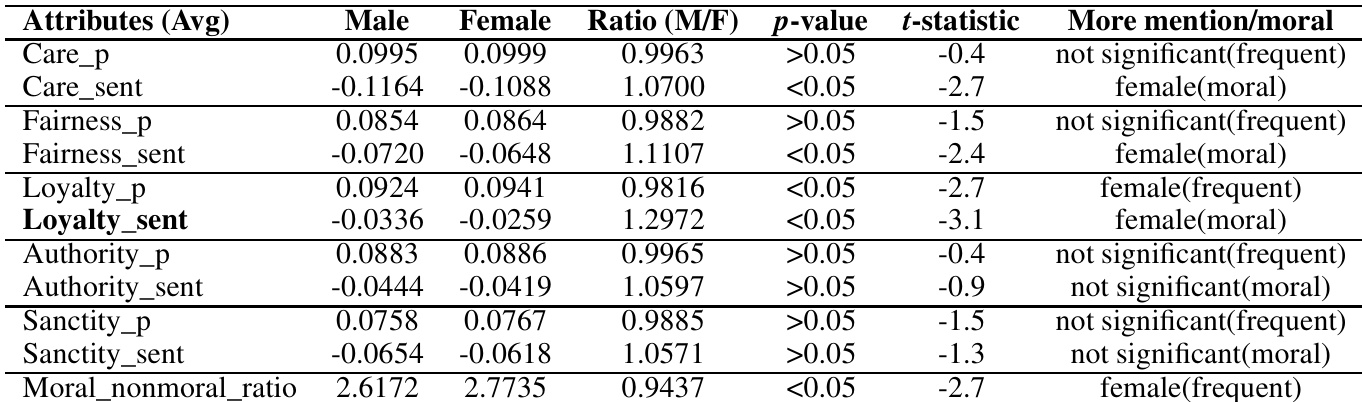
The authors analyze gender differences in moral foundations and event portrayals in fairy tales, finding that female characters are more associated with care, loyalty, and sanctity, while male characters are linked to fairness and authority. Female characters are also more frequently mentioned with moral words and are more positively framed across moral dimensions, though these differences vary by cultural context. Female characters are more frequently associated with moral words and are positively framed in moral foundations compared to male characters. Male characters are more associated with fairness and authority, while female characters are linked to care, loyalty, and sanctity in moral foundation mentions. Gender differences in moral foundation sentiments persist even when analyzing events alone, with female characters consistently portrayed as more emotionally and morally engaged.
The study evaluates gender portrayals in fairy tales by analyzing moral foundations, narrative events, and cultural contexts to validate how traditional stereotypes shape character depictions. Female characters are consistently linked to care, loyalty, and sanctity, appearing more frequently in personal life events and receiving positive moral framing, while male characters are associated with fairness, authority, and professional or conflict-driven scenarios. These gendered patterns are significantly moderated by cultural dimensions, with higher power distance and uncertainty avoidance reinforcing stereotypes, whereas individualism and indulgence soften them. Ultimately, the analysis confirms that fairy tales perpetuate conventional gender roles through distinct moral and contextual biases.