Command Palette
Search for a command to run...
How Good Is NLP? A Sober Look at NLP Tasks through the Lens of Social Impact
How Good Is NLP? A Sober Look at NLP Tasks through the Lens of Social Impact
Zhijing Jin Geeticka Chauhan Brian Tse Mrinmaya Sachan Rada Mihalcea
One-click Deployment of NLP Beginner’s Tutorial
Abstract
Recent years have seen many breakthroughs in natural language processing (NLP), transitioning it from a mostly theoretical field to one with many real-world applications. Noting the rising number of applications of other machine learning and AI techniques with pervasive societal impact, we anticipate the rising importance of developing NLP technologies for social good. Inspired by theories in moral philosophy and global priorities research, we aim to promote a guideline for social good in the context of NLP. We lay the foundations via the moral philosophy definition of social good, propose a framework to evaluate the direct and indirect real-world impact of NLP tasks, and adopt the methodology of global priorities research to identify priority causes for NLP research. Finally, we use our theoretical framework to provide some practical guidelines for future NLP research for social good.
One-sentence Summary
The authors propose a framework grounded in moral philosophy and global priorities research to evaluate the direct and indirect real-world impacts of NLP tasks and identify priority research causes, ultimately providing practical guidelines to steer future NLP development toward social good.
Key Contributions
- Establishes a theoretical foundation for NLP research by defining social good through moral philosophy and applying global priorities research methodologies to identify high-impact causes.
- Introduces a meta-framework that evaluates the direct and indirect real-world impacts of NLP tasks across dimensions including accessibility, inequality reduction, alignment with priority goals, and quality of life improvements.
- Provides practical guidelines for NLP practitioners, demonstrated through systematic applications to Green NLP, QA and dialog, information extraction and summarization, and social media analysis.
Introduction
Natural language processing has rapidly transitioned from theoretical research into ubiquitous real-world systems that power consumer devices, healthcare analytics, and crisis response tools. This widespread integration amplifies both the potential for meaningful societal benefits and the risk of unintended harms like algorithmic bias, privacy violations, and toxic outputs. While current AI ethics initiatives establish valuable principles such as fairness and transparency, they currently lack a structured, scientific methodology to help researchers systematically evaluate the real-world consequences of their work. To address this gap, the authors leverage insights from moral philosophy, causal impact modeling, and global priorities research to establish a comprehensive framework for assessing social good in NLP. They introduce an Important, Neglected, and Tractable evaluation structure alongside a practical checklist, enabling researchers to systematically measure both direct and indirect impacts and make more informed decisions about high-value research directions.
Dataset
-
Dataset Composition and Sources: The authors compile a curated corpus of 570 long papers from the ACL 2020 conference to map the progression of NLP research across a structured theory to application pipeline.
-
Subset Details: The collection is divided into four developmental stages based on research maturity and downstream utility:
- Stage 1 (Fundamental Theories): Focuses on core knowledge advancement, with linguistics theory being the most prevalent topic.
- Stage 2 (Building Block Tools): Covers foundational components for downstream systems, highlighting information extraction, model design, and interpretability.
- Stage 3 (Applicable Tools): Encompasses pre commercialized NLP systems and core tasks, dominated by dialog response generation, question answering, and machine translation.
- Stage 4 (Deployed Applications): Highlights finished products and services wrapped in user interfaces and business models, with top topics addressing misinformation, dialog, and healthcare.
-
Data Usage and Processing: The authors employ this categorized dataset as an analytical framework rather than a traditional training corpus. Instead of fixed training splits or mixture ratios, each paper is manually annotated according to the four stage classification system, with full annotation guidelines provided in Appendix A. The processed data is then cross referenced against the United Nations Sustainable Development Goals to evaluate existing research contributions and systematically identify gaps for future task development.
-
Metadata and Framework Construction: The dataset utilizes a hierarchical tagging system that assigns each paper a primary developmental stage and associated research topic. The authors construct a structured mapping table that links these categorized papers to specific UN SDGs, explicitly cataloging existing NLP examples and flagging proposed tasks that align with global social impact priorities.
Method
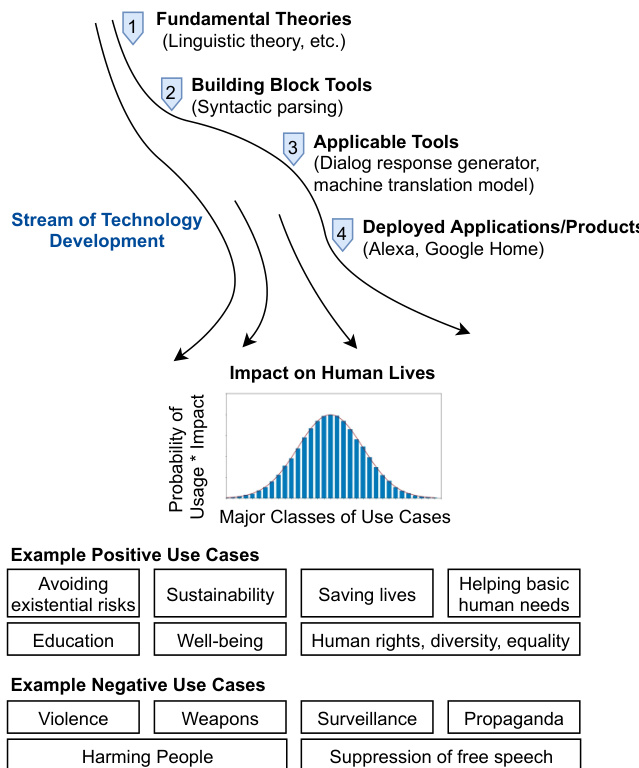
The authors leverage a structured framework to estimate the social impact of natural language processing (NLP) technologies, grounded in a four-stage model of technological development. This model categorizes NLP technologies into distinct stages: Stage 1 comprises fundamental theories such as linguistic theory; Stage 2 involves building block tools like syntactic parsing; Stage 3 consists of applicable tools, including dialog response generators and machine translation models; and Stage 4 encompasses deployed applications or products such as Alexa and Google Home. The framework posits that technologies in Stage 4 directly influence human lives, with their impact distributed across various use cases, which can be either positive or negative. As shown in the figure below, the impact on human lives is modeled as a probability distribution, where major classes of use cases are categorized into examples of positive impacts—such as avoiding existential risks, improving well-being, and supporting human rights—and negative impacts—including surveillance, propaganda, and violence. The authors argue that the overall impact of a Stage-4 technology t is determined by summing the product of its usage scale and aspect-specific impact across all relevant aspects AS, as formalized in the equation:
I(t)=as∈AS∑scaleas(t)⋅impactas(t),where scaleas(t) represents the usage scale of technology t in aspect as, and impactas(t) denotes the impact in that aspect.
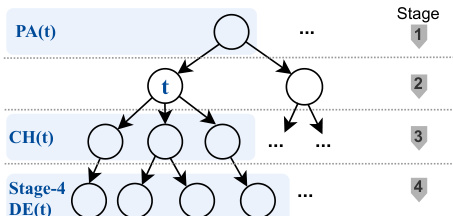
For technologies in earlier stages (Stage 1–3), direct impact estimation is not feasible due to their indirect influence. To address this, the authors introduce a structural causal model represented as a directed graph G, where each technology t is connected through causal relationships to its parent technologies (PA(t)) and its child technologies (CH(t)). A technology t can influence downstream technologies through causal paths, and its overall impact is derived from the cumulative impact of its descendants in Stage 4. The impact of an early-stage technology t is thus computed as the sum over all its Stage-4 descendants x, weighted by the probability of their successful development p(x), the contribution of t to x denoted by cx(t), and the impact of x itself, as expressed by:
I(t)=x∈Stage−4 DE(t)∑p(x)⋅cx(t)⋅I(x).This formulation aligns with do-calculus, interpreting the effect of intervening on t as P(X∣do(t))−P(X) for X∈Stage-4 DE(t).
Experiment
This analysis evaluates the current state of NLP research for social good by examining the topic distribution and geographic origins of ACL 2020 submissions against a UN Sustainable Development Goal priority framework and global expenditure data. The evaluation validates a significant qualitative misalignment, as research efforts heavily concentrate on interpretability, misinformation, and healthcare while neglecting vital areas like education, poverty alleviation, and clean energy. This disparity is primarily driven by funding biases and a limited understanding of structured priority frameworks within the academic community. Ultimately, the findings conclude that research incentives and community priorities must be realigned to better address globally prioritized humanitarian needs.
{"summary": "The authors analyze the distribution of NLP research for social good at ACL 2020, focusing on the topics and contributions from academia and industry. The results show that interpretability and misinformation are the most prominent areas, with significant contributions from academia, while other topics like education and legal applications have minimal representation. The analysis highlights a gap between research focus and global priorities, indicating a misalignment in value and funding.", "highlights": ["Interpretability and misinformation are the dominant research topics, with the majority of contributions coming from academia.", "Research on education, legal applications, and other social good areas is sparse, indicating underrepresentation.", "The distribution of research efforts does not align with global priorities, suggesting a value misalignment in the NLP community."]
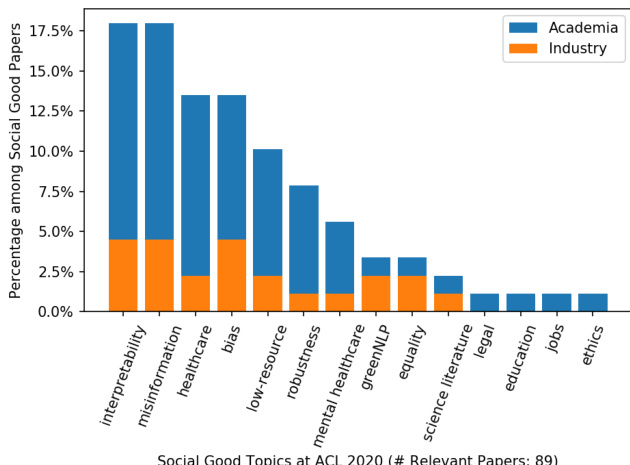
The study evaluates the distribution of NLP research focused on social good at ACL 2020 by examining publication topics and the relative contributions of academic versus industry researchers. The analysis reveals that interpretability and misinformation dominate the discourse, with academia driving most of the output, while vital domains such as education and legal applications remain significantly underrepresented. These qualitative patterns indicate a substantial misalignment between current research trajectories and global societal priorities, highlighting a broader value and funding gap within the community.