Command Palette
Search for a command to run...
Blur Detection via Classification
Abstract
One-sentence Summary
This paper defines fuzzy and crisp bisimulation for the fuzzy description logic ALCreg extended with inverse roles, nominals, number restrictions, and involutive negation under Gödel semantics, establishes concept invariance and Hennessy-Milner properties, and demonstrates that fuzzy bisimulation separates the expressive powers of these logics while strong bisimilarity minimizes their interpretations.
Key Contributions
- Define fuzzy bisimulation and bisimilarity for a large class of fuzzy description logics under Gödel semantics, alongside crisp bisimulation and strong bisimilarity for logics extended with involutive negation or the Baaz projection operator. The definitions utilize elementary conditions for number restrictions rather than relational composition.
- Establish invariance of concepts under the introduced bisimulations and prove conditional invariance of fuzzy TBoxes and ABoxes under bisimilarity and strong bisimilarity. Demonstrate the Hennessy-Milner property for witnessed and modally saturated interpretations, generalizing prior theoretical guarantees beyond image-finite domains.
- Apply fuzzy bisimulations to separate the expressive powers of different fuzzy description logics and utilize strong bisimilarity to minimize fuzzy interpretations while preserving the validity of fuzzy axioms and assertions.
Introduction
Description logics formalize knowledge about objects and their relationships, making them essential for relational domains like social networks, while fuzzy extensions handle inherent data vagueness and bisimilarity provides a foundational notion of indiscernibility for concept learning. Prior research has explored bisimulation for fuzzy transition systems and Zadeh-based fuzzy description logics, but extending these concepts to Gödel semantics proves difficult because standard relational composition techniques fail when handling number restrictions. The authors resolve this by introducing novel fuzzy and crisp bisimulation definitions that use elementary conditions to properly accommodate number restrictions, rigorously proving fundamental properties like concept invariance and the Hennessy-Milner property while demonstrating practical applications in separating logical expressive power and minimizing interpretations.
Dataset
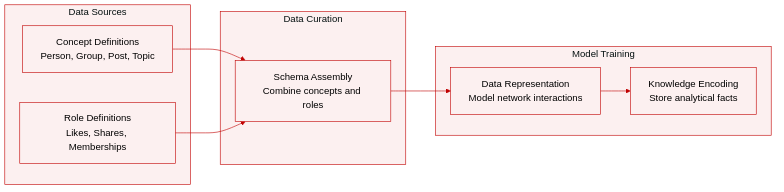
- Dataset Composition and Sources: The authors present a knowledge representation schema rather than a traditional empirical dataset. It is constructed from structured concept and role definitions designed to model social network analytics.
- Subset Details: The framework consists of two primary components. Concept names include Person, Male, Female, Group, Post, Hobby, and Topic. Role names define relational predicates such as hasCloseFriend, posts, postedBy, likes, likedBy, shares, sharedBy, relatedTo, interestedIn, isMemberOf, and hasMember.
- Data Usage: The authors employ this ontology to represent analytical data and encode domain knowledge about social network interactions. The excerpt does not specify training splits, mixture ratios, or empirical scaling procedures.
- Processing and Metadata: The provided text focuses on ontological construction rather than data preprocessing. No cropping strategies, filtering rules, or automated metadata generation steps are described.
Method
The framework of the proposed method centers on the formalization and analysis of bisimulation relations within the context of fuzzy description logics (DLs) under the Gödel semantics. The core of the approach lies in defining and characterizing fuzzy bisimulations between fuzzy interpretations, which are functions mapping pairs of elements from two domains to truth values in the interval [0,1]. These bisimulations are designed to preserve the semantic equivalence of concepts and roles across interpretations, ensuring that related elements exhibit the same behavior with respect to the logic's constructs.
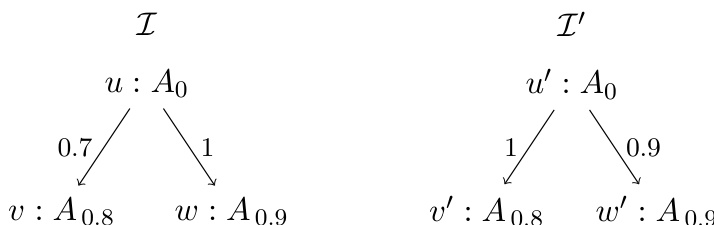
The framework diagram illustrates two fuzzy interpretations, I and I′, which are the primary structures under analysis. In I, the domain contains elements u, v, and w, with u associated with concept A at a truth value of 0.7, and v and w associated with A at values of 0.8 and 0.9, respectively. The diagram for I′ shows a similar structure, with elements u′, v′, and w′, where u′ has a truth value of 1 for A, v′ has a value of 0.8, and w′ has a value of 0.9. The arrows represent roles connecting these elements, with the associated values indicating the strength of the relationship. The authors leverage these interpretations to define the conditions for a fuzzy Φ-bisimulation Z, which must satisfy specific properties to ensure that the interpretations are related in a semantically meaningful way. For instance, the function Z must preserve the truth values of concepts and the structure of roles, ensuring that for any concept C, the value of C in I at x is equivalent to the value of C in I′ at x′, as captured by the inequality Z(x,x′)≤(CI(x)⇔CI′(x′)). This property, known as invariance of concepts, is a fundamental result that establishes the robustness of the bisimulation relation.
The method further extends to the notion of crisp bisimulation, which is a special case where the bisimulation function Z takes values only in {0,1}. This allows for the definition of strong bisimilarity, where two interpretations are considered equivalent if there exists a crisp bisimulation that relates all named individuals. The authors prove that under certain conditions, such as being witnessed and modally saturated, the greatest crisp bisimulation can be explicitly constructed by comparing the truth values of all concepts in a sublanguage L(Phi,triangle)0, which excludes certain constructors and uses the Baaz projection operator. This leads to a Hennessy-Milner property, which states that if two interpretations are indistinguishable by concepts in this sublanguage, then they are strongly bisimilar. The framework also includes results on the invariance of fuzzy TBoxes and ABoxes under bisimilarity, demonstrating that certain logical constructs are preserved across bisimilar interpretations. The overall architecture is designed to provide a rigorous foundation for reasoning about the expressive power of fuzzy DLs and to enable the minimization of interpretations by quotienting them with respect to strong bisimilarity.
Experiment
The provided text does not contain empirical experiments but rather formal proofs that validate the theoretical framework. Lemma 3.7 establishes that fuzzy bisimulation preserves logical equivalence across complex constructs, ensuring structural consistency. Theorem 3.15 characterizes the greatest fuzzy bisimulation by aligning it with the infimum of concept equivalences under witnessed and modally saturated interpretations. Theorem 4.11 extends these results to crisp settings, collectively confirming the logical soundness and robustness of the system.