Command Palette
Search for a command to run...
Water Bridging Dynamics of Polymerase Chain Reaction in the Gauge Theory Paradigm of Quantum Fields
Water Bridging Dynamics of Polymerase Chain Reaction in the Gauge Theory Paradigm of Quantum Fields
L. Montagnier J. Aïssa A. Capolupo T. J. A. Craddock P. Kurian C. Lavallee A. Polcari P. Romano A. Tedeschi G. Vitiello
One-click Deployment of GROMACS Beginner Tutorial: Lysozyme in Water
Abstract
We discuss the role of water bridging the DNA-enzyme interaction by resorting to recent results showing that London dispersion forces between delocalized electrons of base pairs of DNA are responsible for the formation of dipole modes that can be recognized by Taq polymerase. We describe the dynamic origin of the high efficiency and precise targeting of Taq activity in PCR. The spatiotemporal distribution of interaction couplings, frequencies, amplitudes, and phase modulations comprise a pattern of fields which constitutes the electromagnetic image of DNA in the surrounding water, which is what the polymerase enzyme actually recognizes in the DNA water environment. The experimental realization of PCR amplification, achieved through replacement of the DNA template by the treatment of pure water with electromagnetic signals recorded from viral and bacterial DNA solutions, is found consistent with the gauge theory paradigm of quantum fields.
One-sentence Summary
Grounded in the gauge theory paradigm of quantum fields, the authors demonstrate that London dispersion forces between delocalized DNA base pair electrons generate dipole modes whose spatiotemporal couplings, frequencies, amplitudes, and phase modulations form an electromagnetic image in surrounding water that Taq polymerase directly recognizes, thereby enabling PCR amplification when pure water is exposed to electromagnetic signals recorded from viral and bacterial DNA solutions.
Key Contributions
- A water-mediated recognition model establishes that London dispersion forces between delocalized electrons in DNA base pairs generate collective electromagnetic dipole modes, which form a spatiotemporal electromagnetic image of the template within the surrounding hydration structure.
- A quantum field theory framework explains how Taq polymerase recognizes this water-imprinted image through dipole wave quanta exchange, providing a dynamic account of the high efficiency and precise targeting characteristic of enzymatic amplification.
- Experimental validation demonstrates that pure water treated with electromagnetic signals recorded from viral and bacterial DNA solutions successfully drives polymerase chain reaction amplification, aligning with spectroscopic observations of a DNA-templated chiral hydration spine.
Introduction
The polymerase chain reaction depends on highly efficient DNA-enzyme interactions, yet traditional kinetic and stoichiometric models cannot adequately explain how Taq polymerase achieves precise long-range targeting amid stochastic molecular motion. Recent experimental observations further complicate this picture by demonstrating that PCR amplification can occur when physical DNA templates are replaced by electromagnetic signals, underscoring an unexplained mediating role for the surrounding water matrix. The authors leverage the gauge theory paradigm of quantum fields to show that London dispersion forces and delocalized electrons generate radiative dipole waves that imprint a coherent electromagnetic image of DNA into the aqueous environment. By modeling water dipoles as a dynamically symmetry-breaking field, they demonstrate that Taq polymerase recognizes this water-mediated signature through dipole wave exchange rather than direct physical contact. This field-theoretic framework resolves longstanding gaps in enzymatic catalysis models and provides a mechanistic foundation for signal-based DNA amplification without physical templates.
Dataset
-
Dataset Composition and Sources: The authors compile an experimental dataset centered on signalized water and recovered nucleic acid sequences. The primary sources include DNAse and RNase-free water, specific biological targets such as Borrelia and HIV-1 LTR fragments, and sequenced PCR products derived from cloned inserts.
-
Key Details for Each Subset: The collection is organized into filtration, dilution, and sequencing tiers. The filtration subset applies 450 nm and 100 nm sterile filters for Borrelia samples, alongside a 20 nm Anotop filter for HIV-1 LTR targets. The dilution subset contains serial 1 in 10 dilutions ranging from 10−2 to 10−15 prepared in 1.5 ml DNA Lobind tubes. The sequencing subset comprises cloned DNA inserts from pCR2.1-TOPO vectors, validated through EcoRI digestion and M13 primer sequencing.
-
Data Usage and Processing: The authors use the dataset to validate electromagnetic signal transduction and DNA reconstruction rather than for machine learning training. Each sample follows a fixed pipeline where 10 ml of filtered water receives a 1 Hz, 2 volt modulated current via a solenoid amplifier for one hour. The authors then vortex the treated water, perform secondary filtration, and amplify recovered fragments using PCRBIO HS Taq DNA. The resulting amplicons are cloned into chemically competent E. coli, isolated via miniprep, and sequenced to verify sequence fidelity against the original targets.
-
Metadata Construction and Processing Controls: The authors document all experimental parameters, including amplifier passband specifications, solenoid dimensions, and precise reagent volumes. To maintain data integrity, the authors enforce strict environmental controls by conducting all steps on non-conductive workbenches, shielding against low-frequency electromagnetic fields, and disabling cell phones with removed batteries to prevent external signal interference during data collection.
Method
The authors leverage a gauge field theory framework to model the interaction between DNA and Taq DNA polymerase, proposing that the process is mediated by coherent dipole waves in the surrounding water matrix, analogous to photon exchange in quantum electrodynamics. The overall mechanism is structured around two interaction vertices: the DNA-water interaction vertex and the signalized water-Taq interaction vertex. At the first vertex, the DNA induces coherent dipole oscillations in the surrounding water, generating an electromagnetic signal (EMS) that encodes the molecular structure of the DNA. This signal is detected, amplified, and digitized, forming the basis for the electromagnetic image of the DNA. 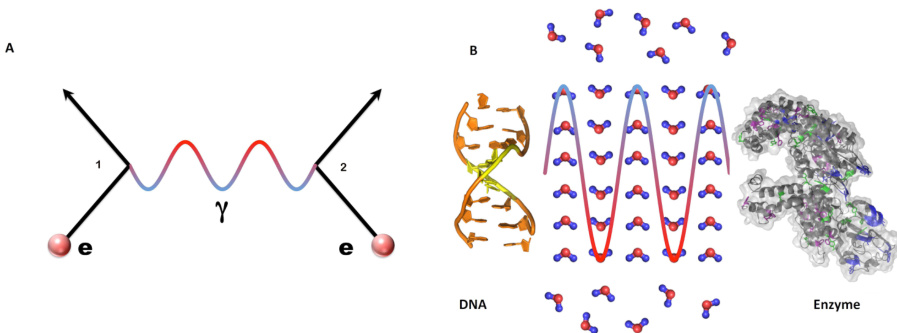
The second vertex involves the interaction between this signalized water and the Taq polymerase. The coherent dipole waves in the water, which carry the electromagnetic image of the DNA, are recognized by the Taq polymerase. This recognition process is mediated by the collective dipole oscillations within the aromatic amino acid network of the enzyme, which are shown to have energy modes that overlap with those of DNA. The interaction at this vertex triggers the polymerase to initiate DNA amplification through a series of PCR cycles, effectively "reading" the electromagnetic signal and synthesizing a complementary DNA strand. The framework thus posits that the long-range correlation between DNA and enzyme is established via the propagation of these coherent dipole waves in the aqueous environment, which orchestrates the spatial and temporal coordination of the PCR process. This model explains the high efficiency and specificity of PCR, which cannot be accounted for by classical Brownian motion alone, by introducing a dynamical mechanism based on collective electromagnetic interactions.