Command Palette
Search for a command to run...
Phase-Only Planar Antenna Array Synthesis with Fuzzy Genetic Algorithms
Phase-Only Planar Antenna Array Synthesis with Fuzzy Genetic Algorithms
Boufeldia Kadri Miloud Boussahla Fethi Tarik Bendimerad
Genetic Algorithms
Abstract
This paper describes a new method for the synthesis of planar antenna arrays using fuzzy genetic algorithms (FGAs) by optimizing phase excitation coefficients to best meet a desired radiation pattern. We present the application of a rigorous optimization technique based on fuzzy genetic algorithms (FGAs), the optimizing algorithm is obtained by adjusting control parameters of a standard version of genetic algorithm (SGAs) using a fuzzy controller (FLC) depending on the best individual fitness and the population diversity measurements (PDM). The presented optimization algorithms were previously checked on specific mathematical test function and show their superior capabilities with respect to the standard version (SGAs). A planar array with rectangular cells using a probe feed is considered. Included example using FGA demonstrates the good agreement between the desired and calculated radiation patterns than those obtained by a SGA.
One-sentence Summary
This paper presents a phase-only synthesis method for probe-fed rectangular planar antenna arrays that optimizes phase excitation coefficients using fuzzy genetic algorithms (FGAs), which employ a fuzzy controller to adjust standard genetic algorithm parameters based on individual fitness and population diversity, thereby generating radiation patterns that align more closely with target specifications than those produced by standard genetic algorithms.
Key Contributions
- A fuzzy genetic algorithm framework is developed to synthesize planar antenna arrays by optimizing phase excitation coefficients for precise radiation pattern matching.
- A fuzzy logic controller is integrated into the standard genetic algorithm to dynamically adjust control parameters based on population diversity measurements and individual fitness values.
- Validation across mathematical test functions and a probe-fed rectangular array demonstrates that the proposed method achieves superior pattern fidelity and controlled sidelobe levels compared to the standard genetic algorithm.
Introduction
Planar antenna arrays are foundational to radar and wireless communication systems, where precise beam steering directly dictates overall network efficiency and signal reliability. Although genetic algorithms are widely adopted for optimizing these arrays due to their robustness in navigating complex, non-differentiable design spaces, they commonly suffer from slow convergence rates, premature entrapment in local optima, and inefficient local search capabilities. To overcome these bottlenecks, the authors leverage fuzzy set theory to construct a fuzzy genetic algorithm that dynamically adjusts crossover and mutation probabilities based on real-time population diversity and fitness metrics. This adaptive framework enables highly efficient phase-only synthesis of planar antenna arrays, successfully generating targeted radiation patterns with narrow main beams and suppressed sidelobes while demonstrating clear performance advantages over conventional genetic optimization approaches.
Method
The authors leverage a fuzzy genetic algorithm (FGA) framework to optimize the phase excitation coefficients of a planar antenna array for synthesizing a desired radiation pattern. The overall method integrates a fuzzy logic controller (FLC) into a standard genetic algorithm (SGA) to dynamically adjust key control parameters—crossover probability pc and mutation probability pm—during the evolutionary process. This adaptive approach aims to maintain a balance between exploration and exploitation, thereby enhancing convergence speed and solution quality.
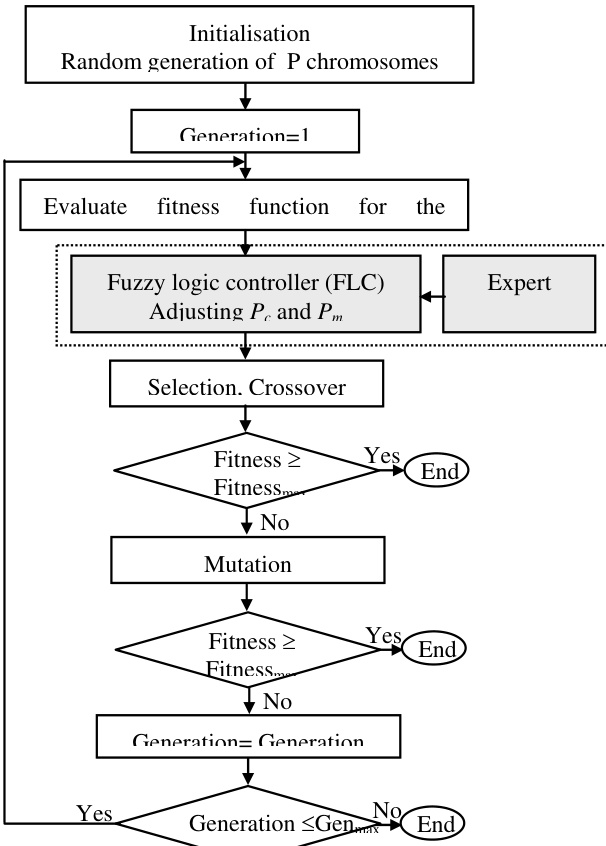
As shown in the figure below, the FGA framework begins with the random initialization of a population of chromosomes, each representing a candidate solution for the phase excitation coefficients. At each generation, the fitness of the current population is evaluated. The FLC then adjusts the control parameters pc and pm based on real-time performance metrics of the genetic algorithm. The FLC receives three inputs: the gene-wise diversity Dgw, the ratio of the average fitness to the maximum fitness f/fmax, and the number of consecutive generations in which the best fitness value has not improved. These inputs are used to assess the current state of the population, including its diversity and convergence level. The FLC processes these inputs through a fuzzy inference system and generates updated values for pc and pm, which are then applied in the subsequent genetic operations.
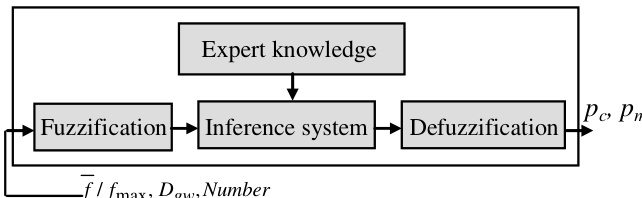
The structure of the FLC is detailed in the accompanying diagram, which shows the flow from fuzzification of the input variables to defuzzification of the output control parameters. The fuzzification stage converts the crisp input values into linguistic terms using predefined membership functions. The inference system applies a set of rule-based logic, informed by expert knowledge, to determine the appropriate adjustments to pc and pm. Finally, the defuzzification stage computes the precise numerical values for the control parameters. This dynamic adjustment mechanism allows the algorithm to adaptively respond to changes in population diversity and convergence, ensuring sustained exploration when diversity is high and increased exploitation as the population approaches convergence.
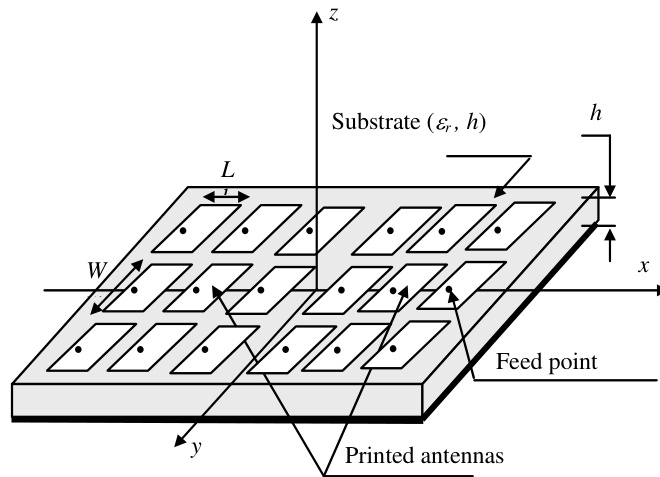
The antenna array under consideration is a planar configuration with rectangular cells, where each element is a printed antenna fed by a probe feed. The array is mounted on a substrate with relative permittivity εr and thickness h. The dimensions of the array are defined by the lengths L and W along the x and y axes, respectively, with the feed point located at a specific position to excite the array elements. The design of the array and its physical layout are integral to the optimization process, as the phase excitation coefficients directly influence the resulting radiation pattern. The FGA method is applied to optimize these coefficients to achieve a radiation pattern that closely matches the desired characteristics.
Experiment
The experiment evaluates standard genetic algorithms against fuzzy-controlled genetic algorithms for optimizing the radiation pattern synthesis of a planar microstrip antenna array. By comparing fixed-parameter optimization with adaptive fuzzy logic control, the study validates the effectiveness of dynamic crossover and mutation rate adjustments in antenna design. The results indicate that the fuzzy-controlled approach converges more rapidly to optimal solutions and consistently produces radiation patterns that better match the desired specifications. Ultimately, the findings demonstrate that integrating fuzzy logic significantly enhances both the convergence speed and the accuracy of antenna array synthesis compared to traditional methods.