Command Palette
Search for a command to run...
Incentiviert Reinforcement Learning tatsächlich Reasoning-Fähigkeiten in LLMs jenseits des Basismodells?
Incentiviert Reinforcement Learning tatsächlich Reasoning-Fähigkeiten in LLMs jenseits des Basismodells?
Yang Yue Zhiqi Chen Rui Lu Andrew Zhao Zhaokai Wang Shiji Song Gao Huang
Zusammenfassung
Reinforcement Learning mit verifizierbaren Belohnungen (Reinforcement Learning with Verifiable Rewards, RLVR) hat kürzlich beachtliche Erfolge bei der Verbesserung der Reasoning-Performance großer Sprachmodelle (LLMs) erzielt, insbesondere bei Mathematikund Programmieraufgaben. Es wird weithin angenommen, dass RLVR – analog dazu, wie klassisches RL Agenten beim Erkunden und Erlernen neuer Strategien unterstützt – LLMs kontinuierliche Selbstverbesserung ermöglicht und ihnen damit neuartige Reasoning-Fähigkeiten verleiht, die die Kapazität der entsprechenden Basismodelle übertreffen. In dieser Studie nehmen wir den aktuellen Stand von RLVR kritisch in den Blick, indem wir die Reasoning-Fähigkeitsgrenzen von RLVR-trainierten LLMs über verschiedene Modellfamilien, RL-Algorithmen und Benchmarks für mathematisches, kodierendes und visuelles Reasoning systematisch untersuchen, wobei pass@k bei großen k-Werten als Evaluationsmetrik dient. Während RLVR die Stichprobeneffizienz in Richtung korrekter Pfade verbessert, stellen wir überraschend fest, dass das aktuelle Training keine grundlegend neuen Reasoning-Muster hervorruft. Wir beobachten, dass RLVR-trainierte Modelle zwar bei kleineren k-Werten (z. B. k=1) ihre Basismodelle übertreffen, die Basismodelle bei großen k-Werten jedoch höhere pass@k-Werte erzielen. Darüber hinaus beobachten wir, dass die Reasoning-Fähigkeitsgrenze von LLMs mit fortschreitendem RLVR-Training oft enger wird. Weitere Abdeckungsund Perplexitätsanalysen zeigen, dass die von RLVR-Modellen generierten Reasoning-Pfade bereits in der Stichprobenverteilung der Basismodelle enthalten sind, was darauf hindeutet, dass deren Reasoning-Fähigkeiten ihren Ursprung im Basismodell haben und durch dieses begrenzt werden. Aus dieser Perspektive, das Basismodell als obere Schranke betrachtend, zeigt unsere quantitative Analyse, dass sechs populäre RLVR-Algorithmen ähnlich abschneiden und davon weit entfernt sind, das Potenzial des Basismodells vollständig auszuschöpfen. Im Gegensatz dazu stellen wir fest, dass Distillation neue Reasoning-Muster vom Lehrermodell einführen und die Reasoning-Fähigkeiten des Modells tatsächlich erweitern kann. Zusammengenommen legen unsere Ergebnisse nahe, dass aktuelle RLVR-Methoden das Potenzial des Reinforcement Learning, wirklich neuartige Reasoning-Fähigkeiten in LLMs hervorzurufen, noch nicht vollständig ausgeschöpft haben. Dies unterstreicht die Notwendigkeit verbesserter RL-Paradigmen – wie kontinuierliches Skalieren und Multi-Turn-Agent-Umgebungs-Interaktion –, um dieses Potenzial zu erschließen.
One-sentence Summary
Researchers from LeapLab at Tsinghua University and Shanghai Jiao Tong University use pass@k at large k to systematically probe RLVR-trained LLMs and find that RLVR narrows rather than expands reasoning capability boundaries, with all tested reasoning paths originating from the base model's sampling distribution, whereas distillation genuinely introduces novel reasoning patterns.
Key Contributions
-
This paper provides a systematic framework for evaluating reasoning capability boundaries of RLVR-trained large language models across model families, reinforcement learning algorithms, and math, coding, and visual reasoning benchmarks, using pass@k at large k values.
-
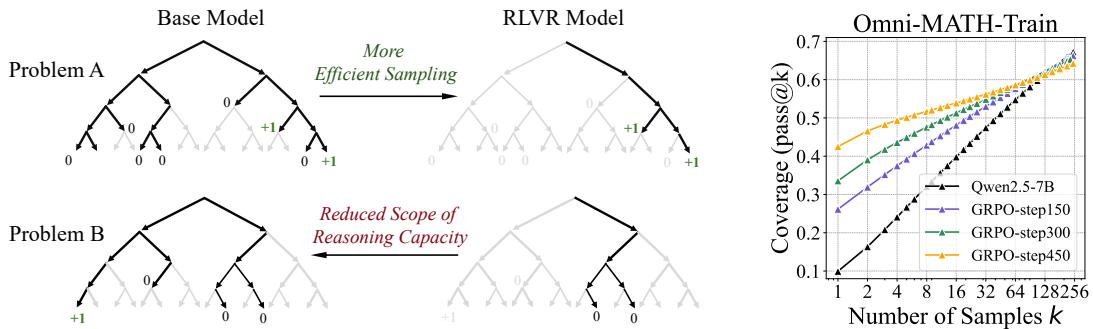
Empirical results indicate that current RLVR training improves sampling efficiency toward correct paths already present in base models, while base models can achieve higher pass@k scores at large k and RLVR-trained models often show narrowed reasoning boundaries.
-
A comparison of six popular RLVR algorithms against distillation shows that the RLVR algorithms perform similarly and remain far from fully leveraging the base model, whereas distillation introduces new reasoning patterns and expands reasoning capability.
Introduction
The authors study reinforcement learning with verifiable rewards, or RLVR, which has become important for improving large language models on reasoning-heavy tasks such as math and coding. In this setting, models are optimized using automatically verifiable feedback, such as final-answer correctness or passing unit tests, without relying on costly human annotations. Prior work has shown strong empirical gains, but it remained unclear whether RLVR genuinely teaches new reasoning strategies or merely makes better use of the base model’s existing capabilities. Previous analyses were often limited in scope and typically evaluated average-case performance, which can obscure a model’s true reasoning potential. The authors contribute a rigorous boundary evaluation using pass@k across multiple model families, sizes, tasks, and RLVR algorithms. They show that current RLVR improves sampling efficiency but does not fundamentally expand reasoning capacity, and that the successful reasoning paths found by RLVR models largely already exist in the base model.
Dataset
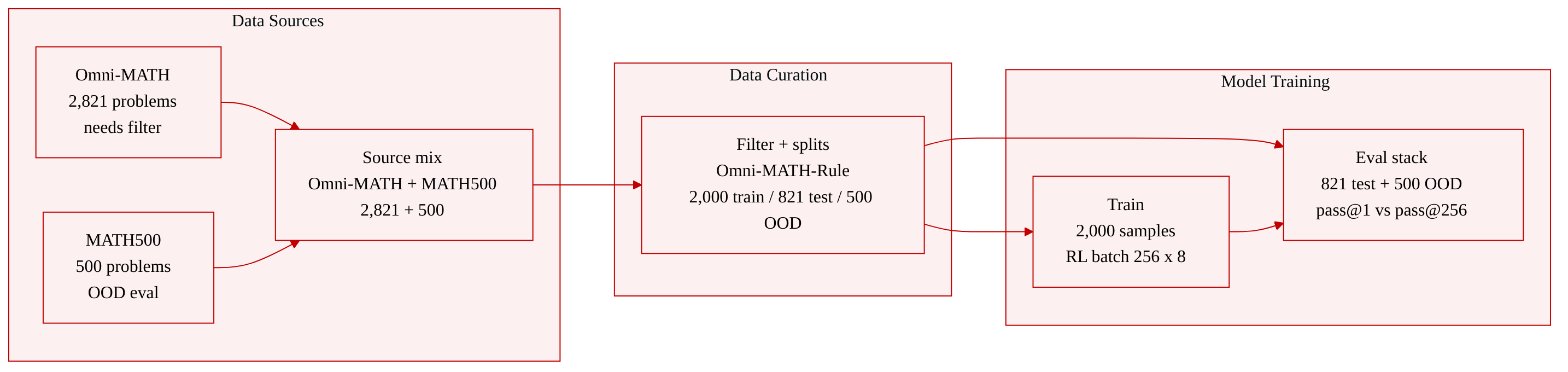
- The dataset is Omni-MATH-Rule, a subset of Omni-MATH selected to include math problems with verifiable answers.
- The authors split Omni-MATH-Rule into a 2,000-sample training set and an 821-sample in-domain test set.
- They use MATH500 as a separate out-of-domain benchmark for evaluating generalization.
- The data is used to study how different RL algorithms affect sampling efficiency, especially by comparing pass@1 with base-model pass@256.
- During evaluation, prompts are handled in batches of 256, with 8 candidate responses generated per prompt, under a maximum generation length of 8,192 tokens.
Method
The authors formulate reinforcement learning with verifiable rewards as an optimization problem over an LLM policy. Let πθ denote a language model with parameters θ that generates a token sequence y=(y1,…,yT) conditioned on a prompt x. A deterministic verifier V evaluates the generated output and returns a binary reward
r=V(x,y)∈{0,1},where r=1 if and only if the model’s final answer is exactly correct. In some settings, an additional format reward is used to encourage the model to separate its reasoning process from the final answer. The training objective is to maximize the expected reward over the prompt distribution D:
J(θ)=Ex∼D[Ey∼πθ(⋅∣x)[r]].The overall RLVR workflow, including prompt sampling, model generation, verifier scoring, and policy optimization, is summarized in the accompanying figure.
For policy optimization, the paper adopts Proximal Policy Optimization and its variants. PPO maximizes a clipped surrogate objective:
LCLIP=E[min(rt(θ)At,clip(rt(θ),1−ϵ,1+ϵ)At)],where
rt(θ)=πθold(yt∣x,y<t)πθ(yt∣x,y<t),and At is the advantage estimated by a value network Vϕ. The probability ratio rt(θ) measures how much the updated policy deviates from the old policy at each token position. The clipping operation limits the magnitude of this deviation, improving training stability compared with unbounded policy updates. An optional KL divergence term can also be added to constrain the optimized policy from drifting too far from the initial model.
PPO belongs to the broader policy gradient family of RL methods. These algorithms learn from on-policy samples, meaning the training data are generated by the current policy or an older version of it. In the verifiable-reward setting, the training signal is especially clean: samples whose final answers are correct receive positive feedback, while incorrect samples receive negative or zero feedback. Consequently, the policy gradient process increases the log likelihood of successful continuations and decreases the likelihood of unsuccessful ones.
The training protocol distinguishes between math tasks and coding or visual reasoning tasks. For math, the authors follow a zero RL setting, where RL is applied directly to a pretrained base model without prior supervised fine tuning. This setting is useful for isolating the effect of RLVR itself. For coding and visual reasoning, instruction-tuned models are typically used as starting points because zero RL from a pure pretrained model can be less stable. In those cases, the paper compares a supervised fine tuned model against its RLVR-trained counterpart to examine the incremental impact of reinforcement learning with verifiable rewards.
Experiment
The experiments evaluate reasoning capacity boundaries across mathematical, coding, and visual reasoning benchmarks using pass@k with extensive sampling and consistent zero-shot prompts, comparing base, RLVR-trained, and distilled models. The results show that RLVR mainly improves sampling efficiency at small k, while base models often cover more solvable problems at larger k, indicating a narrower reasoning boundary after RL training. Analyses of coverage, perplexity, training settings, entropy, algorithm choice, and a near-frontier model suggest that current RLVR sharpens existing base-model reasoning paths rather than expanding them, whereas distillation can introduce new reasoning capabilities.
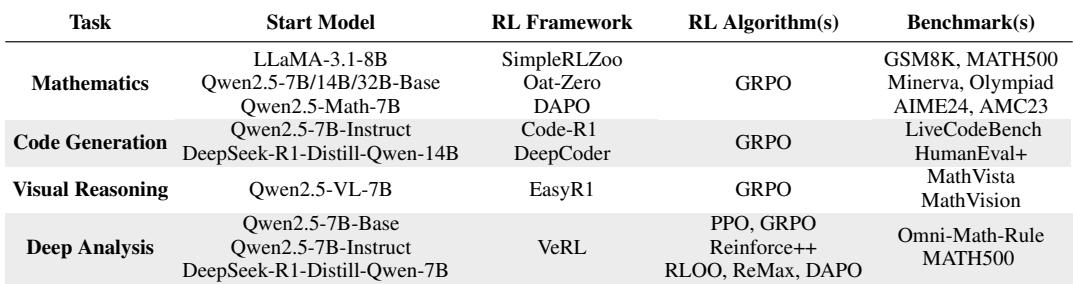
The experiments compare base and RLVR models across mathematics, code generation, and visual reasoning using matched zero-shot sampling settings. RLVR consistently improves low-budget pass performance, but its advantage narrows as the sampling budget increases, and larger near-frontier models show a similar boundary-limited pattern. The evaluation spans multiple model families, RL frameworks, and task domains, including mathematics, coding, and visual reasoning. Base and RLVR models use the same zero-shot prompt style to avoid confounding from few-shot examples. RLVR provides clear gains at low pass budgets, while base models catch up or outperform RLVR at higher pass budgets. KL regularization and entropy-matched generation do not remove the apparent narrowing of the RLVR reasoning boundary.
The base model and RLVR-trained model mostly solve the same problems, but the base model still solves many problems that the RLVR-trained model misses. The reverse case is rare, especially on AIME24, so the RLVR model's gains mainly reflect more reliable sampling on problems the base model can already solve. Both models fail on a notable fraction of AIME24 problems, while shared failures are much less common on MATH500. Most problems solved by the RLVR-trained model are also solvable by the base model. The base model covers a broader set of solvable problems than the RLVR-trained model. RLVR-trained models rarely solve problems that the base model cannot.
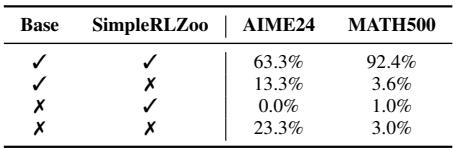
The experiments compare base and RLVR-trained models on mathematics, coding, and visual reasoning under matched zero-shot sampling across multiple model families and RL frameworks. They show that RLVR mainly increases reliability on problems the base model can already solve, yielding larger gains at low sampling budgets that narrow as budgets grow. The base model generally covers a broader set of solvable problems, while RLVR models rarely solve tasks beyond the base model's reach, suggesting reasoning boundary limitations rather than expanded capability.