Command Palette
Search for a command to run...
Von REAL zu SYNTHETISCH: Synthese von Millionen diverser und komplexer Benutzerinstruktionen mittels Attributed Grounding
Von REAL zu SYNTHETISCH: Synthese von Millionen diverser und komplexer Benutzerinstruktionen mittels Attributed Grounding
Chiwei Zhu Benfeng Xu Xiaorui Wang Zhendong Mao
Zusammenfassung
Die Erstellung vielfältiger, komplexer und umfangreicher Instruktionsdaten ist entscheidend für das automatische Alignment großer Sprachmodelle (LLMs). Zwar existieren Verfahren zur skalierbaren Generierung synthetischer Instruktionen, diese leiden jedoch entweder an begrenzten Grounding-Quellen, was zu einer engen Datenverteilung führt, oder sie stützen sich auf triviale Erweiterungen, die keine sinnvolle Komplexität hervorbringen. Im Gegensatz dazu werden Instruktionen, die ein effizientes Alignment begünstigen, typischerweise unter Berücksichtigung kognitiver Erkenntnisse formuliert und an reale Anwendungsfälle rückgebunden. In diesem Paper synthetisieren wir solche Instruktionen mittels Attributed Grounding, welches 1) einen Top-down-Attributionsprozess umfasst, der eine selektive Menge realer Instruktionen an situativ eingebettete Benutzer rückbindet, und 2) einen Bottom-up-Syntheseprozess, der Webdokumente nutzt, um zunächst eine Situation und anschließend eine sinnvolle Instruktion zu generieren. Dieser Rahmen ermöglicht es uns, vielfältige und komplexe Instruktionen im großen Maßstab zu generieren, indem die enorme Bandbreite von Webdokumenten genutzt wird. Konkret konstruieren wir einen Datensatz mit 1 Million Instruktionen namens SYNTHQUESTIONS und zeigen, dass darauf trainierte Modelle führende Ergebnisse auf mehreren gängigen Benchmarks erzielen, wobei sich die Verbesserungen mit zunehmendem Umfang der Web-Korpora kontinuierlich skalieren. Daten, Modelle und Code sind unter https://github.com/Ignoramus0817/SynthQuestions verfügbar.
One-sentence Summary
Researchers at the University of Science and Technology of China and Metastone Technology propose attributed grounding, a two-stage framework that combines top-down attribution of real instructions to situated users with bottom-up synthesis from web documents to produce SynthQuestions, a one-million-instruction dataset on which trained models achieve leading benchmark performance that scales continuously with additional web corpora.
Key Contributions
-
The paper constructs REALQUESTIONS, a cleaned and filtered human instruction dataset that provides seed data and in-context demonstrations for instruction synthesis.
-
The paper proposes an attributed grounding framework that first maps real instructions to situated users and motivations, then uses web documents to generate realistic situations and meaningful instructions at scale.
-
The framework produces SYNTHQUESTIONS, a 1-million synthetic instruction dataset, and LLaMA-3-8B models fine-tuned on it achieve leading benchmark results comparable with models trained using 10 times more data and preference training, with gains continuing as web corpora grow.
Introduction
Instruction following LLMs depend on alignment training, which uses instruction response pairs to make models behave according to human intent. This matters because strong capability on complex and varied tasks requires high quality, diverse, and large scale data.
Earlier methods collect human conversations or synthesize instructions from seed tasks, web concepts, or simulated questioners. These approaches can produce large sets, but they often inherit narrow design biases and fail to capture the situated, lifelike diversity of real user needs.
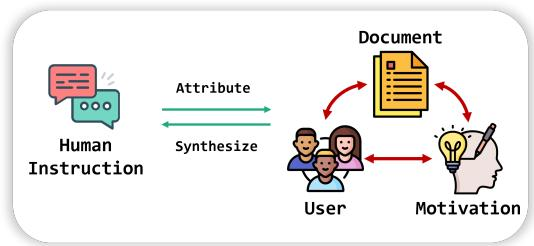
The authors introduce an attributed grounding framework. They treat an instruction as grounded in a document, a user, and a motivation, then reverse that structure to generate realistic situations and instructions from web documents. They build RealQuestions as a cleaned seed set and create a 1 million example SynthQuestions dataset. Fine tuning an 8B Llama 3 model on SynthQuestions gives strong benchmark results, comparable to models trained with far more data or preference training.
Dataset

-
The authors use REALQUESTIONS as a high-quality seed instruction dataset. It is built from 1.92M raw conversations collected from seven human-labeled instruction sources: Chatbot Arena Conversations, Databricks-dolly-15k, LMSYS-Chat-1M, OpenAssistant, ShareGPT, Ultra-Chat, and WildChat.
-
The authors clean the data by removing incomplete conversations and non-English conversations. They also remove instructions that resemble evaluation benchmarks such as Alpaca Eval 2.0 and Arena Hard. Model responses are discarded, and only first-round user instructions are retained.
-
For semantic deduplication, the authors embed instructions and use community detection with a similarity threshold of 0.85. One instruction is kept per semantic cluster, while outlier instructions that do not cluster are retained to preserve unique samples. This reduces the dataset to 690K conversations.
-
The authors score remaining instructions using a modified Arena Hard rubric across seven dimensions, with LLaMA-3-70B-Instruct as the judge. The 29K instructions receiving full scores form REALQUESTIONS. They use this seed set to ground later generation and as demonstrations, and they fine-tune LLaMA-3-8B on it to validate data quality.
-
The authors construct attributed grounding data by linking REALQUESTIONS instructions to real-world context. LLaMA-3-70B-Instruct extracts key concepts from each instruction, web search provides a top-ranked document, and the model then simulates a user and motivation. This yields tuples containing instruction, document, user, and motivation.
-
For SYNTHQUESTIONS, the authors synthesize new instructions from documents rather than starting from real user prompts. The document source is mainly FineWeb, mixed with PILE and MathPILE to include difficult mathematics and coding content. LLaMA-3-8B-Instruct generates user and motivation profiles for each document and then generates a new user-style instruction.
-
Synthetic instructions are scored with the same seven-dimension rubric. Instructions scoring below 3 are removed to filter unclear or ambiguous samples while preserving requirements such as specificity, problem-solving, and technical accuracy. BERTopic is used for topic modeling, and the final 1M SYNTHQUESTIONS is built by selecting the highest-scoring instructions within each topic to improve diversity.
-
The authors report that SYNTHQUESTIONS has long average turn length and strong lexical diversity measured by MTLD. Semantic diversity is evaluated using sentence embeddings, t-SNE projections, and Vendi Score on 10,000 sampled instructions, with SYNTHQUESTIONS showing high diversity.
-
The authors also evaluate complexity by scoring 10,000 unfiltered synthetic instructions with Arena Hard criteria and observe that scores are concentrated in the higher range. Safety is checked with LLaMA-Guard-3-8B, which flags 4.32% of the 1M dataset as potentially risky, mostly in the specialized advice category. Harmful content is removed when the dataset is open-sourced.
-
No visual cropping strategy is described because the dataset consists of text instructions and associated metadata such as documents, user profiles, and motivations.
Method
The proposed data generation pipeline is organized around attributed grounding. It uses two complementary processes: a top-down attribution step that recovers contextual factors for existing instructions, and a bottom-up synthesis step that generates new instructions from grounded situations. The goal is to create instructions that are anchored in plausible user roles, real-world documents, and clear motivations.
In the top-down attribution process, each instruction is linked to a document, a user, and a motivation. The authors first extract key concepts from an instruction using LLaMA-3-70B-Instruct. These key concepts are used as queries for web retrieval, and the highest ranked retrieved page is treated as the supporting document. This document provides background knowledge about the real-world situation implied by the instruction.
The authors then prompt LLaMA-3-70B-Instruct with both the document and the original instruction. The model is asked to imagine a setting in which a user interacts with the document and produces the instruction for a specific reason. This step infers a user profile and a motivation that make the instruction more plausible. Manually crafted demonstrations are used to guide the model toward more grounded attributions. The resulting attributed sample can be represented as:
RQα={(i,d,u,m)}where i is the instruction, d is the attributed document, u is the inferred user, and m is the inferred motivation.
The bottom-up synthesis process reverses this direction. Instead of starting from instructions and recovering context, it starts from documents and synthesizes users, motivations, and then instructions. The attributed samples from RQα are reused as demonstrations to regulate generation behavior.
For document collection, the pipeline uses general web documents as the primary source. It also includes documents that involve more complex reasoning tasks, such as mathematical or coding material, to encourage higher quality reasoning-oriented instructions. For each document, the authors prompt LLaMA-3-8B-Instruct to generate a grounded user and motivation. This step is conditioned on the document itself, a grounding prompt, and examples from the attributed dataset:
(u′,m′)=LLaMA(Pg,d′,demo)where u′ and m′ are the generated user and motivation, d′ is the input document, Pg is the grounding prompt, and demo contains demonstrations derived from RQα.
After a user and motivation are generated for a document, the model is asked to role-play as that user and produce the instruction that would most naturally arise in the constructed situation. This produces a new synthetic instruction:
i′=LLaMA(Pi,d′,u′,m′,demos)where i′ is the generated instruction, Pi is the instruction-generation prompt, and demos provides examples of grounded user behavior.
The generated instructions are then filtered using an instruction-level scoring function. The filtering stage prioritizes specific dimensions such as specificity, problem-solving clarity, and technical accuracy. Instructions with scores below 3 are discarded. The threshold is set heuristically rather than requiring perfect scores on all dimensions, allowing the pipeline to remain somewhat tolerant while removing unclear or ambiguous instructions.
Finally, the pipeline addresses diversity through topic modeling with BERTopic. For each discovered topic, the highest scoring instructions are retained to form the final dataset. This produces a collection of synthetic instructions that are grounded in documents, user roles, and motivations, while balancing quality and topical diversity.
Experiment
Experiments train LLaMA and Qwen models on SYNTHQUESTIONS and evaluate instruction following, reasoning, closed-form knowledge, preference optimization, scaling, and ablations. The data improves alignment and reasoning, remains competitive with open-source and some proprietary baselines, and benefits from preference optimization, with consistent gains as synthetic data scales and across model architectures and sizes. Ablations show that attributed grounding is essential and that math or code documents help challenging reasoning tasks.
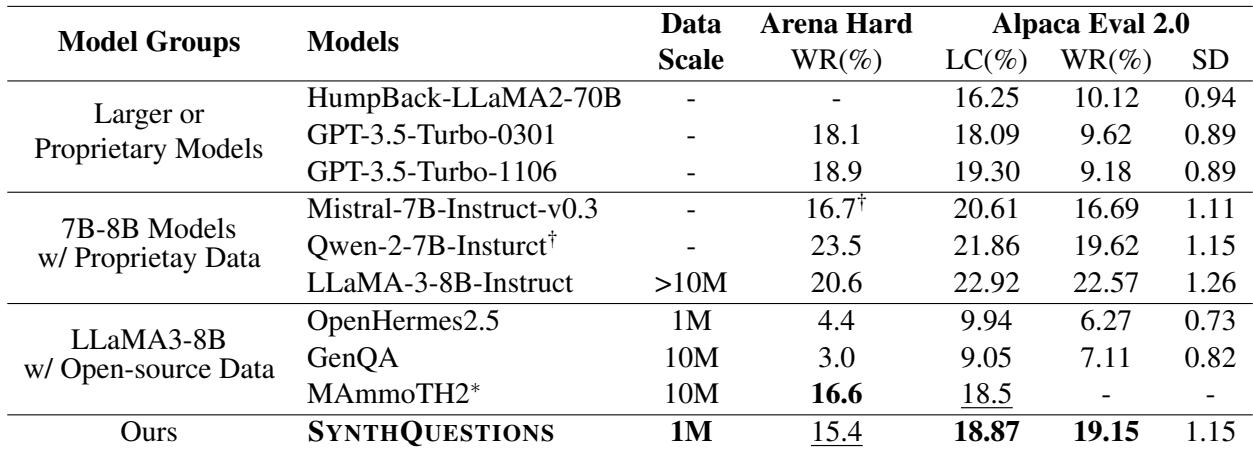
Models trained with SYNTHQUESTIONS achieve the strongest alignment performance among models trained on open-source data on Alpaca Eval 2.0. They also remain competitive with models trained on proprietary data, including surpassing Mistral-7B-Instruct-v0.3 on Alpaca Eval 2.0. On Arena Hard, MAmmoTH2 performs better, likely because it also uses external math and code datasets. SYNTHQUESTIONS training gives the best open-source-data result on Alpaca Eval 2.0. SYNTHQUESTIONS-trained models outperform MAmmoTH2 and HumpBack on Alpaca Eval 2.0. MAmmoTH2 leads on Arena Hard, possibly due to extra math and code fine-tuning. SYNTHQUESTIONS-trained models compare well with proprietary-data and reinforcement-learning models.
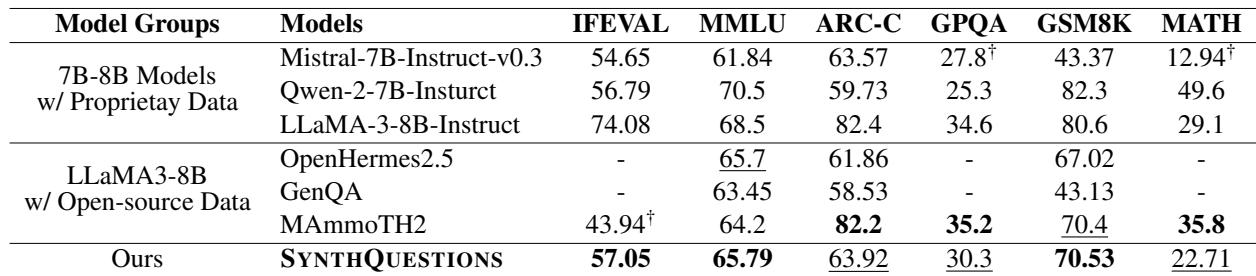
Models trained on SYNTHQUESTIONS remain strongly competitive on close-ended knowledge and reasoning tasks. Among models trained with open-source data, SYNTHQUESTIONS is consistently at or near the top across the reported benchmarks. Leading models trained with proprietary data still show advantages on several reasoning and subject-specific tasks. SYNTHQUESTIONS-trained models stay competitive with or ahead of open-source baselines on general knowledge, instruction following, and math tasks. Proprietary instruction-tuned models remain stronger on several advanced reasoning and subject-specific evaluations.
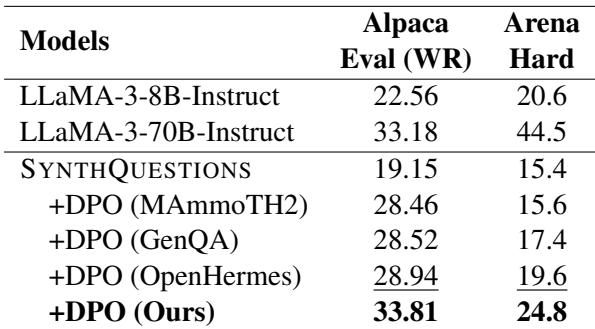
Models trained with DPO on the proposed synthetic instructions achieve the strongest results among the compared DPO variants. They reach the highest Alpaca Eval win rate and surpass LLaMA-3-70B-Instruct on that metric, while also improving Arena Hard scores over the other synthetic datasets. The Arena Hard results still remain below the 70B reference model, showing that the advantage is strongest on Alpaca Eval. DPO with the proposed dataset gives the best Alpaca Eval win rate among the evaluated DPO variants. The proposed DPO model outperforms LLaMA-3-70B-Instruct on the Alpaca Eval win rate. Arena Hard performance improves over other DPO datasets but remains lower than the 70B model.
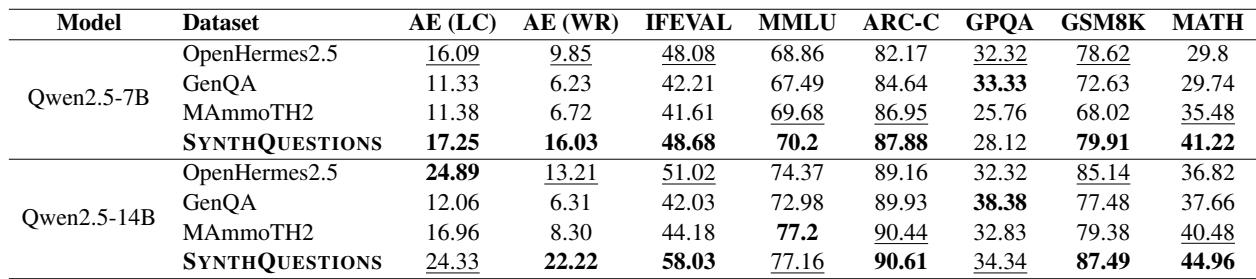
Training Qwen2.5-7B and Qwen2.5-14B on fixed-size instruction subsets shows that SYNTHQUESTIONS transfers well to different model sizes. In the Qwen2.5-7B comparison, it achieves the best scores on Alpaca Eval and most knowledge and reasoning benchmarks, with a pronounced advantage on MATH. Its weaker performance on GPQA indicates a remaining gap on science-heavy evaluation. SYNTHQUESTIONS gives the strongest Alpaca Eval results for Qwen2.5-7B. The advantage is largest on mathematical reasoning, especially MATH. GPQA performance is less competitive than on other reasoning benchmarks.
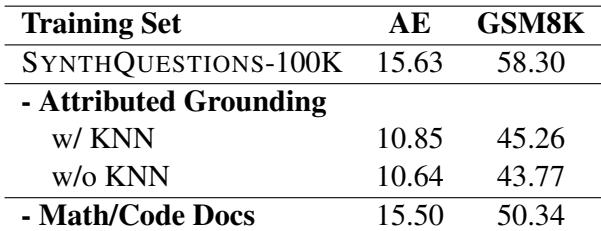
The ablation results show that removing attributed grounding causes both Alpaca Eval and GSM8K performance to drop clearly relative to the full synthesized instruction set. Including math and code documents has little effect on Alpaca Eval but helps GSM8K accuracy, indicating that those documents are especially useful for mathematical reasoning. Attributed grounding is a key driver of better overall model performance. Math and code documents mainly benefit GSM8K while preserving Alpaca Eval performance.
Experiments evaluate models trained or DPO-tuned on SYNTHQUESTIONS across open-ended instruction following, knowledge, reasoning, math, and ablation settings. The results show that the data yields strong open-source alignment, especially on Alpaca Eval, and remains competitive with proprietary or larger models, though proprietary models and external math/code tuned baselines can lead on Arena Hard or specialized reasoning. Cross-size and ablation experiments confirm good transfer, a pronounced gain in mathematical reasoning, and that attributed grounding is central, while math and code sources mainly help GSM8K.