Command Palette
Search for a command to run...
Muss NLP extraktiv sein?
Muss NLP extraktiv sein?
Steven Bird
Zusammenfassung
Wie lassen sich Sprachtechnologien in einer Welt mit 7.000 Sprachen verbreiten? Einer gängigen Erzählung zufolge skalieren wir die Erfolge der NLP auf die sogenannten spracharmen Sprachen und leisten dabei immer mehr mit immer weniger Ressourcen. Dieser Ansatz verkennt jedoch die Tatsache, dass die verbleibenden Sprachen – jenseits der etwa 500 institutionell verankerten Sprachen – mündliche Volkssprachen sind. Diese Sprechgemeinschaften interagieren mit der Außenwelt über eine Kontaktsprache. Ich argumentiere, dass Kontaktsprachen das geeignete Ziel für Technologien wie Spracherkennung und maschinelle Übersetzung sind und dass sich die rund 6.500 mündlichen Volkssprachen eines anderen Ansatzes bedürfen. Ich schildere Erfahrungen aus einer indigenen Gemeinschaft, in der lokale Akteure eine extraktive Agenda im Sinne ihrer relationalen Agenda umgestalteten. Ich beschreibe das aufkommende Paradigma der Relational NLP und erkläre, wie es den Weg zu nicht-extraktiven Methoden und zu Lösungen ebnet, die die menschliche Handlungsfähigkeit stärken.
One-sentence Summary
Researchers at the Northern Institute, Charles Darwin University propose Relational NLP, which targets contact languages for speech and translation technologies and frames engagement with the 6,500 oral vernaculars through non-extractive, community-driven methods that center Indigenous agency.
Key Contributions
- The paper argues that contact languages, not the approximately 6,500 oral vernaculars, should be primary targets for speech recognition and machine translation, while oral vernaculars require distinct methods.
- The paper develops Relational NLP as a Third Wave perspective that treats language technologies as sociotechnical tools for human agency, thick translation, dialect opportunities, and non-extractive community-centered methods.
- The paper grounds the proposal through Indigenous-community narratives and a synthesis of three NLP waves along seven dimensions, showing how extractive agendas can be reshaped into relational practice and community-centered design.
Introduction
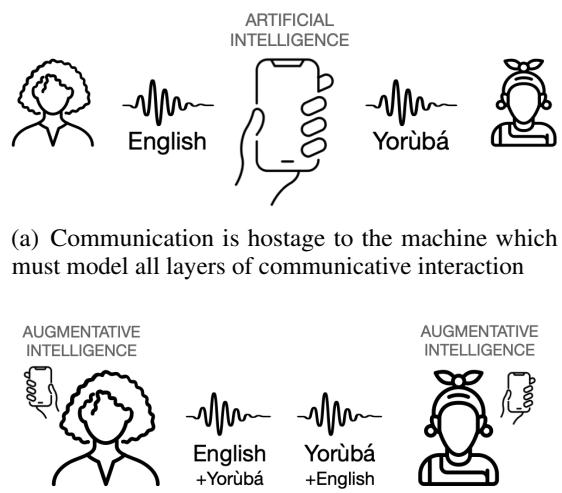
The paper examines natural language processing for oral and minoritized languages, arguing that generative AI and large language models often treat language as standardized text rather than situated human practice. This matters because massive multilingual systems promise broad access for speakers, yet most of the world’s languages are oral, embedded in local places, kinship systems, and shared histories that cannot be fully captured through scraped corpora or translation into written norms. The authors argue that first-wave symbolic and second-wave statistical NLP limit natural language by assuming bounded, standardised languages, cross-cultural semantic overlap, and extractive data pipelines that overlook agency, context, and power. They propose Relational NLP as a third wave, reframing language technologies as augmentative, community-centered tools that strengthen human agency instead of replacing it.
Dataset

-
The corpus is a small field dataset created during guided walking tours in Kabulwarnamyo, Arnhem Land, with local Kunwinjku speakers. The authors use the data to show how place-based, learner-directed audio can support language learning and documentation.
-
An early impromptu recording was collected, but it was excluded because it included incidental participants. The usable data comes from a more controlled guided-tour protocol.
-
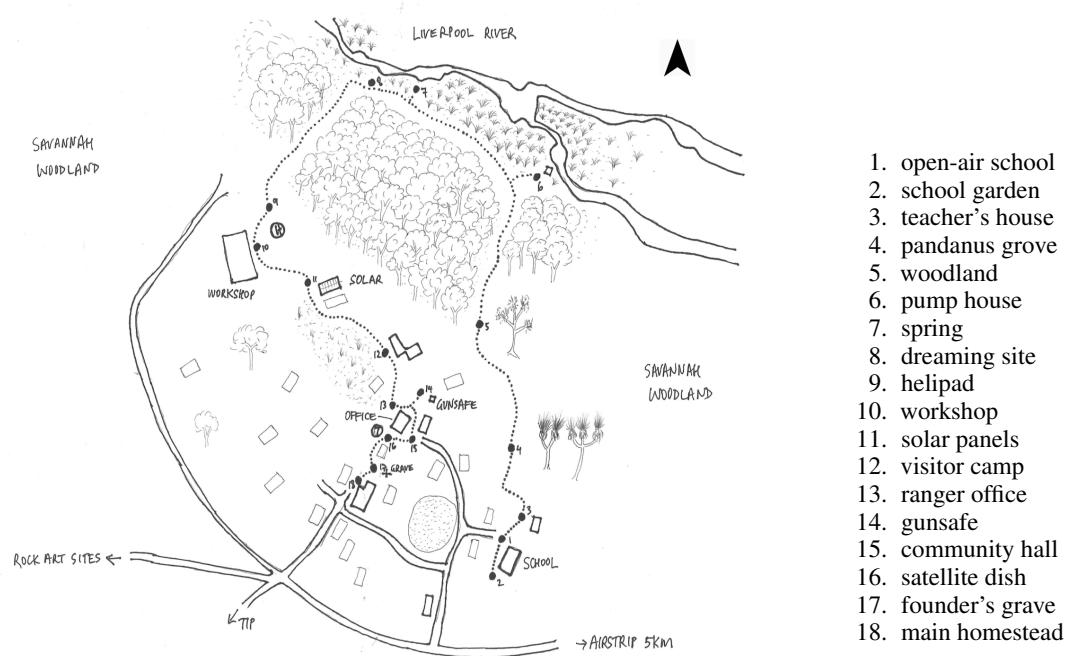
Main audio subset: eight participants were recorded while following the same community path. The path had 18 fixed locations, including an open-air school, school garden, teacher’s house, pandanus grove, woodland, pump house, spring, dreaming site, helipad, workshop, solar panels, visitor camp, ranger office, gunsafe, community hall, satellite dish, founder’s grave, and main homestead.
-
Audio capture details: recordings were made as 16 bit, 16 kHz mono audio using a wireless lapel microphone and a professional field recorder.
-
Participant metadata and recording schema: each session begins with the speaker introducing themselves and stating their clan and country. The fixed tour structure, stop list, and speaker information form the main metadata frame for the dataset.
-
Elicitation and annotation prompts: the author led the tour and stopped at each of the 18 sites. At places with plant species, the author prompted the speaker in Kunwinjku to name the plant and describe any known uses, seasons, or related knowledge. When a word seemed important, the author repeated it to encourage the speaker to elaborate.
-
Parallel language session: the paper describes one additional walkthrough in English, where the author acted as guide and provided plain English descriptions while Kunwinjku prompts were used. This illustrates the bilingual, location-based nature of the activity, though the documented corpus centers on Kunwinjku spoken on Country.
-
Respeaking and transcription processing: the authors created careful respeaking recordings by playing spontaneous audio phrase by phrase and repeating it in clearer near-field speech. A consultant corrected the author’s repeats to recover phonologically reduced morphemes, roots, and affixes. These respeaking files were used for internal analysis and checking, not as learner-facing audio. The main corpus was then transcribed using the Kunwinjku orthography.
-
Training use: the paper does not report training, validation, or test splits, nor does it report mixture ratios. The data are presented as a small annotated field corpus rather than a large machine training set.
-
How the authors use the data: they use the corpus as evidence of how Kunwinjku learning can occur through guided interaction with Country. They also frame it as a prototype for an augmentative intelligence application, where a mobile system could detect the user’s location, track recent speech production to estimate proficiency, and suggest relevant Kunwinjku words or phrases tied to the surrounding environment.
Method
The proposed method is organized as a situated, location-grounded recording pipeline. Its core module is a standardized guided tour. Instead of requesting isolated vocabulary or elicited sentences, the author adapts an existing community practice: showing visitors around Country. The participant leads the researcher along a fixed circuit through the community, pausing at a predefined set of eighteen locations, including the school garden, pandanus grove, spring, dreaming site, helipad, workshop, ranger office, and main homestead. The same route is repeated with multiple local guides, which creates parallel records that can later be compared, indexed by place, or sequenced by difficulty. Refer to the route diagram below:
The recording protocol has a clear front-end interaction module. At the beginning of each tour, the participant introduces themselves and identifies their clan and country. During the walk, the guide explains what is visible at each stop, including purpose, history, seasonal significance, and plant uses. The researcher elicits additional detail by pointing to objects or repeating terms that seem salient, but the participant remains the primary knowledge source. This design converts a social and safety-oriented tour into a structured documentation task while preserving the naturalness of the interaction. Audio is captured with professional field-recording equipment, using a wireless lapel microphone and a field recorder at 16 bit and 16 kHz mono, which keeps the data manageable while preserving enough speech quality for later analysis.
The pipeline includes a post-capture linguistic normalization module called careful respeaking. In this step, spontaneous phrases are replayed and then reproduced in a controlled near-field recording, as if dictating to a future transcriber. The purpose is to reduce the effect of phonological reduction in fluent speech and to make morphological structure more visible. For example, a reduced surface form such as [gAwdiri] can be expanded into the careful form /gAbiri−jAw−diri/, exposing the relationship among the pronoun, the diminutive, and the verbal root. The fluent speaker then corrects pronunciation, missed segments, and morpheme boundaries. This turns the respeaking process into a validation layer for identifying roots, affixes, and plausible interpretations before written transcription.
The resulting corpus is intentionally place-dependent. It is not designed to stand alone as a complete language resource. Its meaning depends on the physical locations, social relationships, and interpretive work of local experts. This design supports a later augmentative application layer. In one envisioned scenario, a mobile system could detect the speaker’s current location, analyze recent speech productions to estimate proficiency, and suggest words or phrases relevant to the place being visited. The system would not claim to translate or interpret the cultural content by itself. Instead, it would help the learner ask better questions and notice likely vocabulary at the right moment. As shown in the figure below:
The architecture therefore combines location-aware context tracking, speech production analysis, and suggestion generation. Its goal is to amplify human communication rather than replace it. The guided-tour recordings provide the contextual anchors, while local speakers remain essential for confirming names, histories, and appropriate usage.
Experiment
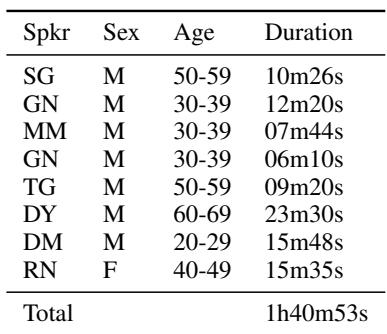
The table describes seven guided tour recordings by male participants spanning age groups from the 20s to the 60s. Recording durations vary widely, with some sessions under ten minutes and the longest exceeding twenty minutes. The variation suggests differences in tour length rather than a fixed recording time. All listed participants are male. Tour recordings range from under ten minutes to over twenty minutes. The longest recording is associated with the oldest age group.
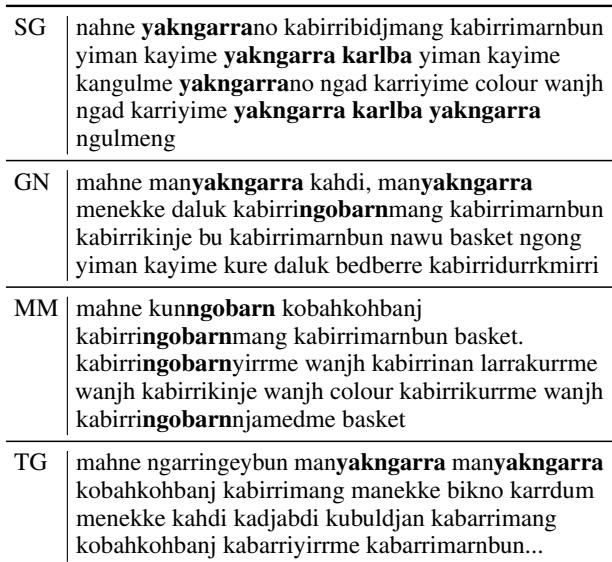
The transcription samples show recurring content words across different records made in the pandanus grove. Several variants share object terms and repeated word forms, while surrounding words differ. This suggests stable core vocabulary combined with variable phrasing across the samples. Repeated word forms appear across multiple transcription variants. Object terms such as basket and colour are present in several samples. The variants differ in wording and order while retaining recognizable content words.
The framework contrasts symbolic, subsymbolic, and relational approaches to language work, moving from formal codes and machine-readable data toward embodied social practice and human agency. It also shows shifting values and goals, from linguistic description and theoretical adequacy to scalable machine learning systems and then to cultural survival and community control. Each wave defines language differently, as a formal code, as sequence data, and finally as embodied social practice. Symbolic approaches emphasize precision, coverage, and formal grammars, while second wave approaches emphasize scalable data and efficient technological solutions. Relational approaches center local ownership, cultural survival, and methods such as story work with elders and Country.
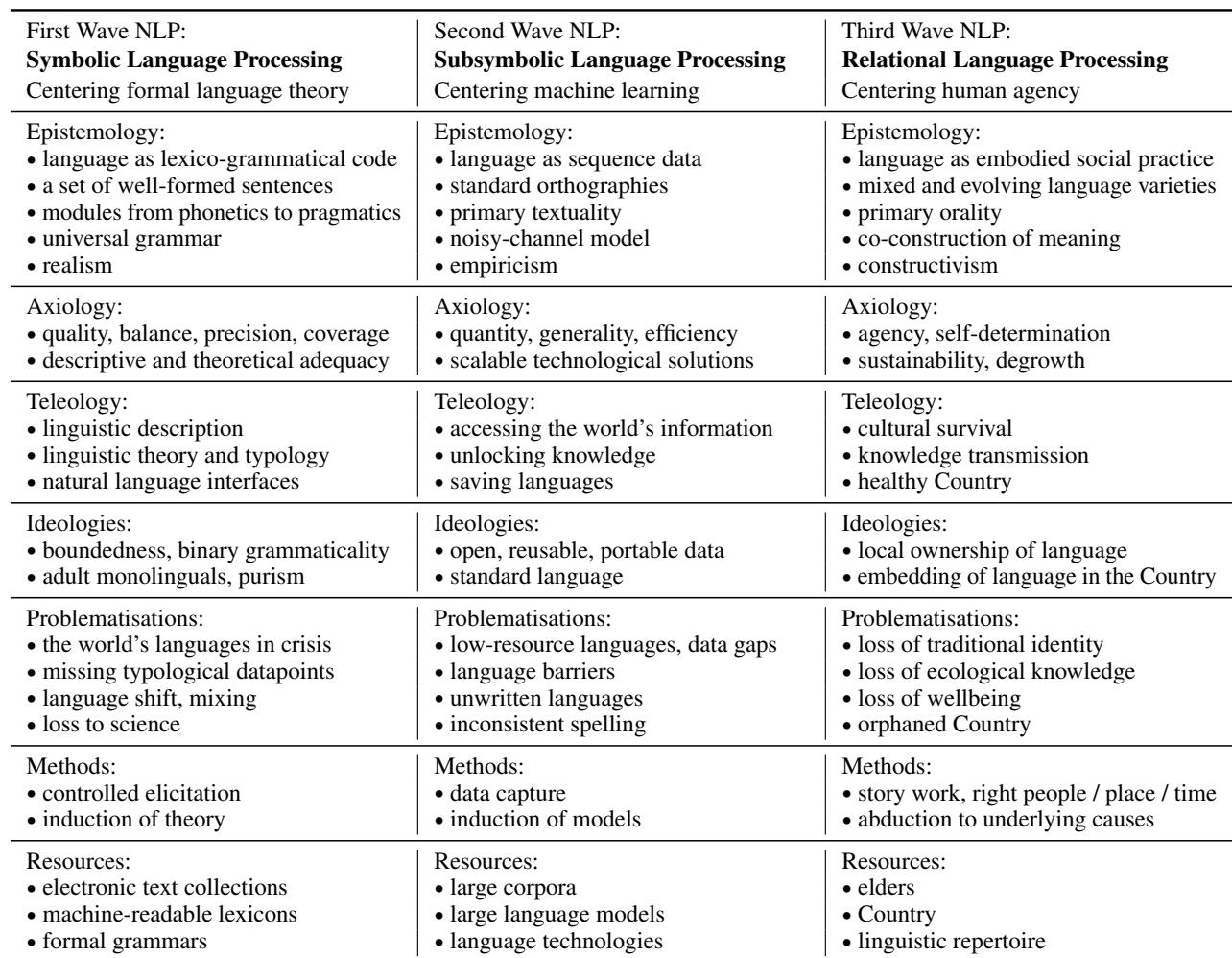
The evaluation examines seven male guided tour recordings of varying lengths, indicating that recording duration reflects tour length rather than a fixed protocol, with the longest session associated with the older age group. Transcription samples from the pandanus grove reveal recurring object terms and content words amid differing wording and order, supporting the presence of stable core vocabulary across variable phrasing. A comparative framework traces three approaches to language work, showing a shift from formal and scalable computational goals toward culturally grounded, community controlled practice.