Command Palette
Search for a command to run...
Verbesserung und Erweiterung von Videobearbeitungsfähigkeiten ohne Videos
Verbesserung und Erweiterung von Videobearbeitungsfähigkeiten ohne Videos
Ji Xie Yanhao Jia Xiangpeng Yang Martin Q. Ma Sihan Xu Erik Cambria Louis-Philippe Morency
Zusammenfassung
Bildbearbeitungsmodelle können einer Vielzahl von Anweisungen folgen, doch Videobearbeitungsmodelle hinken weiterhin hinterher, was teilweise auf die Schwierigkeit zurückzuführen ist, gepaarte Quellund bearbeitete Videos zu sammeln. Ist es möglich, fortgeschrittene Bildbearbeitungsfähigkeiten ohne neue gepaarte Videos auf Videoeditoren zu übertragen? Wir stellen Image-to-Video Transfer (I2VT) vor, das vortrainierte Videoeditoren verbessert und sie mithilfe eines Bildeditors auf neue Bearbeitungsaufgaben erweitert. Es ermöglicht effizientes Nachtraining ohne architektonische Änderungen und ohne neue Videos, wobei ausschließlich einzelne Bilder verwendet werden. Unsere Kernidee besteht darin, den Videoeditor in die Rolle eines Bildeditors schlüpfen zu lassen: Er bearbeitet ein Bild als Einzelbild-Video, wobei der Bildeditor die Vorhersagen des Videoeditors bei jedem Denoising-Schritt anleitet. Obwohl der Videoeditor während des Trainings nur Einzelbilder sieht, wendet er zur Testzeit die verbesserten und erweiterten Fähigkeiten auf ganze Videoclips an und bewahrt dabei die zeitliche Konsistenz. Um die Grenzen der Videobearbeitung zu erweitern, führen wir OpenVE++ ein, eine Erweiterung von OpenVE-Bench, die vier neue, für die Videoproduktion nützliche Bearbeitungsaufgaben hinzufügt, darunter Handlungsänderungen, Ausdrucksänderungen, Körperbewegungen und Szenen-Relighting. Unsere Experimente mit drei verschiedenen Videoeditoren zeigen, dass I2VT bestehende Bearbeitungsfähigkeiten verbessert und auf neue Aufgaben erweitert, und unsere Modelle erreichen State-of-the-Art-Leistungen (SOTA) sowohl auf OpenVE-Bench als auch auf OpenVE++.
One-sentence Summary
Researchers from Carnegie Mellon University, Nanyang Technological University, University of Technology Sydney, and University of Michigan introduce Image-to-Video Transfer (I2VT), which post-trains pretrained video editors with no architectural changes and no new videos by using only individual images and having each video editor role-play as an image editor with the image editor guiding its predictions at each denoising step, and OpenVE++, an extension of OpenVE-Bench that adds four video-production tasks including action changes, expression changes, body movements, and scene relighting; across three different video editors, I2VT improves existing editing capabilities and expands them to new tasks, achieving state-of-the-art performance on both OpenVE-Bench and OpenVE++.
Key Contributions
- Image-to-Video Transfer (I2VT) is proposed as a post-training method that improves pretrained video editors and expands them to new editing tasks by letting the video editor edit an image as a one-frame video, with an image editor guiding its predictions at each denoising step, using only individual images and no new paired videos or architectural changes.
- OpenVE++ is introduced as an extension of OpenVE-Bench that adds four video-production-oriented editing tasks: action changes, expression changes, body movements, and scene relighting.
- Experiments across three video editors show that I2VT improves existing editing capabilities, enables the new tasks, generalizes to whole video clips while preserving temporal consistency, and achieves state-of-the-art results on OpenVE-Bench and OpenVE++.
Introduction
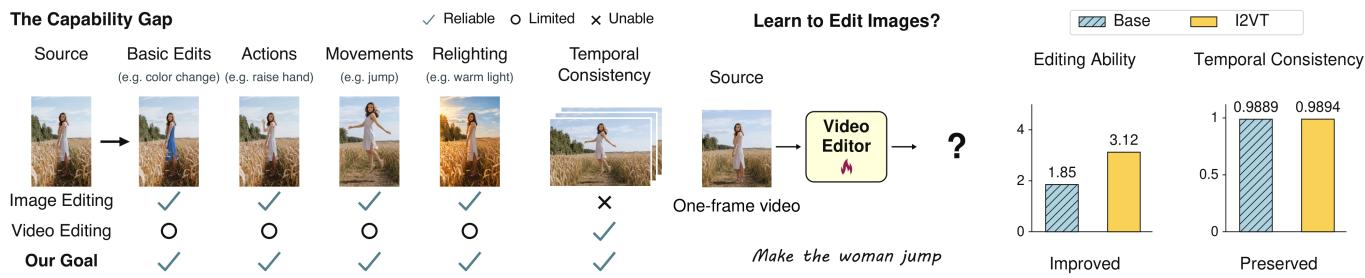
Recent image editing models have advanced rapidly with diverse paired datasets, but video editors still lag on basic edits and struggle with production-oriented tasks such as changing a person’s actions, expressions, body movement, or scene lighting. A key bottleneck is the difficulty of creating high-quality paired video editing data, especially for complex and diverse edits. The authors propose Image-to-Video Transfer (I2VT), which lets a pretrained video editor role-play as an image editor by learning from a frozen image editor’s denoising feedback on single images, avoiding new paired videos and architecture changes. They also introduce OpenVE++, a benchmark extension with four new tasks, and show that I2VT improves basic edits and enables new capabilities that generalize to full video clips with temporal consistency across three video editors.
Dataset

- Source and scale: The authors build I2VT-17K by sampling individual frames from OpenVE-3M, a dataset already commonly used to train video editors. The name indicates a 17K-scale dataset.
- Composition: Frames and instructions are organized into two pools: the OpenVE pool for basic edits, and the OpenVE++ pool for four additional task groups.
- OpenVE++ task groups:
- Action Change: head, gaze, and arm edits where the person stays in place.
- Body Movement: whole-person movements such as crouching, jumping, sitting down, standing up, and turning.
- Expression Change: facial expressions such as sadness, happiness, and anger.
- Scene Relighting: changes to light type and direction.
- Filtering and instruction creation: For the new tasks, a Vision-Language Model describes the source frame so the authors can choose a suitable edit and write its instruction. An instruction is accepted only if the frame contains what the edit needs and does not already show the requested change. For example, raising an arm requires the arm to be visible and not already raised.
- Instruction variants: The same edit is specified with two instruction forms. c_img refers to a single image, while c_video refers to a video and may include temporal requirements such as “throughout the video.” Conversion between these forms uses simple text replacements.
- Use in the model: The dataset provides paired frame-instruction training data for video editing models, combining basic edit examples from OpenVE with the four new OpenVE++ task types. No explicit training split or mixture ratio is given in this section. No separate cropping strategy is described beyond sampling individual frames from OpenVE-3M.
Method
The authors introduce Image-to-Video Transfer (I2VT), a method that allows a pretrained video editor to role-play as an image editor. By treating an individual image as a one-frame video, the video student is fine-tuned with guidance from a frozen image teacher at each denoising step. As a baseline, the authors also consider offline distillation, where the student is fine-tuned on source and edited image pairs prepared by the image teacher.
In the offline distillation baseline, the image teacher applies an instruction to a source image to produce an edited target. The video student is then fine-tuned on these pairs, treating both images as one-frame videos. To form the flow-matching target, the edited image is encoded into a clean latent and noised at a random time step. The student learns to predict the velocity using the following loss:
Loff=ED,t,ϵθ(xte,t,cvideo)−(ϵ−x0e)22.However, this offline approach fine-tunes the student on noised teacher outputs rather than states from its own rollouts, which may disrupt the student's original rollout distribution.
To address this, I2VT fine-tunes the video student along its own denoising trajectory. The student edits each source image as a one-frame video from noise, and the teacher guides its prediction at each step. This process leverages the shared VAE latent space used by existing image and video models.
Refer to the framework diagram:
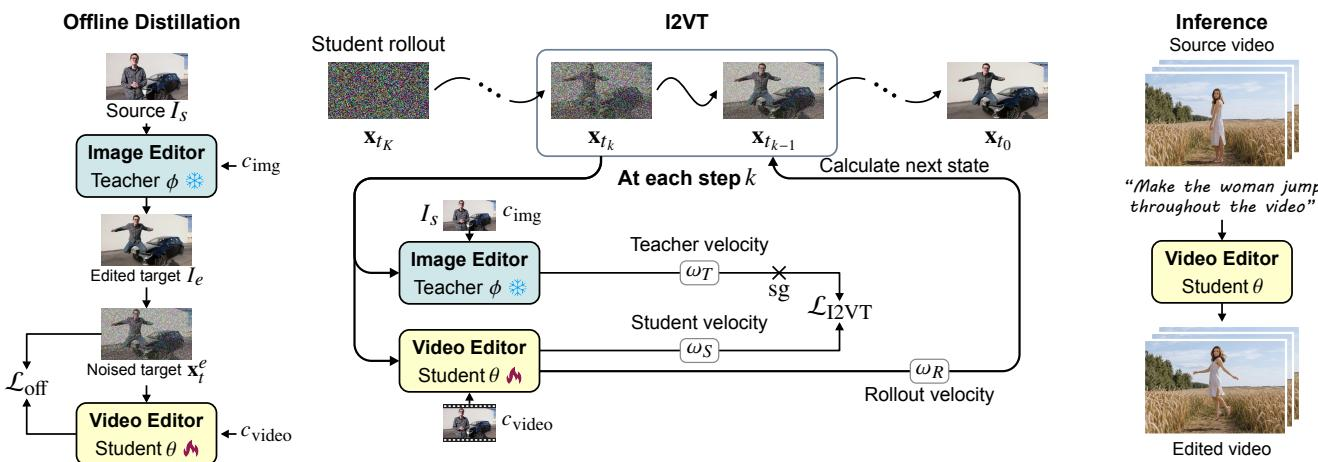
As shown in the figure above, for each training example, the student is initialized at pure noise and rolled out over K denoising steps. The timesteps decrease from noise to the clean edited image, and each step updates the state as follows:
xtk−1=xtk+(tk−1−tk)rollout velocityθ(xtk,tk,cvideo).At each step k, the state is fed to the teacher, which returns a target velocity for the edited frame. The student is fine-tuned by matching its own velocity to this target:
LI2VT=student velocityθ(xtk,tk,cvideo)−sg(teacher velocityϕ(xtk,tk,cimg))22,where sg is the stop-gradient operator. Rollout states and teacher targets are treated as constants, so gradients flow only through the student velocity.
Both image and video editors follow the instruction through classifier-free guidance (CFG). The guided velocity is computed as:
θω(xt,t,c)=(1−ω)θ(xt,t,∅)+ωθ(xt,t,c),where ∅ denotes an empty prompt. In I2VT, the rollout, student, and teacher velocities each use their own guidance scale. At inference time, the teacher is discarded, and the student edits a source video using the sampler and the same settings as the pretrained editor. Although fine-tuned only on single frames, it generalizes the improved capabilities to the whole video.
The authors build the training dataset by sampling individual frames from a large video dataset and organizing them into pools for basic edits and new task groups. These new tasks include action changes, body movements, expression changes, and scene relighting.
As shown in the figure below:
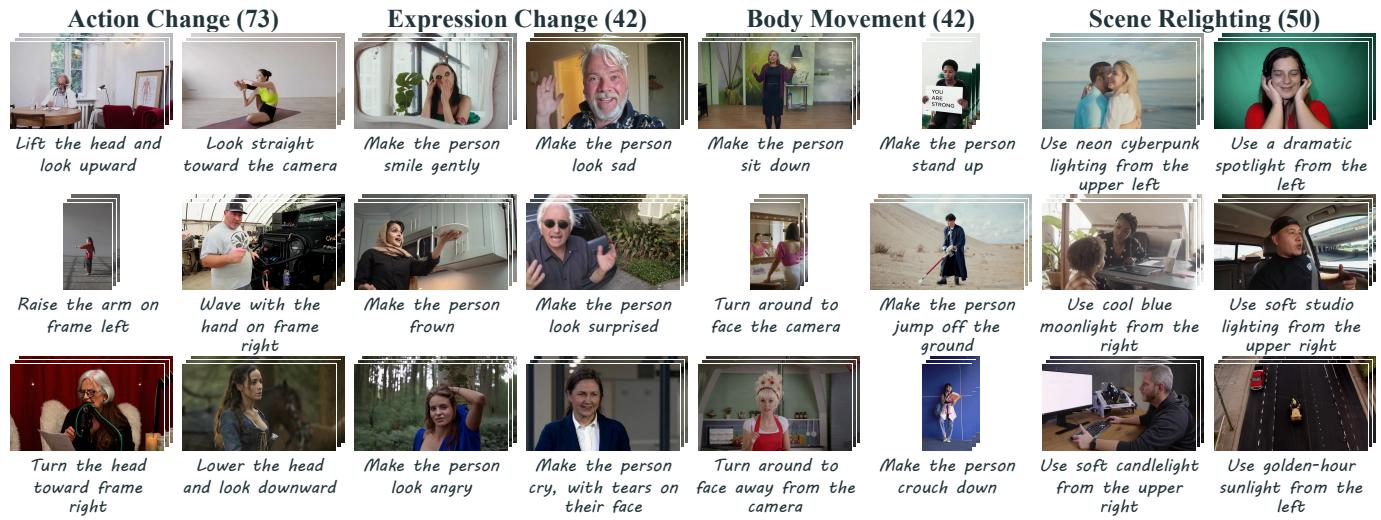
For the new tasks, a Vision-Language Model describes the source frame to select a suitable edit and write its instruction. The instructions are adapted for each model, with the video instruction potentially including temporal requirements.
Experiment
The experiments evaluate I2VT on three pretrained video editors, Bernini-R-1.3B, Bernini-R-14B, and VideoCoF, using an image editor as teacher and fine-tuning with single-frame LoRA on OpenVE-Bench and the new OpenVE++ categories. Results show that I2VT consistently strengthens existing basic editing skills and teaches new action, expression, and body-movement edits from images alone, with online rollout supervision outperforming offline distillation overall. The fine-tuned models achieve state-of-the-art results among compared open-source video editors while maintaining broadly comparable temporal and visual quality, and they also improve generalization on an out-of-distribution benchmark.
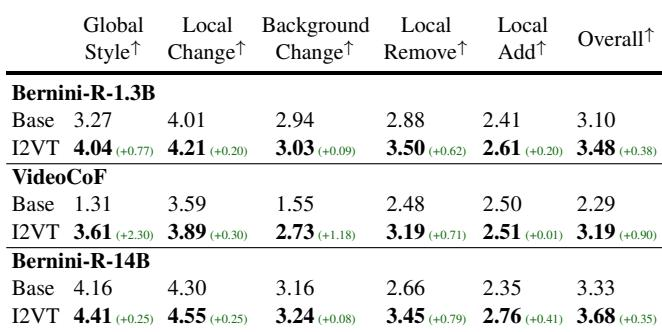
Distilling with I2VT improves basic editing performance across all three video editors tested. VideoCoF shows the largest overall gain, rising from 2.29 to 3.19, while the Bernini-R models improve by smaller margins. Gains are uneven across categories, with global style and local remove improving substantially and local add remaining nearly flat for VideoCoF. I2VT raises overall basic-edit scores for all three editors, with the largest absolute improvement for VideoCoF. Global style and local remove show substantial gains for Bernini-R-1.3B, while local add improves only modestly. VideoCoF's global style and background change scores increase sharply, but local add is nearly unchanged.
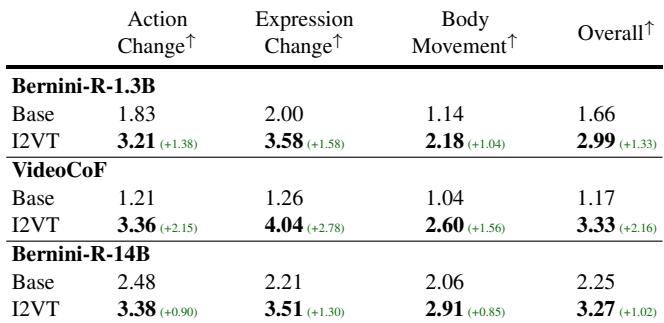
Distillation with I2VT adds action change, expression change, and body movement editing abilities to all three base video editors. VideoCoF starts from the weakest baseline but improves the most overall, reaching a level similar to the fine-tuned Bernini-R-14B. Expression change gains the most among the new tasks, while body movement shows the smallest improvement. All three base editors improve on action change, expression change, and body movement after distillation. VideoCoF shows the largest overall gain and reaches a comparable level to the fine-tuned Bernini-R-14B despite a much weaker starting point. Expression change improves the most across the reported student editors, while body movement improves the least.
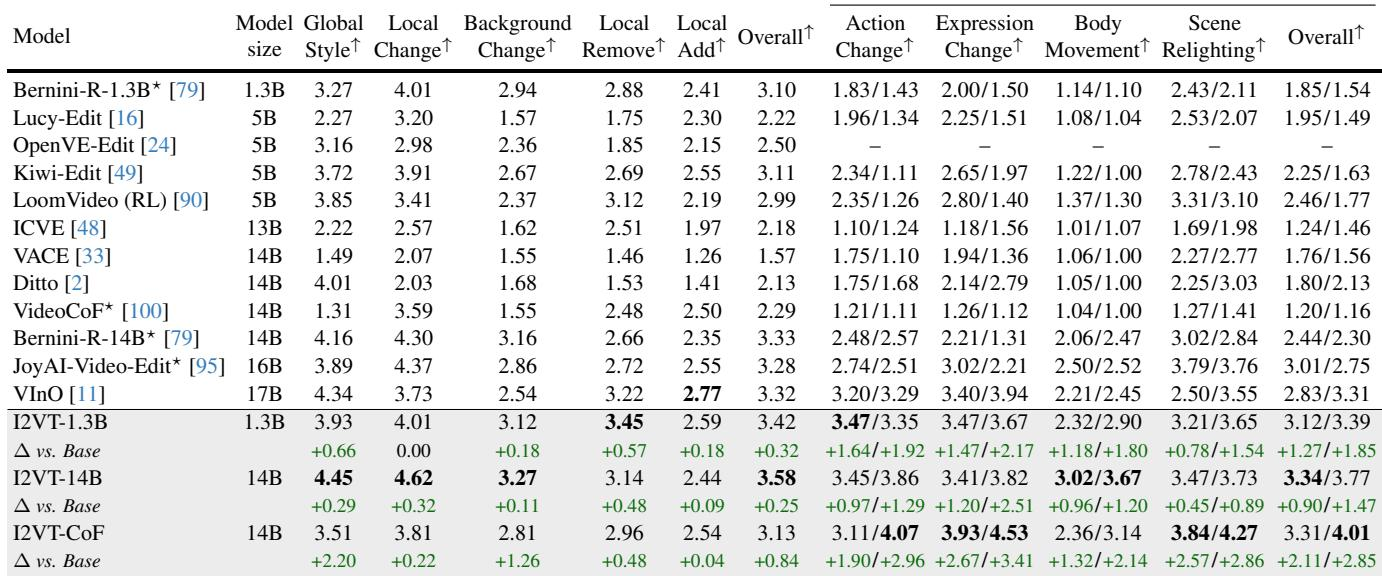
Existing open-source video editors generally score higher on basic edits than on newer tasks such as action changes and body movement, where all listed baselines remain relatively weak. Among the compared baselines, LoomVideo (RL) and Kiwi-Edit lead the new task aggregate, while Bernini-R-1.3B and Kiwi-Edit are strongest on basic editing. The proposed I2VT models are reported in the cited evaluation to outperform these open-source baselines on both basic and new task benchmarks. New editing tasks are considerably harder for existing editors than basic edits, with body movement and action change scores remaining low across all listed models. Among baselines, LoomVideo (RL) achieves the best new task overall and the highest global style and scene relighting scores, while Kiwi-Edit is competitive on expression changes. Basic editing strengths are concentrated in local changes and global style, whereas background change and local add are weaker across several baselines. The proposed I2VT-14B is reported to surpass all compared open-source editors on both basic and new task aggregate scores.
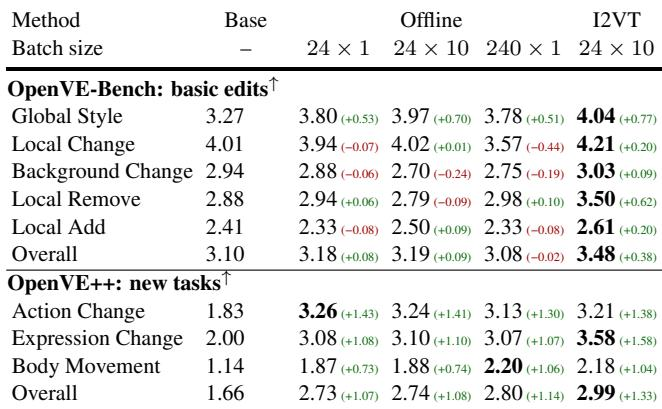
Offline configurations on Bernini-R-1.3B improve global style but reduce background-change performance relative to the base model. I2VT achieves the highest overall scores on both basic and new tasks, while offline distillation shows trade-offs and a remaining gap on body movement. All tested offline configurations improve global style over the base model but consistently lower background-change scores. I2VT attains the highest overall performance on both basic and new task pools, despite some offline configurations slightly outperforming it on action changes or body movements.
On OpenVE-Bench, the default guidance configuration of 1 for rollout, student, and teacher scales scores highest overall among the tested settings. Raising student guidance substantially degrades performance, while raising rollout guidance has little effect on basic edits. Stronger teacher guidance underperforms the default on basic edits but can improve harder task groups when applied selectively. Default guidance of 1 for all scales yields the highest overall score, while increasing student guidance causes large drops and can fall below the base model. Rollout guidance changes have little effect on basic edits, and selective stronger teacher guidance improves harder tasks without hurting overall OpenVE-Bench scores.
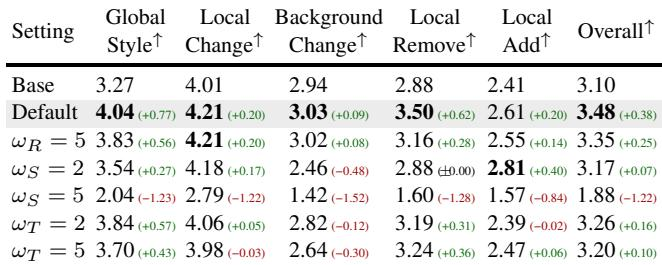
The experiments evaluate an I2VT distillation approach across three video editors, covering basic editing, newly added action, expression, and body movement tasks, comparisons with open-source baselines, offline distillation variants, and guidance-scale settings on OpenVE-Bench. Distillation consistently improves basic editing, with VideoCoF gaining the most and global style or local remove improving more than local add; it also adds action, expression, and body movement abilities, with expression changes improving most and body movement least. The resulting I2VT models outperform existing open-source editors on both basic and new task aggregates, while offline distillation improves global style but reduces background change. Default guidance scales perform best overall, whereas higher student guidance hurts and selective stronger teacher guidance can aid harder tasks.