Command Palette
Search for a command to run...
SLIC: Reinforcement-Feintuning kleiner Sprachmodelle für die mehrstufige Analogschaltungsoptimierung
SLIC: Reinforcement-Feintuning kleiner Sprachmodelle für die mehrstufige Analogschaltungsoptimierung
Yan Xu Zhengqi Gao Ching-Yun Ko Zhang-Wei Hong Wenjie Lu Tao Yu Xin Zhang Duane S. Boning Ruonan Han
Zusammenfassung
Der Entwurf analoger integrierter Schaltungen (IC) ist eine mehrstufige, simulatorgestützte Ingenieuraufgabe, die iteratives Schlussfolgern über gekoppelte Leistungskompromisse erfordert. Proprietäre Process-Design-Kits (PDKs) erschweren jedoch den Einsatz gehosteter Large-Language-Model-Workflows in praktischen Entwurfsumgebungen. Wir präsentieren SLIC – Small LM Iterating on Circuits – ein Reinforcement-Feintuning-Framework, das ein lokal einsetzbares Sprachmodell im 4B-Maßstab für die Closed-Loop-Optimierung analoger Schaltungen trainiert. SLIC kombiniert strukturierte Schaltungsrepräsentationen mit diskretisierten Aktionen zur relativen Anpassung, domänenund erfolgsgesteuerten multiobjektiven Belohnungen sowie Reward-Guided Rollout Steering (RGRS), das schrittweises Simulatorfeedback in Signale sowohl für das Policy-Lernen als auch für die Online-Rollout-Konstruktion in dieser spärlichen, stark restriktiven Domäne überführt. Darüber hinaus veröffentlichen wir einen offenen, zielkonditionierten Benchmark mit 41 Verstärkertopologien und standardisierten Protokollen für die In-Distribution-Validierung, die Evaluation auf zurückgehaltenen Topologien und den Transfer über Technologieknoten hinweg. Ausschließlich mit quelloffenen 65-nm-CMOS-Predictive-Technology-Models (PTM) trainiert, erreicht SLIC RANDOM 87,1 % In-Distribution-Pass@1 bei vier Spezifikationen innerhalb von acht Runden und übertrifft damit das 763B-Modell DeepSeek-V4.1-Flash THINK um 48,5 Prozentpunkte. Außerhalb der Trainingsverteilung erreicht SLIC-SOFTMAX 72,6 % Pass@1 auf zurückgehaltenen Topologien, und die trainierten Policies übertragen sich konsistent auf fünf ungesehene Technologieknoten ohne zusätzliches Feintuning. Dieser Transfer erstreckt sich auf ein kommerzielles TSMC-65-nm-CMOS-PDK, bei dem SLIC-RANDOM 49,9 % Pass@1 auf zurückgehaltenen Topologien erzielt, was den praktischen Einsatz durch lokale Inferenz ohne Übertragung proprietärer Daten an externe LLM-Dienste demonstriert. Die Leistung skaliert weiter mit Testzeit-Simulatorinteraktionen und erreicht bis zu 83,2 % Pass@1 auf zurückgehaltenen Topologien bei einem Budget von 32 Runden, was darauf hindeutet, dass SLIC es der kleinen Policy ermöglicht, zusätzliche Simulatoraufrufe in verbesserte Schaltungsentwürfe umzusetzen. Projektseite: https://hangroup.mit.edu/slic/.
One-sentence Summary
Developed by MIT, Analog Devices, Inc., and IBM Research, SLIC (Small LM Iterating on Circuits) is a reinforcement fine-tuning framework that trains a 4B-scale, locally deployable language model for multi-turn analog circuit optimization using structured circuit representations, discretized relative-update actions, success-gated multi-objective rewards, and Reward-Guided Rollout Steering, with SLIC RANDOM achieving 87.1% in-distribution four-specification Pass@1 within eight turns and SLIC-SOFTMAX reaching 72.6% held-out topology Pass@1 while transferring across technology nodes.
Key Contributions
- SLIC is a reinforcement fine-tuning framework that trains a 4B-scale, locally deployable language model for closed-loop analog circuit optimization, using structured circuit representations and discretized relative-update actions.
- SLIC combines domain- and success-gated multi-objective rewards with Reward-Guided Rollout Steering, which turns per-step simulator feedback into signals for policy learning and online rollout construction. The 4B SLIC-RANDOM policy achieves 87.1% in-distribution four-specification Pass@1 within eight turns, surpassing the 763B DeepSeek-V4.1-Flash THINK baseline by 48.5 percentage points.
- An open, goal-conditioned benchmark of 41 amplifier topologies is released with protocols for in-distribution validation, held-out topology evaluation, and cross-technology-node transfer. Trained policies reach 72.6% held-out topology Pass@1 with SLIC-SOFTMAX, 49.9% held-out-topology Pass@1 on a commercial TSMC 65 nm CMOS PDK with SLIC-RANDOM, and 83.2% held-out Pass@1 with a 32-turn test-time budget.
Introduction
Analog integrated circuits are critical interfaces between physical signals and computation, but their design remains manual, expert-driven, and tightly coupled to specific process technologies, limiting scalability. Prior AI-driven automation often struggles with scarce public circuit data, technology fragmentation, limited transfer across topologies, and the privacy and cost risks of relying on external LLM APIs. The authors introduce SLIC, a locally deployable 4B-parameter small language model framework that treats analog circuit optimization as a multi-turn, simulator-grounded reinforcement learning problem with verifiable rewards. Trained only on synthetic data from public 65 nm predictive technology models, SLIC transfers to held-out topologies, unseen technology nodes, and a commercial TSMC 65 nm PDK without additional fine-tuning.
Dataset
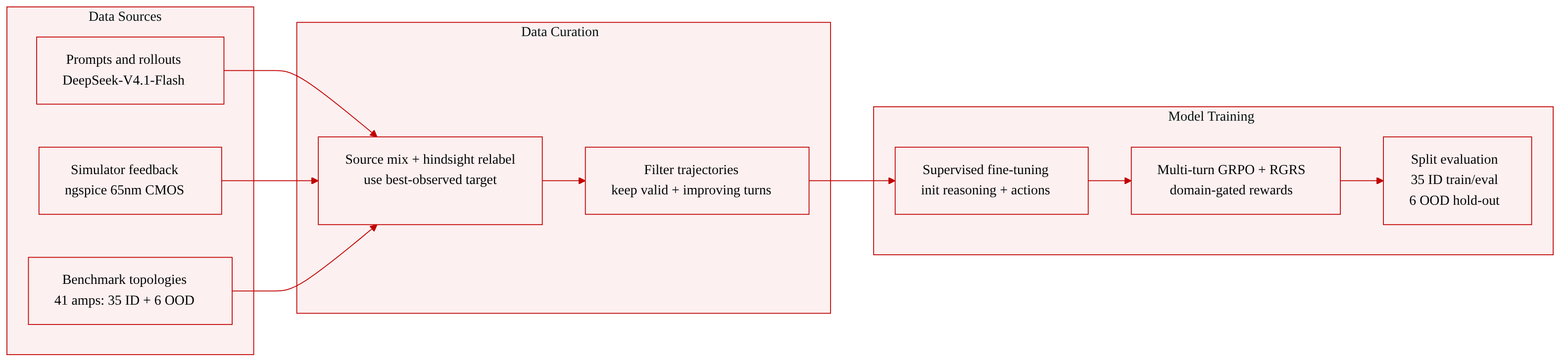
The authors use two related data components: a simulator-grounded synthetic trajectory set for training and an amplifier topology benchmark for evaluation.
- Synthetic data sources and composition: Trajectories are collected by running a strong prompted model, DeepSeek-V4.1-Flash, on simulator-grounded multi-turn circuit optimization without explicit goals. Each trajectory is then relabeled with its best-observed performance tuple as the goal-conditioned training target, following hindsight relabeling. This avoids the need for labeled circuit and target-specification pairs.
- Synthetic data filtering: The dataset is filtered to retain valid and performance-improving turns before supervised fine-tuning.
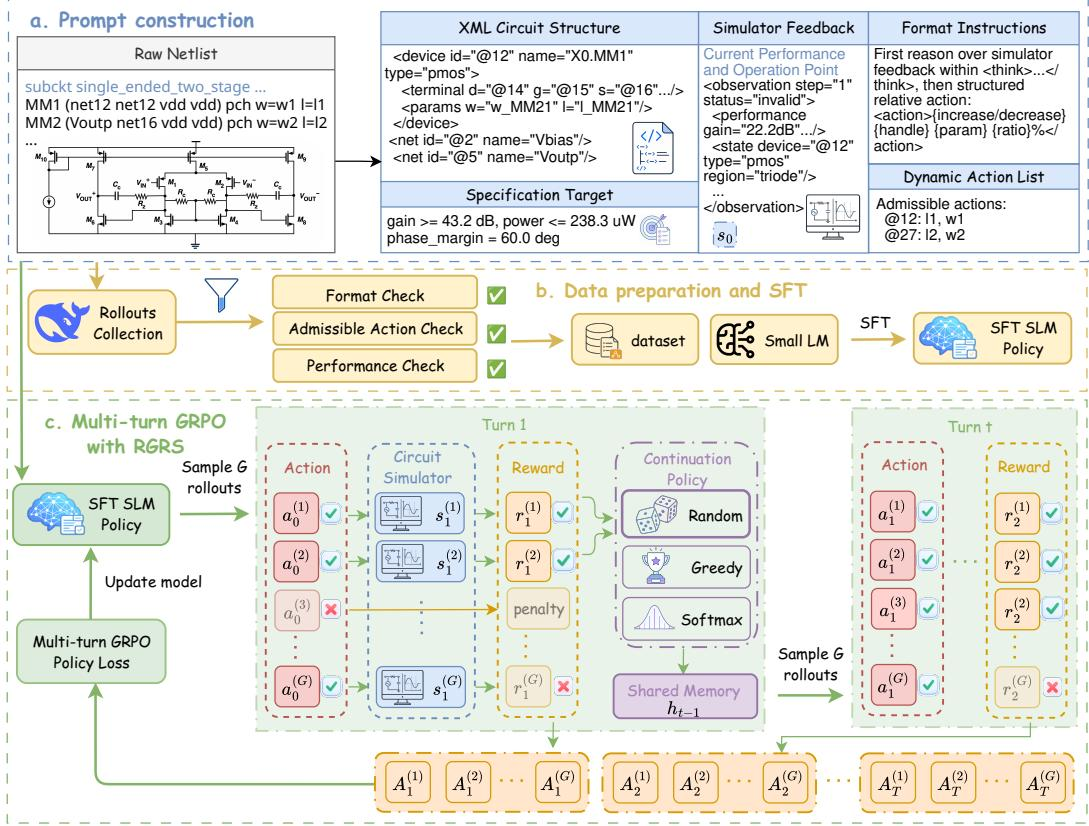
- Prompt and action schema: Each prompt includes XML-structured circuit state, target specifications, simulator feedback, and a dynamically generated admissible action list. The policy outputs reasoning and interpretable discretized relative-update actions rather than absolute parameter values.
- Benchmark composition: The benchmark contains 41 amplifier topologies. Of these, 35 are used for training and in-distribution evaluation, while 6 are held out for out-of-distribution evaluation.
- Benchmark subsets: Topologies are further divided into Simple and Complex categories, each paired with multiple target goals and initial states. The benchmark spans different topology complexity, tunable parameter counts, and valid/invalid initial-state ratios.
- Simulation environment: Training tasks are simulated with ngspice using the 65 nm bulk CMOS Predictive Technology Model. Cross-technology evaluation uses corresponding PTM models for 22-45 nm and 90-130 nm nodes. Cadence Spectre with a commercial TSMC 65 nm PDK is used for evaluation.
- How the data is used: The filtered synthetic trajectories are used for supervised fine-tuning to initialize the policy with basic reasoning and action-generation behavior. The SFT checkpoint is then trained with multi-turn GRPO using domain-gated rewards and reward-guided rollout steering. The topology benchmark is used for training and in-distribution evaluation on 35 topologies and for out-of-distribution evaluation on 6 held-out topologies.
Method
The authors formulate analog circuit optimization as a multi-turn reinforcement learning with verifiable rewards problem. At each turn t, the state st=(ct,ft) consists of the textual circuit representation ct and the simulator feedback ft, which includes measured performance metrics and device-level operating states. Given the task specification q and the interaction history ht, the policy generates a sequence of circuit edit actions at∼πθ(⋅∣ht). The simulator applies these updates and returns the next state st+1 along with a verifiable reward rt.
To address the scarcity of labeled circuit data, the authors introduce the SLIC framework, which leverages simulator-grounded synthetic data and a structured training pipeline.
Refer to the framework diagram
The pipeline begins with prompt construction, where each prompt integrates an XML-structured circuit state, target specifications, simulator feedback, and a dynamically generated admissible action list. Instead of predicting absolute parameter values, the policy outputs reasoning traces and interpretable discretized relative-update actions. For the supervised fine-tuning phase, the authors collect trajectories from a strong prompted model without specifying explicit goals. They then relabel each trajectory with its best-observed performance tuple as the goal-conditioned training target, following the hindsight experience replay principle. This synthetic dataset is filtered to retain only valid and performance-improving turns, initializing the policy with fundamental reasoning and action-generation capabilities.
Following supervised fine-tuning, the policy is further optimized using multi-turn Group Relative Policy Optimization. To overcome the challenges of applying off-the-shelf methods to analog circuit design, such as tightly coupled performance requirements and ambiguous credit assignment, the authors introduce domain-specific adaptations. First, they design a domain reward shaping mechanism that prioritizes valid amplification and joint specification satisfaction. Domain-validity gates are applied before aggregating per-specification rewards; for instance, non-positive gain suppresses credit for power and bandwidth, and an in-band flatness gate prevents distorted frequency responses from receiving misleading rewards. Additionally, a success-conditional slack bonus is implemented to prioritize target satisfaction. Unsuccessful scores are strictly kept below one, while successful scores are assigned in the range [1,1.5] with a bonus based on the mean normalized specification slack. This ensures that even when all candidates in a group succeed, the model receives a rich learning signal based on performance headroom. For policy updates, the validity and performance feedback are normalized separately before combining their advantages.
To further refine the training process and resolve credit-assignment ambiguities in multi-turn optimization, the authors propose Reward-Guided Rollout Steering. During the multi-turn optimization phase, this module samples G candidate responses from the same interaction history at each turn. These candidates propose alternative parameter edits, which are evaluated through the circuit simulator. This search-augmented procedure serves a dual purpose. For policy learning, all sampled candidates remain available for group-relative updates, providing same-context comparisons for stepwise advantage estimation. The advantage for each trajectory is normalized across the sampled group as:
A^i=σG+ϵRi−μGwhere μG and σG are the mean and standard deviation of the returns Ri across the group. The policy is updated using a clipped objective:
LGRPO(θ)=EG1i=1∑G∣oi∣1ℓ=1∑∣oi∣min(ρi,ℓ(θ)A^i,ℓ,clip(ρi,ℓ(θ),1−ϵlow,1+ϵhigh)A^i,ℓ)where ρi,ℓ(θ) is the token-level importance ratio.
For trajectory construction, the steering module selects one eligible successor as the parent state to advance the shared history. Continuation selection is restricted to valid candidates whenever available. The authors explore three continuation policies to balance performance preference and exploration: RANDOM samples uniformly from eligible candidates, GREEDY selects the highest-scoring candidate, and SOFTMAX favors higher-scoring candidates while retaining a nonzero selection probability for others. This design effectively treats search as a policy-improvement operator, allowing the model to internalize improved behavior derived from simulator-interactive feedback.
Experiment
The study evaluates simulation-guided multi-turn analog circuit optimization on 41 amplifier topologies, using 35 for in-distribution and 6 held-out topologies for out-of-distribution evaluation under four specification targets and validity gates. The main comparisons show that SLIC policies outperform their SFT initialization and untuned or prompt-based LLM baselines, and generalize to held-out topologies, complex circuits, and unseen technology nodes, including transfer to a commercial TSMC 65nm PDK without additional fine-tuning. Ablations confirm the benefit of domain-validity guidance and a success-conditional slack bonus, particularly for out-of-distribution generalization. Further analyses show robustness across backbones and improved test-time scaling with moderate multi-turn training, while reinforcement fine-tuning concentrates success into fewer rollouts.
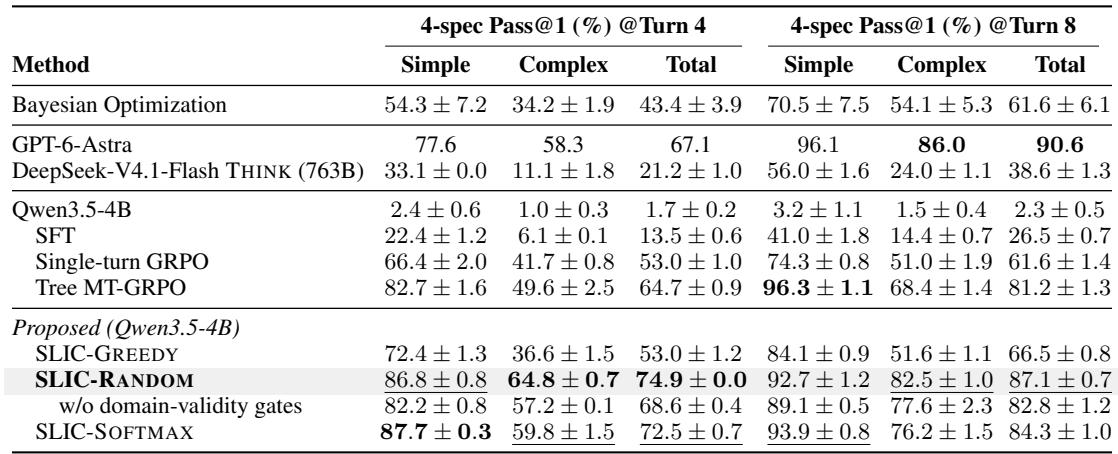
SLIC variants substantially outperform SFT and DeepSeek at both four-turn and eight-turn evaluation horizons, and reinforcement fine-tuning lifts the 4B student from below its DeepSeek teacher to well above it. At four turns, SLIC-RANDOM surpasses GPT-6-Astra, while at eight turns GPT-6-Astra holds a narrow overall lead over the locally deployable SLIC-RANDOM policy. Among SLIC variants, softmax sampling is strongest on simple topologies, while random sampling leads on complex topologies and overall. SLIC-RANDOM exceeds GPT-6-Astra at four turns and nearly matches it at eight turns despite being a locally deployable 4B policy. Softmax sampling performs best on simple topologies, whereas random sampling performs best on complex topologies and overall.
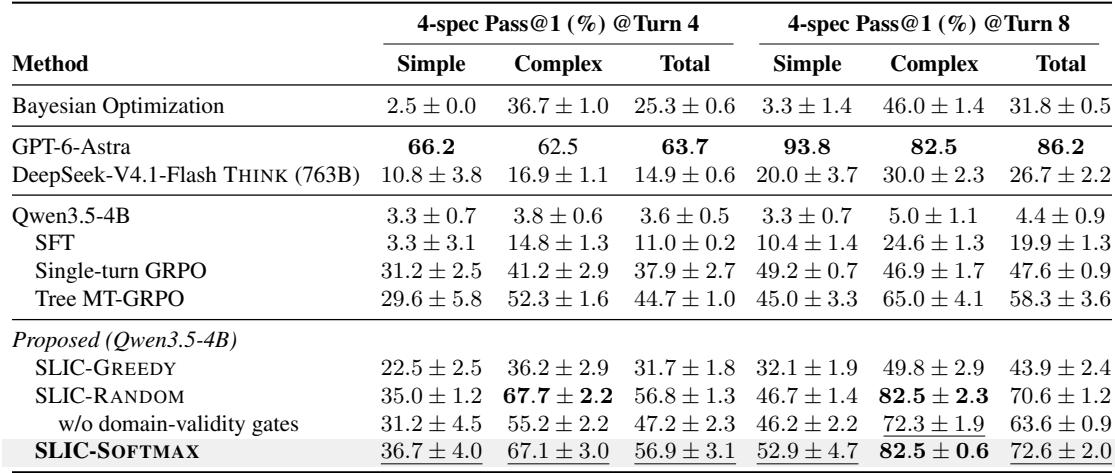
On held-out PTM 65 nm tasks, GPT-6-Astra reports strong overall success, with its advantage concentrated on simple topologies, while SLIC-SOFTMAX leads the SLIC variants and substantially outperforms DeepSeek at eight turns. Multi-turn learned policies improve over the Qwen3.5-4B and SFT baselines, and single-turn GRPO provides a large gain but remains below the strongest approaches. Bayesian Optimization improves with more simulator calls but stays lower than learned policies, particularly on simple topologies. GPT-6-Astra's held-out advantage is concentrated in simple topologies; on complex topologies it matches the reported performance of SLIC-SOFTMAX. SLIC-SOFTMAX outperforms DeepSeek by a wide margin on held-out tasks at eight turns. Single-turn GRPO substantially improves over SFT and Qwen3.5-4B but still trails the best multi-turn policies. Bayesian Optimization remains lower than learned policies despite matched simulation budgets, with the largest shortfall on simple topologies.
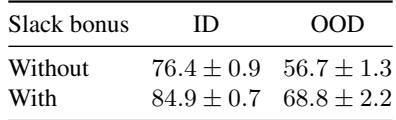
Adding the success-conditional slack bonus improves four-specification Pass@1 with random continuation and dynamic filtering. The gain is larger on held-out topologies than on in-distribution tasks, indicating that richer feedback supports generalization. This supports the value of the slack bonus beyond in-distribution performance. Adding the slack bonus raises in-distribution Pass@1 from 76.4 to 84.9 and out-of-distribution Pass@1 from 56.7 to 68.8. The out-of-distribution improvement of 12.1 points is larger than the in-distribution improvement of 8.5 points, suggesting better generalization from the slack bonus.
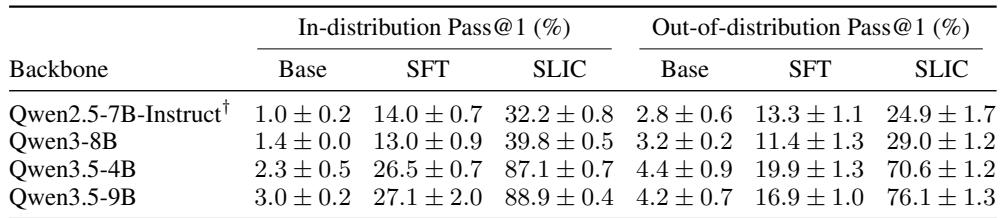
SLIC improves Pass@1 over SFT across all evaluated backbones on both in-distribution and held-out tasks. The Qwen3.5 family shows particularly strong results, with higher absolute success rates and clear gains from scaling model size, especially on held-out tasks. SLIC consistently outperforms SFT across all tested backbones and task splits. Qwen3.5 backbones achieve the largest improvements and the highest Pass@1 among the evaluated models. Within the Qwen3.5 family, scaling from 4B to 9B improves held-out Pass@1 more than in-distribution Pass@1.
These experiments evaluate SLIC variants against SFT, DeepSeek, GPT-6-Astra, and Bayesian Optimization on four-turn and eight-turn circuit topology tasks, including held-out PTM 65 nm designs. SLIC consistently outperforms SFT and DeepSeek, with reinforcement fine-tuning lifting a 4B student above its teacher; random sampling is strongest on complex topologies while softmax sampling excels on simple topologies, and SLIC-RANDOM nearly matches GPT-6-Astra at eight turns. Adding the success-conditional slack bonus improves Pass@1, especially on held-out topologies, and SLIC delivers consistent gains across backbones, with Qwen3.5 models showing the largest improvements and clear scaling benefits on held-out tasks.