Command Palette
Search for a command to run...
OpenGCUA: Auf dem Weg zu einem vollständig offenen Stack für die generalistische Computernutzung
OpenGCUA: Auf dem Weg zu einem vollständig offenen Stack für die generalistische Computernutzung
Zusammenfassung
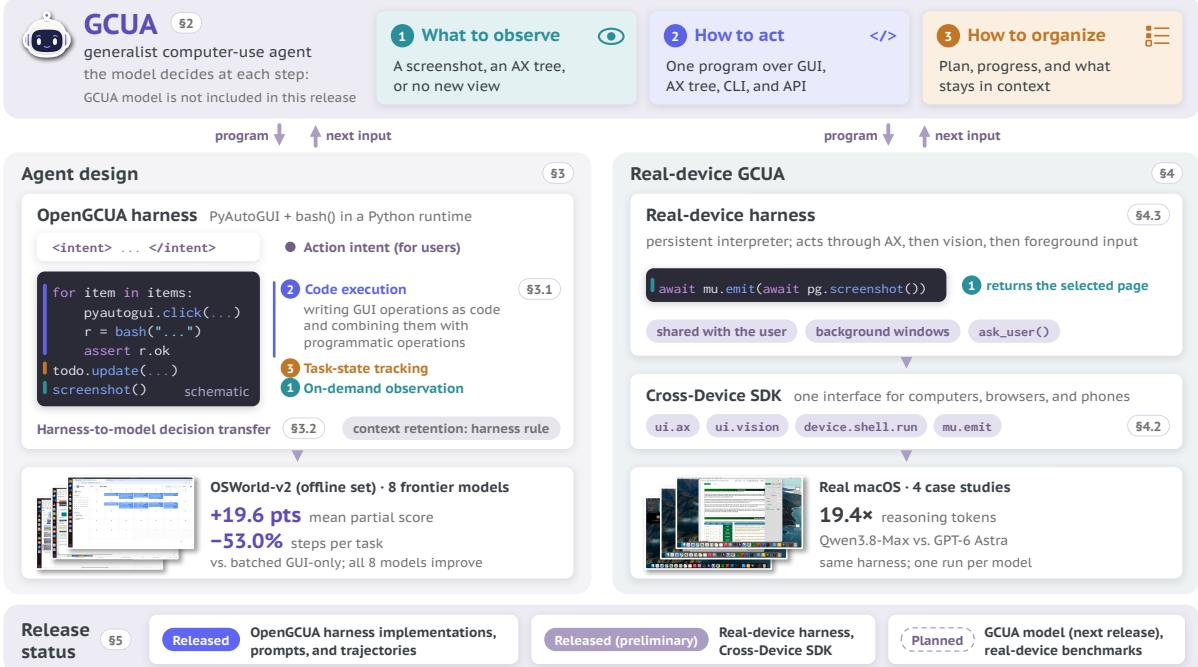
Die Computernutzung hat einen Wendepunkt erreicht: Der Fokus erweitert sich von rein GUI-basierter Interaktion hin zu Systemen, die Aufgaben auf den Computern der Nutzer über visuelle und programmatische Schnittstellen erledigen. Wir definieren einen generalistischen Computer-Use-Agenten (GCUA) als ein System, in dem das Modell selbst wählt, wie es seine Arbeit über visuelle und programmatische Schnittstellen hinweg beobachtet, ausführt und organisiert. Spitzenimplementierungen wie das Computer-Use-System von GPT-6 Astra bleiben jedoch weitgehend geschlossen, was die systematische Untersuchung ihres Designs einschränkt. Wir stellen Open Generalist CUA (OpenGCUA) vor, ein laufendes Projekt zur Entwicklung und Öffnung des vollständigen Stacks für GCUAs gemeinsam mit der Community. Dieser Bericht präsentiert die erste Version von Open Generalist CUA. Die Codeausführung ist ein zentrales Merkmal unseres Agentendesigns: Sie ermöglicht es, dass Zwischenergebnisse nachfolgende Operationen bestimmen, und versetzt Modelle in die Lage, ihre vorhandenen Programmierfähigkeiten direkt auf die Computerinteraktion anzuwenden. Wir schlagen außerdem einen Harness-to-Model-Entscheidungstransfer vor, bei dem ausgewählte Beobachtungen und Aufgabenstatus-Entscheidungen von festen Harness-Regeln auf das Modell verlagert werden. Auf OSWorld-v2 verbessert unsere vollständige Konfiguration die Aufgabenbewertungen über alle acht evaluierten Modelle hinweg, darunter GPT-6 Astra und Claude Opus 5, erhöht den mittleren partiellen Score um +19,6 Punkte und reduziert die berichteten Schritte pro Aufgabe um durchschnittlich 53,0 % im Vergleich zu einer rein GUI-basierten Batch-Ausführung. Wir veröffentlichen unsere Implementierung und Prompts, die Evaluations-Trajektorien aller acht Modelle sowie vorläufige Versionen eines Realgeräte-Harness und eines geräteübergreifenden SDK. Der Harness adressiert Herausforderungen realer Geräte, die von Benchmarks nicht vollständig erfasst werden, während das SDK eine gemeinsame Programmierschnittstelle über Computer, Mobilgeräte und Browser hinweg bereitstellt. Über vier reale macOS-Aufgaben unter unserem Realgeräte-Harness verwenden ausgewählte Qwen3.8-Max-Läufe 19,4-mal so viele berichtete Reasoning-Tokens wie GPT-6 Astra, was auf erhebliche Unterschiede zwischen Modellen in der Ausführungseffizienz auf realen Geräten hinweist.
One-sentence Summary
Alibaba Token Hub, Alibaba Group introduce OpenGCUA, an open full-stack generalist computer-use agent that combines code execution with harness-to-model decision transfer; on OSWorld-v2, it raises mean partial score by +19.6 points and reduces reported steps per task by an average of 53.0% across all eight evaluated models, including GPT-6 Astra and Claude Opus 5, and the project releases a real-device harness and a cross-device SDK.
Key Contributions
- The first release introduces Open Generalist CUA (OpenGCUA), an open full-stack project for generalist computer-use agents, with an agent design centered on code execution and a proposed harness-to-model decision transfer that moves selected observation and task-state decisions from fixed harness rules to the model.
- On the offline OSWorld-v2 subset, the full OpenGCUA configuration improves task scores across all eight evaluated models, raising mean partial score by 19.6 points and reducing reported steps per task by an average of 53.0% relative to batched GUI-only execution; ablations show additional benefits from code execution beyond interface access alone.
- The release includes the implementation, prompts, evaluation trajectories, and preliminary versions of a real-device harness and cross-device SDK, and across four real macOS tasks selected Qwen3.8-Max runs use 19.4 times as many reported reasoning tokens as GPT-6 Astra.
Introduction
Computer use has shifted from GUI-only control toward generalist systems that combine visual interaction, shell commands, accessibility APIs, and code execution to complete work on real computers. This matters because operating on a user’s own machine introduces challenges such as shared control, background windows, changing requests, and efficiency constraints that traditional benchmark settings do not fully capture. Prior work is limited because most open agents remain GUI-centric or fix observation and action choices in advance, while frontier systems such as GPT-6 Astra are largely closed, making their prompts, harnesses, and trajectories difficult to reproduce or compare. The authors introduce OpenGCUA to open the full stack for generalist computer use, defining a generalist computer-use agent as one whose model decides what to observe, how to act, and how to organize work at each step, and providing an initial real-device harness, cross-device SDK, and released trajectories.
Method
The authors design an agent framework centered on two core behaviors: code execution and harness-to-model decision transfer. Instead of relying on fixed harness rules, the model is empowered to write executable programs that unify graphical user interface interactions and programmatic operations. By combining tools like PyAutoGUI for desktop interaction and bash for shell commands within a single Python program, the model can specify not only what operations to perform but also how execution proceeds. Loops and conditional logic allow the program to repeat operations and choose subsequent actions based on intermediate results without requiring a new model call for each step.
To further enhance autonomy, the framework shifts selected workflow decisions from fixed harness rules to the model. This harness-to-model decision transfer dictates what the model observes and how it organizes its task state. The system provides mechanisms for on-demand observation, allowing the model to request a new screenshot only when visual feedback is necessary, thereby reducing context length. Task-state tracking is maintained through a persistent todo interface, where the model updates and retrieves progress records to distinguish between pending work, attempted changes, and verified outcomes. Additionally, an action intent mechanism requires the model to state the purpose of each code-execution step before it runs, making the program's goal explicit.
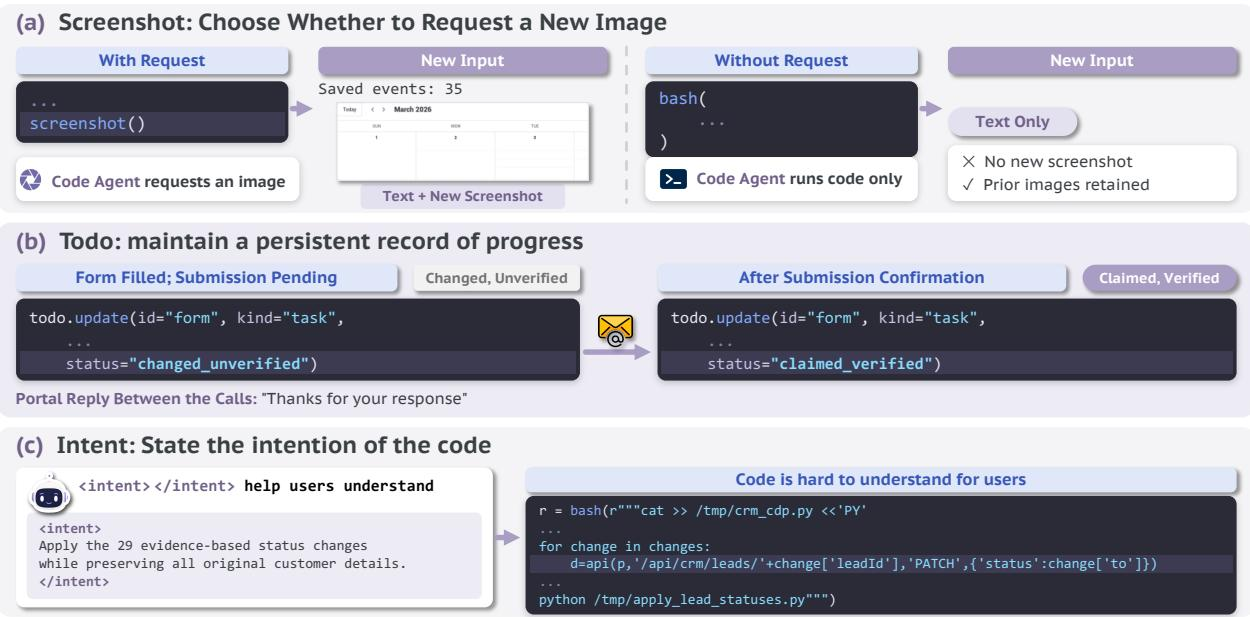
These interfaces are illustrated in the model outputs above, demonstrating how the agent selectively requests visual feedback, maintains persistent task records across programs, and explicitly states its intentions before executing complex code.
For deployment on actual user computers, the authors introduce a Cross-Device SDK and a real-device harness to handle the complexities of uncontrolled environments. The Cross-Device SDK provides a unified programming interface that allows a single agent to coordinate operations across mobile applications, desktop tools, and browser-based services. It supports shared operations with explicit targets, cross-device coordination within a single task, and shared observation processing.
The real-device harness integrates this SDK with the agent loop and platform-specific mechanisms through a structured five-layer architecture.
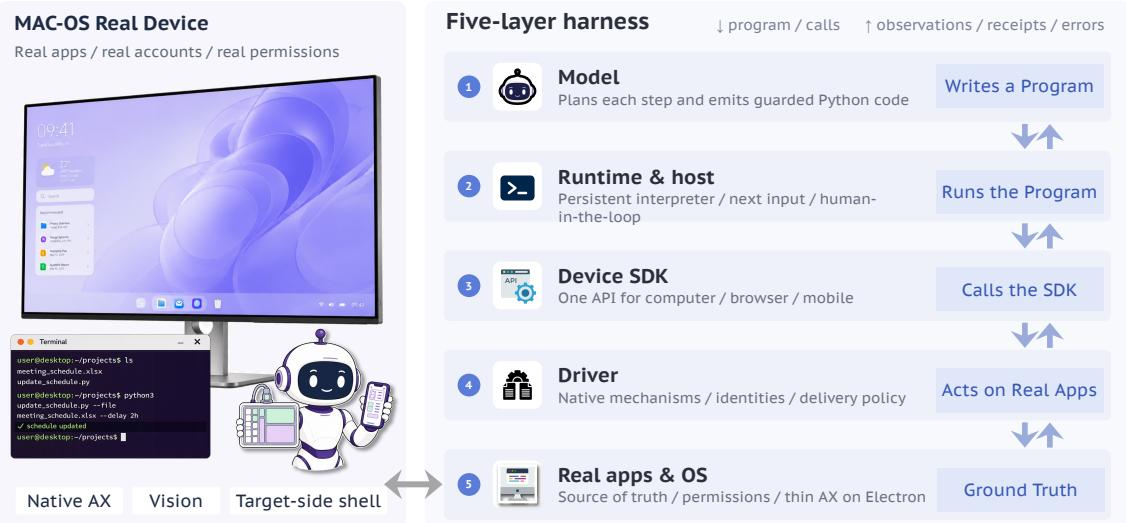
As shown in the figure above, the system is separated into five distinct layers. The Model layer generates Python programs based on the task and interaction history. The Runtime layer manages the agent loop and executes these programs in a persistent interpreter, handling context retention and constructing the next model input. The Device SDK layer binds observations and actions to explicit resources like devices and windows. The Driver layer translates SDK requests into native operations, managing element identities and action delivery policies. Finally, the Applications and Operating System layer represents the ground truth, determining available observations and control capabilities based on permissions and application state. This explicit separation of responsibilities allows compatible components to be replaced independently and ensures that execution failures are properly reported and distinguished from task-level outcomes.
Experiment
These experiments evaluate the OpenGCUA agent design on the offline OSWorld-v2 subset across multiple frontier models, comparing GUI-only and GUI+CLI baselines with the full configuration that adds code execution and harness-to-model decision transfer. The full design consistently improves task completion and interaction efficiency across all models, showing that gains come from executable control over GUI and shell operations and from model-controlled observation and workflow management rather than interface access alone. Ablations indicate that code execution supports adaptive coordination, on-demand observation improves cache reuse, and task-state tracking helps maintain progress, while resource-aware analysis shifts model rankings under cost or time limits. Preliminary real-device results further suggest that practical performance depends on observation targeting, reasoning volume, and whether models write code that verifies complete task coverage.
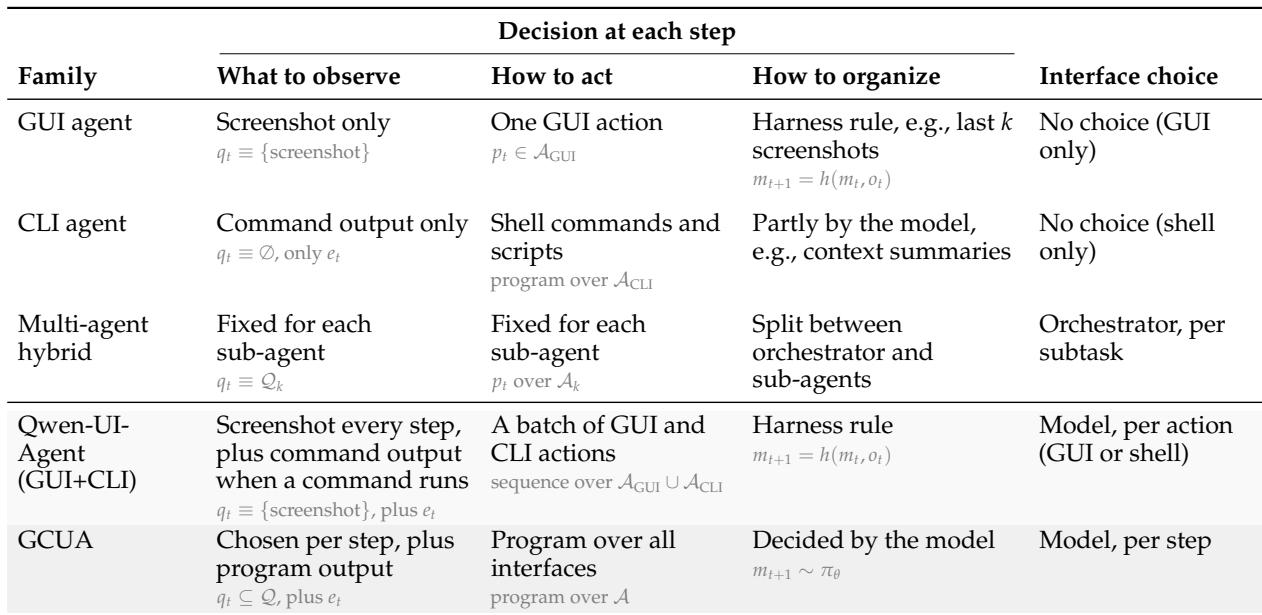
GCUA is defined against existing agent families by which of three decisions are fixed in advance: what to observe, how to act, and how to organize. GUI and CLI agents lock in their observation and interface choices, while multi-agent hybrids make interface choices only per subtask. The progression from an earlier GUI+CLI agent to GCUA moves toward a single model making all three decisions at every step. Existing families fix at least one of these decisions, whereas GCUA leaves observation scope, action interface, and working-state updates to the model each step. The earlier GUI+CLI agent already selects between GUI and shell actions per action, but GCUA also makes observation and memory organization decisions dynamically.
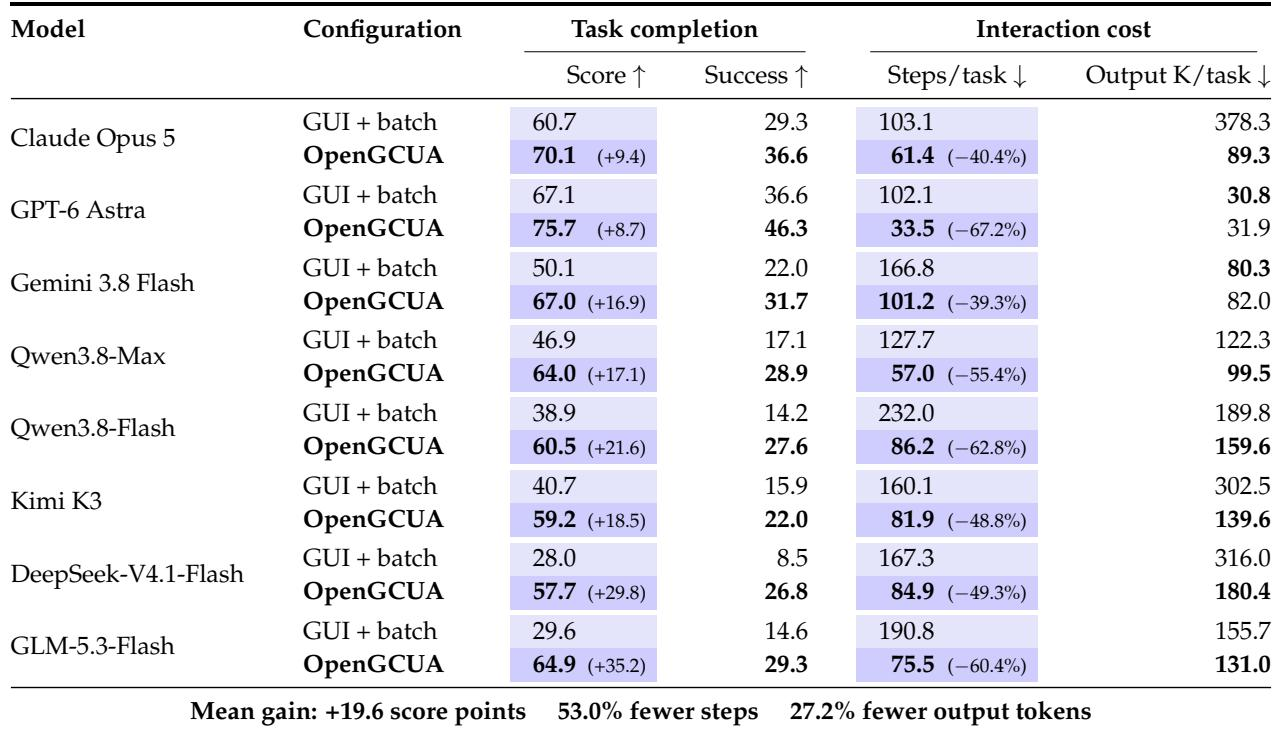
The full OpenGCUA configuration improves task completion scores and full-task success while sharply reducing steps per task across the evaluated models, relative to a batched GUI-only baseline. Output-token use falls for most models but not universally, so fewer steps do not always mean fewer tokens. The gains hold across models with very different baseline performance and efficiency. Across the eight evaluated models, the cross-model mean score rises from 45.3 to 64.9 while steps per task fall by an average of 53.0%. In the shown model subset, output-token use is mixed: one model reduces tokens sharply, while others use similar token budgets despite large step reductions.
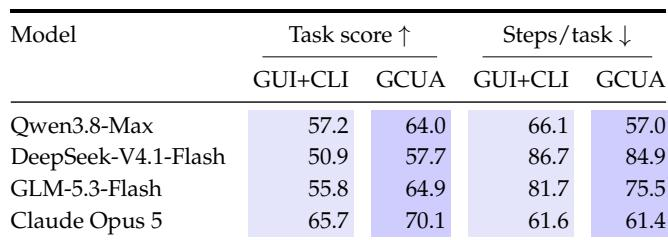
Full GCUA improves over the batched GUI+CLI baseline by adding code execution and model-initiated workflow control. In selected runs, all four models achieved higher task scores, and most also used fewer steps per task. The results suggest that control over execution and workflow matters beyond simply providing GUI and CLI access. Every evaluated model achieved a higher task score under full GCUA than under the batched GUI+CLI baseline. Steps per task decreased for most models under full GCUA, while Claude Opus 5 improved in score with almost no change in step count. Score gains in the selected runs were roughly 4 to 9 points, with Qwen3.8-Max showing the largest reported step reduction.
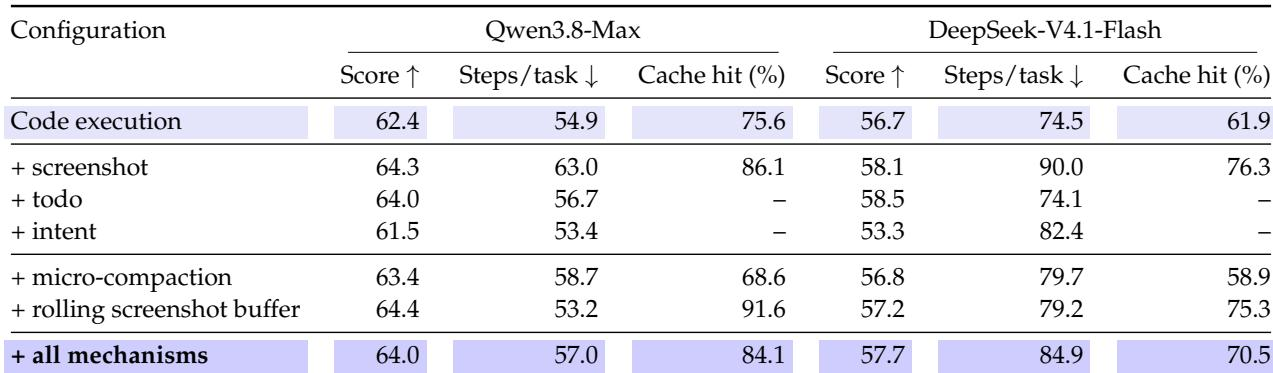
An ablation from a code execution baseline shows that the added mechanisms mainly affect cache reuse and step efficiency, while task score changes stay modest. Screenshot observation and the rolling screenshot buffer improve cache hit without lowering task scores, and todo yields a small score increase. Intent lowers scores slightly, while micro-compaction reduces cache reuse but does not appear to lower the selected task scores. Screenshot observation improves cache hit and task score over code execution for both evaluated models. Rolling screenshot buffer produces the largest cache hit improvements among the added mechanisms, while task scores remain at or above baseline. Todo increases task score slightly, consistent with its role in tracking progress and unresolved work. Intent annotation slightly lowers task scores, reflecting its focus on user interpretability rather than benchmark performance. Micro-compaction reduces cache hit compared with code execution, but task scores do not fall in these selected comparisons.
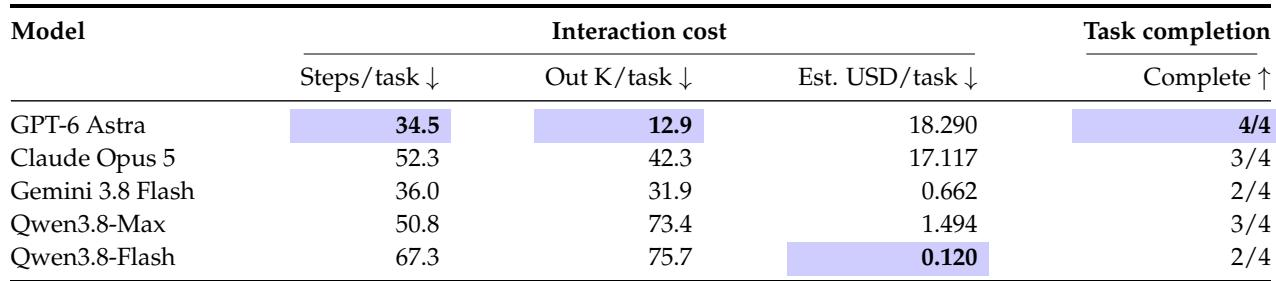
Real-device evaluations reveal substantial trade-offs among completion, generation volume, interaction length, and estimated cost. GPT-6 Astra attains the highest completion count with the fewest steps and output tokens but is the most expensive under the pricing assumptions, while Qwen3.8-Max uses far more reasoning tokens yet costs much less. Task-level cases show that reasoning overhead and code coverage can diverge even when models perform similar operations. Across configurations, completion counts range from two to four tasks, and lower token usage does not always imply lower cost. GPT-6 Astra completes all four tasks while using the fewest steps and output tokens, but its estimated cost per task is the highest. Qwen3.8-Max produces about 5.7 times more output tokens per task than GPT-6 Astra, mostly from reasoning, yet its estimated cost is much lower. On a workbook task, GPT-6 Astra fills all 125 required answer cells, whereas Qwen3.8-Max leaves 40 empty after processing only a subset of rows. A simple screenshot operation highlights a reasoning-cost gap: Qwen3.8-Max emits over two thousand output tokens while GPT-6 Astra emits around one hundred and twenty.
The experiments evaluate GCUA against fixed-decision baselines such as GUI-only and batched GUI+CLI agents, showing consistent task-score gains and large step reductions across models, though token use and cost vary. Full GCUA benefits from code execution and model-initiated workflow control, improving scores beyond what GUI and CLI access alone provides. Ablations indicate that added mechanisms mainly affect cache reuse and step efficiency with modest score changes, while real-device evaluations reveal trade-offs where fewer tokens and steps do not always mean lower cost.