Command Palette
Search for a command to run...
Was macht World Action Models generalisierungsfähig? Eine empirische Studie zur Zukunftsmodellierung zur Testzeit
Was macht World Action Models generalisierungsfähig? Eine empirische Studie zur Zukunftsmodellierung zur Testzeit
Zusammenfassung
World Action Models (WAMs) sagen während des Trainings die Zukunft zusammen mit Aktionen vorher. Aufgrund der hohen Rechenkosten der Video-Entrauschung ist umstritten, ob die Zukunft während der Inferenz weiterhin generiert werden muss: Explizite WAMs entrauschen sie zusammen mit jedem Aktionsblock zu sauberen Frames, während latente WAMs sie zur Beschleunigung vollständig verwerfen. Wir stellen fest, dass latente WAMs, obwohl sie bei In-Distribution-Aufgaben mit expliziten gleichziehen, nicht die Generalisierungsvorteile behalten, die ursprünglich die Motivation für WAMs waren. Um dies zu zeigen, evaluieren wir Generalisierung entlang dreier Achsen: Umgebungsperturbation, Dateneffizienz und Aufgabengeneralisierung. Kontrollierte Vergleiche mit gleichem Backbone, gleichen Trainingsdaten und gleichem Budget zeigen eine konsistente Verschlechterung über alle drei Achsen, sobald der Aktions-Experte nicht mehr auf Zukunftsrepräsentationen konditioniert. Weitere Analysen zeigen, dass die Lücke fast vollständig aus dem ersten Entrauschungsschritt herrührt: Der Nutzen entsteht durch die Vorbereitung der Zukunft, nicht durch deren Generierung. Daher schlagen wir Simple-WAM vor, das die Zukunftsmodellierung zu einem einzigen Vorwärtsdurchlauf vollständig verrauschter Video-Tokens vereinfacht und den Rauschplan während des Trainings an dieses Inferenzverhalten anpasst. Über Simulationsund reale Aufgaben hinweg erreicht Simple-WAM das Beste aus beiden Welten: Es übertrifft explizite WAMs in der Generalisierungsleistung bei einer mit latenten WAMs vergleichbaren Effizienz.
One-sentence Summary
Leap Lab, Tsinghua University, et al. propose Simple-WAM, which simplifies future modeling into one forward pass of fully noised video tokens and adapts the training-time noise schedule to this inference behavior, after showing that latent WAMs lose the generalization benefits of explicit WAMs because the action expert no longer conditions on future representations; Simple-WAM matches latent WAM efficiency and outperforms explicit WAMs on simulation and real-world tasks.
Key Contributions
- A matched evaluation framework spanning environmental perturbation, data efficiency, and task generalization shows that latent world action models consistently lose generalization ability when inference-time future conditioning is removed.
- Controlled comparisons with a matched backbone, training data, and budget trace the generalization gap almost entirely to the first denoising step, indicating that preparing future video tokens matters more than generating clean future frames.
- Simple-WAM uses a single forward pass of fully noised video tokens and adapts the training-time noise schedule to this inference behavior, leading explicit world action models in generalization performance with efficiency comparable to latent models.
Introduction
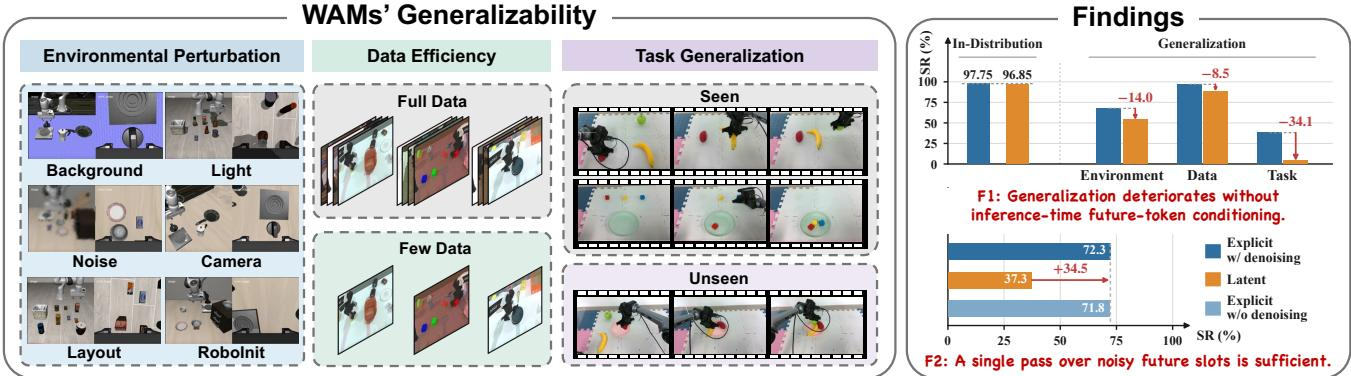
World Action Models (WAMs) aim to build generalizable robot policies by jointly predicting future video frames and actions, using web-scale video pretraining to supply rich spatiotemporal priors and observation-space supervision beyond sparse action labels. This future-modeling ability is seen as a key advantage over Vision-Language-Action models, whose static image-text pretraining provides little temporal understanding. A central open question is whether future video must also be generated at inference. Explicit WAMs denoise future frames alongside actions, which supports generalization but makes high-frequency closed-loop control costly because video tokens far outnumber action tokens. Latent WAMs skip test-time video generation and match explicit WAMs on in-distribution tasks at much lower cost, but prior comparisons did not isolate how inference-time future modeling affects the broader generalization that originally motivated WAMs. The authors introduce a controlled evaluation across environmental robustness, data efficiency, and task generalization, find that latent WAMs fall behind on all three axes, and propose Simple-WAM, which conditions on fully noised future tokens in one pass to recover most of the generalization benefit at near-latent inference cost.
Method
The authors leverage a language-conditioned visuomotor control framework that couples a video expert with an action expert. At each control step t, the policy takes an image observation ot, a language instruction ℓ, and a proprioceptive state st to predict an action chunk At=at:t+H−1. The video expert processes a sequence of latents spanning the current and future frames, while the action expert regresses a velocity field over an independent flow time.
To understand the design of the proposed method, it is necessary to consider the two existing conditioning paradigms. Explicit World Action Models iteratively denoise future video tokens across the entire schedule, providing rich future context but incurring high inference costs. Conversely, latent World Action Models drop the future video tokens entirely during inference, relying solely on the current frame to achieve high efficiency at the expense of generalizability.
Refer to the framework diagram for a visual comparison of these conditioning schemes.
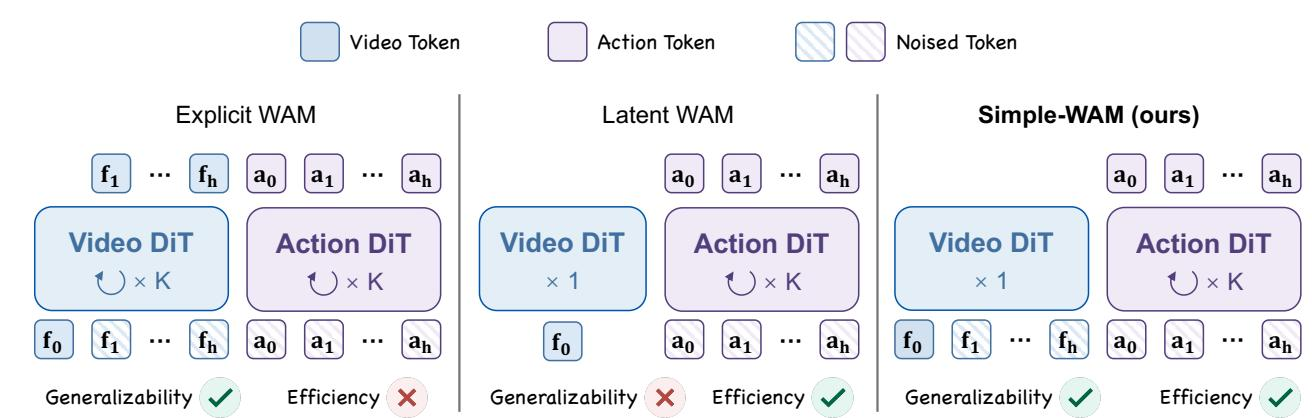
The proposed Simple-WAM bridges this gap by retaining the future video tokens of the explicit paradigm while adopting the single forward pass efficiency of the latent paradigm. During inference, the model abandons iterative denoising of the future video tokens. Instead, the video expert performs a single forward pass over the sequence with the future video tokens left as pure Gaussian noise at flow time τ=1. The resulting feature conditions all K action steps, effectively balancing the generalization of the explicit approach with the computational efficiency of the latent approach.
To support this inference strategy, the authors introduce a mixed training schedule. Since the inference relies entirely on features extracted at τ=1, the training process must strengthen the ability to read features from pure noise. The flow time of the future video tokens is sampled such that τ=1 with probability p, and drawn from the standard flow-time schedule otherwise. This mixture ensures the video expert is specifically optimized for the noise level encountered during inference, while the remaining training budget maintains supervision across the rest of the schedule. The two experts are trained jointly, minimizing a combined loss of the action and video velocity fields.
Experiment
The paper evaluates world-action model generalization along environmental perturbation, data efficiency, and task generalization, using controlled explicit and latent inference-time future conditioning paradigms. It finds that in-distribution parity hides a large gap: removing future modeling at inference hurts generalization, while conditioning on a fully noised future already provides most of the benefit. Simple-WAM builds on this by using noise-level future conditioning and matches or exceeds explicit future modeling across simulated and real-world benchmarks with substantially lower inference cost. Ablations show that the mixed schedule is robust and that noised video tokens outperform learned queries or zeros because they remain aligned with video pretraining.
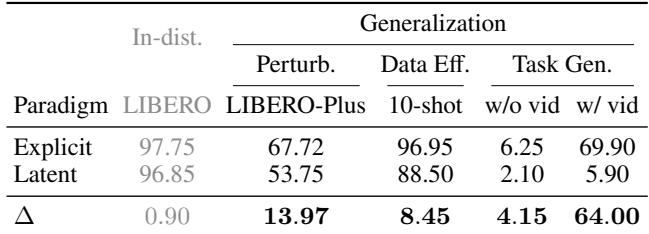
Under the matched in-distribution setting, explicit and latent future conditioning perform comparably. Across environmental perturbation, data efficiency, and task generalization, the explicit paradigm consistently leads, with the largest gap when action-free video is available for held-out tasks. This indicates that future modeling is needed at inference, not only as a training objective. In-distribution success is nearly identical between explicit and latent paradigms. Explicit future modeling maintains a clear advantage under environmental perturbation and reduced demonstration settings. Action-free video provides a large benefit for the explicit paradigm on held-out tasks, while the latent paradigm remains near its no-video level. Removing future modeling at inference reduces generalization even when in-distribution performance appears matched.
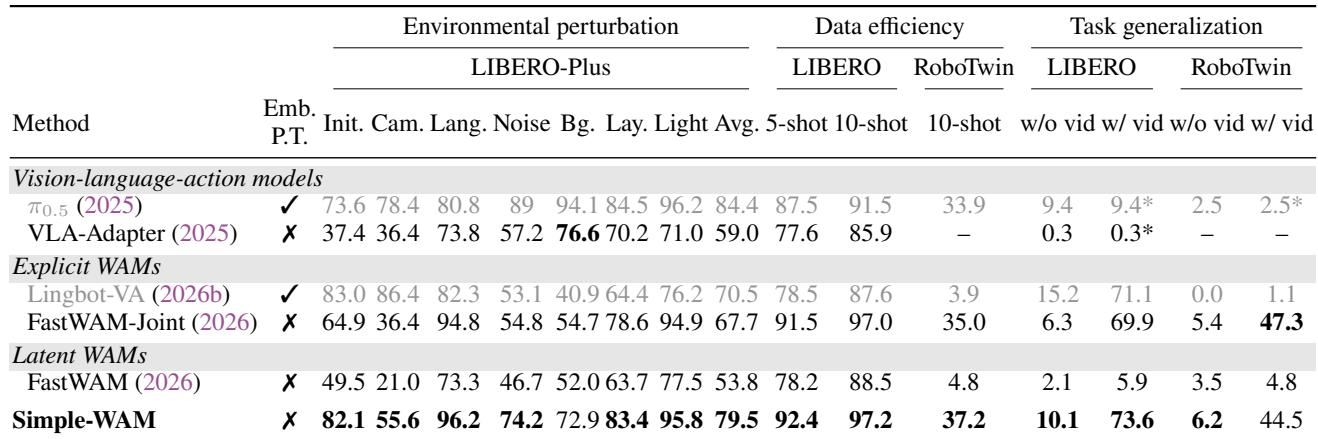
Simple-WAM preserves most of the generalization benefits of explicit future modeling while remaining much closer to latent-model inference cost. Across environmental perturbation, data efficiency, and held-out task generalization, latent future modeling falls behind, while noised future conditioning recovers performance without iterative denoising. This supports future modeling as a test-time requirement for robustness and generalization. Simple-WAM leads methods without embodied pretraining on environmental perturbation and narrows the gap to a large-scale embodied-pretrained baseline. Compared with explicit future modeling, Simple-WAM is substantially faster per action chunk while staying competitive on low-data and held-out task generalization.
Ablations on LIBERO-Spatial show that intermediate probabilities for the mixed schedule are robust and outperform both extremes, with data efficiency remaining the most stable axis across settings. The endpoints suffer mainly on environmental perturbation and task generalization. Replacing noised future video tokens with learned queries or zeros causes sharp drops on every axis, especially task generalization, underscoring the importance of pretraining-aligned noised video conditioning. Intermediate mixing probabilities outperform the extremes, with average performance remaining stable across the mid-range values. Replacing future video tokens with learned queries or zeros degrades all axes, with the largest losses on task generalization.
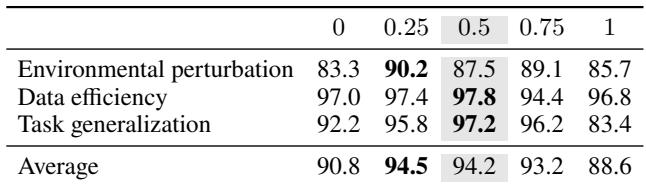
The experiments compare explicit and latent future conditioning across in-distribution, environmental perturbation, data efficiency, and held-out task generalization settings, with ablations on LIBERO-Spatial. Explicit future modeling performs comparably in-distribution but consistently leads under distribution shift and low-data regimes, especially when action-free video is available, while noised future conditioning via Simple-WAM retains these gains at lower inference cost. Ablations show that intermediate mixed-schedule probabilities are robust and that replacing noised future video tokens with learned queries or zeros sharply degrades all axes, particularly task generalization. Overall, future modeling is needed at inference, not only as a training objective.