Command Palette
Search for a command to run...
JEPA-Anything: Lernen prädiktiver Modelle über verschiedene Welten hinweg
JEPA-Anything: Lernen prädiktiver Modelle über verschiedene Welten hinweg
Zusammenfassung
Weltmodellierung ermöglicht es intelligenten Systemen, Konsequenzen vorherzusehen, Interventionen zu steuern und aus Interaktion zu lernen. Dennoch bleiben prädiktive Modelle domänenspezifisch: Kann ein gemeinsames Lernprinzip die Weltmodellierung über grundlegend unterschiedliche Systeme hinweg tragen? Wir stellen JEPA-Anything vor, ein domänenunabhängiges Framework auf Grundlage der orthogonalen prädiktiven Faktorisierung (OPF). OPF erweitert Joint-Embedding-Prädiktionsarchitekturen, zerlegt latente Ziele in komplementäre Faktoren, lernt diese über dedizierte Pfade und rekombiniert sie innerhalb eines gemeinsamen prädiktiven Designs. Wir evaluieren JEPA-Anything in sieben Domänen: Bildverarbeitung, Biologie, klinische Verläufe, Regelung, Molekulardynamik, physikalische Felder und Wetter. Die Experimente umfassen Repräsentationslernen, Interventionsvorhersage, Generalisierung außerhalb der Verteilung und langfristige Dynamik, darunter 10 abgestimmte Dynamikaufgaben, die Vorhersage von über 1.000 klinischen Ereignissen und 100-Schritt-Molekül-Rollouts über vier Systeme hinweg. Im Vergleich zu abgestimmten JEPA-Baselines verbessert JEPA-Anything die berichteten Metriken bei allen 10 Dynamikaufgaben und reduziert den Vorhersagefehler für Einzelinterventionen bei Interventional Pong um 34,8 %. Es erzielt die niedrigsten Ein-Schrittund 100-Schritt-Molekülfehler unter den verglichenen Methoden in allen vier Systemen. Über die Vorhersage hinaus erhält eine durch Faktoren nominierte biologische Intervention experimentelle Unterstützung in Zell-Co-Kulturen, patientenabgeleiteten Organoiden, Tumorfragmenten und Mäusen; latente Orbitalmoden reproduzieren den keplerschen Skalierungsexponenten mit einer angepassten Steigung von −1,4991. Diese Ergebnisse stützen ein gemeinsames faktorisiertes prädiktives Prinzip über heterogene Welten hinweg und verbinden Weltmodellierung mit Intervention und experimentell fundierter wissenschaftlicher Entdeckung.
One-sentence Summary
Researchers from PhAI Labs, The Chinese University of Hong Kong, Fudan University, and other institutions propose JEPA-Anything, a domain-agnostic framework based on orthogonal predictive factorization (OPF) that decomposes latent targets into complementary factors, learns them through dedicated pathways, and recombines them within a shared predictive design, improving over matched JEPA baselines on all 10 dynamics tasks, lowering single-intervention prediction error on Interventional Pong by 34.8%, and achieving the lowest one-step and 100-step molecular errors among compared methods across four systems.
Key Contributions
- JEPA-Anything is introduced as a domain-agnostic framework based on orthogonal predictive factorization (OPF), which decomposes latent targets into complementary factors, learns them through dedicated pathways, and recombines them within a shared predictive design.
- Evaluated across seven domains, JEPA-Anything improves reported metrics on all 10 matched dynamics tasks, reduces single-intervention prediction error on Interventional Pong by 34.8%, and achieves the lowest one-step and 100-step molecular prediction errors among compared methods in all four systems.
- The results connect factorized prediction to experimentally grounded discovery: a factor-nominated biological intervention receives support in cell co-cultures, patient-derived organoids, tumor fragments, and mice, and latent orbital modes recover the Keplerian scaling exponent with a fitted slope of -1.4991.
Introduction
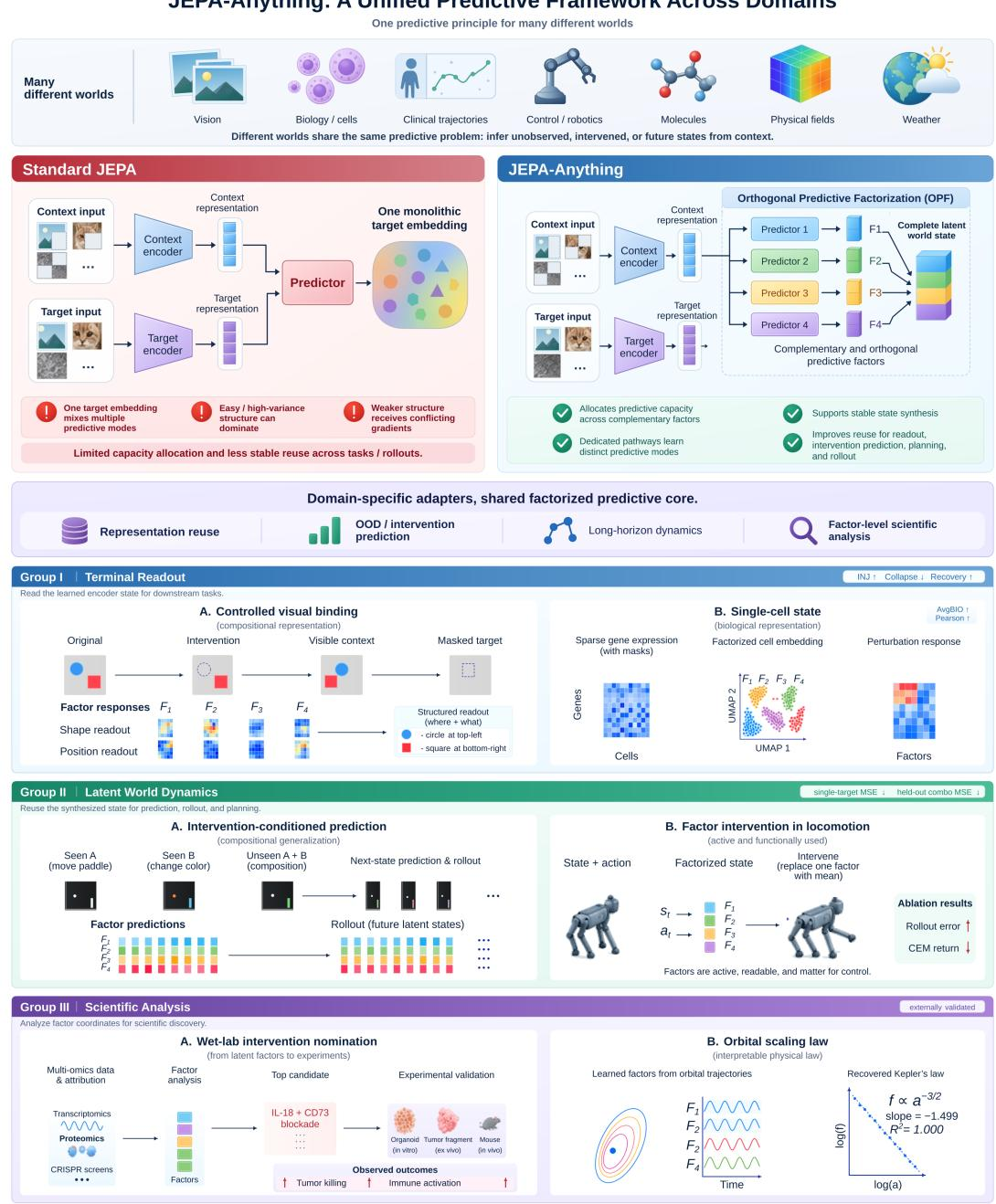
Latent world models learn predictive states that let agents and scientific models anticipate future or hidden states across many domains, from visual scenes and patient histories to molecular trajectories and physical fields. Joint-embedding predictive architectures support this by predicting in latent space, but the usual formulation represents each target as one monolithic embedding with one prediction pathway. That design can let high-variance or easily predicted structure dominate optimization, while weaker or complementary predictive structure receives conflicting gradients, turning latent state design into a capacity-allocation problem. The authors address this with JEPA-Anything, a framework based on orthogonal predictive factorization that decomposes each target state into multiple learned factors with dedicated predictors, using within- and cross-factor orthogonality and activity regularization. The same interface is applied across visual, single-cell, longitudinal health, control, molecular dynamics, physical field, weather, and clinical systems.
Method
The authors leverage a unifying latent world-state interface to standardize predictive learning across diverse domains. A domain adapter maps a raw observation into content tokens and structural descriptors, while a view sampler selects context and target indices. This establishes a common interface where the semantics of the adapter and sampler are domain-specific, but the subsequent predictive algorithm remains identical.
As shown in the figure below:
An online encoder processes the context tokens to produce a context representation, while a target encoder generates a latent target representation. The target encoder parameters are updated as an exponential moving average of the online encoder parameters and receive no gradients.
To overcome the limitations of predicting a monolithic target embedding, the authors introduce Orthogonal Predictive Factorization (OPF). Instead of a single predictor, the framework employs K learned projectors Pk∈Rd×r, chosen such that Kr=d. The stop-gradient target representation is factorized into K complementary subspaces:
z~t=sg(zt),zt(k)=Pk⊤z~t,k=1,…,KEach factor is assigned a dedicated predictor qk that maps the shared context representation and target descriptor into an r-dimensional space:
z^t(k)=qk(zc,st)The individual factor predictions are concatenated into a single vector u^t and synthesized into a complete latent state using the Moore-Penrose pseudoinverse of the analysis map:
z^t=(P⊤)†u^twhere P=[P1,…,PK]. When the projectors are exactly orthogonal, this synthesis reduces to a simple summation of the projected factors.
The training objective combines a standard base loss with the OPF loss. The prediction loss directly regresses each predicted factor to its target:
Lpred=K∣T∣r1t∈T∑k=1∑K∥z^t(k)−zt(k)∥22To ensure the learned subspaces are mutually orthogonal and avoid degenerate bases, an orthogonality loss is applied:
Lorth=k=1∑K∥Pk⊤Pk−Ir∥F2+1≤i<j≤K∑∥Pi⊤Pj∥F2Furthermore, to prevent representation collapse and maintain factor activity, the authors introduce activity regularization terms. These terms penalize low empirical standard deviations in both the projected target coordinates and the online context representations. The complete training loss is the sum of the domain-specific base loss and the weighted OPF components:
Ltrain(δ)=Lbase(δ)+Lpred+λorthLorth+λfacLfac+λencLencThe optimization loop iteratively adapts observations, samples contexts and targets, computes representations, predicts orthogonal factors, and updates the network parameters. For downstream applications, the framework supports two distinct modes. In representation mode, the online encoder is retained to extract reusable features for task-specific readouts, discarding the predictive heads. In operational world-model mode, the learned projectors and predictors are preserved to synthesize future latent states, enabling autoregressive simulation, planning, and intervention forecasting.
Experiment
The evaluation applies the same JEPA-Anything core across visual, biological, clinical, control, molecular, physical-field, and weather systems, organized into terminal readout, recursive latent dynamics and planning, and scientific factor analysis. Terminal-readout experiments show gains in controlled visual binding, single-cell clustering and perturbation prediction, and clinical event forecasting. Dynamics and rollout experiments indicate improved intervention composition, out-of-distribution prediction, and long-horizon stability, while continuous-control planning improves on Walker2d and HalfCheetah but not Hopper. Factor-level analyses confirm active and intervenable latent channels, and external wet-lab and orbital scaling results support reuse of the learned coordinates for scientific validation.
JEPA-Anything separates domain-specific predictive-state construction from a shared predictive core. Domain adapters and view samplers handle raw representation, tokenization, context-target semantics, encoder architecture, and the original loss, while the core provides a common token interface, factorized predictors with state synthesis, and orthogonal regularization. Analyses in biological and orbital domains show that the learned factor coordinates can support external scientific validation. Raw representations and encoder architectures vary across images, sequences, graphs, sets, and records, while the predictive core and regularizers remain shared. Learned factor coordinates supported a wet-lab nominated intervention in cancer models and recovered a Keplerian orbital scaling relation from unlabeled trajectory data.
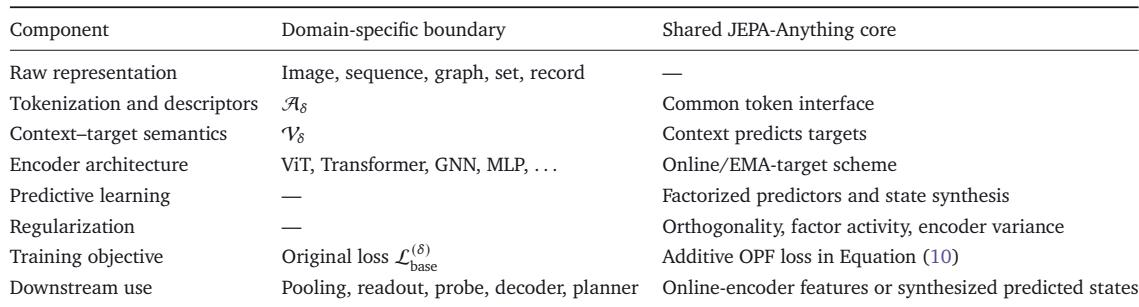
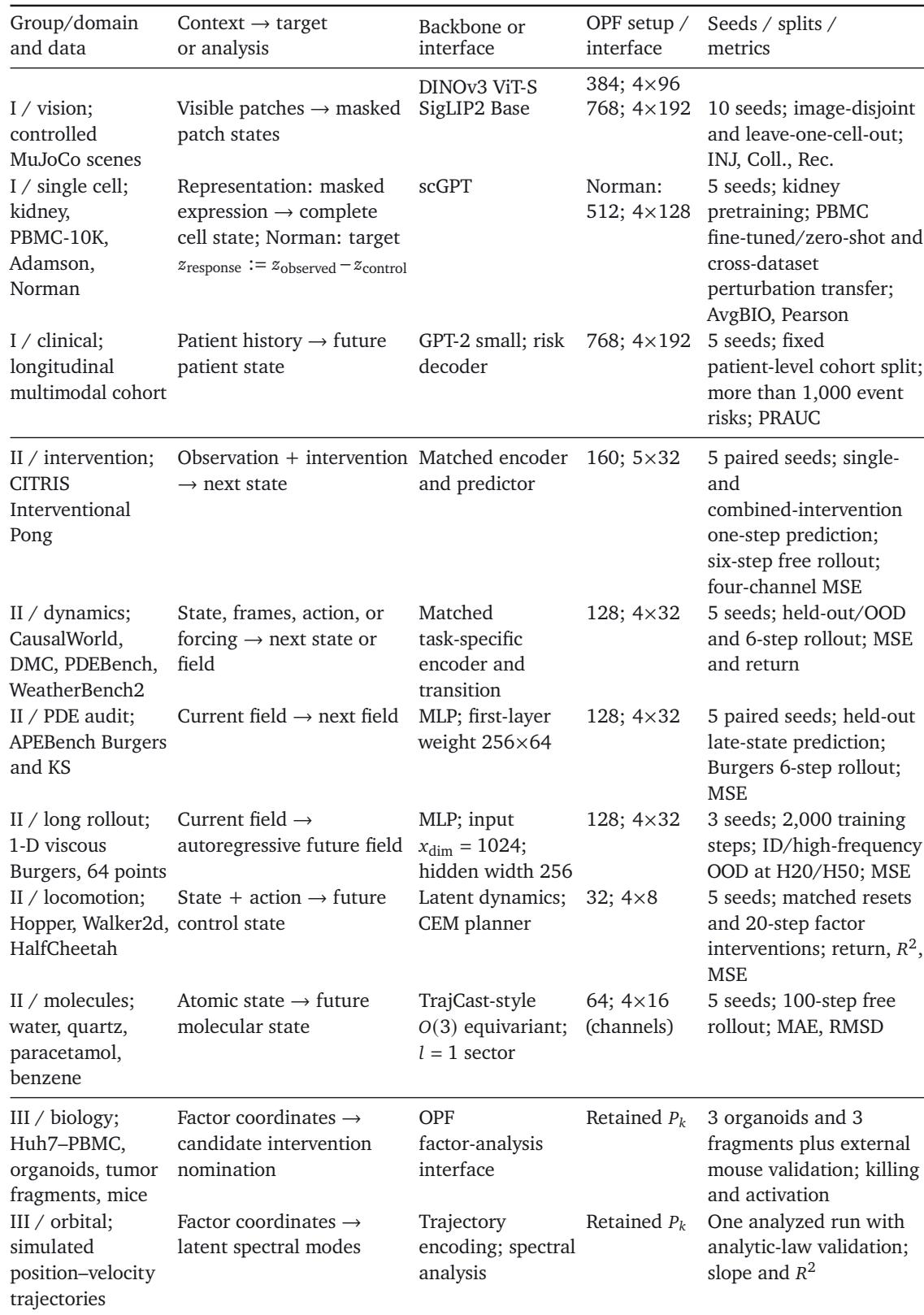
The experiments evaluate a shared orthogonal predictive factorization interface across visual, single-cell, clinical, interventional, dynamical, PDE, and long-rollout settings. Quantitative comparisons hold core modeling choices fixed against domain and monolithic JEPA baselines, using domain-specific metrics over repeated seeds and held-out or out-of-distribution splits. Factor-level analyses connect learned coordinates to external biological and physical validation. Terminal-readout experiments report stronger visual, cellular, and disease-state metrics with the OPF-based formulation. Intervention and dynamics benchmarks support combined-intervention prediction, out-of-distribution forecasting, and repeated multi-step rollout. Learned factor coordinates are non-overlapping and unit-conditioned, with near-exact synthesis. Factor-level analysis nominated an IL-18 plus NT5E/CD73 blockade intervention that wet-lab studies supported and recovered the Keplerian orbital scaling relation from simulated trajectories.
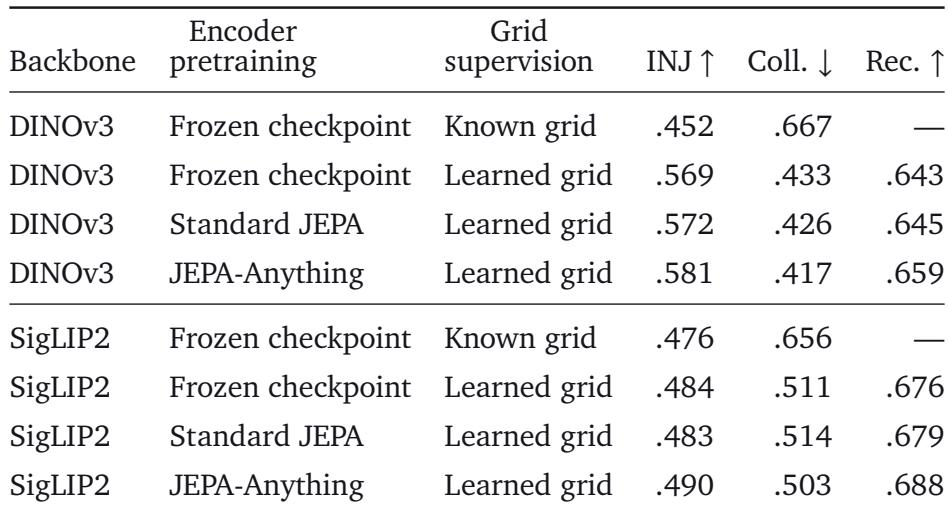
In controlled MuJoCo visual binding, using a learned grid readout improves intervention and collision metrics for both frozen encoder backbones while also enabling reconstruction. DINOv3 benefits further from JEPA-style encoder pretraining, with JEPA-Anything yielding the best reported intervention and collision results. SigLIP2 shows a smaller frozen-checkpoint gain, and its standard JEPA variant performs similarly to the learned-grid frozen setup. Learned grid supervision improves collision over known grid supervision for frozen DINOv3 and SigLIP2 backbones. DINOv3 with JEPA-Anything and a learned grid achieves the strongest combined intervention and collision performance in the reported comparison. For SigLIP2, standard JEPA pretraining tracks the frozen learned-grid readout rather than providing a large additional gain.
The evaluation compares scGPT, Cell-JEPA, and JEPA-Anything on PBMC cell-type clustering and perturbation-response prediction. Cell-JEPA improves over scGPT across all reported metrics, with especially large gains in zero-shot PBMC clustering and Norman perturbation prediction. JEPA-Anything adds orthogonal factorization and achieves the highest scores on both clustering metrics and both perturbation datasets. JEPA-Anything attains the highest values across PBMC finetuned clustering, PBMC zero-shot clustering, Norman perturbation prediction, and Adamson perturbation prediction. Cell-JEPA improves over scGPT on every reported metric, with the largest gains in zero-shot PBMC clustering and Norman perturbation prediction. Adding orthogonal factors to Cell-JEPA further improves both clustering quality and perturbation-response prediction.

An audit of the factor interface on CITRIS Interventional Pong shows that orthogonal factorization produces factor subspaces with negligible overlap, near-unit minimum singular values, and near-unit condition numbers, whereas unconstrained multi-head factors overlap substantially and are poorly conditioned. Orthogonal factorization also reduces transpose synthesis NMSE by many orders of magnitude, indicating near-exact reconstruction from exact factors. Orthogonal factorization drives cross-factor subspace overlap down to near machine precision, while unconstrained multi-head factors remain substantially overlapped. The projection matrix under orthogonal factorization is well-conditioned, with minimum singular value and condition number close to one; unconstrained multi-head is ill-conditioned with a much lower minimum singular value. Transpose synthesis from exact factors becomes near-exact under orthogonal factorization, in contrast to high reconstruction error for unconstrained multi-head.
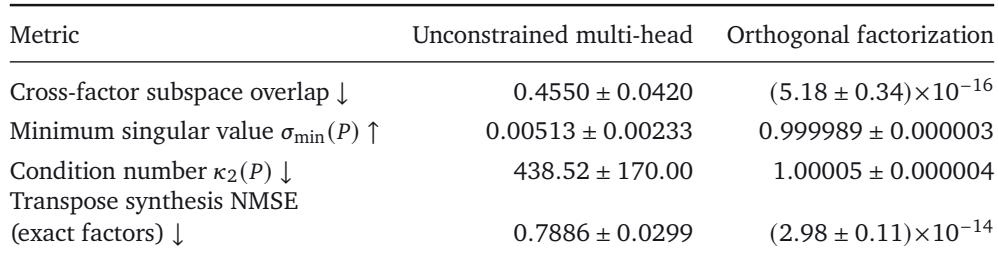
The experiments evaluate a shared orthogonal predictive factorization interface across visual binding, single-cell, clinical, interventional, dynamical, PDE, and long-rollout settings, comparing JEPA-Anything with domain-specific and monolithic JEPA baselines under held-out and out-of-distribution evaluations. Visual binding results show learned grid readouts and JEPA-style pretraining improve intervention and collision performance, with the strongest combined result from JEPA-Anything. In biological and factor-audit settings, orthogonal factorization improves clustering and perturbation prediction while producing non-overlapping, well-conditioned, near-exact factor synthesis. Factor-level analyses link learned coordinates to external validation, including a wet-lab supported cancer intervention and recovery of the Keplerian orbital scaling relation from unlabeled trajectories.