Command Palette
Search for a command to run...
LLaDA-Image: Leistungsstarke Bildgeneratoren mit vollständig offenen Trainingsrezepten
LLaDA-Image: Leistungsstarke Bildgeneratoren mit vollständig offenen Trainingsrezepten
Zusammenfassung
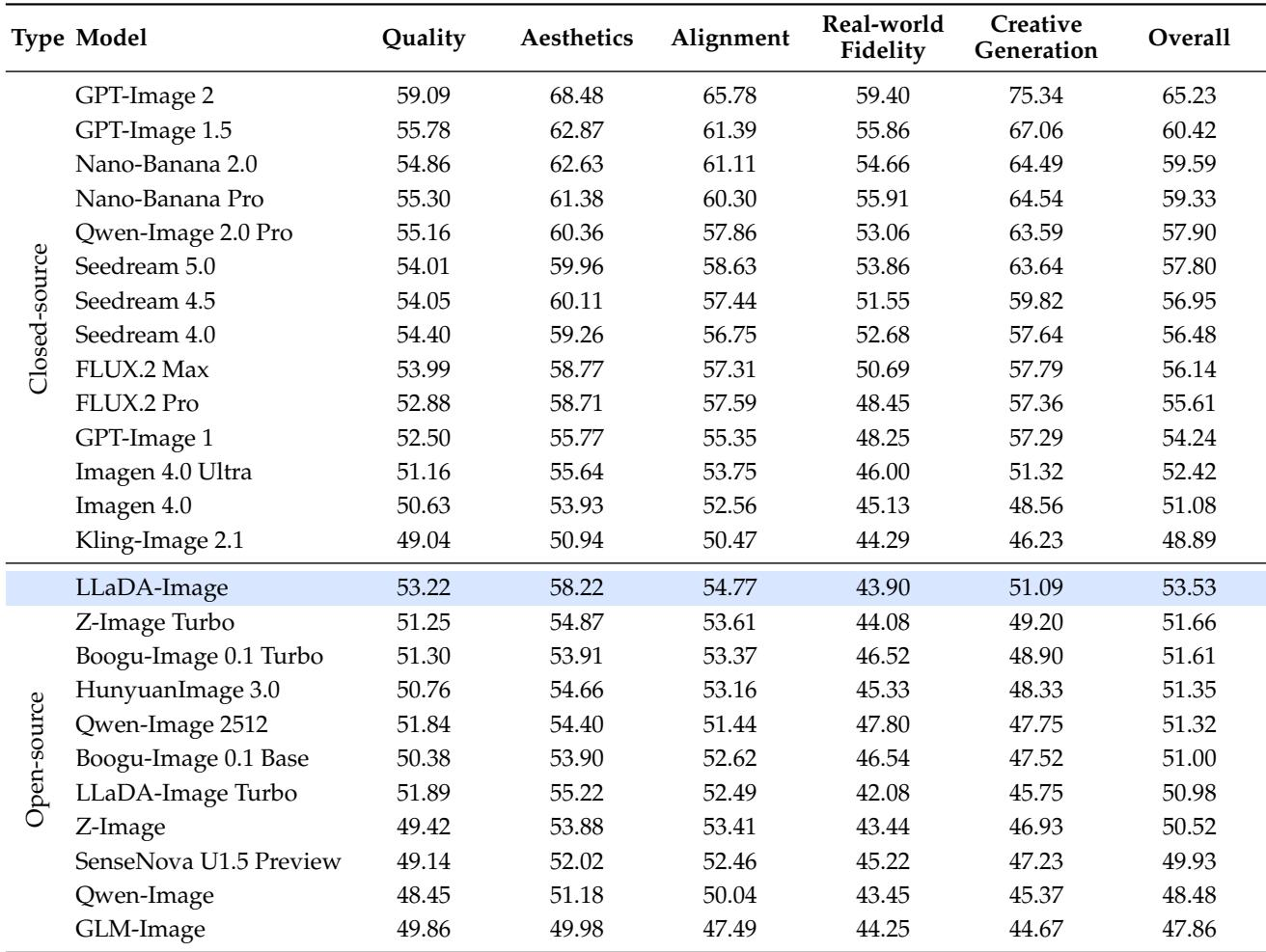
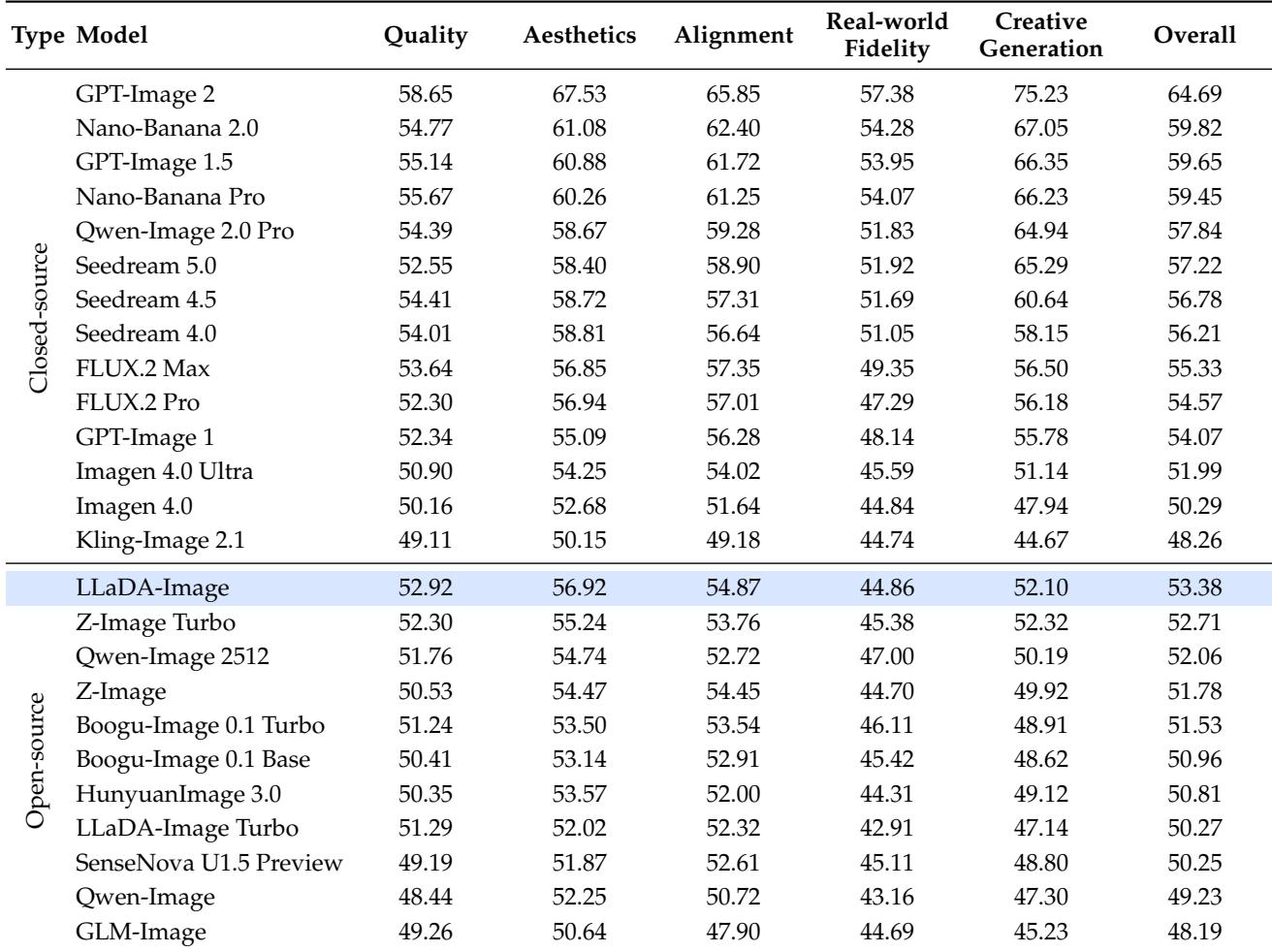
Wir stellen LLaDA-Image vor, ein einheitliches Framework, das einen von Grund auf trainierten 6B Diffusion Transformer (DiT) mit einem eingefrorenen Bild-Sprach-Verständnismodul kombiniert, welches auf dem LLaDA2.0-Mini Diffusions-Sprachmodell-Backbone aufbaut. Anstatt von Beginn an stark auf gepaarte Bild-Text-Daten angewiesen zu sein, etablieren wir zunächst einen leistungsfähigen visuellen generativen Prior durch reines Bild-Vortraining und Mid-Training. Die Generierungspipeline umfasst 220 Millionen Samples, von denen 98 % echte Bilder sind. Zur effizienten und skalierbaren Optimierung verwenden wir durchgängig parameterfreies RMSNorm im DiT zusammen mit dem Muon-Optimierer. Das resultierende einheitliche Modell erzeugt hochgradig fotorealistische Bilder und folgt gleichzeitig präzise feingranularen Bearbeitungsanweisungen. Wir destillieren LLaDA-Image weiter zu LLaDA-Image Turbo, was eine schnelle Inferenz in 2–4 Sampling-Schritten ermöglicht. Auf dem Qwen-Image-Bench erreicht LLaDA-Image Gesamtpunktzahlen von 53,53 und 53,38 auf den englischen bzw. chinesischen Tracks und setzt damit einen neuen Stand der Technik unter den Open-Source-Modellen auf beiden Tracks. Um die weitere Forschung an leistungsfähigen und effizienten generativen Modellen zu unterstützen, veröffentlichen wir unsere Modellgewichte, den Trainingscode und detaillierte Rezepte.
One-sentence Summary
Researchers from AGI Research Center and Inclusion AI propose LLaDA-Image, a unified framework pairing a 6B Diffusion Transformer trained from scratch with a frozen vision-language module built on the LLaDA2.0-Mini backbone, using image-only pre-training on 220M samples (98% real images), parameter-free RMSNorm, and the Muon optimizer to achieve state-of-the-art open-source image generation on Qwen-Image-Bench (53.53 English, 53.38 Chinese) and enabling fast 2−−4 step inference via distillation into LLaDA-Image Turbo.
Key Contributions
- LLaDA-Image is a unified 6B Diffusion Transformer that pairs a frozen vision-language module with a DiT trained from scratch, achieving state-of-the-art open-source scores on both English and Chinese tracks of Qwen-Image-Bench.
- A real-data-dominant progressive training pipeline uses 220M generation samples (98% real images) and keeps real data above 70% during supervised fine-tuning, with parameter-free RMSNorm and the Muon optimizer stabilizing training for high photorealism and editing accuracy.
- The model is distilled into LLaDA-Image Turbo via TwinFlow, a distribution-matching and self-adversarial flow distillation, enabling inference in 2–4 sampling steps while maintaining competitive generation quality.
Introduction
Image generation systems are evolving into general-purpose visual creation tools that must handle multilingual prompts, photorealistic synthesis, reference-preserving editing, accurate text rendering, and efficient inference. However, open models face significant bottlenecks: prevailing training paradigms tie visual-prior learning to language alignment from the start, requiring expensive and lossy paired captions during the most compute-heavy stages; synthetic data can speed up convergence but often introduces artifacts and limits long-run realism; and unifying generation with editing while keeping inference costs low remains difficult. The authors introduce LLaDA-Image, a 6B-parameter Diffusion Transformer trained from scratch with a complete open recipe. They decouple visual-prior learning from language alignment through image-only pre-training, use a unified dLLM-based architecture for understanding, generation, and editing, adopt a real-data-dominant progressive training pipeline, and distill the model into a 2–4-step variant via TwinFlow, all while keeping the overall data budget moderate and releasing weights, code, and training recipes.
Dataset
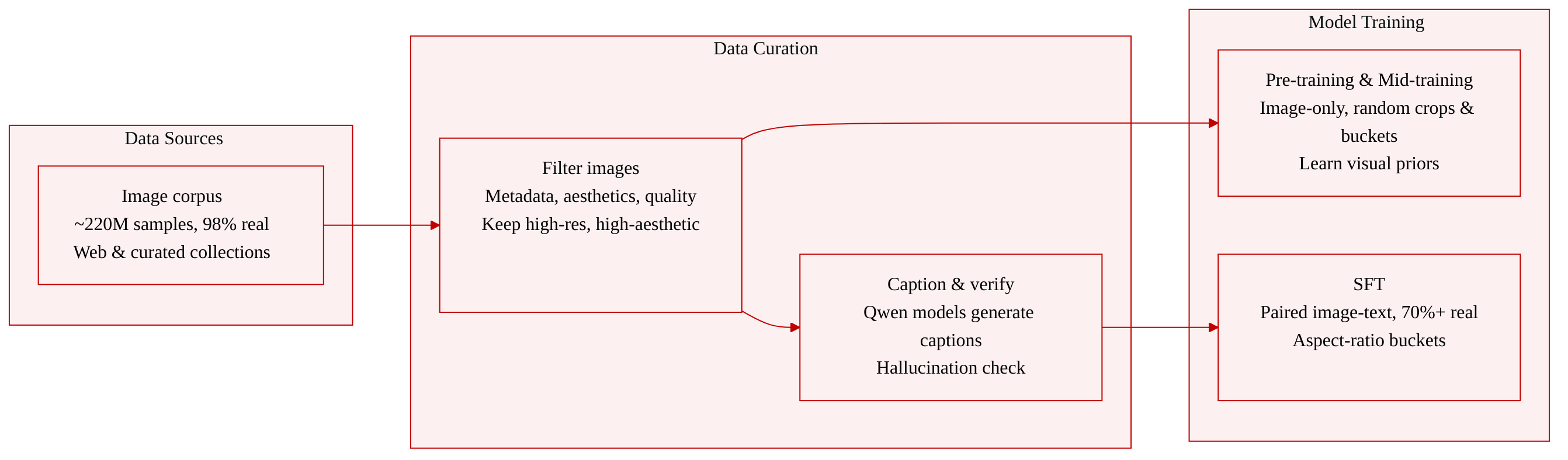
The authors build a large-scale image corpus from web sources and curated collections, with a small synthetic component used mainly for text-rendering tasks in supervised fine-tuning (SFT). The dataset provides image-only samples for pre-training and mid-training, and paired image-text samples for SFT.
-
Composition and scale
- Total of roughly 220M samples used across generation training.
- Over 90% are image-only samples (real images); the remaining ~10% are paired image-text samples for SFT.
- Real images make up 98% of the whole corpus; synthetic images account for 2% and appear only in the SFT portion.
- SFT data is organized into four groups: nature, design, people, and synthetic content. Among the paired SFT data, real images still exceed 70%.
-
Filtering
- Three-stage pipeline: metadata, aesthetics, and quality filtering.
- Metadata: keep images with total pixel count > 1024² and a file-size-to-pixel ratio ≥ 0.15 bytes per pixel.
- Aesthetics: remove images with ArtiMuse score < 60.
- Quality: remove images with DeQA-Score < 4.0.
-
Cropping and resolution
- Pre-training uses random square crops resized to 256×256.
- Mid-training and SFT stages use aspect-ratio buckets (details in the paper’s Section 4.3).
-
Captioning for SFT
- Filtered images are captioned by Qwen3.6-35B-A3B and Qwen3-VL-235B-A22B-Instruct, using a prompt that demands a faithful description of subjects, attributes, actions, spatial relations, scenes, and visual styles, plus accurate transcription of any visible text in its original language.
- A hallucination check (performed by Qwen3.6-35B-A3B) discards captions that invent objects, attributes, relations, or text, or that transcribe text incorrectly.
- Additional removal filters out malformed outputs, refusal responses, degenerate repetitions, private information, and watermark signals. The remaining captions form the image-text supervision for SFT.
-
Image-editing data
- Subjected to similar image-quality filtering, then an edit-instruction consistency check keeps only source-target pairs where the instruction correctly describes the visible changes without unsupported details.
-
Usage in training
- Image-only real data is used for pre-training and mid-training, exposing the model to diverse visual content at scale without captions.
- Paired image-text data (with aspect-ratio buckets) is used for SFT, with the real-image share kept above 70% and synthetic images reserved for text-rendering scenarios.
Method
The authors propose LLaDA-Image, a unified architecture that seamlessly supports both text-to-image generation and image editing. The framework decouples high-level semantic interpretation from pixel-space generation by assigning each to a dedicated component, bridged by an explicit connector.
As shown in the figure below:
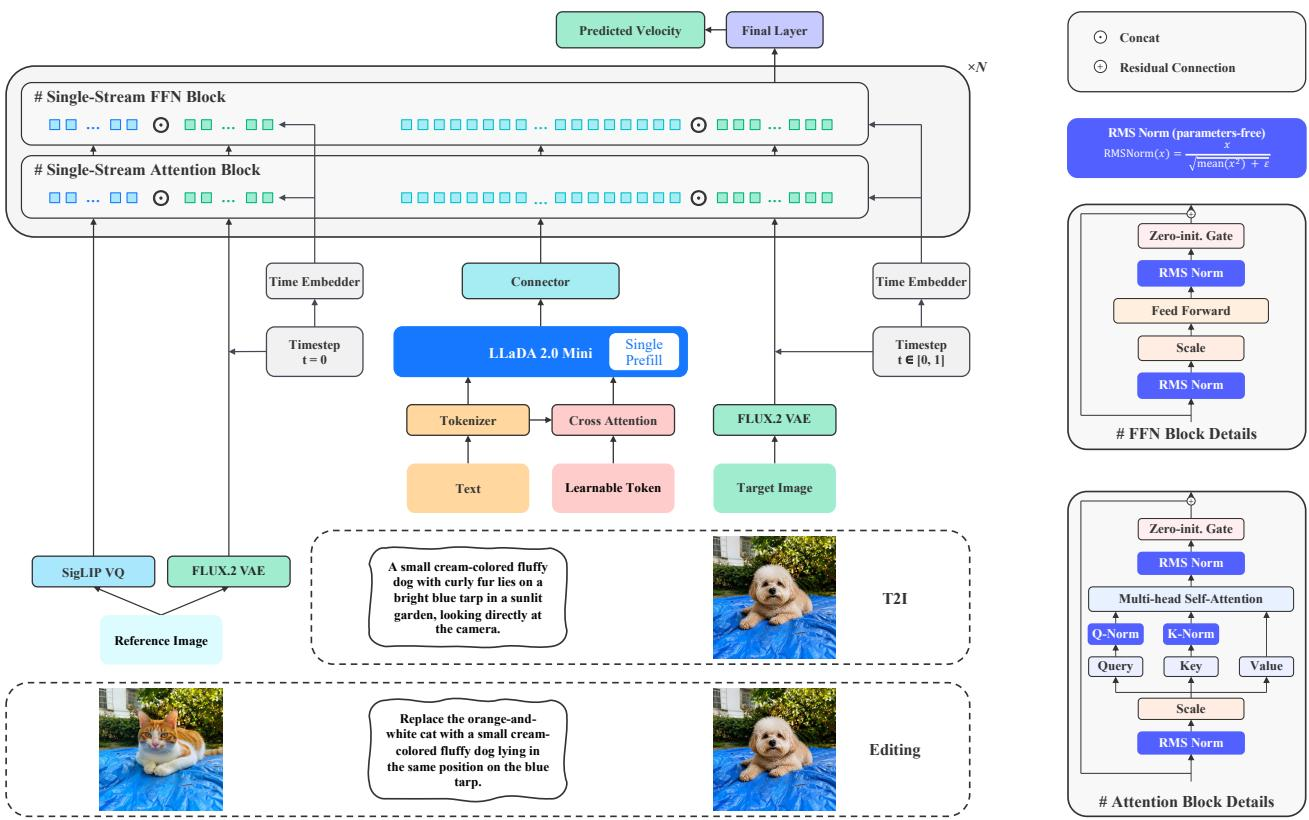
The understanding component is built upon the LLaDA 2.0 Mini diffusion large language model backbone, equipped with a SigLIP-VQ vision encoder. It processes text prompts or editing instructions to steer generation. For image editing, the reference image deliberately bypasses this comprehension stage and is injected directly into the generation component.
To bridge the distinct representation spaces of the VLM and the Diffusion Transformer (DiT), the authors introduce an understanding-to-generation interface. This interface consists of a Residual Query Adapter (RQA) and a Transformer Connector. The RQA utilizes a set of learnable query tokens that cross-attend to the multimodal input sequence. These residual queries are appended to the original input and processed by the frozen VLM backbone in a single prefill pass. This prompts the VLM to extract multimodal context maximally beneficial for generative synthesis. Subsequently, the Transformer Connector, composed of a shallow stack of Transformer blocks, projects the VLM hidden states into the DiT conditioning space.
The generation component is a pure single-stream Transformer-based DiT. The authors replace every normalization layer with parameter-free RMSNorm to improve optimization stability. Given a noised image latent, a timestep, and the condition encoding, the image and condition tokens are embedded into a shared sequence. Every block in the DiT directly models interactions between semantic conditions and evolving visual tokens through joint self-attention. For image editing, a parallel reference-image stream is introduced. The reference image is encoded via SigLIP-VQ and processed by a DiT-specific reference branch to produce semantic tokens. These are concatenated with the text condition tokens. Additionally, the clean reference image is encoded with a VAE, and its latent is concatenated with the noised target latent before the DiT input embedder. This dual-pathway design provides both high-level semantic guidance and native pixel-level evidence for unmodified regions.
The training pipeline is meticulously designed to bootstrap visual generation capabilities before aligning them with textual instructions. The authors first conduct Chain-of-Thought supervised fine-tuning to enhance the backbone comprehension. They then employ an image-only pre-training stage at a 256x256 resolution. Instead of relying on large-scale image-text pairs, a frozen VLM extracts semantics from unlabeled images to serve as a self-conditioning signal. To prevent trivial identity mapping, an image-token masking ratio is applied, converting the task into a sparse-to-dense prediction optimized via flow matching. The generator predicts the constant velocity field by minimizing the objective LFM=E[∥Fθ(xt,t,hcond)−(z−x)∥22].
Following pre-training, an image-only mid-training stage increases the pixel budget to 512x512 and introduces aspect-ratio-bucketed variable-resolution training. This strategy maintains a nearly constant per-image pixel budget across data parallel ranks while preserving the source aspect ratio, preventing geometric distortion and equipping the model to generate diverse aspect ratios.
During supervised fine-tuning, the authors transition to paired text-to-image alignment. They adopt logit-normal timestep sampling to allocate a larger fraction of the optimization budget to high-noise states, improving the stability of the early denoising process. The alignment begins at 512x512 pixels and progressively scales to 1024x1024 pixels to smoothly adapt to higher resolutions. To support editing within the same unified model, mixed-task continued training is applied, jointly training on text-to-image and image-to-image editing examples. This balanced mixture acts as capability replay, preventing the model from forgetting its open-ended generation quality while learning precise edit instruction following. Finally, the authors apply checkpoint merging to suppress transient step-dependent deviations and employ TwinFlow for few-step distillation, utilizing a shared DiT backbone with dual output heads to optimize the generator and fake-score estimator alternately.
Experiment
LLaDA-Image is evaluated as a unified model for both text-to-image generation and instruction-based image editing, using a comprehensive suite of benchmarks that assess visual quality, prompt alignment, text rendering, compositional understanding, and bilingual editing. In general generation, it establishes a new open-source state of the art on Qwen-Image-Bench, with broad gains in quality, aesthetics, and alignment, while showing balanced bilingual text rendering and strong object composition, though a counting weakness is noted. For editing, the model successfully retains semantic consistency across English and Chinese prompts, but perceptual quality trails that of specialized editing systems, indicating a direction for future refinement.
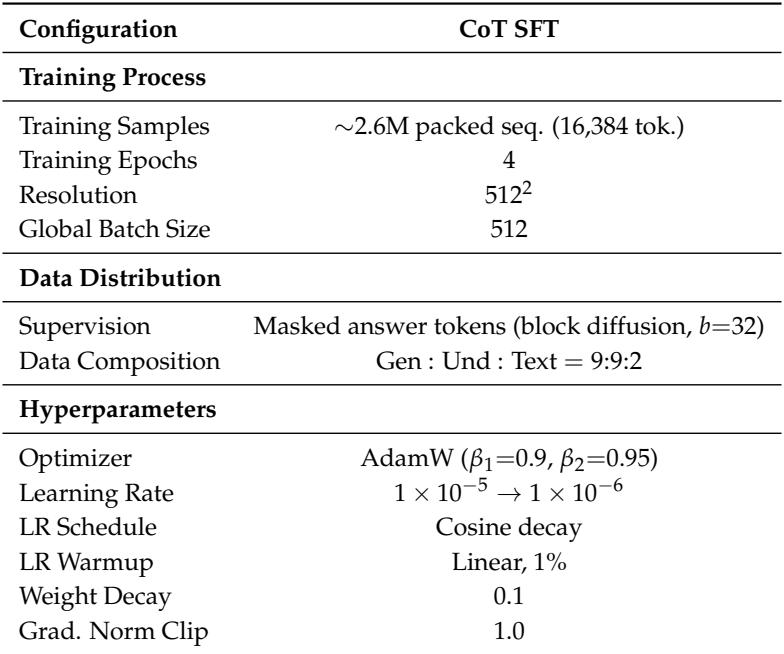
The understanding training stage applies chain-of-thought supervised fine-tuning on about 2.6 million packed sequences of 16,384 tokens. Training spans 4 epochs at a resolution of 512×512 pixels with a global batch size of 512. Supervision masks answer tokens using block diffusion with a block size of 32. CoT SFT uses approximately 2.6M packed sequences, each with 16,384 tokens. Training runs for 4 epochs at 512×512 resolution and a global batch size of 512. Supervision is applied via masked answer tokens in a block diffusion scheme with block size 32.
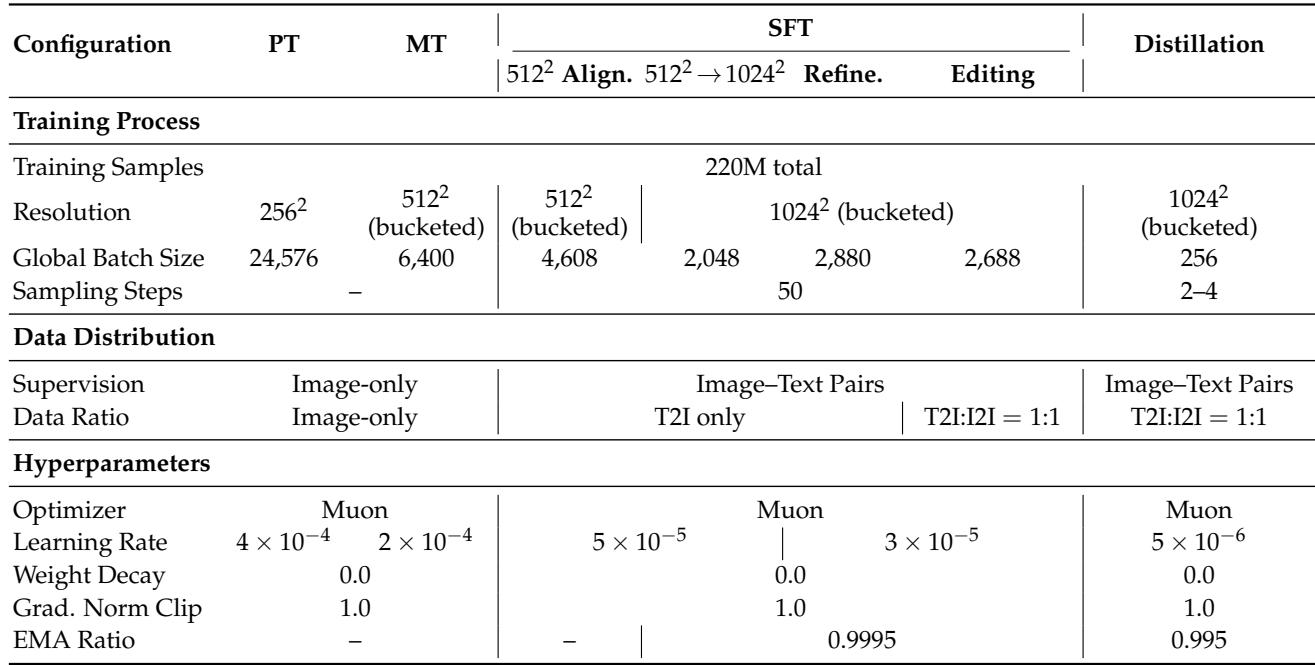
The generation training pipeline uses a cumulative 220 million samples across image-only pre-training, mid-training, supervised fine-tuning, and few-step distillation. Resolution increases from 256² to 1024² while batch sizes decrease, and sampling steps are introduced in mid-training then reduced to 2–4 in the fine-tuning stage. The Muon optimizer is used throughout all stages. Pre-training operates at 256² resolution with a large global batch size of 24,576, whereas later stages progressively lower the batch size and raise the resolution. Supervised fine-tuning begins with a text-alignment phase at 512² and then transitions to 1024² for refinement and editing. Mid-training uses 50 sampling steps, while the supervised fine-tuning stage reduces this to 2–4 steps, and few-step distillation is applied as the final stage.
Closed-source models lead the English Qwen-Image-Bench, with GPT-Image 2 achieving the highest overall score of 65.23 and the strongest creative generation at 75.34. LLaDA-Image sets a new open-source state of the art at 53.53, surpassing the previous best open-source model by 1.87 points. Creative generation is the top-performing dimension across all listed models. GPT-Image 2 attains the highest overall score (65.23) and leads in every dimension, with creative generation reaching 75.34. LLaDA-Image establishes a new open-source state of the art with an overall score of 53.53, outperforming Z-Image Turbo by 1.87 points.
On the Chinese Qwen-Image-Bench, closed-source models lead the ranking, with GPT-Image 2 achieving the highest overall score by a clear margin. All listed models perform best on Creative Generation and weakest on Real-world Fidelity. LLaDA-Image establishes a new open-source state of the art with an overall score of 53.38, surpassing the next-best open-source model. GPT-Image 2 tops every dimension, with Creative Generation reaching 75.23 and an overall score of 64.69, well ahead of the next closed-source model. Creative Generation is the strongest dimension across all models, while Real-world Fidelity consistently scores lowest, revealing a shared weakness in photorealistic rendering.
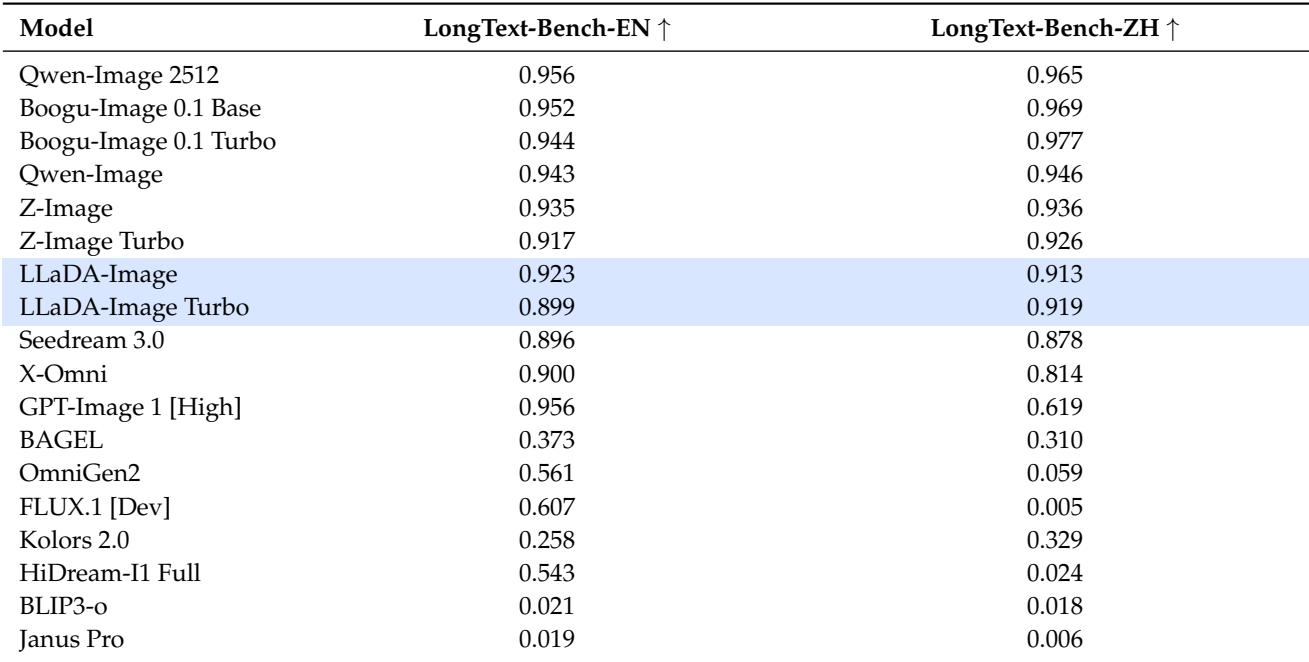
On the LongText-Bench, LLaDA-Image achieves long-text rendering scores of 0.923 (English) and 0.913 (Chinese), placing it below several competitors. The top English score is 0.956 from Qwen-Image 2512, while the top Chinese score of 0.977 belongs to Boogu-Image 0.1 Turbo. LLaDA-Image's English long-text rendering score (0.923) trails Qwen-Image 2512 (0.956) and both Boogu-Image 0.1 variants. For Chinese long-text rendering, LLaDA-Image (0.913) is outperformed by Boogu-Image 0.1 Turbo (0.977) and Boogu-Image 0.1 Base (0.969).
The model is trained through a multi-stage pipeline that scales resolution from 256² to 1024² while progressively reducing sampling steps, using block diffusion masking and the Muon optimizer. On the Qwen-Image-Bench, it sets a new open-source state-of-the-art in both English and Chinese, with creative generation being the strongest dimension across all models. However, it trails several competitors on long-text rendering benchmarks, and real-world fidelity remains a shared weakness among evaluated models.