Command Palette
Search for a command to run...
Ein universelles molekulares Basismodell überträgt sich auf vielfältige olfaktorische Aufgaben
Ein universelles molekulares Basismodell überträgt sich auf vielfältige olfaktorische Aufgaben
Yikun Han Yi Wang Neil Mankodi Stephen Yang Ambuj Tewari
Zusammenfassung
Basismodelle haben die Vorhersage molekularer Eigenschaften grundlegend verändert, doch es bleibt unklar, ob ein molekulares Basismodell, das auf eine einzelne kanonische olfaktorische Vorhersageaufgabe feinabgestimmt wurde, Repräsentationen erlernen kann, die sich auf diverse Probleme des maschinellen Riechens übertragen lassen. Wir untersuchen diese Frage, indem wir Uni-Mol2 auf den GS-LF-Benchmark für die Vorhersage von Geruchsdeskriptoren mit mehreren Labeln feinabstimmen und das resultierende Modell ohne weiteres tiefgehendes Training in vier komplementären nachgelagerten Szenarien evaluieren: datensatzübergreifende Vorhersage von Geruchsdeskriptoren, Klassifikation von riechenden gegenüber geruchlosen Substanzen, Enantiomerenbewertung und Unterscheidbarkeit von Geruchsmischungen. Das feinabgestimmte Modell erreicht oder übertrifft die Leistung der modernsten, spezifisch auf Olfaktion ausgerichteten Baseline auf dem primären GS-LF-Benchmark und überträgt sich konsistent auf diese nachgelagerten Evaluierungen. Die Enantiomerenanalyse zeigt ferner, dass dreidimensionale molekulare Repräsentationen spiegelbildliche Moleküle auf eine Weise unterscheiden, die zweidimensionale Graphmodelle grundsätzlich nicht leisten können, wenngleich die genaue Vorhersage der perzeptuellen Konsequenzen der Stereochemie eine offene Herausforderung bleibt. Zusammengenommen stützen diese Ergebnisse ein Paradigma des einmaligen Trainierens mit anschließender Übertragung auf verschiedene Aufgaben für das maschinelle Riechen und legen nahe, dass chemisch vortrainierte molekulare Repräsentationen eine starke Grundlage für übertragbare olfaktorische Vorhersagen bieten.
One-sentence Summary
Researchers at the University of Michigan fine-tuned Uni-Mol2 on the GS-LF multi-label odor descriptor benchmark and found that the model, without additional deep-learning training, matches or exceeds the state-of-the-art olfaction-specific baseline and transfers to cross-dataset odor descriptor prediction, odorous-versus-odorless classification, enantiomer evaluation, and odor mixture discriminability, while also revealing that three-dimensional molecular representations distinguish mirror-image molecules in ways two-dimensional graph models cannot, supporting a train-once, transfer-across-tasks paradigm for machine olfaction.
Key Contributions
- Fine-tuning the Uni-Mol2 molecular foundation model on the GS-LF multi-label odor descriptor prediction task yields a model that matches or exceeds the performance of a state-of-the-art olfaction-specific baseline on that benchmark.
- Without additional deep-learning training, the same fine-tuned model transfers to four diverse machine olfaction problems, including cross-dataset odor descriptor prediction, odorous-versus-odorless classification, enantiomer evaluation, and odor mixture discriminability, often matching or outperforming specialized baselines.
- Enantiomer analysis shows that the model’s three-dimensional molecular representations distinguish mirror-image molecules, a capability absent in two-dimensional graph models, while accurately predicting the perceptual consequences of stereochemistry remains an open challenge.
Introduction
Deep learning has driven breakthroughs in vision and language, but machine olfaction lags behind due to severe data scarcity. Quantitative structure-odor relationship (QSOR) modeling, which aims to predict odor qualities from molecular structures, has advanced from early statistical methods to graph neural networks and the expert-annotated GS-LF dataset, yet progress on single-molecule odor descriptor prediction has stagnated. The authors address this bottleneck by fine-tuning a molecular foundation model on the GS-LF benchmark and show that the resulting representations transfer robustly to multiple downstream olfactory tasks, including cross-dataset descriptor prediction, odorous-versus-odorless classification, mixture discriminability, and stereochemical evaluation, without requiring extensive task-specific retraining.
Method
The authors present a transfer-learning framework for machine olfaction, leveraging a molecular foundation model to address the scarcity of high-quality odor datasets. The overall pipeline involves fine-tuning the foundation model on a canonical dataset and subsequently evaluating its transferability across diverse olfactory tasks.
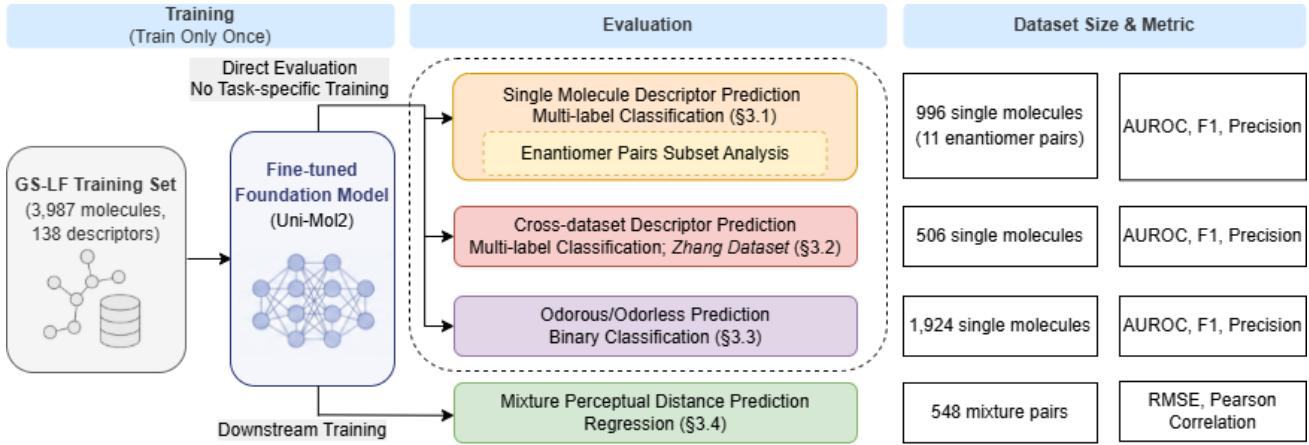
The framework utilizes Uni-Mol2 as the foundational model. Because olfaction is intrinsically linked to molecular shape, geometry, and stereochemistry, standard 2D molecular graphs or SMILES strings are insufficient. Uni-Mol2 is selected for its ability to explicitly integrate atom-level, graph-level, and 3D geometric information, making its representations highly sensitive to spatial molecular structure. By fine-tuning this model on the GS-LF dataset, the authors aim to capture robust molecular representations that generalize across downstream tasks ranging from multilabel classification to regression.
To address the pronounced class imbalance inherent in odor descriptor prediction, the authors employ a focal loss function during fine-tuning. For instance, common descriptors like "fruity" appear thousands of times, while rare ones like "chamomile" appear only dozens of times. The focal loss down-weights frequent classes and emphasizes minority classes, defined as:
Lfocal(pt)=−αt(1−pt)γlog(pt)where pt is the predicted probability of the true class, αt is a class balancing factor, and γ is a focusing parameter that reduces the loss contribution of well-classified examples. To further enhance robustness, the authors construct an ensemble of 50 models by averaging predictions from the top 10 hyperparameter configurations across five cross-validation folds. For single-molecule and cross-dataset tasks, this ensemble is evaluated directly. For the mixture perceptual distance prediction task, the learned molecular embeddings serve as inputs for lightweight classical machine learning models, avoiding additional deep learning fine-tuning.
Beyond immediate performance, the authors analyze common error patterns to motivate future architectural improvements. They define a confusing label pair (ℓtrue,ℓpred) as an error where a molecule annotated with descriptor ℓtrue is incorrectly assigned descriptor ℓpred. This corresponds to a simultaneous false negative for the true label and a false positive for the predicted label.
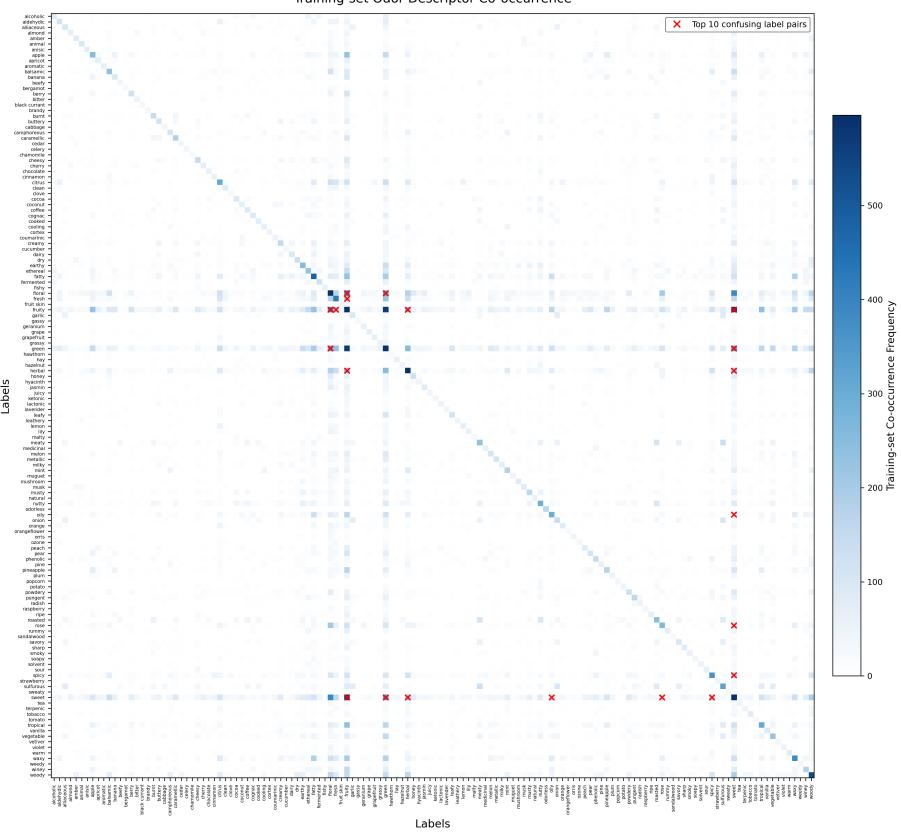
Analysis reveals that the most frequently confused label pairs exhibit notably high co-occurrence frequencies in the training set. For example, the pair "green" and "sweet" co-occurs hundreds of times, far exceeding the dataset average. This suggests that prediction errors are not random but reflect the intrinsic statistical overlap among odor descriptors.
To determine if this statistical structure aligns with semantic similarity, the authors generate BERT embeddings for all descriptors and evaluate the cosine similarity of the top confusing pairs.
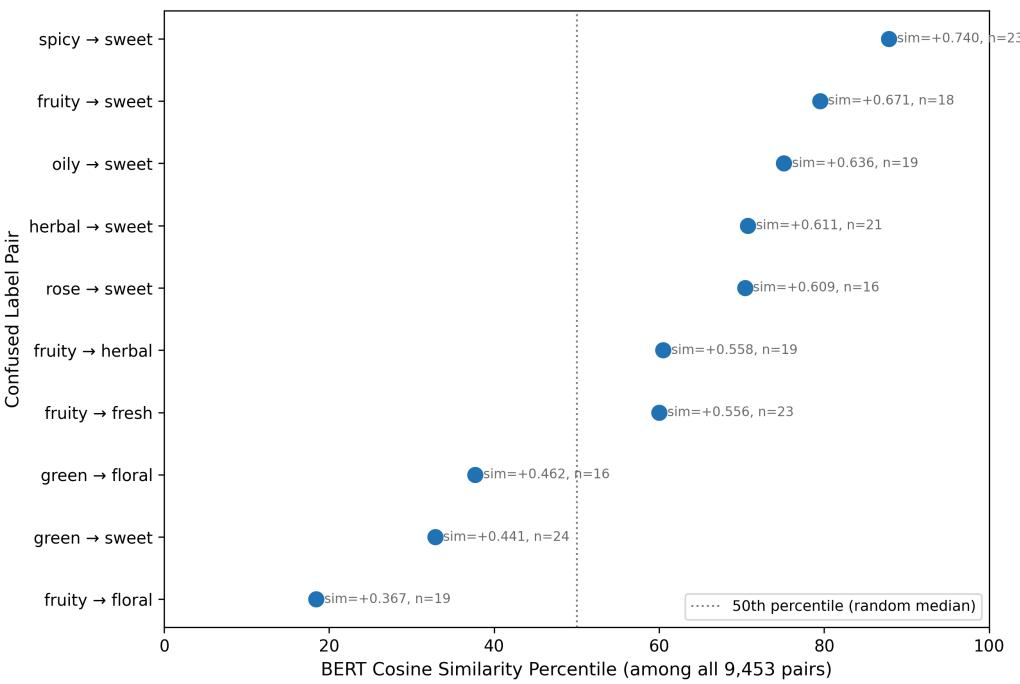
The results indicate that while the most frequent confusion pairs have a mean similarity percentile slightly above chance level, the deviation is not statistically significant. This implies that semantic similarity alone provides weak evidence for the observed confusion structure. Consequently, the authors propose that future foundation models should move beyond treating odor descriptors as independent categorical labels. Instead, they suggest learning joint representation spaces for both molecules and odor descriptors, enabling prediction through a learned compatibility function. This approach would naturally capture relationships among descriptors, share statistical strength across related labels, and potentially support zero-shot generalization to unseen odor descriptors.
Experiment
The evaluation compares Uni-Mol2 against the POM/OpenPOM baseline on single-molecule odor descriptor prediction, enantiomer-pair analysis, cross-dataset transfer, odor detection, and mixture discrimination tasks. Uni-Mol2 consistently outperforms the baseline, demonstrating that its 3D molecular representation captures stereochemical sensitivity, though it still struggles to correctly assign enantiomer-specific odor descriptors. The model also generalizes effectively to external datasets and transfers to predicting perceptual discriminability of odor mixtures, highlighting the broad utility of the learned representations.
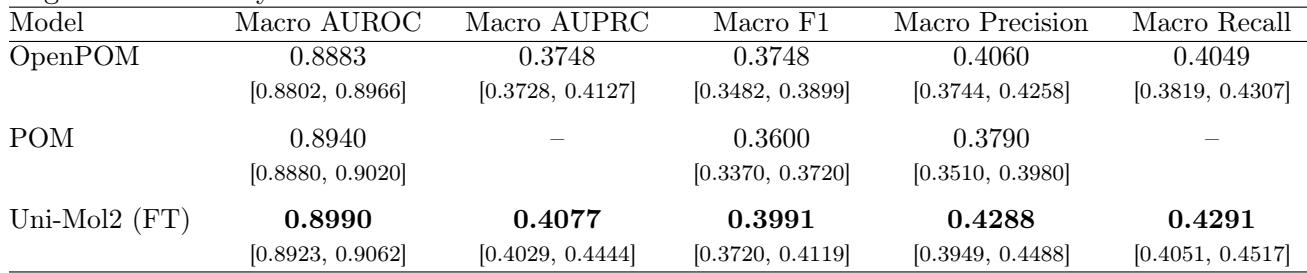
Uni-Mol2 (FT) achieves the best macro AUROC, AUPRC, F1, precision, and recall among the compared models on the GS-LF multi-label classification task. It improves over both the originally published POM results and the fully reproducible OpenPOM baseline. Increasing the Uni-Mol2 model size to 164M did not improve performance under the same hyperparameter tuning budget. Uni-Mol2 (FT) leads all reported classification metrics, with the highest macro AUROC, AUPRC, F1, precision, and recall. POM does not report macro AUPRC or recall, whereas OpenPOM provides complete metric estimates with bootstrap confidence intervals. The larger 164M Uni-Mol2 configuration did not yield additional gains over the 84M configuration.
On the enantiomeric test set, Uni-Mol2 outperforms OpenPOM across all macro-averaged metrics, with the largest relative gain in macro AUPRC. The evaluation uses label-wise thresholds transferred from the training data without further tuning, indicating that the fine-tuned representations better capture stereochemical differences relevant to odor perception. Uni-Mol2 achieves notably higher macro AUPRC than OpenPOM, reflecting a stronger precision-recall trade-off when predicting odor descriptors for enantiomeric pairs. All threshold-dependent metrics (F1, precision, recall) are consistently higher for Uni-Mol2, confirming robust transfer of the learned representations to stereochemical discrimination.

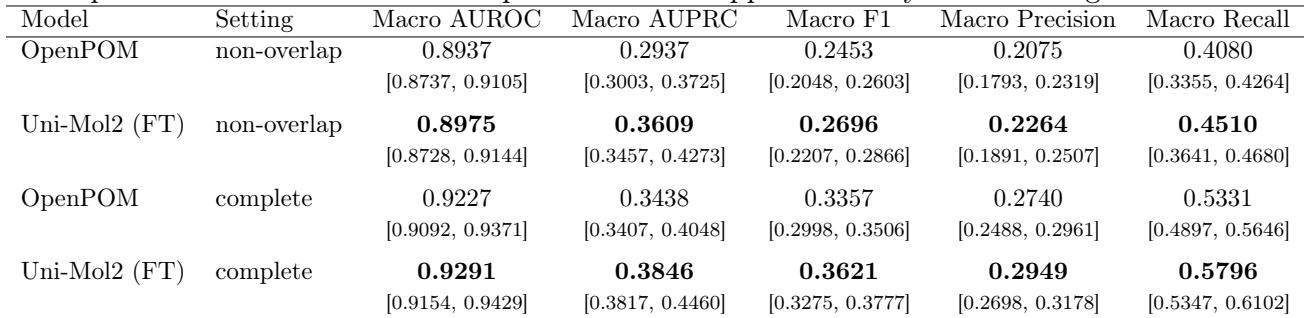
Uni-Mol2 consistently outperforms OpenPOM across all reported metrics on the Zhang odor descriptor test set, both when all molecules are included and when training-set molecules are removed. The model achieves a macro AUROC of 0.8975 on the non-overlapping subset, indicating strong cross-dataset transferability. These results suggest that Uni-Mol2 captures transferable structural features that generalize beyond its original training distribution. Uni-Mol2 yields higher macro AUROC, AUPRC, F1, precision, and recall than OpenPOM in both the complete and non-overlap settings. On the non-overlap subset, Uni-Mol2 reaches a macro AUROC of 0.8975, confirming its ability to generalize to molecules not seen during training.
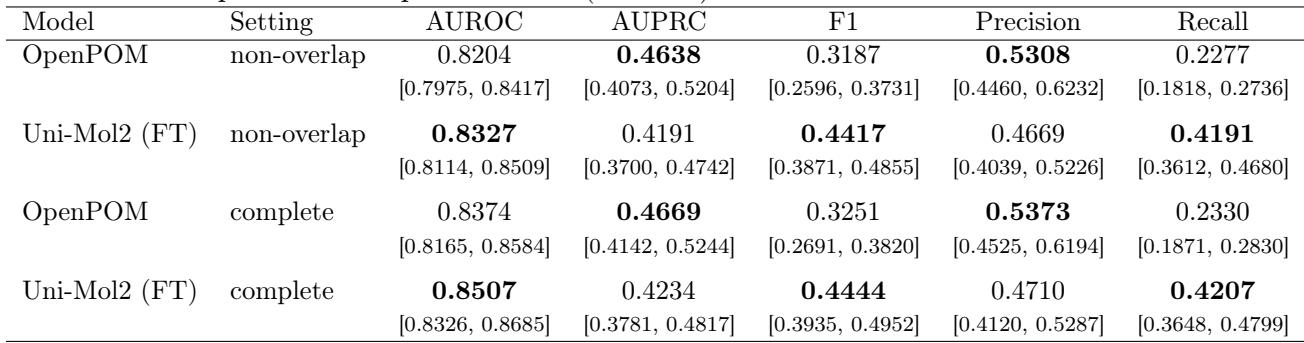
Uni-Mol2 consistently outperformed OpenPOM on the odor detection task, achieving higher AUROC and substantially higher recall and F1 scores for the odorless class on both the complete and non-overlapping test sets. These gains came with a modest reduction in precision and AUPRC, indicating a trade-off where the model identifies more true odorless molecules at the expense of additional false positives. Uni-Mol2 raised recall for odorless molecules by roughly 19 percentage points over OpenPOM in both evaluation settings, capturing a much larger fraction of the positive class. The F1 score of Uni-Mol2 exceeded that of OpenPOM by about 12 points, reflecting a better balance between precision and recall despite a drop in precision.
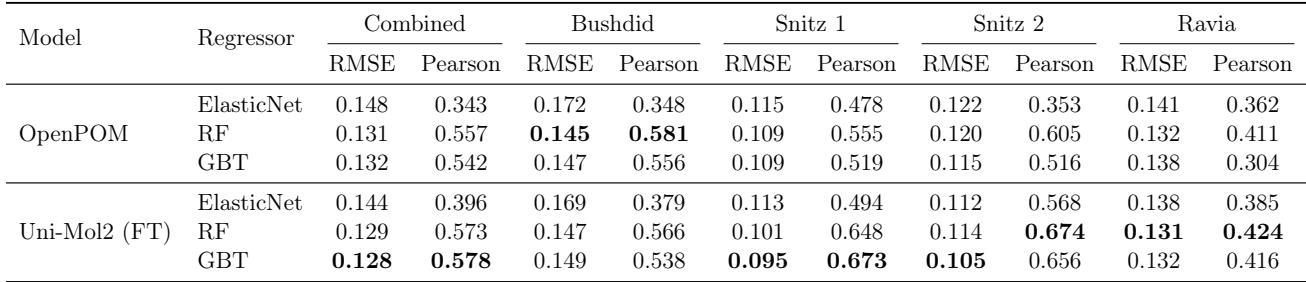
Uni-Mol2 fine-tuned embeddings combined with tree-based regressors achieve the best overall performance for predicting odor mixture discriminability, as measured by combined RMSE and Pearson correlation across four datasets. On individual datasets, Uni-Mol2 outperforms the OpenPOM baseline on Snitz 1, Snitz 2, and Ravia, while OpenPOM has a slight edge on the Bushdid dataset. The results indicate that molecular representations learned from single-molecule tasks transfer effectively to mixture perception. Uni-Mol2 representations with random forest or gradient boosting regressors achieve the highest combined Pearson correlation and lowest combined RMSE, outperforming all OpenPOM variants. On individual datasets, Uni-Mol2 leads on Snitz 1, Snitz 2, and Ravia, while OpenPOM with random forest shows a small advantage on the Bushdid dataset.
Across a range of olfactory benchmarks—multi-label classification, enantiomer discrimination, cross-dataset transfer, odor detection, and mixture discriminability—Uni-Mol2 fine-tuned embeddings consistently outperform the OpenPOM baseline, demonstrating strong generalization and stereochemical sensitivity. The model yields notable gains in recall and F1 for odorless detection and achieves the best combined performance on mixture prediction tasks, while increasing model size does not improve results. These findings confirm that Uni-Mol2 learns transferable molecular representations effective for both single-molecule and mixture perception.