Command Palette
Search for a command to run...
Koevolution in agentischen Systemen: Auf dem Weg zu selbstgesteuerter Evolution jenseits menschlichen Designs
Koevolution in agentischen Systemen: Auf dem Weg zu selbstgesteuerter Evolution jenseits menschlichen Designs
Zusammenfassung
Von agentischen Systemen wird zunehmend erwartet, dass sie sich nach ihrer Bereitstellung verbessern, doch die Selbstentwicklung einzelner Entitäten ist häufig durch einen statischen Lernkontext begrenzt, etwa durch feste Aufgaben und Rückmeldungen. Dieser Überblicksartikel konzentriert sich auf die Koevolution in agentischen Systemen, eine mehrkomponentige Form der Selbstentwicklung, bei der mehrere Agenten und ihre Umgebung wechselseitig Anpassungsdruck aufeinander ausüben. Um die vorhandene Literatur zu strukturieren, schlagen wir eine progressive dreistufige Taxonomie vor, die nachzeichnet, wie das System schrittweise vom Menschen vorgegebene Beschränkungen ablegt. Die Agent-Agent-Koevolution untersucht, wie sich Agenten durch dynamische Gegenüber anpassen, einschließlich adversarieller, kollaborativer und organisatorischer Anpassung. Die Agent-Umwelt-Koevolution erweitert diese Schleife auf adaptive Aufgaben, Rückmeldungen und Interaktionsräume, die sich mit den Agenten verändern. Die Meta-Koevolution erforscht darüber hinaus die Möglichkeit, den Evolutionsmechanismus selbst evolvierbar zu machen. Wir erörtern zudem offene Herausforderungen bei der Evaluierung solcher Systeme, ihrer Skalierung über mehrere Komponenten hinweg und der Gewährleistung von Sicherheit und Kontrollierbarkeit zunehmend autonomer evolutionärer Prozesse. Dieser Überblicksartikel bietet eine einheitliche Grundlage für den Aufbau robuster und ergebnisoffener agentischer Systeme, die sich über feste, vom Menschen entworfene Pfade hinaus verbessern können.
One-sentence Summary
Researchers from Hong Kong University of Science and Technology, University of Illinois Urbana-Champaign, The Chinese University of Hong Kong, The University of Hong Kong, and Peking University present a survey on co-evolution in agentic systems, proposing a progressive three-stage taxonomy of agent–agent, agent–environment, and meta co-evolution that traces how adaptive pressure among multiple components gradually sheds human-engineered constraints, and discuss open challenges in evaluating, scaling, and ensuring safety for such systems to build robust, open-ended agentic systems that improve beyond fixed human-designed paths.
Key Contributions
- The survey provides a formal definition of co-evolution that requires mutual evolutionary pressure between at least two components, and organizes the field through a progressive three-stage taxonomy: Agent–Agent, Agent–Environment, and Meta Co-Evolution.
- A dynamic evaluation paradigm is proposed for co-evolving systems, moving beyond static benchmarks by measuring component-level improvements, cross-play transferability, and using held-out evaluators to detect exploitative behaviors.
- Meta Co-Evolution, where the evolution mechanism itself becomes evolvable, is identified as a critical frontier for reducing human intervention and enabling open-ended, self-improving agentic systems.
Introduction
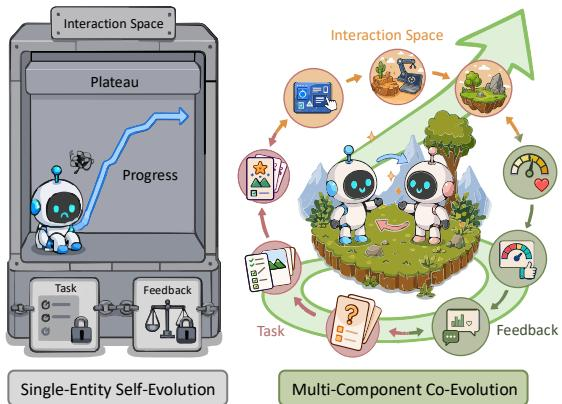
As AI systems shift from isolated models to agentic systems that autonomously use tools, memory, and skills, a central challenge is enabling continual improvement after deployment. Self-evolution lets agents update themselves from experience, but it remains bounded by fixed external conditions, a limitation akin to the Red Queen effect. No existing survey has made co-evolution, where multiple components adapt jointly and reshape each other’s evolution, the central focus. The authors fill this gap by offering the first focused survey of co-evolution in agentic systems, organizing the literature with a progressive three-stage taxonomy that expands evolutionary freedom from agent–agent co-evolution, through agent–environment co-evolution, to meta co-evolution where the evolution mechanism itself becomes adaptive.
Method
The authors propose a three-stage taxonomy that follows the expanding scope of what a system is allowed to evolve, gradually removing human-engineered constraints.
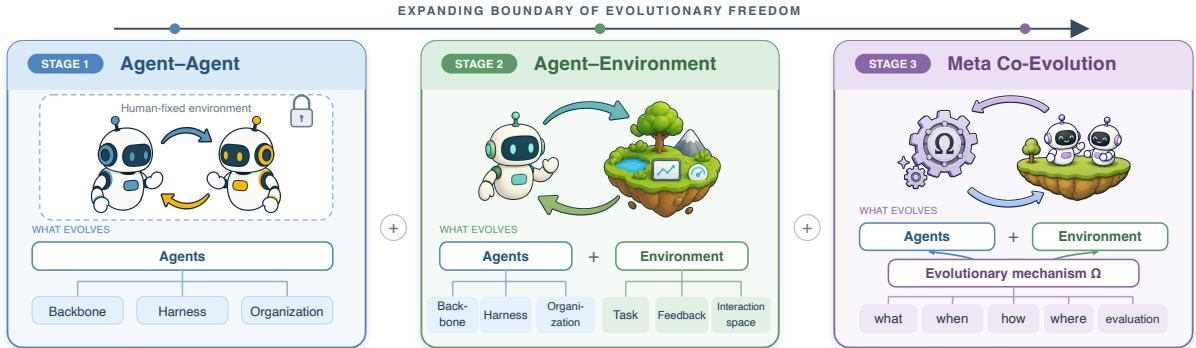
Stage 1 focuses on Agent-Agent Co-Evolution. Coevolution begins when an agent no longer learns against a static counterpart. As agents respond to one another, each agent's progress changes the challenges and opportunities facing its peers, and the collective may also reorganize its structure Π. This creates a coupled evolutionary process within the agent collective defined as:
At+1=({ait+1}i=1n,Πt+1)=Ω(At,E,τt).Stage 2 extends this to Agent-Environment Co-Evolution. While the coupled process in Stage 1 continuously changes the agents, the environment remains fixed, limiting new experiences. Stage 2 allows agent behavior to reshape the whole conditions that subsequently shape the agents:
(At+1,Et+1)=Ω(At,Et,τt).Stage 3 introduces Meta Co-Evolution. In Stage 2, the evolution mechanism remains human-designed. Meta co-evolution is defined as a stage where the lower-level co-evolving system further revises its evolution mechanism through a self-generated revision process Γt:
Ωt+1=Γt(St,Ωt,τt),St+1=Ωt+1(St,τt).This recursion provides a pathway toward open-endedness, characterized by continuous novelty Ωt+1=Ωt and unbounded divergence with adaptive capability H satisfying limt→∞H(St,Ωt)=∞. The authors decompose the evolution mechanism into five adaptive decisions: what to evolve selects the adaptation target, when to evolve triggers updates after failures or plateaus, how to evolve produces variants through training or revision, where to evolve covers the domain and setting, and how to evaluate judges evolution quality.
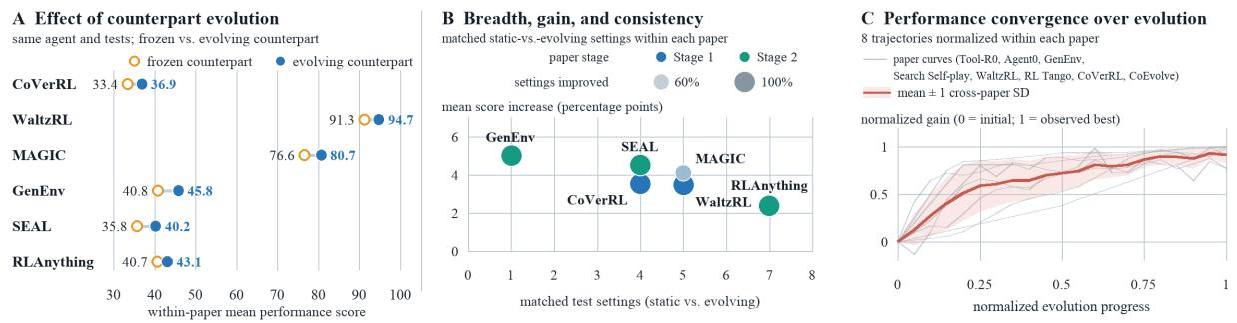
As shown in the figure below, Stage 1 and Stage 2 improve performance across most settings, but the gains become smaller as evolution approaches a plateau. By allowing the evolution mechanism to change, meta co-evolution moves beyond this bottleneck and opens new directions for improvement.