Command Palette
Search for a command to run...
Frontis-MA1: Training eines AI4AI-Modells für rekursive Selbstverbesserung im Machine-Learning-Engineering
Frontis-MA1: Training eines AI4AI-Modells für rekursive Selbstverbesserung im Machine-Learning-Engineering
Zusammenfassung
Rekursive Selbstverbesserung (RSI) erfordert KI-Systeme, die den Prozess der KI-Erstellung verbessern (d. h. AI4AI); Machine-Learning-Engineering (MLE) bietet ein konkretes, ausführbares Testfeld zur Untersuchung dieser Fähigkeit. Wir stellen OpenMLE vor, ein offenes Full-Stack-System für die RSI-Forschung im MLE, das verifizierbare Aufgabenumgebungen mit Ausführungsfeedback (OpenMLE-Gym), Operatorlernen (OpenMLE-ERL) und langfristige Suche (OpenMLE-Evo) umfasst. Auf diesem Stack trainieren wir Frontis-MA1-35B als Meta-Evolutionsagenten für MLE nach, wobei wir Nachtraining und Inferenz um vier atomare Programm-Evolutionsoperatoren (Draft, Improve, Debug, Crossover) ausrichten: Dieselben Operatoren werden mittels ausführungsgestütztem SFT und RL auf Daten trainiert, die gegenüber allen Evaluierungsbenchmarks dedupliziert wurden, und anschließend zu einer langfristigen Suche zusammengesetzt, die Lernen und Evolution in einer einzigen Schleife koppelt. Auf MLE-Bench Lite verbessert Frontis-MA1-35B unter einem 12-Stunden-Budget pro Aufgabe auf einer RTX 4090 mit maximal 12 GB VRAM den Medal Average von 39,39 % auf 60,61 % gegenüber seinem Basismodell mit OpenMLE-Evo und erreicht 71,21 % mit OpenMLE-Evo-Max (benchmarkunabhängige Erfahrungsprioren und asynchrone Suche), womit es GPT-5.5 + Codex übertrifft und sich GPT-5.6 Sol sowie dem 2,8T Kimi K3 annähert. Auf dem zurückgehaltenen NatureBench Lite übertragen sich beide Komponenten: Bei festem Framework erhöht der Austausch des trainierten Modells die Match-SOTA von 50 % auf 70 %; bei festem Modell erhöht der Austausch durch OpenMLE-Evo sie von 20 % auf 50 %. Wir veröffentlichen die Modellgewichte und den vollständigen OpenMLE-Stack, um reproduzierbare Forschung zu ausführbarem AI4AI in Richtung RSI zu ermöglichen.
One-sentence Summary
Researchers from Horizon Research, Frontis.AI, and Tsinghua University introduce Frontis-MA1-35B, a meta-evolution agent that posttrains four atomic program-evolution operators via execution-grounded SFT and RL, composes them into long-horizon search, and boosts Medal Average on MLE-Bench Lite from 39.39% to 71.21% with OpenMLE-Evo-Max, surpassing GPT-5.5+Codex and approaching GPT-5.6 Sol and Kimi K3, while also transferring to NatureBench Lite.
Key Contributions
- OpenMLE is an open full-stack system for meta-evolution research in machine learning engineering. It provides verifiable task environments with execution feedback, execution-grounded operator learning via supervised fine-tuning and reinforcement learning, and long-horizon evolutionary search guided by structured experience.
- Frontis-MA1-35B is post-trained as a meta-evolution agent by aligning training and inference around four atomic program-evolution operators (Draft, Improve, Debug, Crossover) trained with execution-grounded SFT and RL on data deduplicated against evaluation benchmarks, then composed into long-horizon search, coupling learning and evolution.
- Combining the trained model with OpenMLE-Evo improves Medal Average from 39.39% to 60.61% on MLE-Bench Lite, and with OpenMLE-Evo-Max reaches 71.21%. Both the model and the search framework transfer to NatureBench Lite, where the model raises Match-SOTA from 50% to 70% and the search framework raises it from 20% to 50%.
Introduction
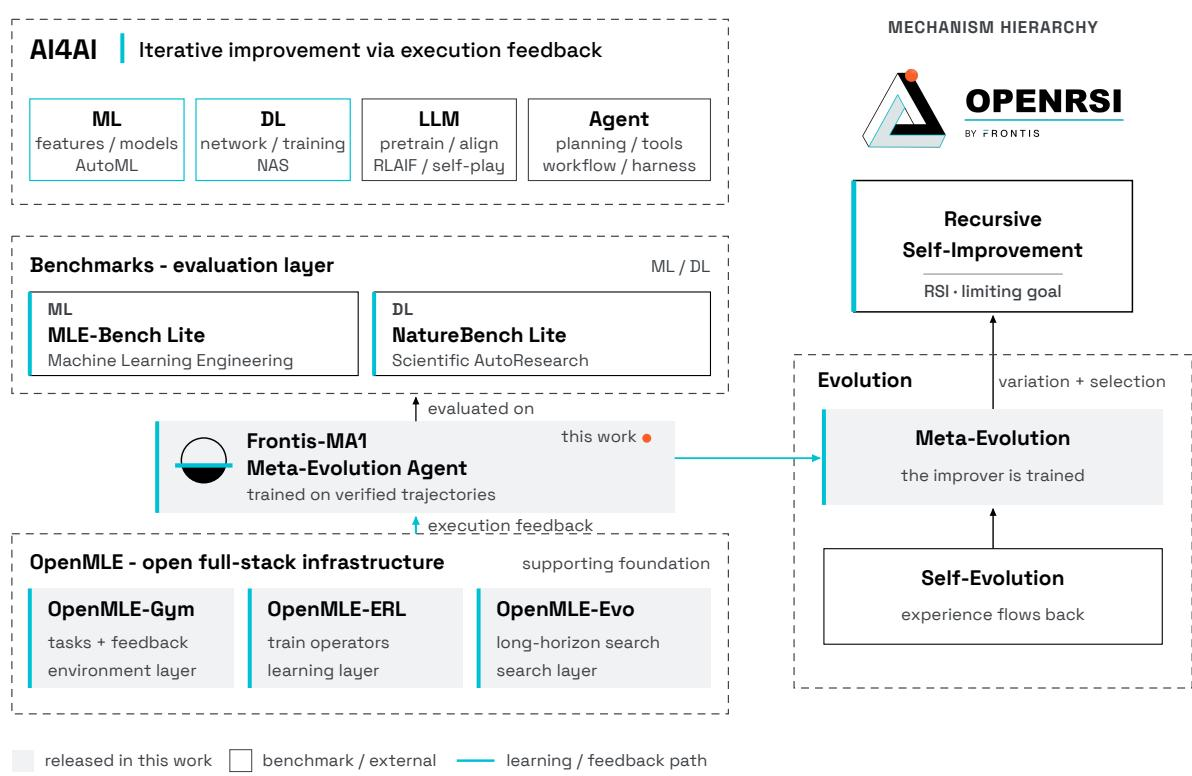
The authors address the challenge of building AI systems that can autonomously improve other AI systems, a direction known as AI for AI (AI4AI) with the long-term goal of recursive self-improvement. Machine learning engineering (MLE) serves as a concrete testbed, where an agent must iteratively develop ML solutions under delayed, noisy execution feedback. Prior work advances MLE agents through evolutionary search, task environments, or execution-grounded post-training, but no existing public system jointly spans scalable task construction, agent training from execution feedback, and a long-horizon evolutionary harness in a reproducible workflow. The authors introduce OpenMLE, an open full-stack solution that unifies these components: OpenMLE-Gym provides quality-gated tasks and structured feedback, OpenMLE-ERL trains reusable program-transformation operators via supervised and reinforcement learning, and OpenMLE-Evo composes those operators into experience-guided search. This integrated stack enables training a meta-evolution agent that serves as the variation engine of its own evolutionary harness, demonstrating significant gains on MLE benchmarks and releasing all artifacts for broader study.
Dataset
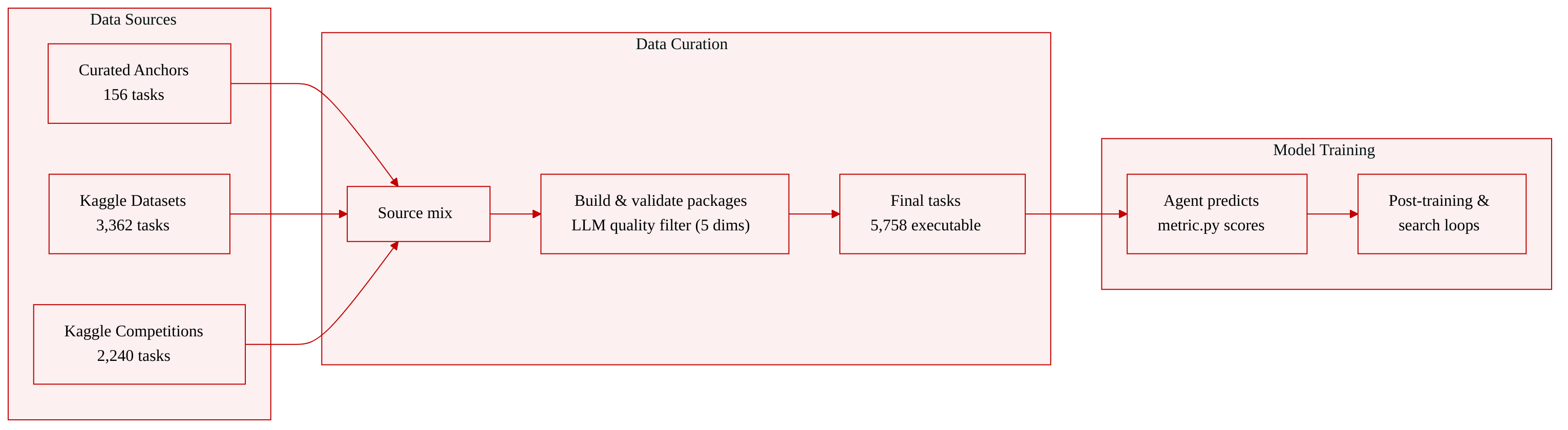
The authors construct OpenMLE-Gym, a suite of 5,758 executable machine learning engineering tasks designed for post-training, search, and evaluation of LLM agents. Each task is a verifiable environment that couples a problem description, training data, hidden test labels, and a metric script into a standardized package. The dataset is built from three complementary sources:
- Curated Anchors (156 tasks): Manually selected from existing papers and benchmarks, offering the highest design confidence but limited scale. Original assets are processed directly into executable packages.
- Kaggle Datasets (3,362 tasks): Generated at scale using the MLE-Smith dataset-to-task pipeline, then filtered with package-level quality control. Objectives are automatically induced, so quality can vary.
- Kaggle Competitions (2,240 tasks): Built through a custom crawling and construction pipeline that downloads competition files, extracts schemas and metadata from Meta Kaggle, and generates task descriptions, data splits, and evaluation scripts. Competitions overlapping with MLE-Bench are excluded to preserve evaluation integrity.
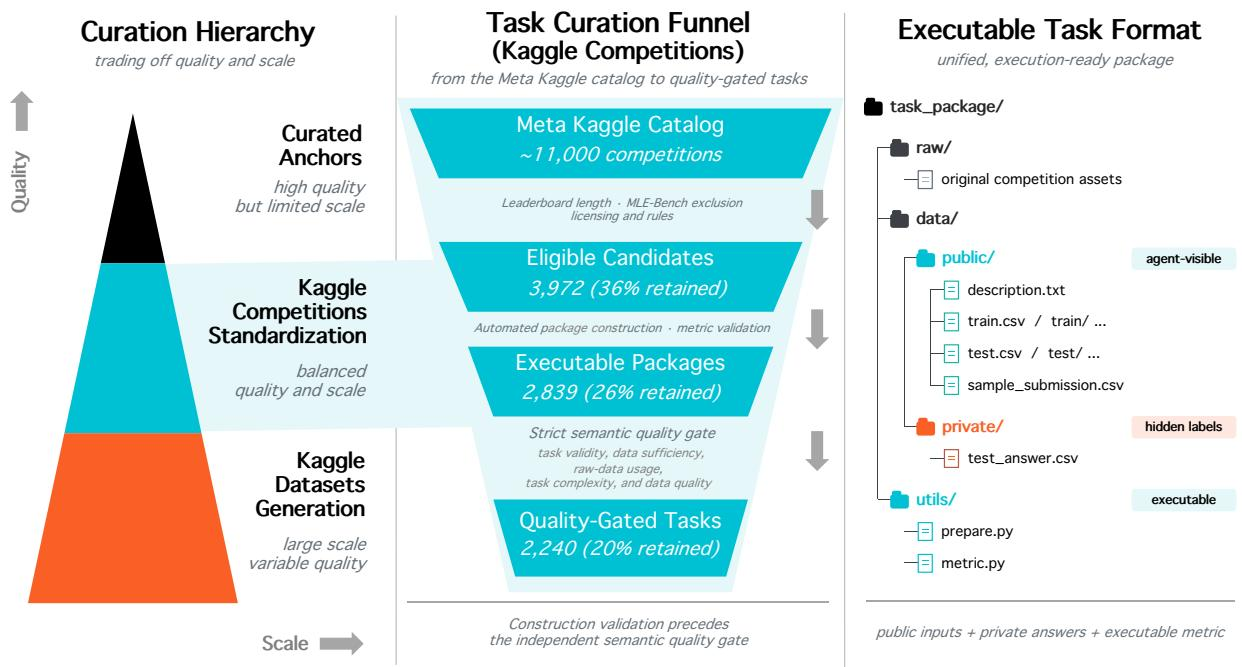
All tasks share a unified layout: raw assets stay in raw/, agent-visible training data, test inputs, and a sample submission reside in data/public/, hidden answers are isolated in data/private/, and a metric.py script validates predictions and returns a scalar score. For competition-derived tasks, the automated framework uses local evidence (schemas, data types, dimensions, sampled rows) together with Meta Kaggle records to produce prepare.py, which deterministically splits labeled data, separates public inputs from private answers, and creates a schema-compatible sample submission. The package is then validated by executing the preparation code and scoring the sample submission; unbuildable packages or those that fail to produce a valid scalar metric are discarded.
A subsequent LLM-based quality filter inspects each task package (description, raw files, processing script, outputs, data samples) and returns structured judgments on five dimensions: task validity, data sufficiency, raw-data usage, task complexity, and data quality. Only metric-valid tasks that receive the strictest recommendation are retained, removing degenerate targets, data leakage, annotation errors, and malformed processing. For the competition branch, this semantic gate is applied after leaderboard-length screening, MLE-Bench overlap removal, and licensing checks.
The final dataset spans tabular, text, time-series, image, and other modalities (11% are multimodal), with classification and regression accounting for 87% of tasks. The authors use these environments to provide agents with verifiable feedback: an agent reads the public training data, produces predictions on the test inputs, and receives a scalar reward from metric.py, enabling post-training, test-time search, and recursive self-improvement loops.
Method
The authors construct OpenMLE-Gym, a unified executable task suite, by mapping three source-specific paths into a shared executable task package. As shown in the figure below, the curation hierarchy balances quality and scale across Curated Anchors, Kaggle Competitions, and Kaggle Datasets. For the competition-derived branch, an automated framework converts a Kaggle competition slug into a standardized executable package, applying a strict semantic quality gate after executability validation. The resulting executable task format separates agent-visible public inputs from hidden private answers and includes executable utilities to ensure reproducible scoring.
To train the model for evolutionary inference, the authors separate local skills from the search algorithm by training a compact set of reusable program-transformation operators: Draft, Improve, Debug, and Crossover. The training process consists of an execution-grounded supervised warm start followed by reinforcement learning.
For the supervised warm start, the authors employ two sampling paths. The parallel path independently samples and executes complete Draft solutions, while the evolutionary path applies Improve, Debug, and Crossover over executed programs to retain useful steps from high-quality local trajectory segments. Collection stops based on a budget-adaptive rule, forming a large-scale SFT corpus.
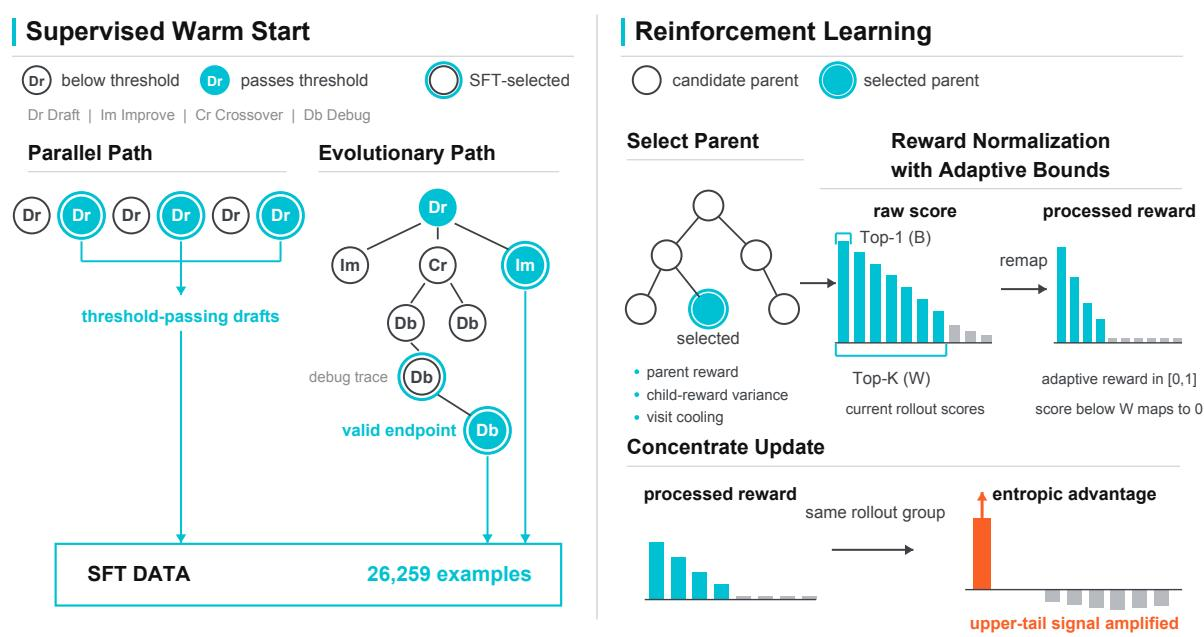
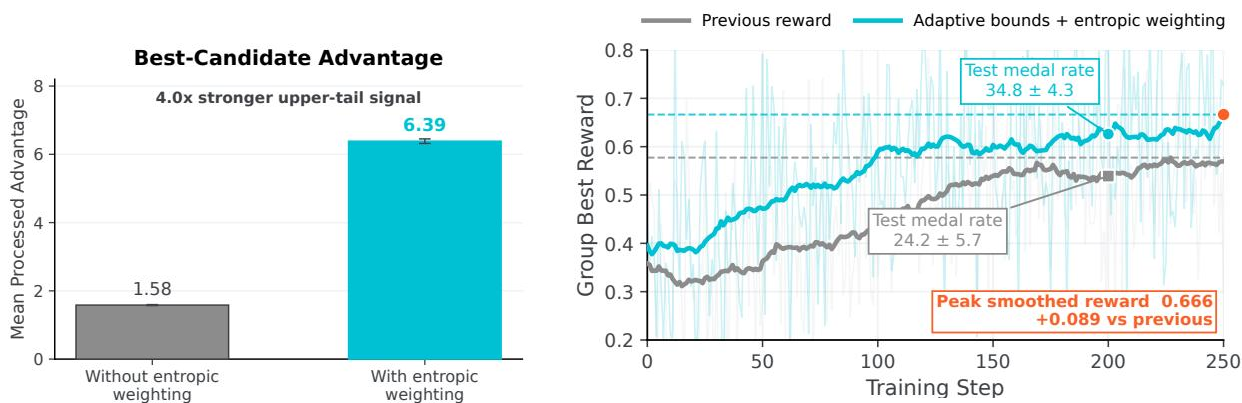
Building on this warm start, the reinforcement learning phase focuses on making heterogeneous outcomes comparable and concentrating the learning signal. The authors first define a bounded base reward and then derive tighter adaptive bounds from the task historical on-policy score frontier to preserve resolution. To further amplify the reward gaps near the top of each rollout group, an entropic advantage is applied, directing substantially more learning signal to the best candidates. As illustrated in the figure below, combining entropic weighting with adaptive bounds yields a stronger smoothed Group Best Reward trajectory compared to previous reward constructions.
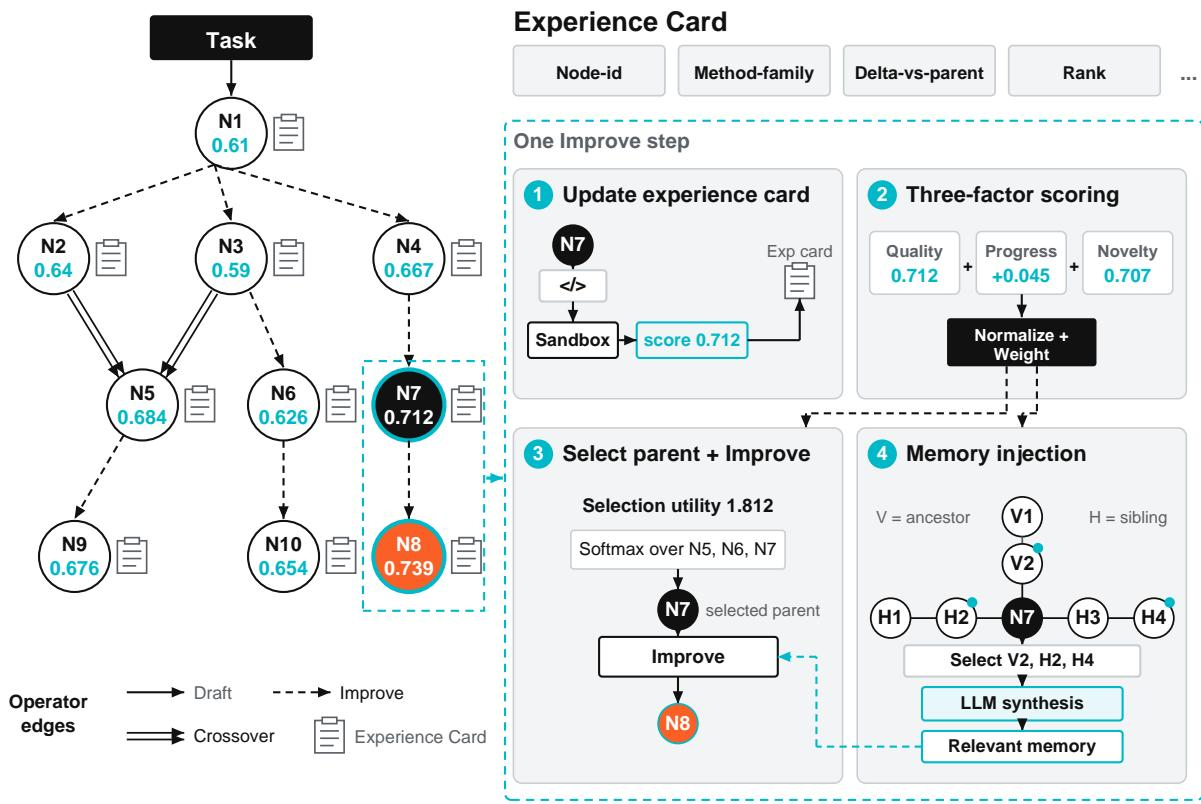
For test-time scaling, the authors introduce OpenMLE-Evo, an experience-driven search harness that converts execution outcomes into reusable evidence. The search process maintains a persistent representation of prior attempts through structured experience accumulation. Each evaluated node generates a node-level experience card capturing provenance and performance, which are aggregated into a task-global experience board.
Parent selection is guided by a multi-factor utility combining normalized validation score, positive improvement over the strongest parent, and method-family novelty. Once a parent is selected, the system defers rich natural-language memory synthesis until an operator call is made, retrieving relevant ancestors and siblings to construct a bounded, operator-conditioned context. The overall experience-guided search framework is depicted in the figure below, showing how experience-card metadata updates the global search state and informs memory injection for subsequent operations.
Experiment
The evaluation uses the 22-task MLE-Bench Lite split under a fixed 12-hour single-GPU budget, reporting Valid Rate, Medal Average, and Human Rank across three runs. Execution-grounded post-training substantially improves performance over base models, and combining it with a domain-specific evolutionary search harness that distills cross-task priors yields complementary gains that surpass strong external systems. Long-horizon search with structured memory and multi-factor selection converts additional compute into sustained improvement beyond the first executable solution, raising solution quality toward Gold medals rather than merely crossing the Bronze threshold. These benefits transfer across input modalities and to a scientific benchmark, where the post-trained model and adapted search framework together improve paper-relative scientific progress.
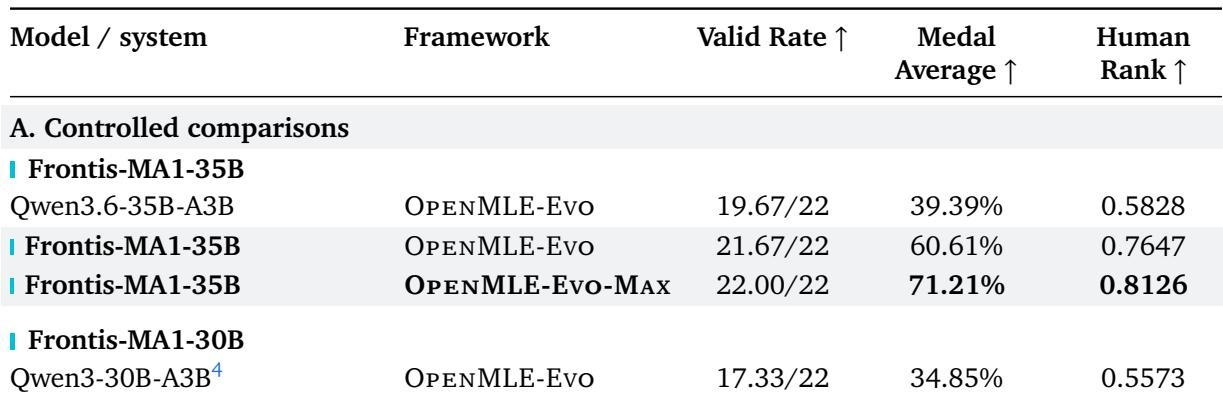
On MLE-Bench Lite, the Frontis-MA1-35B system with the OPENMLE-EVO framework substantially outperforms its base Qwen model, delivering a higher valid submission rate, medal average, and human rank. The OPENMLE-EVO-MAX variant further improves all metrics, achieving perfect validity and the highest medal average. The smaller Frontis-MA1-30B model trails the 35B configuration across the same measures. Frontis-MA1-35B with OPENMLE-EVO raises the medal average and valid rate markedly above the Qwen3.6-35B-A3B base model. Using OPENMLE-EVO-MAX, the system reaches perfect validity (22/22) and a medal average of 71.21%, the highest in the comparison. Human rank improves from 0.58 for the base model to 0.76 with EVO and to 0.81 with the MAX variant. The smaller Frontis-MA1-30B model scores lower on valid rate, medal average, and human rank than the 35B system.
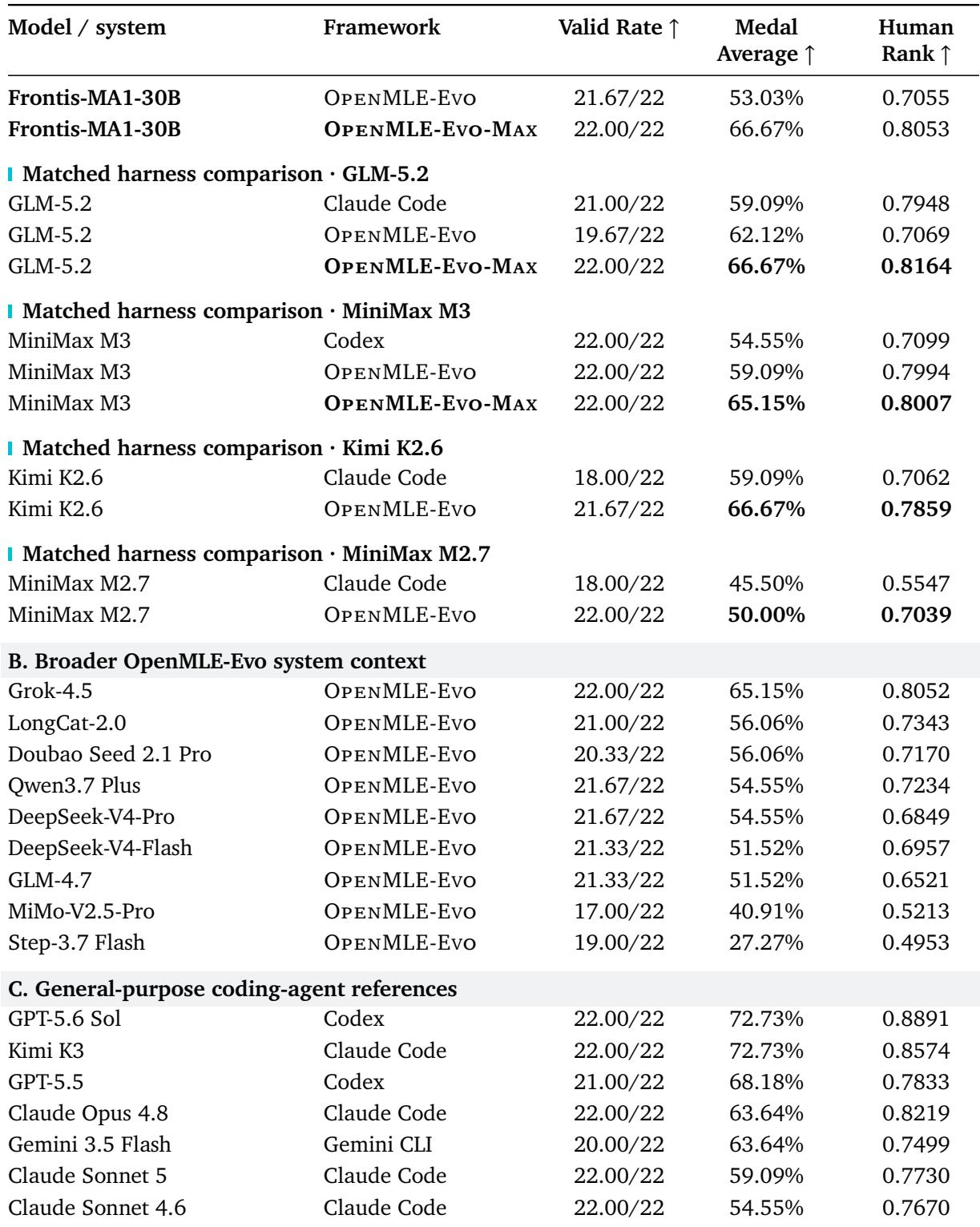
The comparison evaluates Frontis-MA1-30B and GLM-5.2 on an MLE benchmark across different harnesses. OPENMLE-EVO-MAX yields perfect validity and the highest medal average for both models, while GLM-5.2 with this framework attains the top human rank. The OPENMLE-EVO framework shows lower validity but can still improve medal average over the Claude Code baseline for GLM-5.2. OPENMLE-EVO-MAX achieves a flawless valid rate of 22/22 and a medal average of 66.67% for both Frontis-MA1-30B and GLM-5.2. GLM-5.2 with OPENMLE-EVO-MAX records the highest human rank (0.8164), edging out Frontis-MA1-30B with the same framework (0.8053).
On the 10-task NatureBench Lite, the best reference agents achieve 70% Surpass-SOTA and perfect Match-SOTA. The post-trained Frontis-MA1-35B improves over its base model by 10 percentage points in Surpass-SOTA and 20 points in Match-SOTA, while the adapted search harness alone contributes gains of 10 and 30 points, respectively. Together, the model and harness match several strong reference systems, indicating that execution-grounded post-training transfers beyond competition-style machine learning engineering. Claude Opus 4.7 and GLM-5.2 lead the reference agents with 70% Surpass-SOTA and 100% Match-SOTA on the 10-task subset. Frontis-MA1-35B raises Match-SOTA by 20 points over its base model and, combined with the OpenMLE-Evo adapter, reaches performance on par with GPT-5.4 and GLM-5.1.
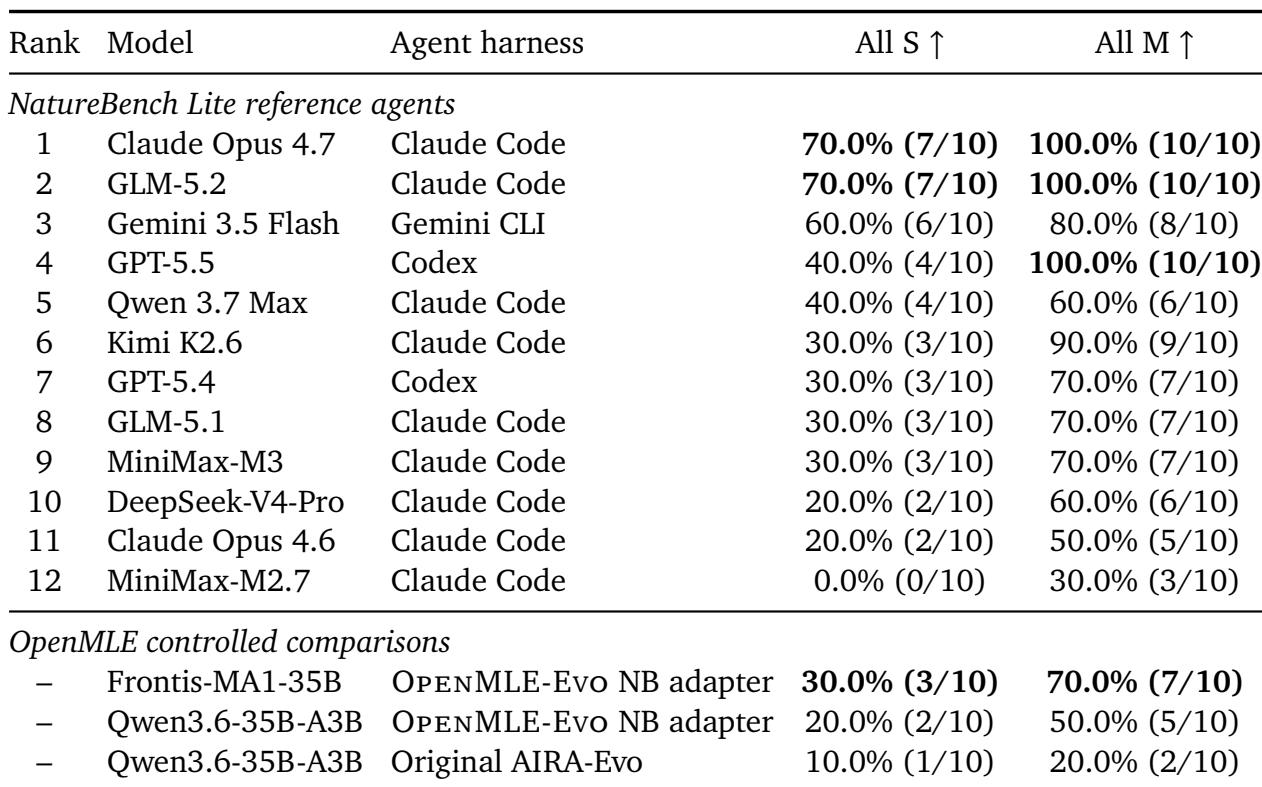
Experiments on MLE-Bench Lite show that the OPENMLE-EVO framework, especially its MAX variant, dramatically improves the Frontis-MA1-35B model's validity, medal average, and human rank over the base model, with perfect validity and the highest medal average; the smaller 30B model lags behind. A head-to-head comparison confirms that OPENMLE-EVO-MAX yields perfect validity and top medal averages for both Frontis-MA1-30B and GLM-5.2, with GLM-5.2 leading in human rank. On NatureBench Lite, post-trained Frontis-MA1-35B combined with the harness matches top reference agents, validating the transfer of execution-grounded post-training beyond competition tasks.