Command Palette
Search for a command to run...
Explizite Schichtenmodellierung für Video-Objekteinbettung und Schichtzerlegung
Explizite Schichtenmodellierung für Video-Objekteinbettung und Schichtzerlegung
Kyujiin Han Seungjoo Shin Sunghyun Cho
Zusammenfassung
Den meisten Videobearbeitungssystemen mangelt es weiterhin an expliziten, geschichteten Videorepräsentationen, was ihre Fähigkeit zu realistischem Compositing, zur Wiederverwendung von Objekten und zur konsistenten Manipulation einschränkt. Diese Einschränkung tritt besonders bei der Einbettung von Videoobjekten und der Zerlegung von Videoebenen zutage, wo bestehende Verfahren aufgrund fehlender expliziter Überwachung der Vordergrundebene auf implizite Inferenz oder szenenweise Optimierung angewiesen sind. Wir stellen TriLayer vor, einen großangelegten Triplett-Videodatensatz, der ausgerichtete Composite-, Hintergrundund Vordergrundvideos enthält, wobei die Vordergrundebenen sowohl das Erscheinungsbild der Objekte als auch zugehörige visuelle Effekte umfassen. Diese explizite Überwachung ermöglicht es Modellen, geschichtete Videorepräsentationen direkt zu erlernen, anstatt sie implizit abzuleiten. Aufbauend auf diesem Datensatz schlagen wir DBL-Diffusion vor, ein zweisträngiges Diffusionsframework, das RGB-Composites und RGBA-Vordergrundebenen durch gemeinsames Entrauschen und strangübergreifende Interaktion gemeinsam modelliert. Wir instanziieren das Framework in zwei Aufgaben: DBL-Insert für die geschichtete Objekteinbettung, das explizite RGBA-Ebenen für realistisches Compositing und flexible Nachbearbeitung erzeugt, und DBL-Decompose für die Videoebenenzerlegung, das Vordergrundund Hintergrundebenen mittels Triplett-Überwachung wiederherstellt. Experimente belegen, dass die explizite Schichtenmodellierung sowohl die Einbettungstreue als auch die Zerlegungsqualität erheblich verbessert.
One-sentence Summary
POSTECH researchers introduce TriLayer, a large-scale triplet video dataset containing aligned composite, background, and foreground layers, and DBL-Diffusion, a dual-branch diffusion framework that jointly models RGB composites and explicit RGBA foreground layers through shared denoising and cross-branch interaction, enabling DBL-Insert for layered object insertion and DBL-Decompose for video layer decomposition, which substantially improve insertion fidelity and decomposition quality.
Key Contributions
- TriLayer is introduced as a large-scale triplet video dataset with aligned composite, background, and foreground videos that include visual effects, providing the first explicit supervision for learning layered video representations, along with a scalable synthesis pipeline.
- DBL-Diffusion is proposed as a unified dual-branch diffusion framework that jointly models RGB composites and RGBA foreground layers through shared denoising and cross-branch interaction, serving as a general backbone for layered video tasks.
- The framework is instantiated in DBL-Insert for layered object insertion and DBL-Decompose for video layer decomposition, with experiments showing that explicit layer modeling substantially improves insertion fidelity and decomposition quality over prior implicit methods.
Introduction
The authors address the missing layered video representations that limit compositing quality and editability in current generative models. Prior video object insertion methods either distort backgrounds or learn from paired data without explicit foreground layers, preventing separation of objects and effects like shadows or reflections. Video layer decomposition also struggles because existing techniques optimize per scene or infer layers without foreground supervision, leading to poor generalization. The core contribution is TriLayer, a large-scale triplet video dataset providing composite–background–foreground correspondences, along with a scalable synthesis pipeline. Building on this data, the authors propose DBL-Diffusion, a unified dual-branch diffusion framework that jointly models RGB composites and RGBA foreground layers, explicitly capturing object-induced visual effects. This framework is instantiated as DBL-Insert, the first video layered object insertion that generates reusable RGBA foregrounds, and DBL-Decompose, a decomposition model that significantly improves accuracy through triplet supervision.
Dataset

The authors introduce TriLayer, a dataset designed to supervise layered video decomposition and generation. Each sample provides three aligned videos: a composite video containing the original scene with the object, a foreground RGBA video capturing both opaque object regions and semi-transparent effects such as shadows and reflections, and a clean background video with neither the object nor its effects. The composite is physically formed by alpha compositing the foreground onto the background. Every sample also includes the object name and a VLM-generated caption describing the object’s appearance and associated visual effects, which serve as conditioning signals for downstream tasks.
Key dataset details:
- Total size: 3,964 video triplets.
- Sources: In-the-wild videos collected from Pexels.
- Subset composition: Each triplet contains a composite video, a foreground RGBA video, and a background video, plus an object name and a VLM caption.
- Filtering rules: Automated semantic filtering with Qwen2.5-VL-32B removes clips with severe blur, heavy occlusion, or extremely small objects. Multiple rounds of human verification ensure mask accuracy, background stability, and foreground fidelity. A final pass after captioning removes remaining failure cases.
How the paper uses the data:
- The dataset provides aligned composite, background, and foreground videos for training layered video representations.
- The clean background serves as the input for layered object insertion.
- Object names and VLM-generated captions are used as conditioning signals for both DBL-Diffusion and DBL-Decompose.
- The paper does not specify explicit training split ratios or mixture ratios.
Processing and construction details:
- Raw videos are resized and temporally trimmed to match the diffusion training setup.
- Shot boundaries are detected with PySceneDetect; only the first clean shot is retained to avoid transition artifacts.
- Per-frame object masks are extracted with Grounded-SAM2 and guide background reconstruction via an off-the-shelf object removal model.
- Foreground RGBA layers are extracted by combining Gen-Omnimatte, MatAnyone, and Grounded-SAM2: the final alpha matte is the per-pixel maximum across sources, and RGB values come from the source with the winning alpha.
- Object-centric captions are generated by a VLM, describing both the object and its visual effects.
Method
To construct the TriLayer dataset, the authors design a multi-stage pipeline that derives foreground-background-composite triplets from in-the-wild videos. This pipeline combines automated processing and human verification to ensure high-quality layered supervision.
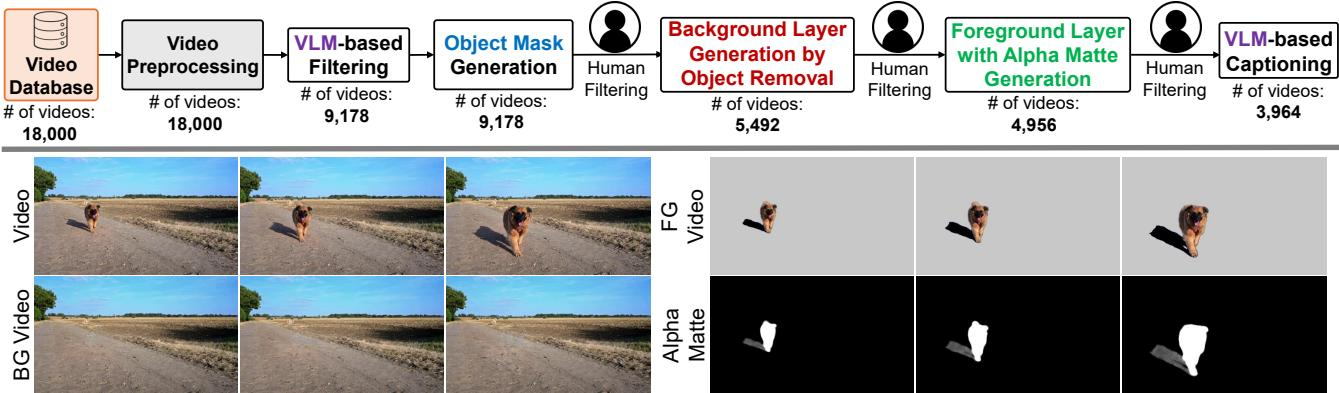
The process begins with video preprocessing and candidate selection. Raw videos are resized and temporally trimmed. For multi-shot videos, shot boundaries are detected, and only the first clean shot is retained to avoid transition artifacts. A vision-language model is then applied to identify the main foreground object and filter out clips with severe blur, heavy occlusion, or extremely small objects. Following this, per-frame object masks are extracted to guide background reconstruction. Foreground regions are removed and inpainted using an object removal model to yield a clean background video. For foreground layer extraction, the authors combine complementary cues from Gen-Omnimatte, video matting, and segmentation. The final alpha matte is computed as the per-pixel maximum across sources, and RGB values are selected from the source with the winning alpha. Finally, object-centric captions are generated using a vision-language model to serve as semantic conditioning signals for downstream tasks. Automated filtering and multiple rounds of human verification are applied throughout to ensure mask accuracy, background stability, and foreground fidelity.
To model videos in an explicit layered representation, the authors propose DBL-Diffusion, which adopts a dual-branch diffusion architecture. This framework separates the foreground object and its associated visual effects from the background scene. It consists of an RGB branch that models scene-level appearance and an RGBA branch that predicts the foreground layer. Although the two branches operate on different layers, they are integrated through joint cross-attention, enabling bidirectional information exchange and consistent layered synthesis. DBL-Diffusion serves as a unified backbone that can be instantiated for different layered video tasks, specifically DBL-Insert for layered object insertion and DBL-Decompose for layered video decomposition.
DBL-Insert applies the dual-branch architecture to layered object insertion. The goal is to synthesize a foreground object layer that can be seamlessly integrated into a target background. The RGB branch produces an RGB composite, which provides a temporally coherent visualization and acts as an auxiliary signal during denoising. The RGBA branch generates an explicit foreground layer containing the object and its associated effects. At inference time, the foreground layer is alpha-blended with the background to obtain the final high-fidelity result. The model takes a background video, a text prompt, a sequence of bounding boxes, and an edited first frame as inputs. Conditioning signals are constructed for both branches, and the VACE diffusion backbone is adopted. The RGB branch operates in the standard VACE latent space, while the RGBA branch uses the RGBA latent space from WAN-alpha.
DBL-Decompose instantiates the framework for layered video decomposition. Given a composite video, the model recovers both a clean background video and an RGBA foreground layer. The RGB branch removes the foreground object and its visual effects to reconstruct the background, while the RGBA branch predicts the foreground layer, capturing appearance, boundaries, transparency, and effects. The model takes a composite video, a text prompt, the object name, and an object mask sequence as inputs. An object-only conditioning video is constructed to guide the RGBA branch, while the composite video conditions the RGB branch.
Both DBL-Insert and DBL-Decompose are trained using a hybrid LoRA-DoRA adaptation strategy that reflects the distinct roles of the two branches. The RGB branch operates in-domain, predicting RGB videos within the latent space of the pretrained diffusion transformer. For this branch, low-rank adaptation via LoRA provides an efficient and stable way to specialize the model. In contrast, the RGBA branch must learn out-of-domain concepts such as transparency, alpha mattes, and layer-specific effects. To support this distribution shift, the authors adopt DoRA, which decouples weight magnitude and direction. This direction-preserving parameterization maintains the pretrained directional prior while allowing controlled low-rank updates.
To further stabilize joint optimization, the model is trained within a rectified-flow framework using disentangled timestep sampling. Each branch evolves at its own noise level, balancing the learning dynamics of RGB appearance and RGBA layer reconstruction. Independent timesteps tx,ty∼U(0,1) are sampled for the RGB and RGBA branches, and the model is trained to predict the corresponding velocities. The overall objective is the sum of the RGB and RGBA velocity-prediction losses. This disentangled training scheme stabilizes optimization and enables conditional generation by independently controlling noise levels in each branch.
Experiment
The experiments validate the DBL framework using a dual-branch diffusion transformer with explicit triplet supervision. DBL-Insert outperforms baselines and single-branch ablations by achieving balanced text-video alignment and subject consistency through disentangled foreground synthesis and scene compositing. DBL-Decompose surpasses prior decomposition methods, delivering clean RGBA layers and visually coherent backgrounds via diffusion priors rather than strict pixel reconstruction. Ablation studies confirm that hybrid LoRA-DoRA and foreground conditioning are critical for stable, high-quality output, and the model further supports intuitive layer-based editing and handles semi-transparent VFX elements such as fire and smoke.
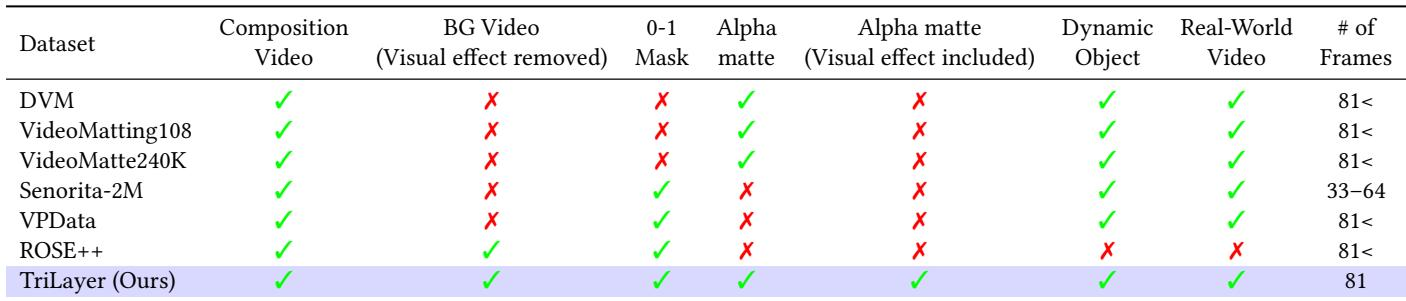
TriLayer is the only dataset that simultaneously provides clean background videos, alpha mattes that include visual effects, and dynamic real-world objects, enabling complete layered supervision for video object insertion and decomposition. Existing datasets lack at least one of these components, preventing them from modeling object-induced effects such as shadows and reflections. All compared datasets provide composition videos, but only TriLayer and ROSE++ include the clean background video needed for layered decomposition. TriLayer uniquely offers alpha mattes that capture visual effects alongside opaque regions, which video matting datasets and ROSE++ omit. Unlike ROSE++, which contains only static virtual objects, TriLayer features dynamic objects in real-world videos, supporting realistic object-scene interactions. Senorita-2M and VPData provide binary masks but lack alpha mattes and background videos, making layered supervision impossible. TriLayer matches the maximum frame count found in other datasets while adding the richest set of annotations.
DBL-Insert outperforms prior methods and ablated VACE variants across nearly all metrics, achieving the highest text-video alignment, aesthetic quality, and subject identity preservation while matching the best background and motion consistency. Compared to the inpainting baseline VACE-Inp, fine-tuning on the TriLayer dataset improves consistency, but only the dual-branch design with triplet supervision simultaneously raises foreground identity and compositing quality to the top tier. DBL-Insert attains the best ViCLIP-T, aesthetic, CLIP-I, and DINO-I scores, and ties for the highest background and subject consistency, demonstrating an all-around advantage over single-branch and prior models. Fine-tuned single-branch variants (VACE-C, VACE-F) lift background or subject consistency over VACE-Inp but cannot match DBL-Insert's subject fidelity and compositing balance, revealing the benefit of explicit triplet supervision and cross-branch interaction.

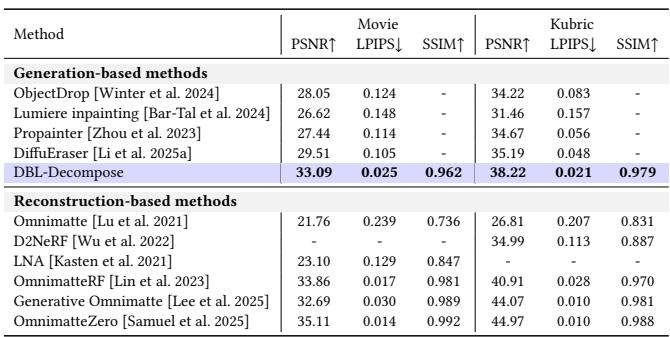
Among generation-based methods for background layer reconstruction, DBL-Decompose significantly outperforms prior work on both Movie and Kubric datasets, achieving the highest PSNR, SSIM, and the lowest LPIPS. The reduction in perceptual distance is particularly stark, with LPIPS on Movie dropping to 0.025 compared to 0.105 for the next best method. DBL-Decompose also uniquely reports SSIM, reaching 0.962 on Movie and 0.979 on Kubric. DBL-Decompose reduces LPIPS on Movie by over 4x relative to DiffuEraser (0.025 vs. 0.105), demonstrating much sharper perceptual background reconstruction. On Kubric, DBL-Decompose achieves a PSNR of 38.22 and LPIPS of 0.021, leaving all other generation-based baselines behind, with the closest competitor Propainter at 34.67 PSNR and 0.056 LPIPS.
The TriLayer dataset uniquely provides clean backgrounds, alpha mattes with visual effects, and dynamic real-world objects, enabling complete layered supervision for video object insertion and decomposition tasks that other datasets fail to support. DBL-Insert, a dual‑branch model trained with triplet supervision, consistently achieves the highest text‑video alignment, aesthetic quality, and subject identity preservation while matching the best background and motion consistency, outperforming prior methods and ablated variants. For background layer reconstruction, DBL‑Decompose reduces perceptual distance by more than four times on the Movie dataset and attains top PSNR and LPIPS scores on Kubric, substantially surpassing all generation‑based baselines.