Command Palette
Search for a command to run...
Auf dem Weg zu effizienten Convolutional Neural Networks für eingebettete Hardware durch mehrdimensionale Pruning-Verfahren
Auf dem Weg zu effizienten Convolutional Neural Networks für eingebettete Hardware durch mehrdimensionale Pruning-Verfahren
Hao Kong Di Liu Xiangzhong Luo Shuo Huai Ravi Subramaniam Christian Makaya Qian Lin Weichen Liu
Zusammenfassung
In diesem Beitrag schlagen wir TECO vor, ein mehrdimensionales Pruning-Framework, das die drei Dimensionen (Tiefe, Breite und Auflösung) von Convolutional Neural Networks (CNNs) gemeinsam beschneidet, um eine bessere Ausführungseffizienz auf eingebetteter Hardware zu erreichen. In TECO führen wir zunächst ein zweistufiges Framework zur Wichtigkeitsbewertung ein, das jede Pruning-Einheit effizient und umfassend sowohl anhand der lokalen Bedeutung innerhalb jeder Dimension als auch der globalen Bedeutung über verschiedene Dimensionen hinweg bewertet. Basierend auf diesem Bewertungsframework präsentieren wir einen heuristischen Pruning-Algorithmus, der die drei Dimensionen von CNNs schrittweise beschneidet, um den optimalen Kompromiss zwischen Genauigkeit und Effizienz zu erzielen. Experimente auf mehreren Benchmarks bestätigen die Vorteile von TECO gegenüber bestehenden State-of-the-Art (SOTA)-Ansätzen.
One-sentence Summary
Nanyang Technological University, Norwegian University of Science and Technology, and HP Inc. propose TECO, a multi-dimensional pruning framework that collaboratively prunes the depth, width, and resolution of CNNs using a two-stage importance evaluation (assessing local importance within each dimension and global importance across dimensions) and a heuristic algorithm to progressively optimize the accuracy-efficiency trade-off for embedded hardware.
Key Contributions
- TECO employs a two-stage importance evaluation framework: an inter-dimensional evaluation strategy (ITES) assesses global redundancy across depth, width, and resolution, while an inner-dimensional evaluation strategy (INES) ranks local importance within each dimension.
- A heuristic pruning algorithm iteratively applies INES and ITES to progressively prune the three dimensions of convolutional neural networks, targeting the optimal trade-off between accuracy and efficiency.
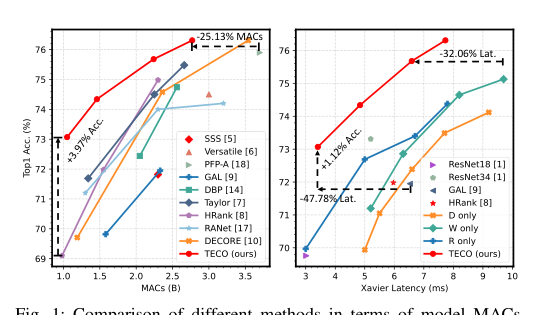
- On ImageNet, TECO achieves 3.97% higher top-1 accuracy than HRank at similar MACs, and on embedded hardware, it delivers a 1.91× speedup over GAL with 1.12% higher accuracy.
Introduction
Modern deep convolutional neural networks are foundational to many applications, but their billions of multiply-accumulate operations make them prohibitively expensive for edge devices where low latency and data privacy are critical. Prior pruning techniques compress models by removing redundancy from a single dimension—depth (layers), width (channels), or input resolution—leaving cross-dimensional redundancy untouched and resulting in a suboptimal trade-off between accuracy and efficiency. The authors propose TECO, a multi-dimensional pruning framework that jointly prunes the depth, width, and resolution of CNNs. It introduces an inter-dimensional evaluation strategy that computes a global importance metric combining model complexity, accuracy, and inference latency to accurately identify redundant units across all dimensions, paired with an inner-dimensional evaluation strategy that quickly narrows pruning candidates, enabling a heuristic search for the optimal compact architecture for resource-constrained embedded devices.
Method
The authors propose TECO, a multi-dimensional pruning framework designed to optimize CNN models by balancing accuracy and execution efficiency. The overall architecture of TECO is illustrated in the framework diagram.
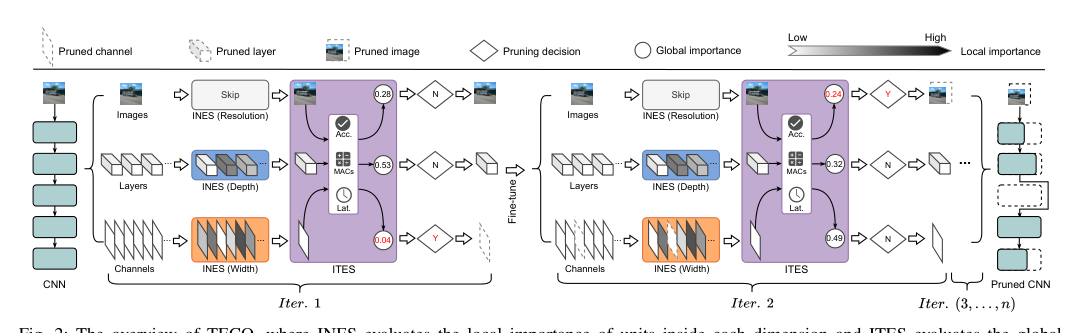
Given a baseline CNN model N, the method operates through an iterative process known as Heuristic Architecture Descent. In each iteration, the authors first employ INES to rapidly assess the local importance of each unit within each dimension, specifically depth, width, and resolution. Based on these local importance scores, the least important unit from each dimension is selected for further analysis. Note that the inner-dimensional evaluation is skipped for the resolution dimension.
Subsequently, these selected units undergo ITES. In this stage, units of different granularities are compared fairly based on their global importance scores. The unit with the lowest global importance score is then pruned safely. Following the pruning step, the model is fine-tuned on the training dataset Dt for one epoch using an SGD optimizer with a learning rate of 1e-4 to restore accuracy for the next iteration.
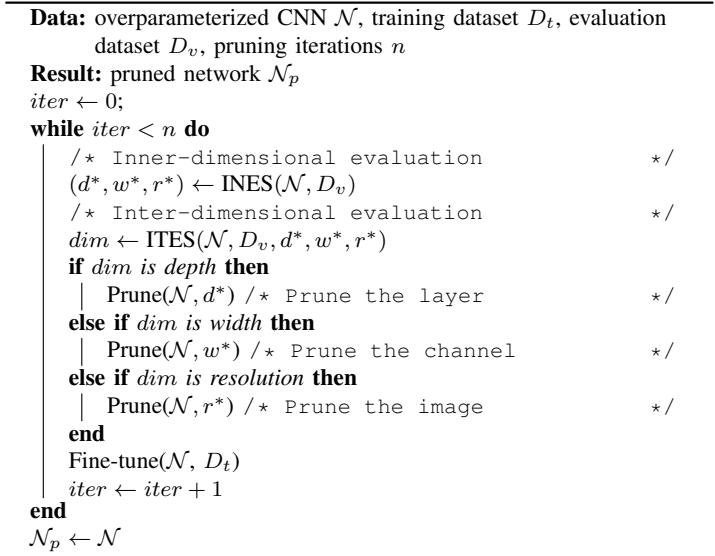
This cycle of INES and ITES is executed iteratively for n iterations to progressively prune the three dimensions of the CNN model. The number of iterations n is determined by the target resource budget, where a smaller budget requires a larger n. In practice, 10 iterations are typically sufficient to obtain a compact model Np. Finally, the completely pruned model is trained from scratch to achieve the final accuracy. This heuristic approach significantly reduces exploration overhead compared to global search algorithms that directly search the vast design space.
Experiment
The experiments evaluate the proposed multi-dimensional pruning framework TECO, which combines inter-dimensional (ITES) and inner-dimensional (INES) importance evaluation to jointly prune network depth, width, and resolution. Evaluated on ImageNet and CIFAR-10 with on-device latency measured on Jetson Nano, TX2, and AGX Xavier, TECO consistently achieves better accuracy and latency trade-offs than state-of-the-art methods. Ablation studies confirm that the cooperative INES and ITES strategy reduces pruning cost by over 83% while maintaining performance, and interpretability analysis shows TECO captures full foreground objects for more accurate predictions. Overall, the method effectively reduces redundancy across dimensions, improving both accuracy and inference efficiency on edge devices.
Multi-dimensional pruning that jointly optimizes depth, width, and resolution outperforms state-of-the-art single-dimension methods on ImageNet with ResNet50, achieving better accuracy and efficiency by identifying redundancy across all three dimensions. The method prunes the network across depth, width, and resolution simultaneously, rather than focusing on a single dimension. Inner-dimensional evaluation (INES) and inter-dimensional evaluation (ITES) are used iteratively to select the most redundant components, improving final model accuracy. Compared to single-dimensional pruning approaches, the proposed multi-dimensional strategy leverages the whole foreground object for prediction, leading to more accurate and robust features.
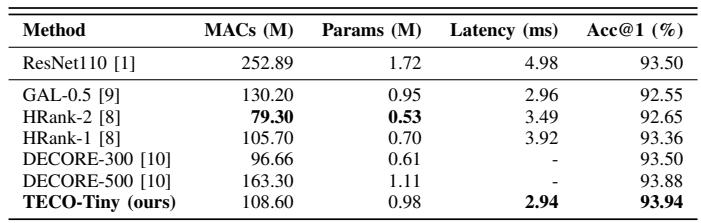
On CIFAR-10, TECO-Tiny achieves the highest accuracy among all pruned ResNet110 variants, while also attaining the lowest inference latency on Jetson Nano. It reduces MACs by 57% compared to the baseline yet improves accuracy by 0.44 percentage points, demonstrating effective removal of redundancy and mitigation of overfitting. The method delivers a better latency-accuracy trade-off than prior pruning approaches, with lower latency than HRank-2 and higher accuracy. TECO-Tiny delivers 93.94% top-1 accuracy, the highest among all pruned models, while reducing inference latency to 2.94 ms, the lowest reported. Relative to the baseline ResNet110, it cuts MACs by 57% and still gains 0.44 percentage points in accuracy.
Removing the INES and ITES evaluation strategies from multi-dimensional pruning results in accuracy comparable to single-dimension methods, showing no advantage. Applying ITES alone yields the best accuracy and resource savings but at an extremely high pruning cost, while combining INES and ITES dramatically reduces that cost and maintains competitive performance. Without INES and ITES, multi-dimensional pruning achieves only 74.67% accuracy, similar to width-only pruning (74.65%), indicating no meaningful gain over single-dimension pruning. Using ITES alone produces the highest accuracy (75.71%) and the lowest MACs (2.12B) and latency (6.42 ms), but the pruning cost is 179.42 hours, making it impractical. Combining INES and ITES cuts the pruning cost by 83.21% compared to ITES alone while preserving strong accuracy and efficiency, demonstrating the framework's practical value.
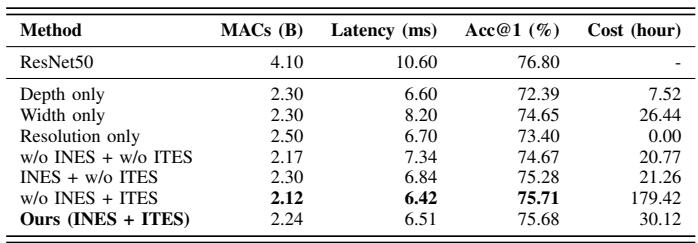
The evaluation on ImageNet with ResNet50 and CIFAR-10 with ResNet110 demonstrates that multi-dimensional pruning jointly optimizing depth, width, and resolution outperforms single-dimension methods, yielding higher accuracy and lower inference latency. The TECO-Tiny variant on CIFAR-10 achieves the best accuracy and fastest latency among pruned ResNet110 models, confirming effective redundancy removal. Ablation studies reveal that the inner- and inter-dimensional evaluation strategies (INES and ITES) are essential; using ITES alone provides the highest accuracy and efficiency but incurs prohibitive pruning cost, while their combination dramatically reduces that cost and maintains strong performance, validating the framework's practical value.