Command Palette
Search for a command to run...
Ereignisbasierte neuronale Dekodierung für neuroprothetische Motorsteuerung
Ereignisbasierte neuronale Dekodierung für neuroprothetische Motorsteuerung
Khaleelulla Khan Nazeer Sirine Arfa Matthias Jobst Richard George Christian Mayr
Zusammenfassung
Eine beträchtliche Anzahl von Patienten leidet unter eingeschränkter Mobilität aufgrund von Behinderungen, Krankheiten oder Unfällen. Obwohl moderne Prothesen, die auf tiefen neuronalen Netzen basieren, das Potenzial haben, die Lebensqualität dieser Personen erheblich zu verbessern, wird ihre breite Anwendung durch erhebliche Latenz, Energieverbrauch und räumliche Anforderungen behindert. Kabelgebundene Verbindungen zu externen Hochleistungsprozessoren schränken die Mobilität der Patienten ein, während drahtlose Verbindungen die Menge an Informationen begrenzen, die an diese Prozessoren übertragen werden können. Gepulste neuronale Netze bieten das Potenzial für komprimierte Kommunikation und energieeffiziente Inferenz, bleiben jedoch in verschiedenen Anwendungen oft hinter modernsten Deep-Learning-Modellen zurück. In dieser Studie schlagen wir eine leistungsstarke neuronale Dekodierungsmethode vor, die Aufgabenleistung und Effizienz effektiv ausbalanciert. Eine ereignisbasierte gated recurrent unit erzeugt ein spärliches Kommunikationsmuster mit abgestuften Spikes und übertrifft klassische gepulste neuronale Netze hinsichtlich der Aufgabenleistung. Durch den Einsatz einer effizienten Trainingsmethode und spärlicher Inferenz eröffnet unser Modell neue Möglichkeiten für die neuronale Dekodierung auf dem Gerät.
One-sentence Summary
Researchers at Technische Universität Dresden and the Centre for Tactile Internet with Human-in-the-Loop propose an event-based gated recurrent unit for neuroprosthetic motor control that generates graded spikes for sparse communication, surpassing classical spiking neural networks in task performance and enabling efficient on-device neural decoding through a specialized training method and sparse inference.
Key Contributions
- Integrating the Event-based Gated Recurrent Unit (EGRU) into reinforcement learning for closed-loop neural decoding yields an average time to target below one second across benchmark tasks, showing that event-driven recurrent architectures can learn effective control policies.
- A compact decoder with two EGRU units (2K parameters) achieves high task performance with lower computational cost than a similarly sized LSTM, offering a favorable accuracy-efficiency trade-off.
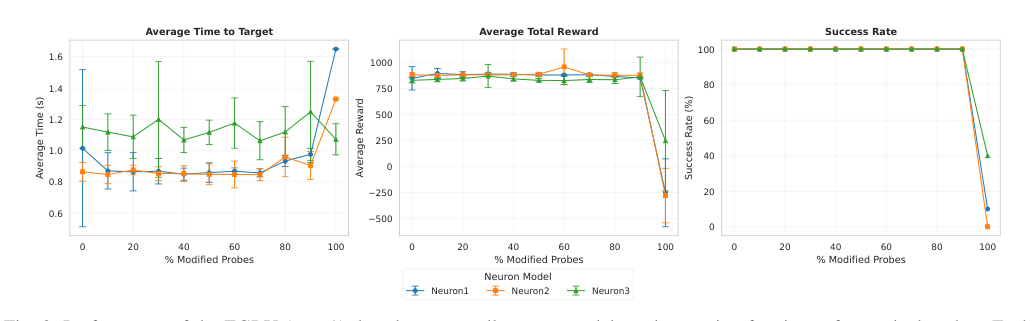
- Training and evaluation under realistic signal dropout and tuning drift perturbations demonstrate maintained high success rates and stable rewards up to approximately 80% probe modification, confirming robustness to chronic neural signal degradation.
Introduction
Intra-cortical brain-machine interfaces aim to restore movement to people with paralysis by decoding neural signals into control commands, but deploying these systems in implantable devices demands algorithms that are both highly accurate and extremely resource-efficient. Prior benchmarks focused on open-loop accuracy, while real clinical use requires closed-loop, real-time adaptation and robustness to the gradual signal degradation that occurs with chronic implants, such as electrode failure and tuning drift. The authors address these challenges by integrating the Event-based Gated Recurrent Unit (EGRU) into a reinforcement learning framework for closed-loop neural decoding. Their approach uses only 2 EGRU units (about 2K parameters) to achieve fast, stable cursor control and demonstrates resilience to severe perturbations, offering a promising path toward low-power, on-device neural prostheses.
Method
The authors leverage Event-based Gated Recurrent Units (EGRUs) to address the need for low-power, event-driven computation in modern prosthetic decoding and robotics. While traditional Recurrent Neural Networks (RNNs) like LSTMs provide memory for sequential tasks, and Spiking Neural Networks (SNNs) offer sparse, asynchronous communication, deep SNNs often lag in accuracy. The EGRU architecture bridges this gap by offering GRU-level expressiveness while communicating sparsely like spiking neurons. Consequently, the compute cost scales with activity; if only a fraction α of units fire, only α times as many Multiply-Accumulate (MAC) operations are required. This allows the decoder to run on low-power hardware with significantly reduced effective MAC operations.
Model Architecture
The proposed architecture processes input spikes to produce velocity commands. As shown in the framework diagram below, the pipeline begins with an initial linear layer that projects the input spikes into a 4-dimensional feature space. This is followed by an EGRU layer that processes the sequence data.
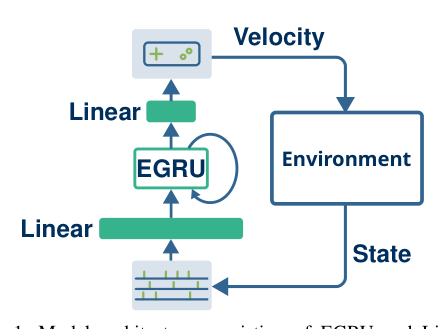
The EGRU consists of n neurons with output y and state h. A sparse output y=(y1,…,yn) is generated from the GRU cell state h=(h1,…,hn) via a thresholding mechanism. These "graded spikes" can take any floating-point value above the threshold. The sparse output y is fed back into the model as recurrent input, while the hidden state h represents the internal state of each cell and is not communicated between units. Finally, the EGRU output passes through a linear head to produce the final two-dimensional velocity at each timestep. For benchmarking, the authors use n=2, resulting in a compact layer configuration of 96-4-2-2 and a footprint of just 2K parameters.
Training Strategy
To train the neural decoder effectively, the authors adopt a two-stage learning strategy comprising open-loop pre-training followed by closed-loop reinforcement learning (RL).
Open-Loop Pre-training In the initial phase, the model is initialized using a large dataset of randomly generated trajectories sampled from the environment. This synthetic data simulates random agent movements to ensure broad coverage of state and action spaces. This pre-training serves as an exploration phase before RL and enables the use of efficient CUDA kernels provided by the EGRU implementation. The authors utilize trajectories of length equal to 4 time-steps, as longer trajectories did not yield additional benefits. This strategy provides a robust initialization that facilitates faster convergence during subsequent task-specific training.
Closed-Loop Reinforcement Learning During the RL phase, the EGRU model interacts directly with the environment. In each episode, the agent receives the current neural state and outputs a velocity command. Actions are drawn from a Gaussian distribution centered on the model's prediction, with a standard deviation controlled by an exploration parameter ϵ. This promotes early exploration and gradually shifts to exploitation as ϵ decays. The environment returns the next state, a shaped reward, and a termination signal. The agent accumulates rewards and updates its parameters after each episode via gradient ascent on the mean reward. Notably, the hidden state is not reset between timesteps but only at the beginning of the episode.
Reward Function
The reward function is designed to provide a smooth, differentiable signal for reaching a target in a continuous control task. It computes the Euclidean distance between the agent's current position and the target, using a sigmoid function to softly indicate target achievement. The total reward comprises three components: a completion reward that increases when the agent finishes close to the target, a time bonus for reaching the target quickly, and a distance penalty to discourage being far from the target. This design encourages accuracy and efficiency while avoiding abrupt changes in the reward landscape.
Robustness and Perturbations
To evaluate robustness under degraded recording conditions, the authors introduce controlled perturbations. A configurable fraction of synthetic neurons is either silenced or has their tuning properties reassigned by resampling preferred directions and firing rates. These perturbations are applied during training, with affected neurons sampled anew each epoch to prevent reliance on fixed patterns and encourage generalization. The figure below illustrates the impact of these combined challenges, showing the decoder's performance across varying fractions of perturbed probes.
The results indicate that the model maintains a high success rate and stable reward even under severe perturbation levels, confirming its resilience to chronic signal degradation.
Experiment
The evaluation consists of two tracks: Track 1 measures control performance under randomized targets, while Track 2 tests robustness against channel silencing and distributional shifts. After a two-stage training process with open-loop pre-training and closed-loop reinforcement learning, the EGRU decoder achieves fast, reliable target acquisition in Track 1 and retains high success rates even under severe perturbations in Track 2. Compared to an LSTM baseline, EGRU delivers comparable accuracy with significantly lower computational demands, making it well-suited for efficient, low-power neural interfaces.
Under combined perturbations of 50% distribution shift and 40% signal loss, the EGRU decoder maintained a 100% success rate across all neuron models, with average time to target staying under one second. Activation sparsity varied modestly while footprint and connection sparsity remained uniformly minimal, and effective multiply-accumulate operations stayed in the low thousands. Compared to a dense LSTM, the sparse EGRU achieved similar control accuracy with substantially lower computational cost. All neuron models achieved 100% success rate despite simultaneous distribution shift and signal loss. Average time to target remained below 0.95 seconds for every tested neuron model. Activation sparsity reached up to 0.041, contributing to event-driven compute savings. Effective multiply-accumulate operations were around 4000, while dense synaptic operations were roughly nine times higher. The EGRU decoder required significantly fewer operations than an LSTM while sacrificing only a slight speed difference.
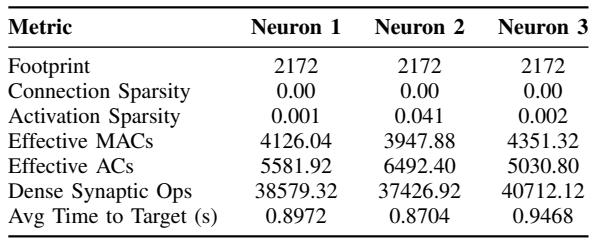
The EGRU decoder uses activation sparsity to reduce effective multiply-accumulate operations relative to a comparable LSTM. While the LSTM reaches the target slightly faster, it requires more compute due to its dense activations. Both models achieve perfect success rates, but EGRU offers a more hardware-efficient trade-off. EGRU exhibits 8–9% activation sparsity, whereas LSTM activations are fully dense. At the same hidden dimension, EGRU consistently uses fewer effective MACs than LSTM, with a 20% reduction at dimension 4. LSTM reaches the target 0.05–0.08 seconds faster on average, but at a higher computational cost. Both decoders maintain 100% success rate under identical evaluation conditions.

The experiments evaluate an EGRU decoder under combined distribution shift and signal loss, as well as in direct comparison with a dense LSTM. The EGRU maintains a 100% success rate across all conditions while leveraging activation sparsity to reduce effective multiply-accumulate operations by up to 20% compared to the LSTM at the same hidden dimension. Although the LSTM reaches the target slightly faster, the EGRU offers a more hardware-efficient trade-off with minimal impact on control accuracy.