Command Palette
Search for a command to run...
Blind-Spots-Bench: Evaluierung blinder Flecken in multimodalen Modellen
Blind-Spots-Bench: Evaluierung blinder Flecken in multimodalen Modellen
Matteo Santelmo Xiuying Wei Israa Fakih Felix Bauer Juan Garcia Giraldo Chengkun Li Etienne Bamas Emmanuel Abbe
Zusammenfassung
Moderne KI-Modelle erzielen starke Leistungen in vielen etablierten Benchmarks, scheitern jedoch weiterhin an Aufgaben, die Menschen nahezu trivial finden, wie das Manipulieren einer Zeichenkette oder das Zeichnen eines Hundes mit fünf Beinen. Diese Beispiele deuten darauf hin, dass bestehende Benchmarks hartnäckige blinde Flecken aktueller Systeme möglicherweise unzureichend messen. Wir stellen blind-spots-bench vor, einen Benchmark, der darauf abzielt, solche blinden Flecken durch Aufgaben aufzudecken, die für Menschen einfach erscheinen, für moderne KI jedoch herausfordernd bleiben. Wir sammeln Rohfragen von Studierenden eines KI-Kurses, bereinigen und annotieren sie mit strukturierten Referenzlösungen und schlagen eine auf den resultierenden Datensatz von 235 Proben zugeschnittene Aufgaben-Taxonomie vor. Darüber hinaus entwickeln wir eine automatisierte Bewertungspipeline, um eine breite Palette von Modellen zu evaluieren, darunter Open-Weightund Closed-Source-Sprach-, Vision-Languageund Bildgenerierungsmodelle. Unsere Analyse auf blind-spots-bench zeigt, dass Closed-Source-Frontiermodelle Open-Weight-Modelle selbst mit einer Lücke von ≈10 % deutlich übertreffen können, selbst wenn sie in bestehenden Benchmarks vergleichbare Leistungen erzielen. Eine feinkörnigere Analyse zeigt, dass kein einzelnes Modell über alle Aufgabentypen hinweg dominiert und dass einige Aufgaben für alle evaluierten Modelle herausfordernd bleiben. Diese Ergebnisse unterstreichen den Wert von blind-spots-bench als diagnostischen Stresstest zur Identifizierung konkreter Schwächen aktueller moderner Modelle.
One-sentence Summary
Researchers at EPFL introduce blind-spots-bench, a diagnostic benchmark of 235 human-trivial tasks with a structured taxonomy and automated grading, revealing that closed-source multimodal models outperform open-weight ones by a ≈10% margin on these blind spots yet no single model dominates all task types, exposing persistent weaknesses that existing benchmarks fail to detect.
Key Contributions
- blind-spots-bench is introduced, a benchmark of 235 tasks that are simple for humans but challenging for modern AI, built from student-generated questions and annotated with structured reference solutions and a fine-grained task taxonomy.
- An automated grading pipeline is developed to evaluate a diverse set of models, including open-weight and closed-source language, vision-language, and image-generation models, enabling consistent and scalable assessment.
- Empirical analysis shows that closed-source frontier models outperform open-weight models by roughly 10%, that no single model dominates all task types, and that taxonomy-level failure analysis reveals distinct patterns of model weaknesses, with scaling model size or enabling tool use not consistently improving performance.
Introduction
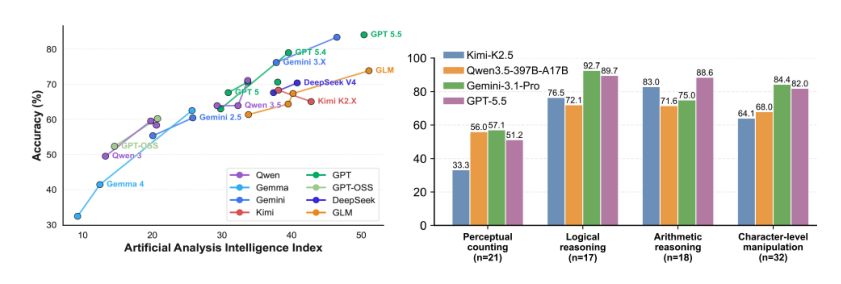
Large language and vision-language models now achieve near-human or superhuman scores on many benchmarks, yet they still exhibit surprising failures on tasks that are trivial for people, such as counting objects in images or generating a string of a specific length. Existing evaluation suites typically aggregate performance into broad scores, obscuring these fine-grained reasoning gaps, and prior taxonomies lack the granularity needed to analyze specific failure modes. To systematically probe these blind spots, the authors introduce blind-spots-bench, a manually curated benchmark of 235 problems sourced from graduate students, accompanied by a structured task taxonomy and an automated grading pipeline. They evaluate 38 frontier models, uncovering persistent weaknesses in object-centric perception and highlighting divergent strengths across model families.
Dataset

The authors construct the blind-spots-bench dataset to probe reasoning failures in frontier AI models. Here is a concise overview of its sources, composition, processing, and usage.
-
Source and collection
-
Raw questions were collected from students in a graduate-level AI course. Each student proposed five questions that appeared easy to humans but were failed by frontier models around October 2025.
-
The initial pool contained approximately 287 questions.
-
Cleaning, filtering, and quality control
-
A systematic pipeline removed overly difficult or duplicate entries, normalized formats, and ensured clarity.
-
A three-stage review was applied: manual verification of task clarity, difficulty thresholding (removing questions too easy for models or too hard for humans), and refinement of linguistic ambiguities.
-
The final dataset, blind-spots-bench, contains 235 samples.
-
Annotations and metadata
-
Solution annotation: Each question includes a structured reference solution specifying the expected answer, correctness conditions, and common failure modes. Failure modes were drawn from student interactions with AI agents and from annotator contributions.
-
Question format: Every example is labeled as text-only, image generation, or multi-to-text (image+text input, text output). This enables assigning examples to models that support the relevant modality.
-
Task taxonomy: Questions are categorized into three main types: Object-centric (e.g., attribute/pattern recognition, spatial reasoning, perceptual counting, generative counting), Abstract reasoning (e.g., geometric/graph reasoning, logical reasoning), and Language and knowledge (e.g., character-level manipulation). Sub-tasks further detail the required ability.
-
Dataset composition
-
By format: text-only (46.2%), image generation (35.6%), multi-to-text (18.2%).
-
By sub-task frequency: spatial reasoning appears most often (53 times), followed by perceptual counting, generative counting, logical reasoning, and character-level manipulation. These frequencies reflect known weaknesses of current models and were not artificially balanced.
-
How the paper uses the data
-
The dataset is a zero-shot evaluation benchmark. It is not split into training/validation/test; all 235 samples serve as a test set to measure model blind spots.
-
The format labels allow comparing models only on the subsets they support, while the taxonomy supports fine-grained error analysis.
-
No cropping or training-specific preprocessing is applied; the benchmark is used as-is for inference and evaluation against the provided reference solutions.
Experiment
The benchmark is constructed from student-generated questions that probe blind spots of frontier models, covering object-centric, abstract reasoning, and language/knowledge tasks with annotated solutions. An automated evaluation pipeline uses a grader model to score responses across text-only, multi-to-text, and image generation formats, validated against human judgments. Results reveal that closed-source models achieve higher accuracy, though open-weight models offer better cost-effectiveness; scaling model size does not uniformly improve performance, and tool use yields mixed benefits. Fine-grained visual perception remains a major bottleneck, and different model families exhibit complementary strengths rather than a single dominant pattern across all subtask categories.
Open-weight models show steady improvement across generations, with GLM-5.2 reaching 73.8% text-only accuracy, but closed-source models Gemini-3.1-Pro and GPT-5.5 remain ahead overall, especially on multimodal problems. Cost efficiency varies widely: DeepSeek-V4-Flash achieves competitive accuracy at only 0.29 USD per 100 samples, while GLM-5.2 offers higher performance at a higher cost. Longer output tokens, as seen with Qwen3.5-397B, correlate with stronger text-only results but do not fully close the multimodal gap. DeepSeek-V4-Flash costs 0.29 USD per 100 samples, roughly a quarter of GLM-5.2's cost, while still attaining 67.6% text-only accuracy. Successive GLM versions show consistent accuracy gains, with GLM-5.2 improving to 73.8% from 61.3% in GLM-4.7, along with a jump in pass@4 from 75.9% to 84.3%.
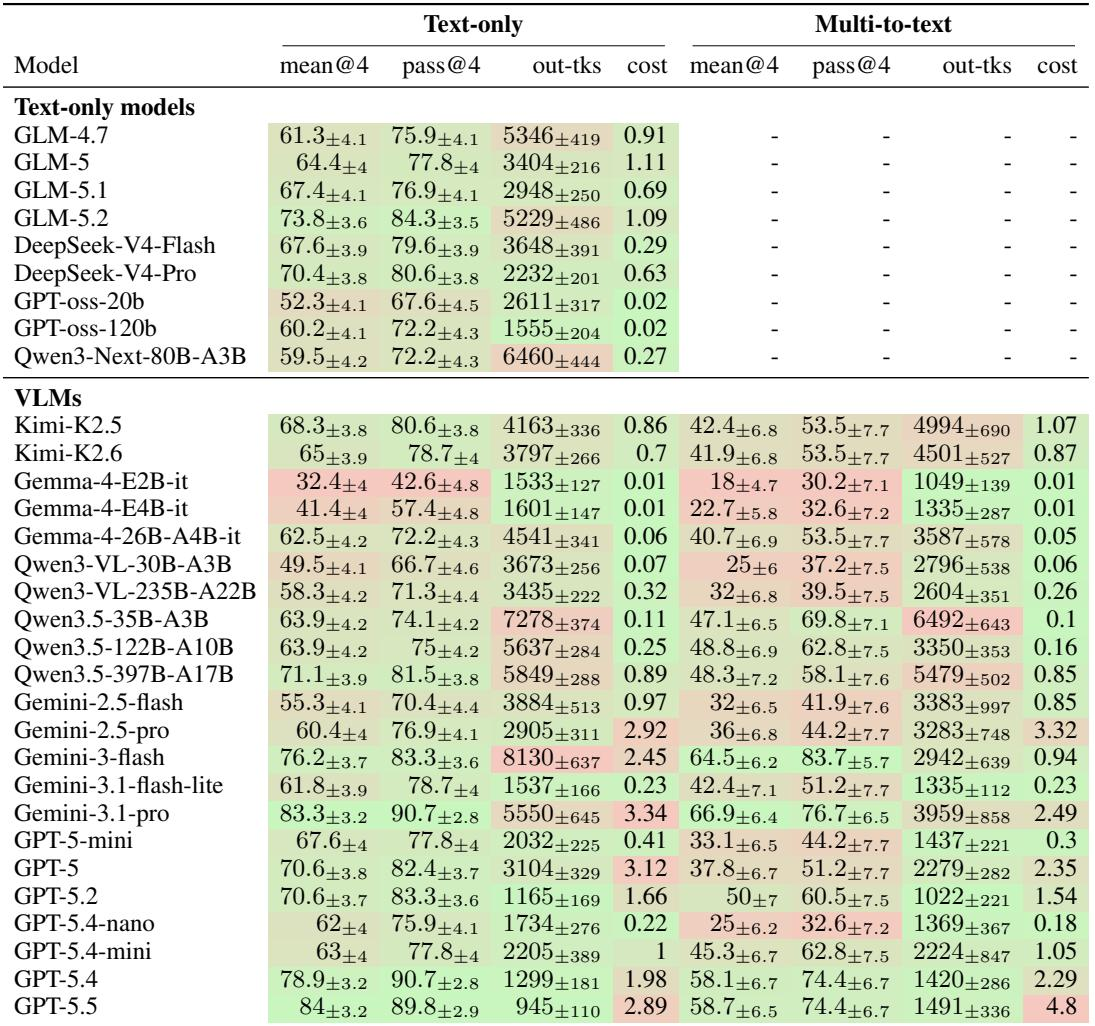
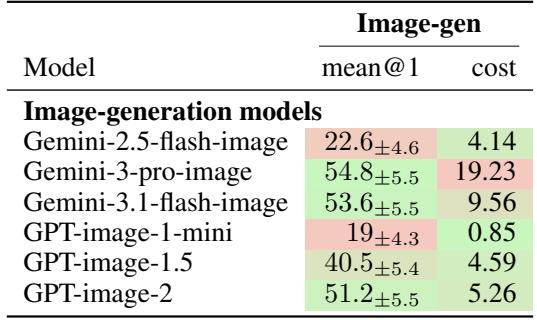
Image-generation models exhibit a trade-off between accuracy and cost. The top Gemini models achieve the highest accuracy, with Gemini-3.1-flash-image offering a more cost-effective alternative to the pro version, while GPT models provide lower-cost options with reduced accuracy. Task analysis reveals complementary strengths: Gemini excels at abstract reasoning, GPT at language and knowledge. Gemini-3-pro-image leads in accuracy but incurs the highest generation cost per sample. Gemini-3.1-flash-image closely matches the pro model's accuracy while costing less than half. GPT-image-1.5 is less accurate than both Gemini models but costs substantially less. The cheapest model, GPT-image-1-mini, records the lowest accuracy. Gemini and GPT models show complementary strengths, with Gemini better on abstract reasoning and GPT better on language and knowledge tasks.
Enabling code execution for text-only problems changes accuracy and token usage differently across models. While some models like Gemini-3.1-pro and GLM-5.2 gain accuracy with fewer tokens, others like GPT-5.4 lose accuracy even though token count drops. The mixed results show that tool-use does not uniformly improve performance or efficiency. Gemini-3.1-pro improved accuracy by 2.78 percentage points and used 199 fewer tokens. GPT-5.4 lost 5.32 percentage points of accuracy while using 451 fewer tokens. Kimi-K2.6 required 3,314 more tokens but only gained 6.25 percentage points in accuracy. GLM-5.2 reduced token usage by 1,712 tokens with a slight accuracy increase of 1.16 percentage points.
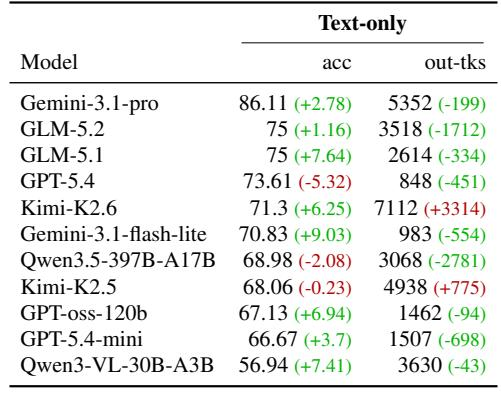
The evaluation across text-only, multimodal, and image-generation tasks reveals that closed-source models continue to lead overall, especially on multimodal problems, while open-weight models are steadily improving with notable cost efficiency differences. Image generation exhibits a clear accuracy-cost trade-off, with Gemini models excelling at abstract reasoning and GPT models providing more affordable options stronger in language and knowledge. Enabling code execution for text-only problems yields mixed results, as accuracy and token usage changes vary widely across models, indicating that tool-use is not uniformly beneficial.