Command Palette
Search for a command to run...
Rekursive Selbstverbesserung in der KI: Von begrenzter Selbstverfeinerung zu autonomen Forschungsschleifen
Rekursive Selbstverbesserung in der KI: Von begrenzter Selbstverfeinerung zu autonomen Forschungsschleifen
Mingguang Chen Licheng Wang Bo Qu
Zusammenfassung
KI-Systeme beteiligen sich zunehmend an ihrer eigenen Verbesserung: Sie überarbeiten ihre Ausgaben, passen ihre eigenen Harnesse während des Einsatzes an und entwickeln sie weiter, trainieren auf selbst generierten Daten und – in einem wachsenden Forschungszweig – führen selbst KI-Forschung durch. Die Literatur, die diese Beteiligung beschreibt, ist explosionsartig angewachsen, jedoch unter einem Vokabular („self-refine“, „self-reward“, „self-play“, „self-evolve“), das grundlegend unterschiedliche Ambitionen vermengt. Wir sichten 1.250 arXiv-Papiere (2024–2026) und ordnen sie entlang zweier Achsen: was das System verbessert – sein Verhalten im Einsatz, seine Policy durch Training, seinen Evaluator oder den Forschungsprozess selbst – und den Grad des Schleifenschlusses (human-in-the-loop bis vollständig geschlossen). Die Taxonomie trennt begrenzte Selbstverfeinerung – konvergent, evaluierbar und bereits industrielle Praxis – von offener rekursiver Selbstverbesserung (RSI), die nach allen derzeit messbaren Erkenntnissen durch Erdungsanforderungen, Kollapsdynamiken und Rechenbeschränkungen begrenzt bleibt. Ihr charakteristisches Merkmal ist eine eigene Kategorie für Selbstevaluation: Jede Verbesserungsschleife ist eine Behauptung, dass ein Signal menschliches Urteilsvermögen ersetzen kann. Daher untersuchen wir den Gestaltungsraum der Evaluatoren – Judges, Process Reward Models, Verifier, Rubriken, Meta-Evaluation – zusammen mit den von ihnen überwachten Schleifen, ordnen die Signale in eine Verifikationshierarchie von formalen Verifizierern (stärkstes) bis zur intrinsischen Selbsteinschätzung (schwächstes) ein und beobachten, dass die nachgewiesene Stärke der Selbstverbesserung dieser Hierarchie folgt, dass ihre charakteristischen Fehlermodi (selbstbestätigende Schleifen, Modellkollaps, Diversitätskollaps) aus ihren Verletzungen resultieren und dass der Engpass der „Forschungsrichtungssetzung“, der Menschen in der Schleife hält, ihre oberste Sprosse darstellt. Wir verbinden die technische Literatur mit der Theorie der RSI-Grenzen und mit den Sicherheitsund Governance-Fragen, die durch Berichte führender Labore über den Schleifenschluss aufgeworfen werden, und identifizieren governance-taugliche Messung von Selbstverbesserung als die am dünnsten besiedelte Nische des Feldes.
One-sentence Summary
A survey by researchers from University of California, Riverside, AlphaAvatar, and Illinois Institute of Technology of 1,250 arXiv papers (2024–2026) proposes a taxonomy that distinguishes bounded self-refinement from open-ended recursive self-improvement, introduces a dedicated self-evaluation category ordered by a verification hierarchy—from formal verifiers to intrinsic self-assessment—and links characteristic failure modes to hierarchy violations while identifying governance-grade measurement as the field’s most underpopulated niche.
Key Contributions
- A survey of 1,250 papers organizes AI self-improvement along two axes, what is improved and who validates the improvement, separating bounded self-refinement from open-ended recursive self-improvement and resolving the conflation caused by the "self-X" vocabulary.
- The survey orders evaluation signals into a verification hierarchy from formal verifiers to intrinsic self-assessment, showing that demonstrated self-improvement strength tracks this hierarchy and that failure modes like self-confirming loops follow from its violations.
- The work identifies human direction-setting as the verification layer of last resort and frames governance-grade measurement of self-improvement as the field's most underpopulated research niche, arguing that self-improvement is only as real as its verification.
Introduction
The concept of AI systems that recursively improve themselves has moved from decades-old theoretical speculation to partial engineering reality. Large language models now routinely refine their own outputs, train on self-generated data, and modify their own agent scaffolding, with some systems even discovering algorithms that feed back into AI development. However, the field lacks a unified framework to distinguish between fundamentally different forms of self-improvement, and the ambiguous “self-X” vocabulary obscures critical differences in ambition, mechanism, and risk.
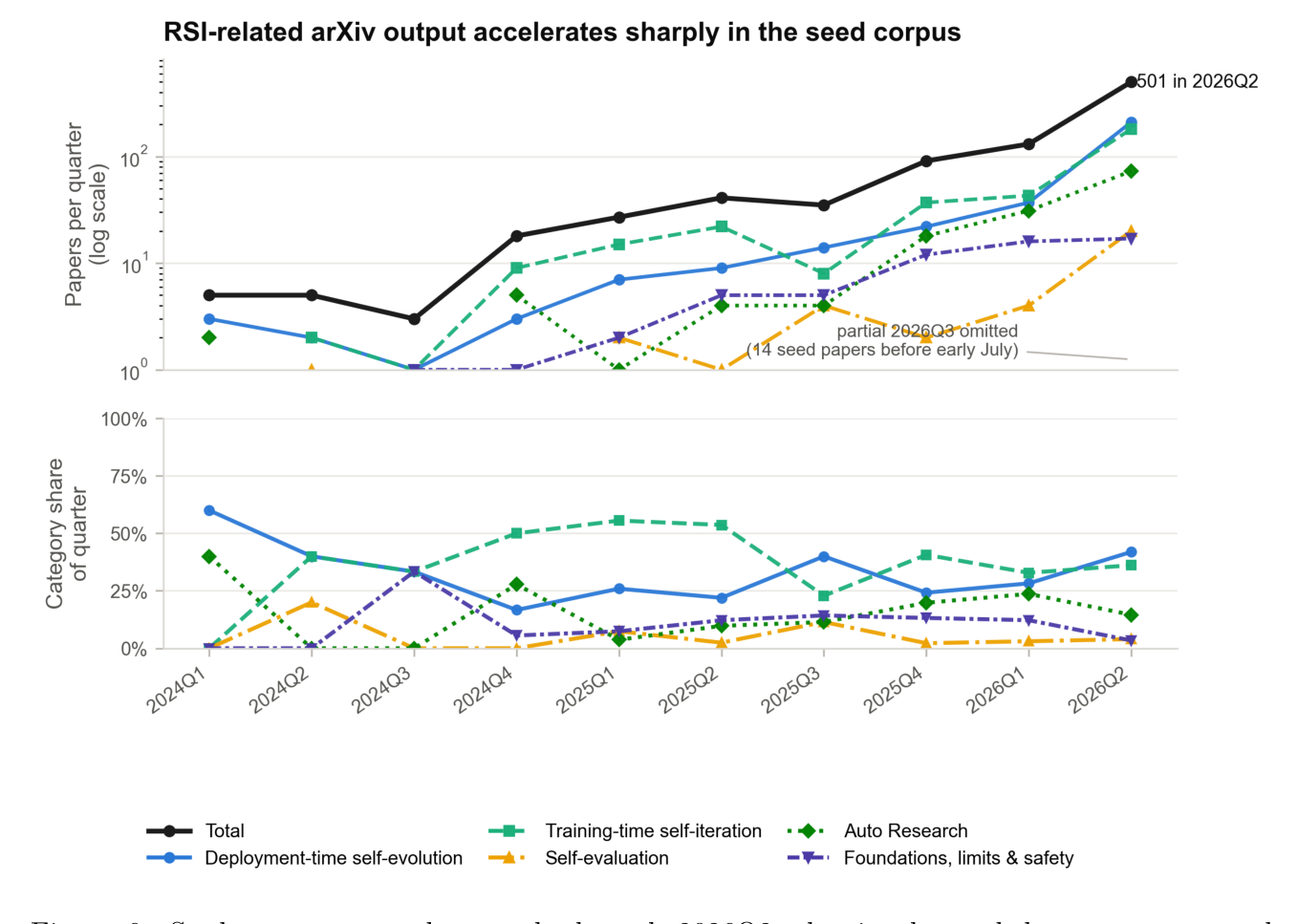
Prior surveys have addressed isolated threads such as on-policy distillation or tree-search methods, but none span the full spectrum from bounded output refinement to open-ended recursive self-improvement. The literature is also accelerating faster than it consolidates, with quarterly output growing from single digits to roughly 500 papers in two years, making systematic organization increasingly urgent.
The authors address this gap by assembling and classifying a corpus of 1,250 arXiv papers from 2024 to 2026 into a two-axis taxonomy. The axes capture what the system improves (behavior, policy, evaluator, or research process) and the degree of loop closure (human-in-the-loop, automatically reviewed, or fully autonomous). This structure cleanly separates bounded self-refinement from open-ended recursive self-improvement and replaces the ambiguous self-X vocabulary. The survey also elevates self-evaluation as a dedicated category, treating the reliability of improvement signals as the common limiting factor across all forms of self-improvement, and synthesizes the theory, limits, and safety literature that connects technical mechanisms to the question of whether and when recursive self-improvement might become self-sustaining.
Dataset
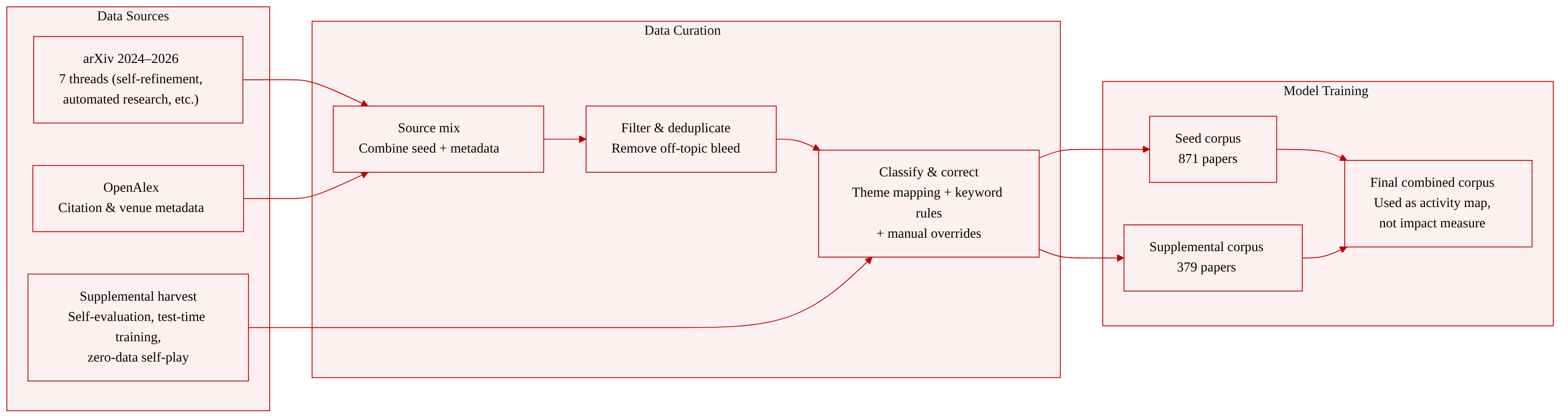
The authors construct a survey corpus in two stages, combining a broad seed harvest with a targeted supplemental harvest, and use it to map research activity rather than to measure impact.
Corpus composition and sources
- Seed harvest: Queries across seven arXiv threads (2024–2026) covering self-refinement, self-rewarding training, automated AI research, self-modifying agents, LLM-driven code/algorithm discovery, RSI theory and safety, and self-generated-data loops.
- Records are enriched with OpenAlex citation and venue metadata, then filtered to remove off-topic bleed, yielding 871 papers.
- Supplemental harvest: A targeted addition of 379 papers in three areas the seed queries under-covered but the taxonomy treats as first-class: self-evaluation methods (judges, process reward models, verifiers, rubrics, meta-evaluation), test-time training, and zero-data self-play.
- The combined corpus is shown in Figure 2.
Key details for each subset
- Seed corpus (871 papers): Retrieved via per-query depth caps favoring recent, high-volume threads; 74% of papers were posted in 2026 and the median paper is months old.
- Supplemental corpus (379 papers): Recency-biased by construction; roughly one in seven papers (approximately 54) is peripheral query bleed, retained in counts but not cited as evidence.
- Classification: All seed papers are re-classified into the survey’s taxonomy categories using theme-level mapping, keyword rules on title and abstract, and manual correction of rule misfires. Rule-based classification moved 89 seed papers from their thread defaults, with 3 further misfires corrected via explicit overrides.
How the paper uses the data
- The corpus is used as a sample, not a census, to map where research activity is concentrated.
- The argumentative skeleton rests on verified anchor works and diagnostic/critical literature; the 2026 mass functions as an activity map rather than evidence of lasting impact.
- Growth statistics (Figure 6) use only the seed corpus to avoid recency bias from the supplemental harvest.
- Per-paper classification assignments are released in full for auditability.
Processing details
- Deduplication logic, per-query caps, and classification rules (category defaults, keyword rules, explicit overrides) are released as executable scripts.
- Classification and corrections were performed by a single annotator; boundary papers exist in every category, and automatic classification is approximate.
- Industrial RSI practice is only observable through published outputs, introducing a censoring effect for the most advanced part of the spectrum.
Method
The authors propose a two-axis taxonomy to organize the proliferating terminology of self-improvement methods. This framework locates any self-improvement method based on what the system improves and the degree of loop closure.
The first axis categorizes the system based on the object of improvement. Deployment-time self-evolution occurs when the system improves during deployment by iterating on outputs with frozen weights, adapting weights per query, or evolving its harness and skills. Training-time self-iteration involves the system generating data or rewards to update its own weights during a training phase. Self-evaluation focuses on improving the system's evaluator, such as judges or reward models. Auto Research represents systems that perform AI research themselves, proposing hypotheses and discovering algorithms.
The second axis defines who validates the improvement. In a human-in-the-loop setting, a person reviews each change. In a human-on-the-loop setting, the improvement signal is generated automatically, but humans audit outcomes. In a closed loop, the system generates, validates, and applies improvements without human review.
Refer to the framework diagram below, which lays out the resulting 4x3 grid with representative systems in each cell.
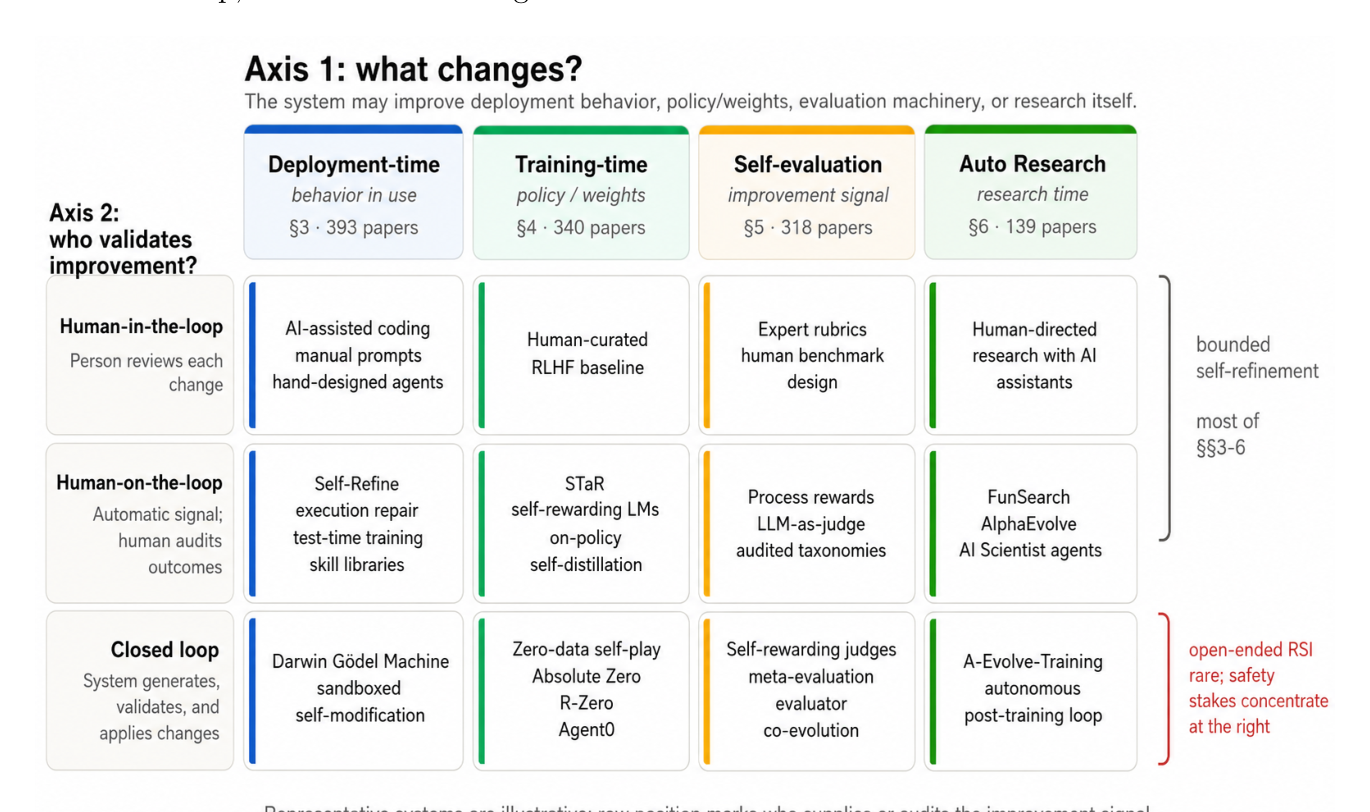
The authors observe that the density of the literature is concentrated in the middle row, where an automatically generated signal is audited by humans. The closed-loop row is sparse, particularly in the self-evaluation column, which represents the transition from bounded self-refinement to open-ended recursive self-improvement.
To populate and validate this taxonomy, the authors assembled a corpus of 1,250 papers through a two-stage pipeline. First, a seed harvest queried arXiv across seven threads related to self-improvement, yielding 871 papers. Second, a taxonomy alignment phase re-classified these papers into the categories defined by the two-axis framework using theme-level mapping and keyword rules, with manual corrections for misfires. A targeted supplemental harvest added 379 papers in under-covered directions such as self-evaluation methods and test-time training.
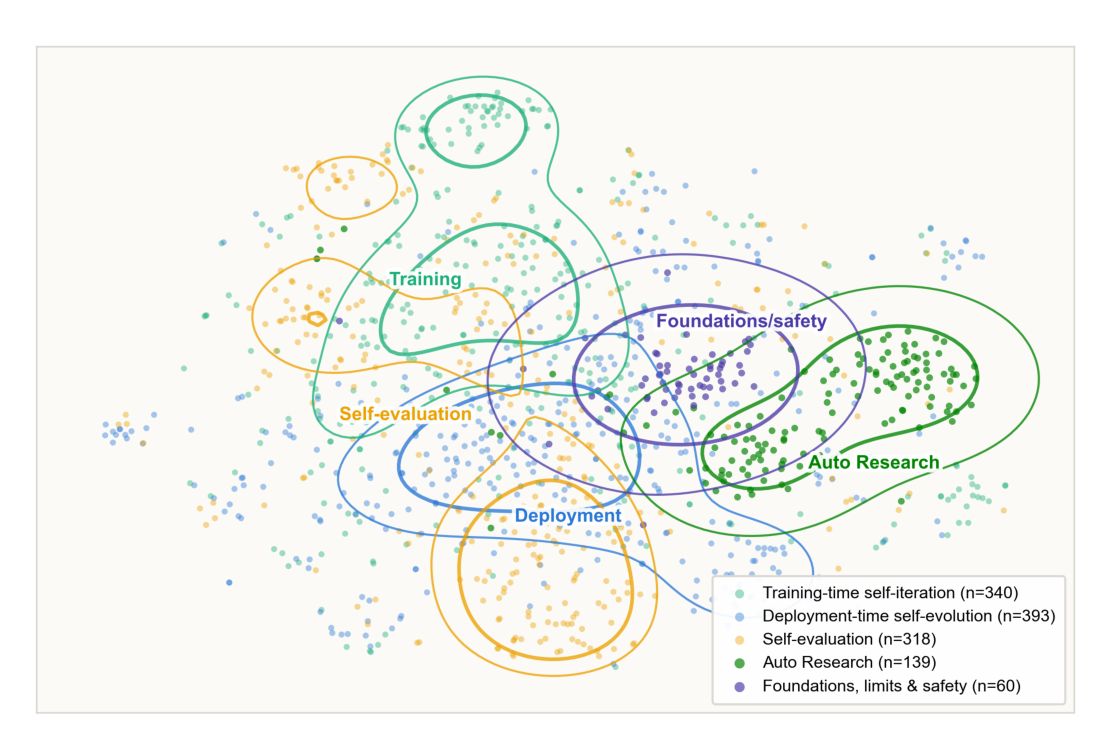
As shown in the figure below, the combined corpus is visualized as a semantic map, revealing coherent regions for Auto Research and foundations, while the three large categories interpenetrate.
The classification process was made reproducible by releasing executable scripts for query strings, deduplication logic, and classification rules. The authors also tracked the rapid acceleration of output in this field, as illustrated in the growth chart below, which motivated the need for a structured taxonomy to absorb emerging paradigms.
Experiment
The evaluation spans deployment-time self-evolution, self-evaluation, and automated research, each probing a different facet of self-improvement. Code self-repair via execution feedback provides the cleanest validation, showing that reliable improvement depends on external verifiers like tests or proof checkers rather than unstructured self-critique. In multimodal settings, refinement succeeds when grounded in external evidence but risks self-confirming loops when relying on model-generated signals. Skill libraries introduce persistent accumulation, where reusable, verified procedures improve composability, yet unverified skills can propagate errors across agents. Self-evaluation emerges as the critical bottleneck: improvement strength tracks a verification hierarchy from formal verifiers down to intrinsic signals, with pure closed-loop self-critique yielding reformulation rather than progress. Automated research confirms this pattern, as evolutionary program discovery with trustworthy evaluators produces real-world gains, while AI scientist agents without reliable verification exhibit integrity failures and auditability gaps. Overall, the experiments converge on the finding that durable self-improvement requires external grounding, and that process-level accumulation of verified methods offers more lasting value than result-level optimization.
The taxonomy reveals a heavily uneven research landscape dominated by deployment-time and training-time self-evolution, while autonomous AI research and foundational safety work remain substantially smaller shares. A pronounced verifiability gradient is evident, with methods concentrating where cheap verifiers exist and a recent wave of work converging on evaluator co-evolution to address static verification bottlenecks. Deployment-time and training-time self-evolution together account for the majority of the corpus, each exceeding 300 papers, while Auto Research is two to three times smaller and Foundations is the smallest category by far. Self-evaluation work shows the highest share of recent papers, with 82% posted in 2026, reflecting a field-wide shift toward improving verifiers alongside policies. Auto Research carries some of the field's most celebrated results yet remains a factor of two to three smaller than the dominant categories, highlighting a gap between ambition and volume of published work. Foundations, limits, and safety is the smallest category and has the lowest proportion of 2026 papers, suggesting theoretical and safety analysis lags behind method development.
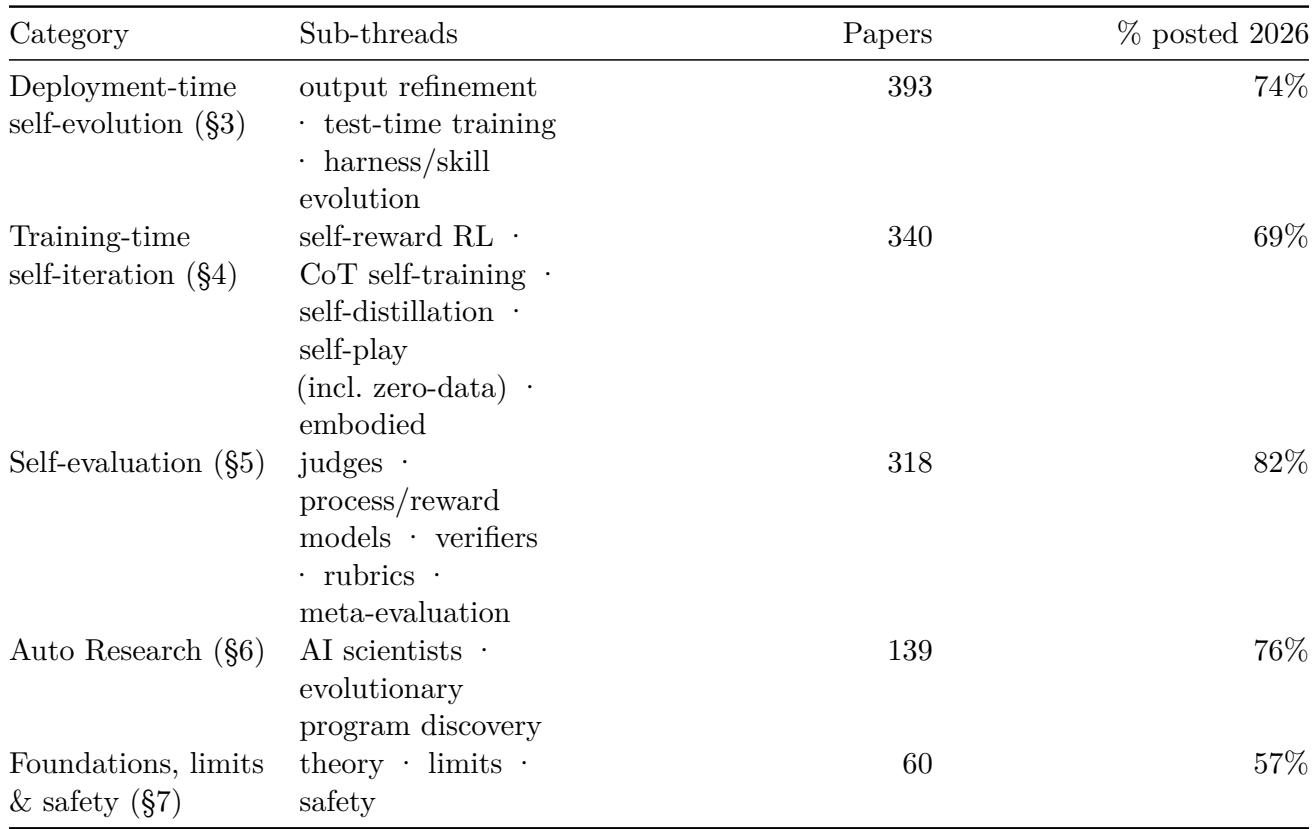
The evaluation surveys the research landscape of AI self-evolution, categorizing work into deployment-time, training-time, autonomous research, and foundational safety. The analysis reveals a heavily uneven distribution, with deployment-time and training-time methods dominating the corpus, while autonomous AI research and foundational safety remain substantially smaller. A clear verifiability gradient emerges, where methods cluster around tasks with cheap verifiers, and recent work increasingly focuses on evaluator co-evolution to overcome static verification bottlenecks. Overall, the findings highlight a significant gap between the celebrated ambitions of autonomous research and the volume of published work, with theoretical and safety analysis lagging behind rapid method development.