Command Palette
Search for a command to run...
ResearchStudio-Reel: Automatisierung der letzten Meile der Forschung vom Paper zu Poster, Video und Blog
ResearchStudio-Reel: Automatisierung der letzten Meile der Forschung vom Paper zu Poster, Video und Blog
Zusammenfassung
Die Verbreitung von Forschungsergebnissen – die Umwandlung eines Papers in ein Poster, ein Vortragsvideo und einen Blogbeitrag – ist nach wie vor eine manuelle letzte Meile. Bisherige Automatisierungsansätze behandeln jedes Artefakt isoliert, extrahieren das Paper jedes Mal neu, liefern meist unidirektionale Renderings, die der Autor nicht in PowerPoint oder Word weiterbearbeiten kann, und bewerten die Qualität anhand weicher VLM-Präferenzwerte, die stagnieren, während tragende Abschnitte weiterhin leer wirken. Wir argumentieren, dass diese letzte Meile am besten als Komposition von Skills aufgebaut wird: schlanke, agentenlesbare Verträge, die sich einen gemeinsamen vorgelagerten Extraktor teilen und deterministische Primitive in eine gemessene Füllschleife einbetten, deren Ausgänge harte Bestanden/Nicht-bestanden-Rendering-Prüfungen sind. Wir instanziieren dies als ResearchStudio-Reel, fünf Claude Codeund Codex-Skills, organisiert in einen gemeinsamen Extraktor (Paper2Assets), drei editierbare Generatoren (Paper2Poster, Paper2Video, Paper2Blog) und eine interaktive Konvergenzschicht (Paper2Reel). Paper2Assets extrahiert jedes Paper einmal in ein gemeinsames Bündel, das von jedem nachgelagerten Skill wiederverwendet werden kann; die drei Generatoren erzeugen ein druckfertiges Poster, ein synchronisiertes Vortragsvideo und einen zweisprachigen Blog, die faktisch konsistent bleiben und sich in PowerPoint oder Word round-trippen lassen; Paper2Reel bindet alle drei in einen eigenständigen HTML-Viewer ein, dessen abschnittsbezogene Klicks das Video, die Folien, die Untertitel und den Blog auf übereinstimmende Inhalte springen lassen. Im Paper2Poster-Benchmark führen unsere Poster in jedem ästhetischen und informativen Unterkriterium sowohl gegenüber früheren automatisierten Systemen als auch gegenüber einmalig abgefragten Frontier-LLMs, übertreffen die von den Autoren selbst erstellten Poster in der Ästhetik unter zwei zurückgehaltenen VLM-Richtern und gewinnen insgesamt bei 84 % bis 93 % der Papers; Fähigkeitsaudits zeigen zudem, dass ResearchStudio-Reel durch die einzigartige Kombination von erzählsynchronen Hervorhebungen auf den Folien mit einem zweisprachigen Blog, der durch layoutbewusste DOCX-Reparatur abgesichert ist, die einzige Pipeline ist, die alle drei editierbaren Artefakte liefert.
One-sentence Summary
Microsoft Research, National University of Singapore, Nanyang Technological University, Tsinghua University, Peking University, Shanghai Jiao Tong University, Westlake University, CFAR, and A*STAR present ResearchStudio-Reel, a skill-based pipeline that automates converting a research paper into a print-ready poster, synchronized talk video, and bilingual blog post by sharing a single Paper2Assets extraction step and enforcing hard pass/fail render gates, thereby delivering fully editable outputs that lead every aesthetic and information sub-criterion on the Paper2Poster benchmark, surpass the authors' own posters on aesthetics, and uniquely ship all three artifacts.
Key Contributions
- ResearchStudio-Reel organizes five Claude Code and Codex skills (Paper2Assets, Paper2Poster, Paper2Video, Paper2Blog, Paper2Reel) around one shared extractor, with a measured-fill loop gated by hard pass/fail render verdicts rather than by soft preference scores.
- The system produces a print-ready poster, a synchronized talk video, and a bilingual blog that remain editable in PowerPoint and Word, while the Paper2Reel viewer binds them into a self-contained HTML surface providing section-level synchronized navigation.
- On the 100-paper Paper2Poster benchmark, the posters outperform all prior automated systems and single-shot frontier LLMs on every aesthetic and information sub-criterion, surpass the authors’ own posters on aesthetics (3.52 vs. 2.94), and ResearchStudio-Reel is the only pipeline to deliver all three editable dissemination artifacts from a single run, winning the overall score on 84–93% of papers.
Introduction
The dissemination of a research paper, namely producing a conference poster, a talk video, and a public-facing blog post, is a time-critical, manual last mile that strains authors right after acceptance. Prior automated systems tackle each artifact in isolation, leading to cross-artifact inconsistencies, non-editable render-only outputs, and quality control that relies on soft aesthetic scores rather than hard completeness checks. The authors address these gaps with a composition of shared skills: a single extractor that feeds consistent assets into three generators, each of which emits an author-editable file (PowerPoint or Word) and applies a hard pass/fail fill verdict, plus a convergence layer that ties the poster, video, and blog into one navigable interactive viewer.
Method
The authors leverage a five-skill architectureto transform a single paper PDF into multiple editor-ready artifacts. As shown in the figure below:
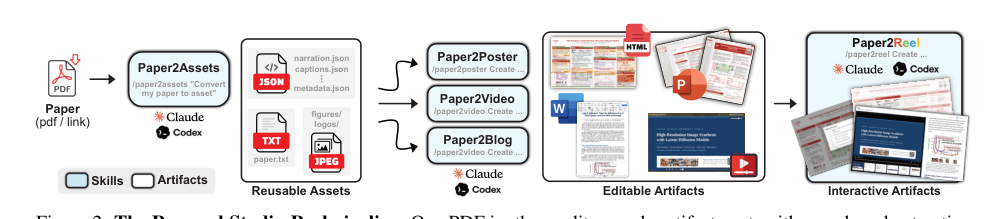
The system is anchored by Paper2Assets, a shared upstream extraction layer. Paper2Assets reads the source PDF once and produces a canonical bundle containing the full body text, cleaned figure images, metadata, and a structured nine-section summary. This bundle serves as the single source of truth for the three downstream generators: Paper2Poster, Paper2Video, and Paper2Blog. By centralizing extraction and figure cleanup, the system ensures cross-artifact factual consistency without requiring each generator to re-parse the source document. Finally, Paper2Reel acts as an interactive convergence layer, binding the three deliverables into a single navigable presentation surface.
Paper2Poster converts the shared asset bundle into a print-ready conference poster. Rather than relying on a combinatorial explosion of fixed templates, the poster is assembled at build time across four orthogonal axes: column layout, visual style, title-band header arrangement, and the bottom Scan-to-Read block. The core of this module is a staged-fill loop designed to converge on a fully populated page. Refer to the figure below:
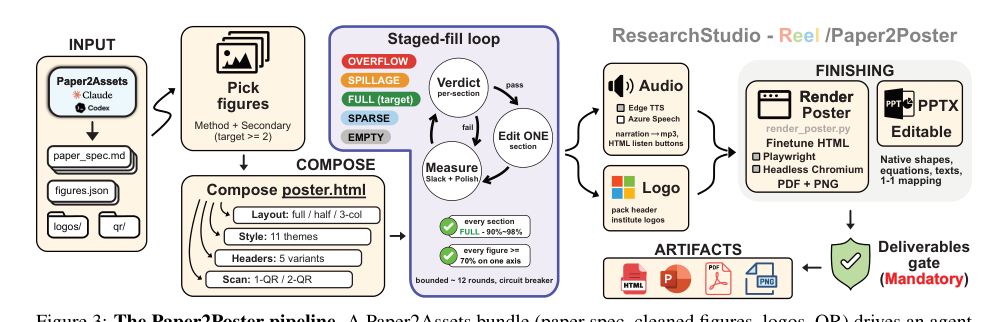
The loop begins with a lean draft and iteratively measures the content height of each section relative to its card height, computing a scalar ratio fullRatio=hcontent/hcard. This ratio is quantized into categorical verdicts (EMPTY, SPARSE, FULL, SPILLAGE, OVERFLOW), which dictate specific remediation actions such as appending supplementary text or tightening prose. The loop terminates only when every section reaches the target FULL band and all figures meet a minimum size threshold. As shown in the figure below:
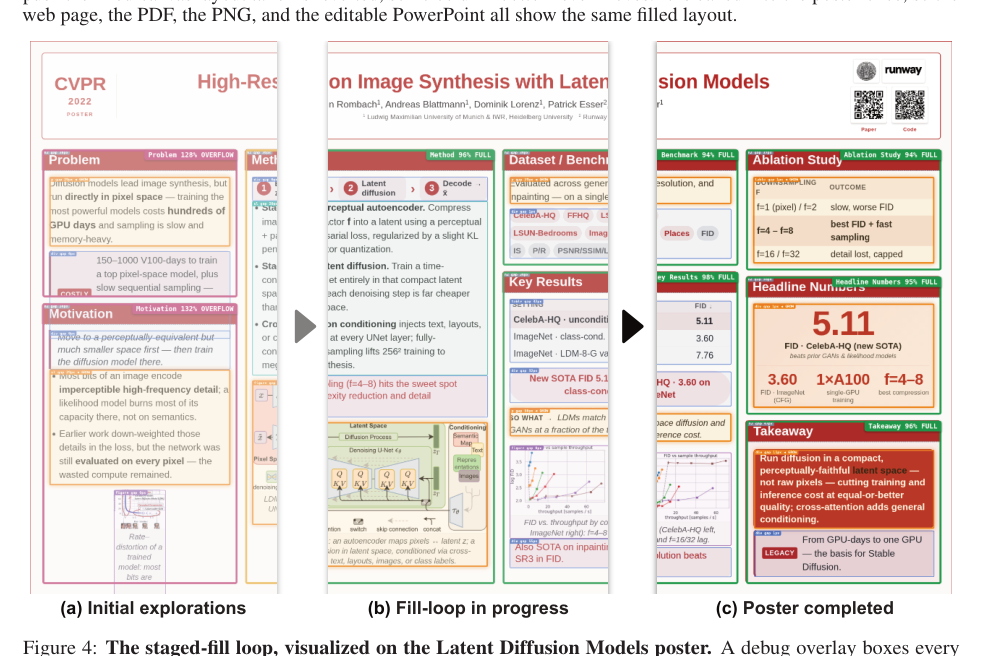
This visualization demonstrates how sections transition from uneven initial explorations to a fully populated layout. To avoid context window overflow, the refinement loop never re-reads the entire poster; instead, it edits only the verbatim source of off-target sections. Once converged, the poster is rendered to PDF and PNG, and simultaneously reconstructed as an editable PowerPoint file by mapping DOM nodes directly to native shapes.
Paper2Video transforms the asset bundle into a synchronized video package. The module first plans the narration duration before text-to-speech synthesis, ensuring the target length is met through content planning rather than post-hoc clipping. The system generates an editable PowerPoint deck, which serves as the render source. To guide viewer attention, Paper2Video produces a visual-cue plan that attaches semantic anchors to specific slide elements, rendering spotlight or laser highlights synchronized with the narration. The final output includes two MP4 variants: one with burned-in subtitles and a clean version for interactive use, alongside a timeline sidecar that aligns audio, captions, slides, and visual cues. Refer to the figure below:
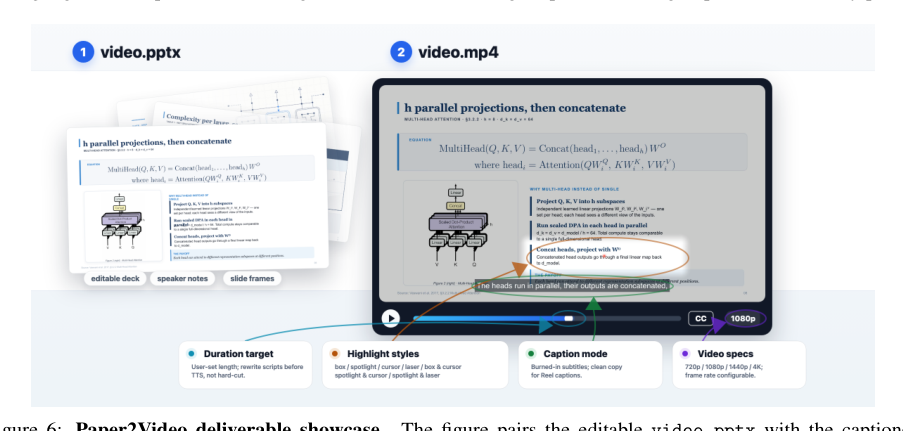
This showcase highlights the editable deck and the captioned video, along with user-facing controls for duration, highlight styles, and caption modes.
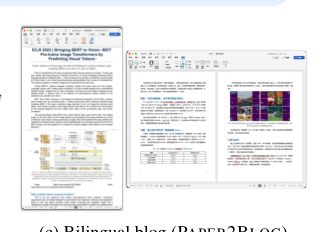
Paper2Blog produces a bilingual editorial package consisting of a Chinese WeChat-style article and an English research-blog piece. The module first builds a shared evidence map from the asset bundle, recording key facts, claims, and figure roles to ensure both language drafts remain factually aligned. The authors leverage language-specific outlines and style guides to control the register of each draft independently, rather than translating sentence by sentence. A shared set of figures is selected and placed near relevant sections in both documents. The assembly process generates Word documents with embedded media and fixed filenames. As shown in the figure below:

This pipeline summary illustrates how the shared evidence map drives multi-lingual drafts that pass through an editorial QA loop checking fact matching, figure fit, and page flow before final delivery.
Paper2Reel serves as the convergence layer, reading the completed deliverables from the three generators to build a self-contained interactive viewer. The viewer is poster-first, presenting the generated poster as the primary navigation surface. Interacting with a poster section opens a modal that aligns the corresponding video segment, slide thumbnails, and bilingual blog passages. An alignment sidecar maps canonical section IDs to their respective assets across all modalities, ensuring that poster blocks, video moments, and blog passages function as different views of the same paper section.
Experiment
The evaluation focuses on the poster generator, comparing ResearchStudio-Reel against single-shot frontier LLMs, prior poster pipelines, and human-authored posters on the Paper2Poster benchmark. The measured-fill loop yields the highest aesthetic and information scores among automated systems, surpassing the human baseline on average, and ablation confirms the quality gain comes from the loop and composition skills rather than the underlying model. The full pipeline is the only system that produces all three dissemination artifacts (poster, video, blog) as editable deliverables, and it keeps operational cost low.
ResearchStudio-Reel (Claude Code) earns the top aesthetic and information scores among all automated poster generators and even surpasses the human author baseline. Single-shot frontier LLMs produce notably stronger posters than earlier multi-step tools, but only ResearchStudio-Reel combines this quality with full pipeline coverage, emitting editable posters, slides, videos, and blogs from one PDF. ResearchStudio-Reel (Claude Code) leads on every aesthetic and information sub-criterion, with an overall aesthetic mean of 3.52 versus the human authors' 2.94. Single-shot frontier models (Claude-4.8 Opus, GPT-5.5, Gemini-3.1 Pro) score around 3.4 to 3.5 on aesthetics, well above older pipeline tools like Paper2Poster, which remains below 2.0. Only ResearchStudio-Reel emits all four dissemination artifacts (HTML poster, PPTX slides, video, and blog) with native editable files; other systems produce at most one or two formats. The earlier Paper2Poster tool achieves the highest reading comprehension score (95.65% understanding accuracy) but lags far behind on visual engagement and layout.
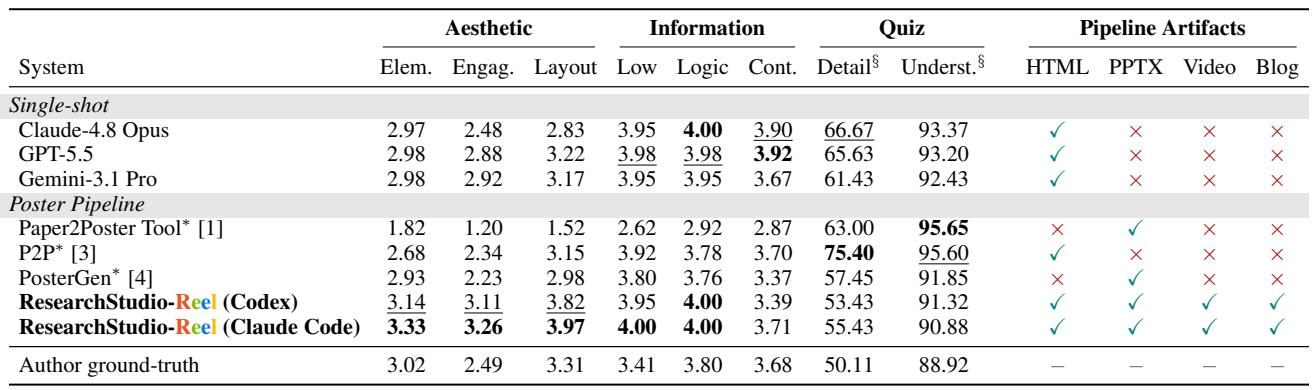
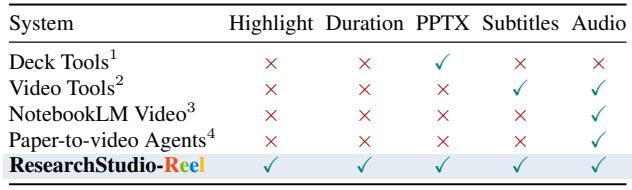
ResearchStudio-Reel is the only system that delivers all five audited capabilities: editable slides, narration audio, subtitles, timed highlight cues, and duration control. The other categories each cover only a subset; deck tools give editable slides but no media, video tools provide subtitles and audio but no timing or editable deck, and paper-to-video agents and NotebookLM Video offer only narration audio. ResearchStudio-Reel uniquely checks every column: highlight cues, duration control, editable PPTX, subtitles, and narration. Deck tools (PowerPoint, Google Slides, Keynote) provide an editable PPTX deck but lack narration, subtitles, highlight cues, and duration control. Video tools (DaVinci Resolve, Premiere Pro, CapCut) support subtitles and audio but not editable slides or timing controls. NotebookLM Video and paper-to-video agents deliver only narration audio, with no highlight cues, duration control, editable deck, or subtitles.
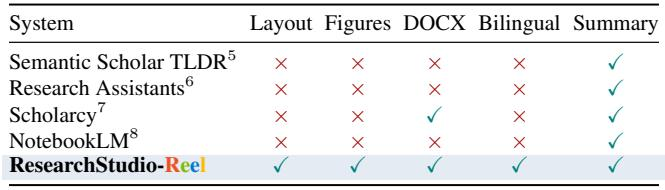
ResearchStudio-Reel is the only system that delivers a complete blog article from a paper, offering layout control, inline figures, editable DOCX export, and bilingual English-Chinese versions. All other compared tools, including Semantic Scholar TLDR, Research Assistants, Scholarcy, and NotebookLM, produce a plain summary without layout or bilingual delivery, and only Scholarcy additionally provides a DOCX output. ResearchStudio-Reel uniquely combines all five audited blog capabilities: layout, embedded figures, editable DOCX, bilingual delivery, and summarization. Every other system lacks at least three of the five capabilities, producing only a text summary without layout or bilingual support, though Scholarcy also exports to DOCX.
The ResearchStudio pipeline produces a full four-artifact bundle from one paper in about 89 minutes, with the poster and narrated video stages dominating the cost. Most of the token traffic consists of cached-context re-reads billed at roughly a tenth of fresh input, keeping the effective dollar cost low. The one-time figure extraction step is the single largest stage but can be bypassed when LaTeX source files are available, substantially reducing the shared overhead. The poster skill's fill loop is the single most expensive stage by token cost. Cached-context re-reads dominate the token volume, making the effective cost much lower than the raw input total suggests. Supplying the paper's LaTeX source avoids the costly figure extraction stage, speeding up the pipeline significantly. The poster and video skills together account for the majority of the pipeline's time and token usage.
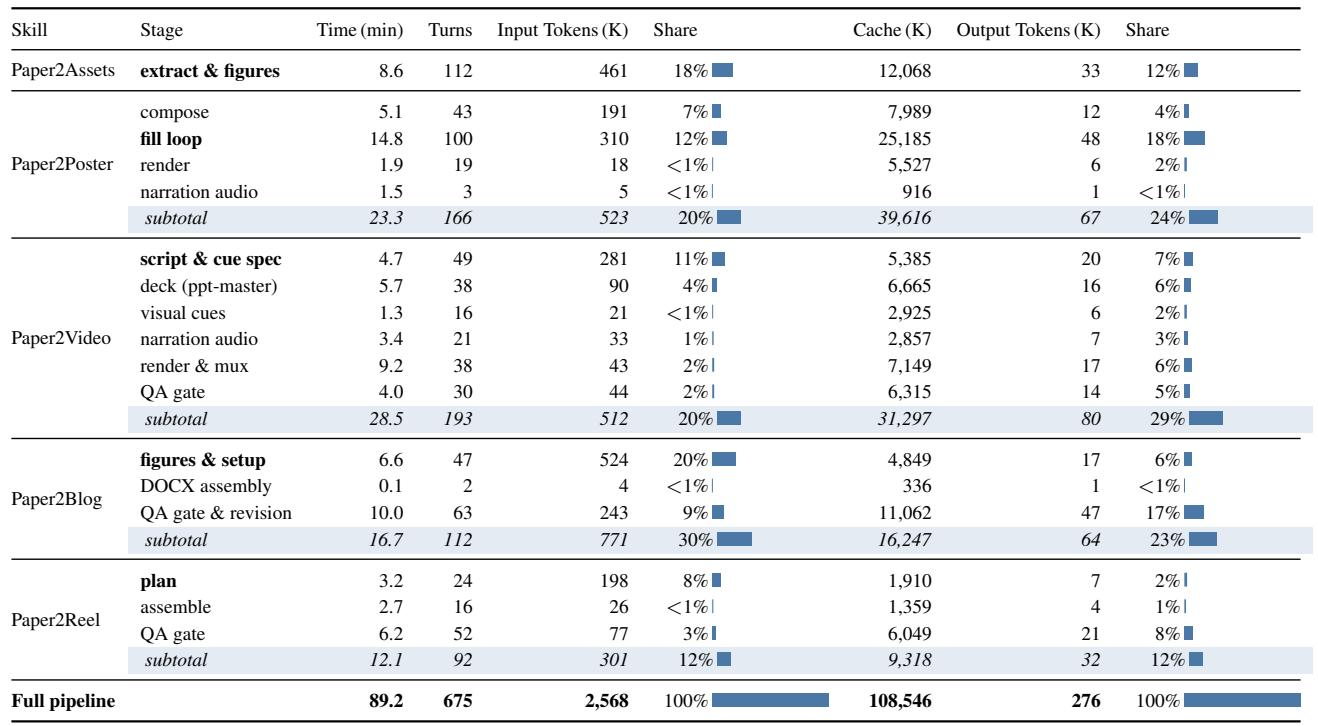
The experiments compare ResearchStudio-Reel against existing tools and human baselines, demonstrating that it uniquely achieves superior aesthetic quality while delivering the full set of editable dissemination artifacts (poster, slides, video with timed highlight cues, and bilingual blog) from a single paper. While frontier LLMs can approach high visual scores, only ResearchStudio-Reel supports all artifact types with native editable files, and its pipeline is made efficient through cached context re-reads and the option to supply LaTeX source to bypass costly figure extraction.