Command Palette
Search for a command to run...
LectūraAgents: Ein Multi-Agent-Framework für adaptives personalisiertes KI-unterstütztes Lernen und verkörperten Unterricht
LectūraAgents: Ein Multi-Agent-Framework für adaptives personalisiertes KI-unterstütztes Lernen und verkörperten Unterricht
Jaward Sesay Yue Yu Siwei Dong Yemin Shi Guangyao Chen Börje F. Karlsson
Zusammenfassung
Effektives personalisiertes, KI-gestütztes Lernen erfordert Systeme, die nicht nur präzise, lernerspezifische Bildungsmaterialien generieren, sondern ihre Instruktion auch dynamisch an diverse Lernende anpassen können. Bestehende educational agents haben sich jedoch vorrangig auf die Automatisierung von Vorlesungsinhalten und Simulationen konzentriert, was häufig nicht ausreicht, um multimodale und verkörperte Lehrmethoden zu modellieren, die auf den individuellen Lernenden zugeschnitten sind. Zu diesem Zweck schlagen wir LectūraAgents vor – ein Multi-Agent-Rahmenwerk, das personalisiertes Lernen durch end-to-end adaptiven verkörperten Unterricht ermöglicht. Im Kern bildet LectūraAgents eine Professor-Student-Beziehung ab, bei der ein ProfessorAgent ein kollaboratives Team spezialisierter untergeordneter agents durch Forschung, Planung, Begutachtung und die verkörperte Vermittlung von Vorlesungsinhalten anführt, die sich an den Bedürfnissen eines Lernenden anpassen. Das Rahmenwerk liefert drei Hauptbeiträge: (1) eine hierarchische Multi-Agent-Architektur für durchgängiges personalisiertes Lernen; (2) einen adaptiven Mechanismus für verkörperten Unterricht, bei dem der ProfessorAgent sichtbare und pädagogisch motivierte Lehraktionen (z. B. handschriftliches Schreiben, Hervorheben, Unterstreichen usw.) auf Inhalten in einer Lehrumgebung ausführt; und (3) einen Teaching Action-Speech Alignment (TASA)-Algorithmus, der auf salienzbasierter Heuristik und zeitlicher semantischer Segmentierung zurückgreift, um kohärente Sequenzen von Lehraktionen zu generieren, die an die Profile der Lernenden angepasst sind. Wir evaluieren LectūraAgents auf verschiedenen Kursen auf Sekundar-, Bachelor- und Masterstufe unter Verwendung einer stichprobenbezogenen, rubrikbasierten Analyse, wobei die generierten Vorlesungsmaterialien und Lehraktionen von fachkundigen Lehrkräften bewertet und validiert werden. Die experimentellen Ergebnisse zeigen durchgängige Verbesserungen hinsichtlich der Qualität von Vorlesungsinhalten, der Qualität des verkörperten Unterrichts, der Bewertung und der Personalisierung im Vergleich zu bestehenden Ansätzen. Dies positioniert LectūraAgents als ein pädagogisch fundiertes Rahmenwerk für personalisiertes Lernen im großen Maßstab.
One-sentence Summary
LecturaAgents is a hierarchical multi-agent framework that enables end-to-end adaptive personalized learning by mirroring a professor-student relationship, wherein a lead agent coordinates specialized sub-agents to execute pedagogically motivated, embodied teaching actions dynamically tailored to individual learners, directly addressing the limitations of static lecture automation in existing educational frameworks.
Key Contributions
- LecturaAgents introduces a hierarchical multi-agent architecture that enables end-to-end personalized learning through a structured professor-student dynamic. A central ProfessorAgent coordinates specialized subordinate agents to research, plan, and review instructional materials while continuously adapting content to individual learner profiles.
- The framework implements an adaptive embodied teaching mechanism that allows the ProfessorAgent to execute visible, pedagogically motivated actions such as handwriting, highlighting, and underlining directly on virtual slides. This approach integrates spatial instructional cues with verbal instruction to guide attention and reduce cognitive load without relying on static lecture automation.
- Extensive quantitative and qualitative evaluations validate the system across lecture content quality, teaching quality, assessment, and personalization metrics. These results demonstrate that the architecture successfully bridges automated content generation with coherent, adaptive, and pedagogically informed instructional delivery.
Introduction
Adaptive personalized AI-assisted learning enhances student engagement and outcomes, but current solutions often prioritize content adaptation over instructional delivery methods and remain confined to text-only generation or controlled simulations. Prior work lacks a unified approach to integrate embodied teaching actions, such as pointing or highlighting, with individualized learning profiles, leaving a gap in how agents can physically guide attention during real-world instruction. The authors leverage a hierarchical multi-agent framework called LectürAAgents to manage the full lecture lifecycle, introducing a Teaching Action-Speech Alignment algorithm that enables an embodied tutor to execute pedagogically motivated gestures over slides while dynamically tailoring content to diverse learner needs.
Dataset
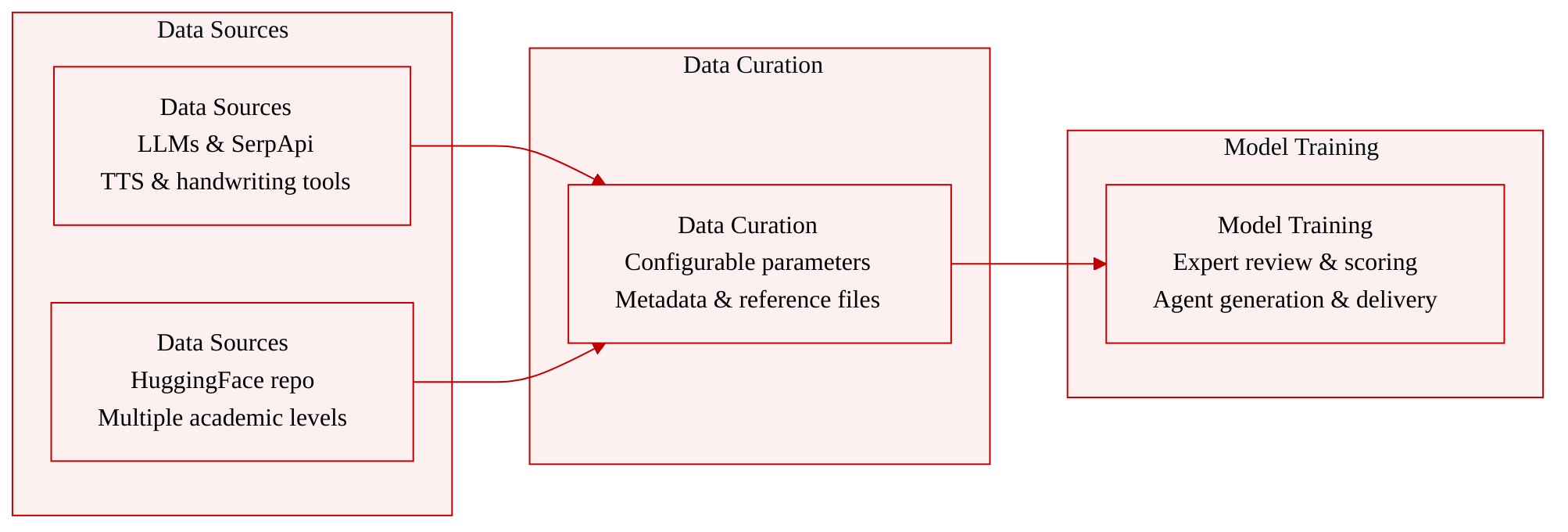
- Dataset composition and sources: The authors host the dataset on HuggingFace, where it contains AI-generated lecture artifacts produced by a modular agent framework. The data is synthesized using multiple large language models, integrated with SerpApi for web-based research, and paired with configurable text-to-speech and handwriting generation backends.
- Key details for each subset: The collection spans multiple academic levels, languages, and generation methodologies. While the provided excerpts do not specify exact subset sizes or explicit filtering rules, the dataset is structured around configurable parameters including instructor voice, learner profiles, target slide counts, and optional reference materials like syllabi or external documents.
- How the paper uses the data: The authors utilize the dataset to evaluate AI-generated educational content through a panel of five expert educators. These specialists reviewed the lecture artifacts and assigned final scores using a refined pedagogical rubric. The pipeline supports both interactive frontend delivery and command-line generation, with real-time process tracking via a group chat interface. No explicit training splits or mixture ratios are detailed, as the data primarily supports agent-based generation and expert evaluation rather than supervised model training.
- Processing and metadata details: Each entry includes structured metadata such as lecture title, description, academic level, learner profile, and language preference. The processing workflow allows users to toggle research methods, select speech and handwriting backends, and choose from multiple slide rendering modes. Optional inputs like custom syllabi or external reference files are incorporated directly into the generation pipeline to ensure contextual accuracy.
Experiment
The framework was evaluated end-to-end through expert-led pedagogical scoring, comparative benchmarking against existing educational systems, and a real-world student trial to validate its personalized content generation and embodied teaching capabilities. Results indicate that the system consistently produces coherent instructional actions across diverse learner profiles and outperforms baseline frameworks in adaptive personalization and assessment alignment. Additionally, the efficacy study demonstrated that the framework enhances short-term comprehension and recall while delivering a superior learning experience compared to alternative AI-assisted and traditional tools. Collectively, these findings confirm that the architecture successfully integrates tailored lecture creation with multimodal delivery to support effective, learner-centered instruction.
The authors evaluate lecture materials generated by seven models using a set of pedagogical rubrics. The results show that artifacts such as slides, scripts, and study guides achieve high scores in dimensions like clarity, coherence, and cognitive appropriateness. Additionally, teaching actions receive strong ratings for embodied teaching criteria, including spatial accuracy and active learning engagement. Lecture materials including slides and scripts score highly on content quality metrics such as clarity and coherence. Teaching actions demonstrate strong performance in embodied teaching criteria like spatial accuracy and rough notation. Study guides and lecture notes show consistent scores in personalization and motivation rubrics.
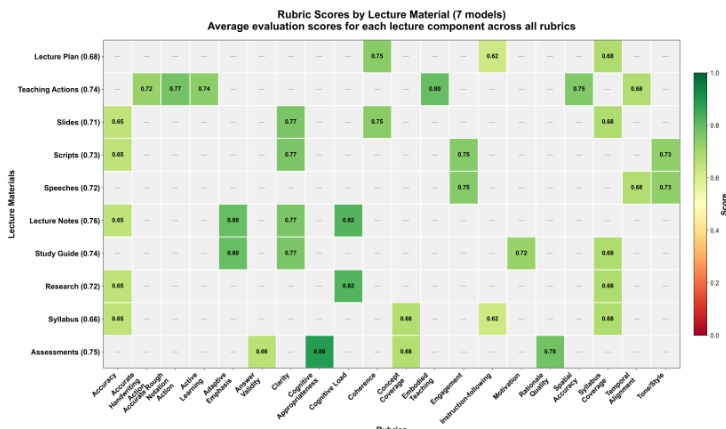
The authors evaluate the framework's capacity to generate personalized lectures and deliver embodied teaching using multiple frontier models. The results demonstrate that the system achieves high scores across lecture content, personalization, and assessment quality metrics. Additionally, the embodied teaching component exhibits reliable spatial alignment and action accuracy, while student efficacy studies indicate improved comprehension and learning experience compared to baseline systems. The framework consistently outperforms existing educational baselines in content quality, personalization, and assessment generation. Embodied teaching actions demonstrate strong spatial accuracy and coherence, maintaining stability across diverse learner profiles. Efficacy studies with real students show that the framework leads to better short-term comprehension and perceived learning support than traditional tools.
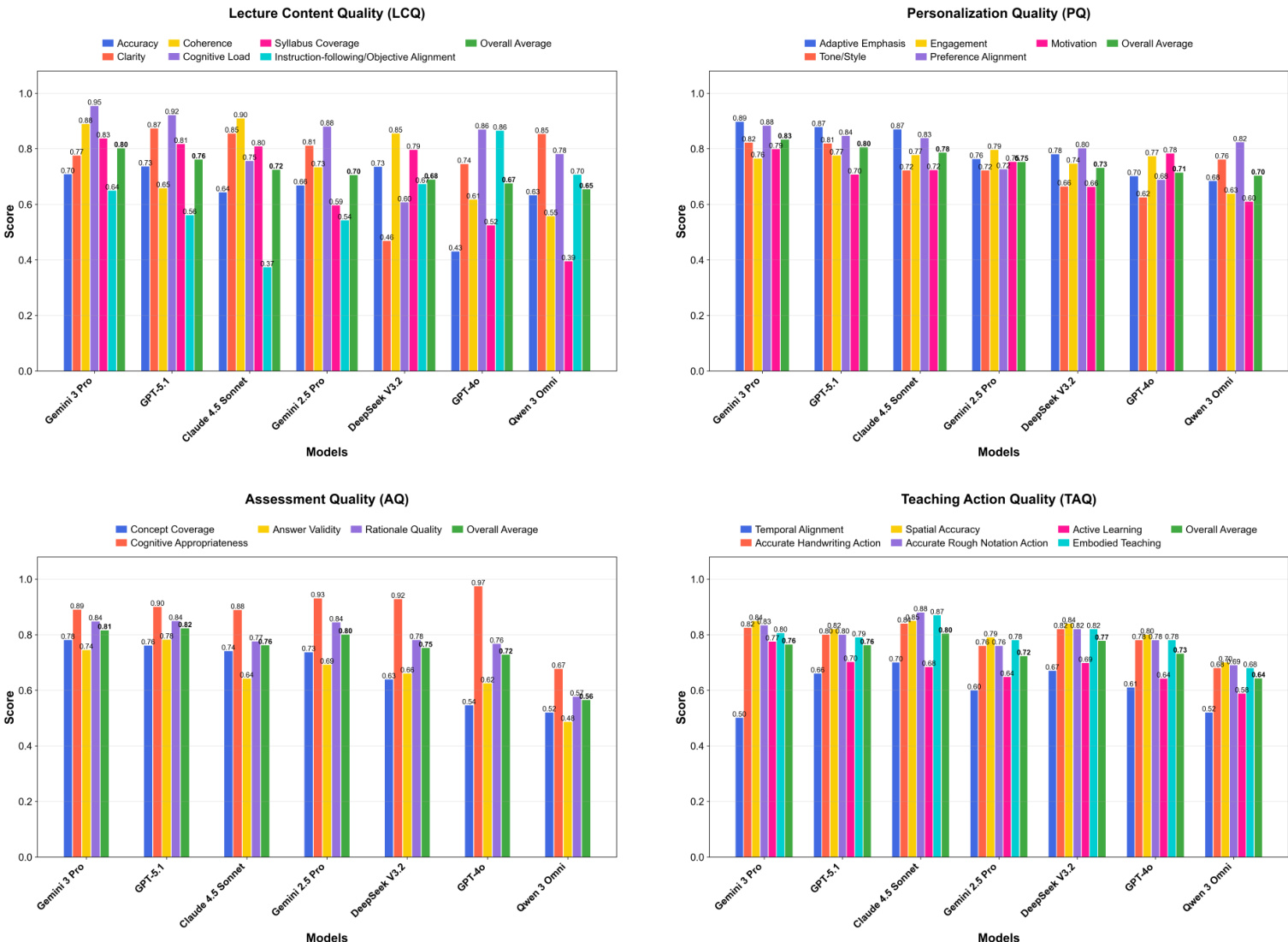
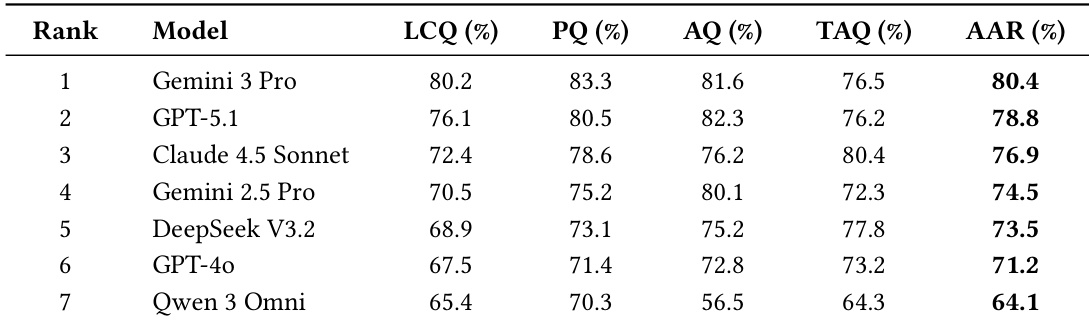
The authors evaluated the LecturaAgents framework using seven frontier models to assess personalized lecture generation and embodied teaching capabilities. Results show a distinct performance hierarchy, with Gemini 3 Pro securing the top position overall. The assessment covers lecture content quality, personalization, assessment quality, and teaching action quality. Gemini 3 Pro leads the ranking, demonstrating superior performance in lecture content and assessment quality. Claude 4.5 Sonnet achieves the highest teaching action quality, surpassing other models in embodied delivery metrics. Qwen 3 Omni records the lowest performance across the majority of evaluation metrics.
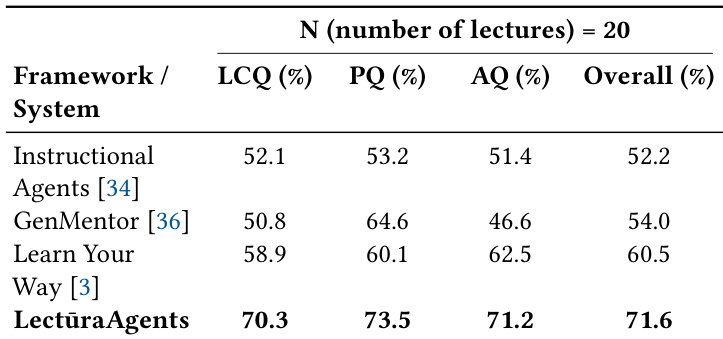
The authors compare LectūraAgents against three baseline frameworks, including Instructional Agents, GenMentor, and Learn Your Way, using a set of 20 lectures. The evaluation assesses Lecture Content Quality, Personalization Quality, Assessment Quality, and an Overall performance score. The results demonstrate that LectūraAgents consistently achieves the highest scores across all metrics, significantly outperforming the competing systems. LectūraAgents obtains superior scores in Lecture Content Quality, Personalization Quality, and Assessment Quality compared to all baseline frameworks. The framework exhibits the strongest overall performance, significantly exceeding the average scores of Instructional Agents, GenMentor, and Learn Your Way. While GenMentor shows relatively strong Personalization Quality, LectūraAgents maintains a clear lead across all categories, indicating better adaptation and instructional coherence.
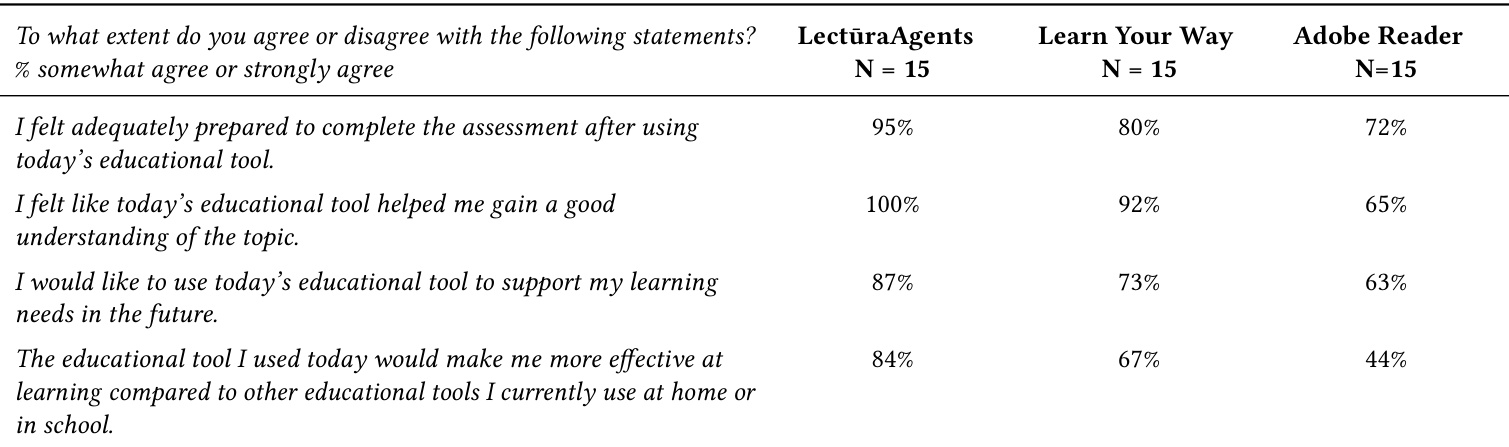
The authors conducted a student efficacy study comparing LecturaAgents against Learn Your Way and Adobe Reader to evaluate learning support and user experience. Survey results indicate that participants using LecturaAgents reported higher levels of assessment readiness, content understanding, and perceived effectiveness compared to the other tools. LecturaAgents achieved the highest agreement rates regarding assessment preparation and topic comprehension. Participants expressed a stronger preference for using LecturaAgents for future learning support compared to the other systems. Students rated LecturaAgents as more effective for learning than their current tools, outperforming both the AI-assisted baseline and the traditional reader.
The evaluation framework assesses personalized lecture generation and embodied teaching capabilities through rubric-based model testing, comparative benchmarking against existing educational systems, and real-world student efficacy studies. These experiments validate the system's ability to generate clear and coherent instructional materials, maintain accurate spatial alignment during delivery, and provide highly adaptive learning support. Across all assessments, the framework consistently demonstrates superior instructional quality and personalization compared to traditional and AI-driven baselines. Furthermore, student feedback confirms that the system significantly enhances comprehension, assessment readiness, and overall learning satisfaction, establishing it as a more effective educational tool than conventional alternatives.