Command Palette
Search for a command to run...
Koordiniertes optimales Power-Quality-Management in Verteilnetzen unter Nutzung der Restkapazität von Community-IBRs
Koordiniertes optimales Power-Quality-Management in Verteilnetzen unter Nutzung der Restkapazität von Community-IBRs
Tiantian Ji Pengfeng Lin Miao Zhu Stephan M. Goetz Ahmed Abu-Siada Syed Islam
Zusammenfassung
Dieser Beitrag schlägt ein netzweites, koordiniertes Optimierungsmodell vor, um Spannungsungleichgewicht (VU) zu mildern, indem die verbleibende Kapazität von gemeinschaftlichen, netzgekoppelten, auf Wechselrichtern basierenden Ressourcen (IBRs) erschlossen wird. Bestehende Ein-Sequenz-Strategien ignorieren gekoppelte Kapazitätsbeschränkungen und führen zu ungenutzten Reserven. Gleichzeitig gelingt es ihnen nicht, die kollektiven Steuerungsfähigkeiten gemeinschaftlicher IBRs zu nutzen. Um diese Diskrepanz zu beheben und das ungenutzte Potenzial auszuschöpfen, haben wir ein sequenzdomänenbasiertes Netzmodell in zwei gemeinsam genutzten synchronen Bezugssystemen entwickelt. Strenge Grenzwerte für Phasenströme und scheinbare Leistung werden formuliert und durch polyedrische Approximationen konvexifiziert. Eine quadratische Zielfunktion gleicht die Zuweisung der Sequenzkapazitäten flexibel aus. Simulations- und experimentelle Ergebnisse validieren die Wirksamkeit der vorgeschlagenen Strategie.
One-sentence Summary
The authors propose a network-wide coordinated optimization model that mitigates voltage unbalance in distribution systems by unleashing the residual capacity of community inverter-based resources, utilizing a sequence-domain network model in dual commonly shared synchronous reference frames where strict phase current and apparent power limits are convexified via polyhedral approximations and a quadratic objective function flexibly balances sequence capacity allocation to overcome the idle headroom of single-sequence strategies, with effectiveness validated through simulation and experimental results.
Key Contributions
- A sequence-domain network model operating within dual commonly shared synchronous reference frames eliminates complex bus phase-angle variables to facilitate network-wide voltage unbalance mitigation.
- Comprehensive inverter constraints enforce phase current, sequence voltage, and apparent power limits, while polyhedral approximations convexify these nonlinear boundaries to reduce computational dimensionality.
- A quadratic objective function flexibly balances positive- and negative-sequence capacity allocation, with simulation and experimental results validating the proposed strategy.
Introduction
Voltage unbalance has emerged as a critical power quality challenge in renewable-heavy distribution networks, threatening system reliability and limiting grid hosting capacity. While traditional mitigation relies on costly dedicated hardware, leveraging the idle capacity of inverter-based resources presents a highly economical alternative. However, prior approaches face significant limitations. Local droop control schemes often produce infeasible current references under severe unbalance and lack multi-device coordination, while existing optimization methods typically treat sequence capacities in isolation, ignoring coupled constraints and relaxing active power limits. The authors bridge these gaps by developing a network-wide coordinated optimization model that operates within dual commonly shared synchronous reference frames. They enforce strict phase current and apparent power boundaries, convexify the nonlinear constraints through polyhedral approximations, and employ a quadratic objective function to flexibly balance positive- and negative-sequence capacity allocation, effectively unlocking the collective potential of community inverters for grid stabilization.
Method
The authors leverage a dual synchronous rotating reference frame approach to model the sequence-domain behavior of a radial distribution network with multiple inverter-based resources (IBRs). The framework operates in two orthogonal rotating frames: DQ+ for the positive sequence and DQ− for the negative sequence, which are defined relative to the phase a axis (Fig. 1). This dual-frame representation effectively handles phase angle discrepancies across different local dq frames. The network is modeled with Bus 0 as an infinite bus, serving as the source of voltage unbalance, and each IBR is represented as a controlled current source injecting three-phase currents. The power flow equations for the positive and negative sequences are derived in the complex domain, resulting in a coupled system of equations expressed in terms of nodal voltages V+, V−, and currents I+, I−, and the network impedance matrix Znet.

The nodal voltage at any bus i is obtained by projecting the overall network equations onto the DQ+ and DQ− frames, yielding expressions for the d- and q-axis components of the positive- and negative-sequence voltages. These components are then used to formulate operational constraints. Voltage magnitude constraints are established by summing the squares of the d- and q-axis components, relaxing the equality to an inequality, and bounding the total voltage magnitude within the rated peak phase voltage. Current constraints are derived by analyzing the time-domain phase currents of each IBR, which are the sum of positive- and negative-sequence components. By applying Cauchy's inequality to eliminate the phase angle variables, a single inequality constraint is obtained for each phase, bounding the total current magnitude by the steady-state limit.
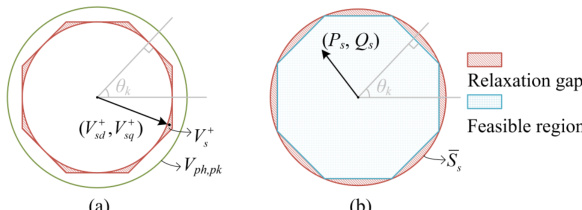
The apparent power output of each IBR is constrained by a circular inequality, which is inherently non-convex. To render the problem tractable, this constraint is approximated using a polyhedral envelope. Specifically, an inscribed n-sided polygon is used to approximate the circular feasible region of the apparent power constraint (Fig. 2(b)), transforming the non-linear constraint into a set of n linear inequalities. This approximation is applied to the power constraints for both positive and negative sequences. Additionally, a tightening technique is employed for the positive-sequence voltage constraint by augmenting it with a circumscribed n-sided polyhedral envelope (Fig. 2(a)), which helps to ensure the constraint is not overly loose and drives the positive-sequence voltage toward its physical value.
The optimization objective function is designed to minimize voltage unbalance while maintaining the positive-sequence voltage close to its nominal value. To avoid the issues associated with the standard voltage unbalance factor (VUF), the authors adopt a quadratic objective function J that penalizes both the magnitude of the negative-sequence voltage and the deviation of the positive-sequence voltage from its nominal level. This objective is minimized subject to the formulated operational constraints, including the polyhedral approximations of the power constraints. The solution provides the optimal current references for all IBRs in the DQ frame, which are subsequently transformed back to the local dq frame of each inverter for implementation.
Experiment
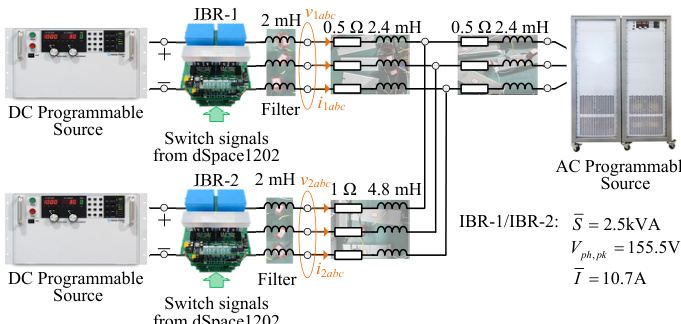
The evaluation combines distribution network simulations and hardware experiments with two identical inverters to validate a proposed coordinated power quality strategy against conventional single-sequence approaches. Both testing environments demonstrate that traditional methods fail to effectively utilize inverter capacity due to their isolated handling of voltage sequences, frequently resulting in constraint violations or significant idle capacity under unbalanced grid conditions. Conversely, the proposed coordinated strategy successfully balances positive- and negative-sequence regulation, fully exploiting available inverter headroom while strictly adhering to hardware limits and delivering superior voltage quality across varying severity levels.
{"summary": "The authors evaluate a coordinated control strategy for inverter-based resources in a simulated and experimental setup, comparing it against single-sequence voltage regulation methods. The proposed strategy effectively balances positive- and negative-sequence voltage support, fully utilizing inverter capacity while adhering to hardware constraints. Experimental results demonstrate that the strategy achieves balanced voltage regulation and maximizes current utilization across both inverters.", "highlights": ["The proposed strategy achieves balanced voltage regulation by jointly managing positive- and negative-sequence components, unlike single-sequence methods that underutilize inverter capacity.", "Experimental results show that the strategy enables both inverters to operate close to their current limits, indicating efficient use of available power capacity.", "The approach successfully regulates voltage under unbalanced conditions while maintaining operational safety, as evidenced by the absence of overcurrents or overvoltages."]
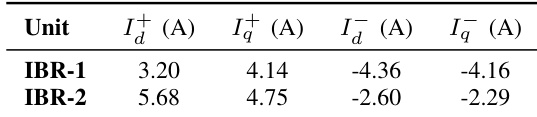
The authors compare the performance of three control strategies for inverter-based resources under unbalanced voltage conditions. Results show that the proposed coordinated strategy achieves better voltage regulation by effectively utilizing inverter capacity across both positive- and negative-sequence components, outperforming single-sequence approaches in terms of overall objective function and current utilization. The proposed strategy achieves the lowest objective value, indicating superior overall performance compared to single-sequence methods. Single-sequence strategies fail to fully utilize inverter capacity, leaving residual capacity unused or causing voltage violations. The coordinated strategy enables balanced utilization of inverter capacity, allowing current limits to be reached while maintaining voltage quality.
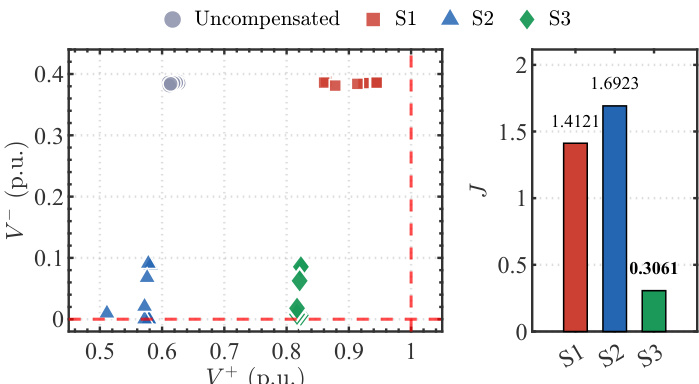
The authors evaluate a coordinated control strategy for inverter-based resources through simulated and experimental testing under unbalanced voltage conditions, comparing it against traditional single-sequence voltage regulation methods. The experiments validate that the proposed approach successfully balances positive- and negative-sequence voltage support while fully utilizing available inverter capacity within hardware constraints. Qualitative results demonstrate that the coordinated strategy consistently outperforms single-sequence methods by maintaining superior voltage regulation, maximizing current utilization, and ensuring operational safety without triggering overcurrent or overvoltage violations.