Command Palette
Search for a command to run...
GLOBE: Ein hochwertiges englisches Korpus mit globalen Akzenten für nullschussige sprecheradaptive Text-to-Speech
GLOBE: Ein hochwertiges englisches Korpus mit globalen Akzenten für nullschussige sprecheradaptive Text-to-Speech
Wenbin Wang Yang Song Sanjay Jha
Zusammenfassung
Dieses Papier stellt GLOBE vor, ein hochwertiges englisches Korpus mit weltweiten Akzenten, das speziell entwickelt wurde, um die Einschränkungen aktueller nullschussiger sprecheradaptiver Text-to-Speech-Systeme (TTS) zu adressieren, die eine schlechte Generalisierbarkeit bei der Anpassung an Sprecher mit Akzenten aufweisen. Im Vergleich zu häufig verwendeten englischen Korpora wie LibriTTS und VCTK zeichnet sich GLOBE durch die Einbeziehung von Äußerungen von 23.519 Sprechern aus, die 164 Akzente weltweit abdecken, sowie durch detaillierte Metadaten für diese Sprecher. Im Vergleich zu seinem ursprünglichen Korpus, d. h. Common Voice, verbessert GLOBE die Qualität der Sprachdaten erheblich durch strenge Filterund Aufwertungsprozesse, während auch alle fehlenden Sprechermetadaten ergänzt werden. Das endgültig kuratierte GLOBE-Korpus umfasst 535 Stunden Sprachdaten mit einer Abtastrate von 24 kHz. Unsere Benchmark-Ergebnisse zeigen, dass das auf dem GLOBE-Korpus trainierte sprecheradaptive TTS-Modell Sprache mit besserer Sprecherähnlichkeit und vergleichbarer Natürlichkeit synthetisieren kann als Modelle, die auf anderen gängigen Korpora trainiert wurden. Wir werden GLOBE nach der Annahme öffentlich freigeben. Der GLOBE-Datensatz ist verfügbar unter https://globecorpus.github.io/.
One-sentence Summary
Researchers at the University of New South Wales introduce GLOBE, a 535-hour, 24kHz English corpus featuring 23,519 speakers across 164 global accents, refined from Common Voice through rigorous filtering and complete metadata, which enables zero-shot speaker adaptive TTS to achieve better speaker similarity and comparable naturalness than models trained on LibriTTS or VCTK.
Key Contributions
- Introduces GLOBE, a curated English speech corpus derived from Common Voice, containing 535 hours of high-quality audio from 23,519 speakers across 164 global accents, with rigorous filtering for noise, bandwidth, and transcription accuracy.
- Provides complete speaker metadata (accent, age, gender) for all speakers, filling gaps present in the original Common Voice dataset, which enables more personalized TTS research and bias mitigation.
- Benchmark experiments show that zero-shot speaker adaptive TTS models trained on GLOBE achieve better speaker similarity and comparable naturalness than models trained on LibriTTS or VCTK, with improved generalizability to accented voices.
Introduction
Recent advances in deep learning have pushed text-to-speech (TTS) systems to produce highly lifelike speech, shifting research toward more complex tasks like zero-shot speaker adaptation, or voice cloning. This technique lets a model mimic a new speaker’s voice from just seconds of audio, broadening TTS usability. However, a key limitation is poor generalizability to accented voices, largely because popular English TTS datasets, such as LibriTTS and VCTK, contain a narrow range of accents, with VCTK covering only 11. While the Common Voice dataset offers over 3,000 hours and 337 accents, it suffers from noise, limited signal bandwidth, mispronunciations, and incomplete or confusing speaker metadata. To overcome these issues, the authors introduce GLOBE, a high-quality English corpus built from Common Voice, which filters out low-quality audio, realigns text, cleans accent labels, and fills missing metadata. GLOBE provides 535 hours of speech from 23,519 speakers across 164 accents, matching the audio quality of LibriTTS while offering superior accent diversity and detailed speaker information, enabling better generalizability for zero-shot speaker-adaptive TTS models.
Dataset

The authors construct the GLOBE corpus by combining and processing several existing English multi-speaker datasets. The primary sources are:
- VCTK: 44 hours of 48 kHz speech from 109 English speakers, each reading about 400 newspaper sentences. It includes accent and gender labels covering 11 accents.
- LibriTTS: 585 hours of 24 kHz audio from 2,456 speakers, derived from LibriSpeech and designed for TTS applications.
- LibriTTS-R: An enhanced version of LibriTTS with improved audio quality, retaining the same 585 hours and 2,456 speakers.
- Common Voice: 3,347 hours of 48 kHz audio from 88,904 volunteer speakers. The authors note that while this dataset is large, it is often unsuitable for TTS due to poor audio quality, so it requires extensive filtering.
The data processing pipeline has three stages:
-
Speech Sample Pre-processing and Filtering: The authors remove low-quality utterances using three criteria. First, they estimate the signal-to-noise ratio (SNR) from waveform amplitude distribution and exclude any utterance with an SNR below 0 dB. Second, they determine the actual signal bandwidth by finding the highest frequency at least 50 dB below the peak average in the power spectrogram, and remove utterances with bandwidths below 12 kHz. Third, they use a voice activity detection (VAD) tool to identify internal silence, and discard utterances containing more than 930 milliseconds of continuous silence. This threshold is derived from the maximum internal silence observed in the LibriTTS clean subset.
-
Speech Text Alignment: Because Common Voice has a high word error rate, the authors improve transcription accuracy. They use Whisper to transcribe all utterances, then normalize both the original dataset text and the transcribed text to spoken forms using a weighted finite-state transducer system. They compute word-level edit distance between the two versions. Utterances with an edit distance greater than 1 are removed. They also discard clips with an edit distance of 1 caused by consecutive word repetitions, as this often indicates repeated pronunciation of unfamiliar words.
-
Speaker Information Refinement and Speech Postprocessing: The authors populate missing metadata for accent, age, and gender. First, they merge or remove accent labels represented by fewer than five speakers or ten utterances, and remove meaningless labels such as "not bad" and "A'lo." Then, for each metadata class, they build a training set with utterances from 11,000 speakers and label-balanced validation and test sets with at least 1,000 speakers each. They train three speaker information prediction models (one per class) using these subsets, applying square-root sampling to handle the long-tail distribution of accent labels. The models achieve accuracies of 97.22% for accent, 99.55% for age, and 99.95% for gender on the test sets, and are used to fill in missing speaker metadata. Finally, they apply post-processing to all utterances: removing leading and trailing silences based on VAD results and suppressing background noise with a speech enhancement tool.
The resulting GLOBE corpus is summarized in Table 1 alongside the source datasets, and is used as training data for TTS models.
Method
The authors propose a comprehensive data processing pipeline to construct the GLOBE corpus, ensuring high-quality training data for Text-to-Speech (TTS) models. The pipeline consists of three main stages: speech sample pre-processing and filtering, speech text alignment, and speaker information refinement with post-processing.
In the initial phase, low-quality speech samples are filtered out to prevent adverse impacts on TTS model performance. The signal-to-noise ratio (SNR) is estimated via waveform amplitude distribution analysis, and utterances with an SNR below 0 dB are excluded. The actual signal bandwidth is determined by identifying the highest frequency at least -50 dB below the power spectrogram peak average, removing utterances below 12 kHz. Additionally, utterances containing more than 930 milliseconds of continuous internal silence, detected by a voice activity detection tool, are removed to avoid negative impacts on duration predictors.
To address the high word error rate in the source dataset, the authors improve transcription accuracy using Whisper for initial transcription. A weighted finite-state transducer-based system normalizes the text, and the word-level edit distance between the original and transcribed texts is computed. Utterances with an edit distance greater than 1, or an edit distance of 1 caused by consecutive word repetitions, are eliminated.
The final stage involves refining speaker metadata, including accent, age, and gender, and applying speech post-processing. Accents with insufficient representation are merged or removed. To populate missing metadata, the authors develop three speaker information prediction models. Refer to the framework diagram:

These models utilize a pre-trained HuBERT Large module followed by an EPACA-TDNN to predict accent, age, and gender. Due to the long-tail distribution of the speaker accent label, as shown in the figure below:
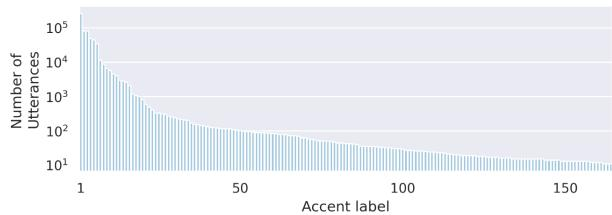
the square-root sampling method is employed during training to mitigate class imbalance. The models achieve high accuracies across test sets and are leveraged to populate missing metadata. Finally, post-processing eliminates leading and trailing silences based on voice activity detection results and suppresses background noise using a speech enhancement tool.
For the TTS experiments, the authors employ YourTTS as a baseline with specific modifications. The language embedding is removed to focus solely on English. To thoroughly assess the dataset influence and avoid bias introduced by pre-trained models, the pre-trained speaker encoder is replaced with a trainable EPACA-TDNN encoder. Furthermore, model parameters are adjusted to facilitate training with 24 kHz audio data.
Experiment
The first experiment evaluated groundtruth speech quality across GLOBE and several popular English datasets using objective metrics (NMOS, UT-MOS, WER, SMCS, SEVS) and subjective ratings. Results showed GLOBE matched LibriTTS in naturalness while outperforming Common Voice, and exhibited richer speaker diversity than other datasets. The second experiment trained a modified YourTTS model on each dataset and assessed synthesized speech. Models trained on GLOBE achieved comparable naturalness to LibriTTS-trained models and showed superior generalization to diverse accents, with no statistically significant drop in speaker similarity when tested on GLOBE's test set, unlike models trained on other datasets.
GLOBE is a large multi-speaker corpus with 535 hours from 23,519 speakers, covering 164 accents and including accent, age, and gender labels, while other corpora vary in size and speaker diversity. Experiments show that models trained on GLOBE generalize better to diverse accents, with smaller declines in speaker similarity on accent-rich test sets compared to models trained on other datasets. GLOBE offers the second-highest total hours among the listed corpora, with 535 hours, and the second-highest speaker count at 23,519, while covering 164 accents. Common Voice has the most hours and speakers but is noted as unsuitable for TTS due to poor audio quality, and GLOBE provides a more balanced alternative with high-quality 24 kHz audio. In evaluations, GLOBE-trained models maintained speaker similarity on accent-diverse test sets with no statistically significant decline, unlike models trained on other datasets such as LibriTTS. The VCTK corpus, with only 109 speakers and 11 accents, led to slightly worse speaker similarity scores due to limited speaker diversity.

Across ground-truth speech samples, most datasets achieve similar naturalness scores, except Common Voice, which is notably lower and statistically worse than GLOBE. GLOBE also shows the highest speaker similarity score, while its word error rate is comparable to LibriTTS and LibriTTS-R but higher than VCTK. GLOBE's naturalness is statistically indistinguishable from LibriTTS, but statistically better than Common Voice. Common Voice has the lowest naturalness and highest word error rate among all datasets. GLOBE achieves the highest speaker similarity score, while VCTK and Common Voice tie for the lowest.
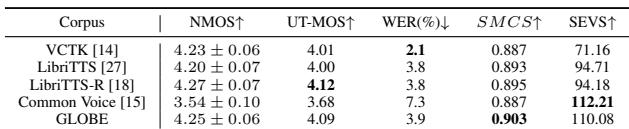
The modified YourTTS model performs best on naturalness when trained on LibriTTS-R, with LibriTTS and GLOBE trailing closely and showing no significant difference. Training on Common Voice leads to a significant drop in naturalness, while VCTK shows lower speaker similarity due to limited speaker diversity. On a more accent-diverse test set, the GLOBE-trained model demonstrates the strongest generalization with the smallest decline in speaker similarity. LibriTTS-R training yields the highest naturalness on the LibriTTS test set, with LibriTTS and GLOBE statistically tied. Common Voice training significantly reduces naturalness and increases word error rate compared to other datasets. VCTK training results in slightly lower speaker similarity, attributed to limited speaker diversity. On the GLOBE test set, all models show a drop in speaker similarity, but the GLOBE-trained model degrades the least, indicating better accent adaptability.

The evaluation compares TTS models trained on GLOBE against those trained on other corpora, using naturalness, speaker similarity, and word error rate as metrics. GLOBE-trained models show the strongest generalization to accent-diverse test sets, with the smallest decline in speaker similarity, while Common Voice consistently yields lower naturalness and higher word error rates due to poor audio quality. VCTK, with limited speaker and accent diversity, leads to slightly worse speaker similarity. Overall, GLOBE provides a balanced, high-quality alternative that matches or outperforms other datasets in accent robustness without sacrificing naturalness.