Command Palette
Search for a command to run...
تدريب نماذج الرؤية واللغة ذات السياق الطويل بفعالية مع تعميم يتجاوز سياق 128K
تدريب نماذج الرؤية واللغة ذات السياق الطويل بفعالية مع تعميم يتجاوز سياق 128K
الملخص
النمذجة ذات السياق الطويل أصبحت قدرة أساسية في نماذج اللغة والرؤية الكبيرة الحديثة (LVLMs)، مما يتيح إدارة مستمرة للسياق عبر فهم المستندات الطويلة، وتحليل الفيديو، واستخدام الأدوات متعدد الأدوار في سير العمل الوكيلية. ومع ذلك، لا تزال وصفات التدريب العملية غير مستكشفة بشكل كافٍ، لا سيما فيما يتعلق بتصميم ومزج بيانات السياق الطويل. في هذا العمل، نقدم دراسة منهجية للتدريب المستمر طويل السياق لنماذج LVLMs، حيث قمنا بتوسيع نموذج بحجم 7 مليار معلمة من 32 ألف إلى 128 ألف سياق مع إجراء استقصاءات واسعة على بيانات المستندات الطويلة. نوضح أولاً أن استعلامات الأسئلة والأجوبة عن الصور (VQA) للمستندات الطويلة أكثر فعالية بكثير من نسخ النصوص الضوئية (OCR). وبناءً على هذا الملاحظة، أدت استقصاءاتنا إلى ثلاث نتائج رئيسية: (أ) لتوزيع طول التسلسل، تتفوق البيانات المتوازنة على البيانات التي تركز على الطول المستهدف (مثل 128 ألف)، مما يشير إلى أن القدرة على السياق الطويل تتطلب استرجاعاً قابلاً للتعميل للمعلومات الأساسية عبر أطوال ومواقع مختلفة؛ (ب) يظل الاسترجاع هو العائق الرئيسي، مما يفضل المزيج الغني بالاسترجاع مع بيانات استنتاجية متواضعة لتنوع المهام؛ و(ج) يحافظ استعلامات VQA للمستندات الطويلة بشكل كبير على قدرات السياق القصير، مما يشير إلى أن البيانات الطويلة المصاغة كتعليمات تقلل من الحاجة إلى مزج البيانات القصيرة. بناءً على هذه النتائج، نقدم MMProLong، الذي تم الحصول عليه من خلال التدريب المستمر طويل السياق من Qwen2.5-VL-7B بميزانية token فقط تبلغ 5 مليار token. يحسن MMProLong درجات استعلامات VQA للمستندات الطويلة بنسبة 7.1% ويحافظ على أداء قوي عند سياقات 256 ألف و512 ألف تتجاوز نافذة تدريبه البالغة 128 ألف، دون تدريب إضافي. كما يتعمم على استرجاع الإبرة متعدد الوسائط المستند إلى صفحات الويب، وضغط الرؤية-النص طويل السياق، وفهم الفيديو طويل المدى دون إشراف خاص بالمهمة. بشكل عام، تؤسس دراستنا لوصفة عملية للتدريب طويل السياق (LongPT) وأساساً تجريبياً لتطوير نماذج اللغة والرؤية طويلة السياق.
One-sentence Summary
The authors introduce MMPROLONG, a 7B vision-language model derived from Qwen2.5-VL-7B through long-context continued pre-training on a 5B-token budget that extends the context window to 128K by prioritizing balanced sequence-length distributions and retrieval-heavy long-document VQA over OCR transcription, thereby preserving short-context capabilities.
Key Contributions
- Long-document visual question answering is identified as a superior training task that provides robust evidence retrieval and reasoning supervision while preserving short-context capabilities without requiring additional short-context data mixing.
- Extensive ablations demonstrate that prioritizing balanced sequence-length distributions and retrieval-heavy mixtures overcomes retrieval bottlenecks, enabling context extension from 32K to 128K within a 5B-token budget.
- The MMProLong recipe extends Qwen2.5-VL-7B via long-context continued pre-training, achieving strong performance on MMLongBench and VTCBench while generalizing to 256K and 512K context lengths across diverse multimodal tasks.
Introduction
The authors leverage long-context continued pre-training to address a critical capability gap in modern vision-language models, which increasingly require sustained context management for long-document analysis, hour-long video understanding, and multi-turn agentic workflows. Despite rapid context window scaling in recent architectures, practical training methodologies remain underexplored, leaving practitioners without clear guidance on how to construct optimal data mixtures, balance sequence length distributions, or effectively integrate short-context supervision. To resolve these challenges, the authors conduct a systematic ablation study on long-document visual question answering and training design, ultimately introducing MMProLong. This approach extends a 7B model from 32K to 128K tokens using a modest 5B-token budget, proves that balanced length distributions and retrieval-heavy data mixtures outperform target-length-focused training, and delivers robust performance at 256K and 512K contexts without additional fine-tuning.
Dataset
-
Dataset Composition and Sources
- The authors construct a foundational pool of over 1.5 million PDF documents spanning academic papers, books, and technical manuals across engineering, medicine, social sciences, and biology.
- To prevent evaluation contamination, they filter the pool by comparing PDF content hashes against known benchmarks.
- Each PDF is rendered into images at 144 DPI using PyMuPDF, and an OCR expert model fine-tuned from Seed 2.0 parses the pages into layout-aware blocks with structural labels like titles, sections, paragraphs, and tables.
-
Key Details for Each Subset
- Long-Document VQA: Sourced from documents containing 32 to 50 pages, yielding multimodal sequences of 32K to 128K tokens. The subset covers three task types: single-page extraction, multi-page extraction, and cross-page reasoning.
- OCR Transcription: Divided into full-document transcription, which requires outputting text from every page, and needle-page transcription, which focuses on 1 to 3 target pages while treating the rest as distractors.
- Short-Context Data: Publicly available instruction tuning data from LLaVA-OneVision is used for supplementary fine-tuning and mixture experiments.
-
Data Usage and Training Mixture
- The authors synthesize long-document VQA data using a short-to-long pipeline, generating questions from 8 to 15 page segments before placing them back into the full document context.
- They compare two length distributions, ultimately selecting the pool-native distribution, which maintains a natural length spread across the sampled documents rather than concentrating on near-maximum lengths.
- For final training, the VQA tasks are grouped into information extraction and reasoning categories. The authors optimize the mixture ratio and adopt an 8:2 extraction-to-reasoning split, which yields the strongest long-context performance.
- Short-context data is mixed with long-context data in controlled ratios to evaluate its impact on preserving general instruction-following capabilities.
-
Processing, Metadata, and Cropping Strategies
- Page sampling relies on OCR-derived structural labels to ensure semantically coherent segments of 8 to 15 consecutive pages are selected for question generation.
- Metadata construction includes explicit segment anchors in every question, such as specifying the exact section or page range, to prevent ambiguous answers when evaluated in the full document context.
- The QA generation process outputs structured JSON containing the question, answer, answer format, evidence page indices, and evidence sources, ensuring strict traceability and format consistency.
- The rendering resolution and OCR parsing pipeline balance visual fidelity with computational efficiency, enabling scalable synthesis of long multimodal sequences.
Method
The authors leverage a three-stage pipeline to construct a long-context training dataset for LongPT, designed to enhance performance on document-level reasoning tasks. The process begins with segment sampling, where a full document is processed using an OCR expert to extract text, and then split into coherent segments of 8 to 15 pages. This step ensures that the input is structured into manageable units suitable for downstream generation while preserving the document's inherent layout and content flow. Refer to the framework diagram.
The second stage involves question-answer (QA) generation, where each document segment is paired with a task instruction to guide the generation process. A QA generator model then produces a QA pair based on the segment and instruction. This stage is critical for creating diverse and contextually grounded questions that require understanding of the document's content. As shown in the figure below:
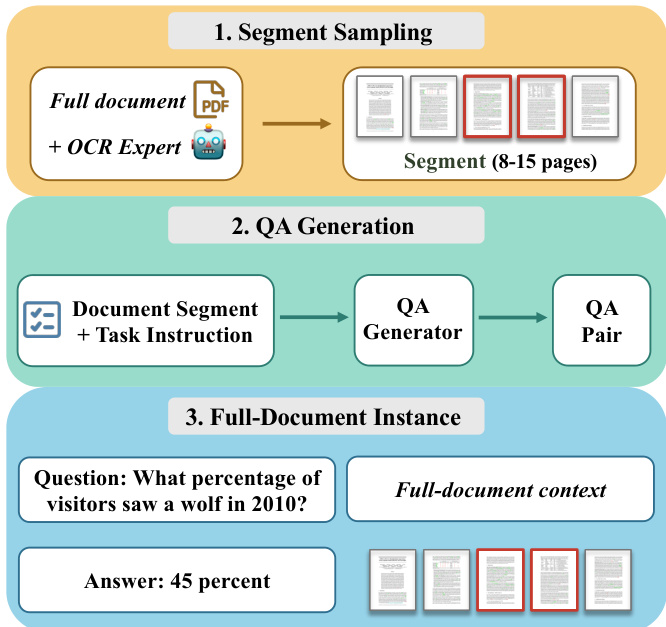
The final stage assembles the generated QA pairs into full-document instances by aggregating the context across the entire document. This step ensures that the model is trained on questions that require reasoning over the full document rather than isolated segments. Each instance includes a question, the corresponding answer, and the full-document context, which enables the model to learn long-range dependencies and perform cross-page reasoning. The framework emphasizes the integration of visual and textual elements, ensuring that both the layout and content are preserved throughout the process.
Experiment
Under a fixed computational budget, experiments compare long-document VQA against OCR transcription and test various short-context data mixing ratios to validate the optimal supervision source and context preservation strategy for extended training. The results indicate that long-document VQA offers superior instruction-aligned supervision, successfully preserving short-context capabilities while substantially enhancing long-document performance. Additionally, the optimized recipe extrapolates robustly to contexts up to 512K and transfers effectively to diverse downstream tasks, including needle-in-a-haystack retrieval, video understanding, and vision-text compression. These findings demonstrate that the proposed methodology cultivates a generalized long-context capability that remains highly effective across different model architectures.
The authors compare the performance of MMProLong against Qwen2.5-VL-7B on long-video understanding benchmarks, including Video-MME, MLVU, and LongVideoBench. Results show that MMProLong achieves higher scores than the base model across all three benchmarks, indicating improved long-video understanding capabilities. MMProLong outperforms Qwen2.5-VL-7B on Video-MME, MLVU, and LongVideoBench The model achieves consistent improvements on long-video understanding benchmarks without video-specific training Results indicate that the training recipe enhances general long-context multimodal capabilities beyond document VQA

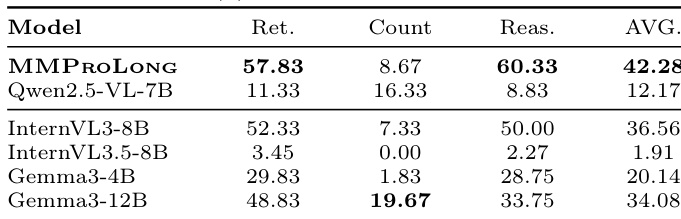
The authors compare the performance of MMProLong against several open-source and closed-source LVLMs on long-document VQA tasks. Results show that MMProLong achieves the highest overall average score, significantly outperforming Qwen2.5-VL-7B and other models across retrieval, counting, and reasoning tasks. The performance gap is particularly pronounced in the reasoning and counting categories, where MMProLong demonstrates superior capability. MMProLong achieves the highest overall average score on long-document VQA tasks compared to other models. MMProLong shows significant improvements in reasoning and counting tasks over Qwen2.5-VL-7B. The model maintains strong performance across retrieval, counting, and reasoning categories, indicating balanced capability.
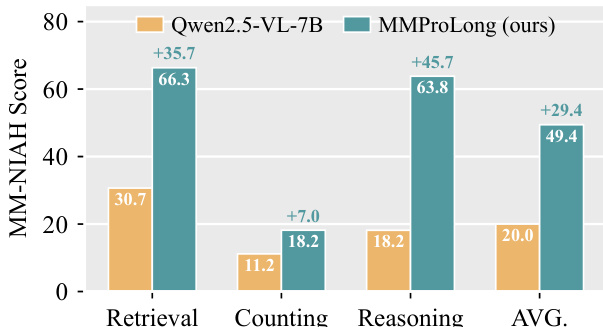
The authors compare the performance of MMProLong against Qwen2.5-VL-7B on the MM-NIAH benchmark, which evaluates retrieval, counting, and reasoning tasks. Results show that MMProLong significantly outperforms the baseline across all three capabilities, with the largest improvement observed in retrieval. The overall average score also shows a substantial gain, indicating that the training recipe enhances performance on multiple aspects of long-context multimodal understanding. MMProLong achieves substantial improvements over Qwen2.5-VL-7B on retrieval, counting, and reasoning tasks in the MM-NIAH benchmark. The largest performance gain is observed in the retrieval task, with a significant increase in score. The overall average score shows a notable improvement, highlighting the effectiveness of the training recipe across different capabilities.
The authors examine the impact of mixing short-context data during long-context training on model performance across various benchmarks. Results show that adding short-context data leads to a trade-off, where short-context performance improves but long-document VQA performance decreases. Pure long-context training preserves short-context capabilities with minimal degradation while achieving the best long-document VQA performance. Mixing short-context data improves short-context performance but reduces long-document VQA performance. Pure long-context training maintains high short-context performance with minimal degradation. Long-document VQA performance is maximized when no short-context data is mixed during training.
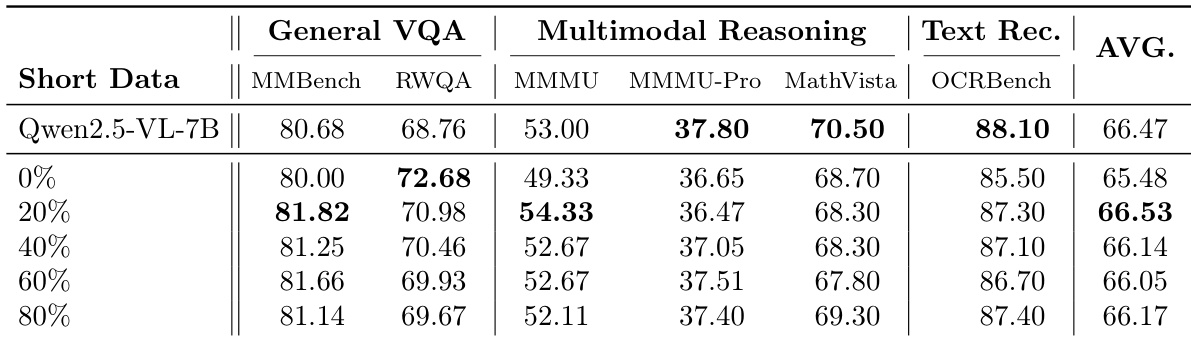
The authors investigate the impact of different data mixing ratios on long-document VQA performance, particularly focusing on the trade-off between short-context and long-context capabilities. Results show that varying the proportion of short-context data during training affects both short-context and long-document VQA performance, with pure long-context training yielding the best long-document results while maintaining strong short-context performance. The optimal balance is found when using a 4:6 ratio of short to long-context data, which achieves high performance on both metrics. Pure long-context training achieves the highest long-document VQA performance while only mildly degrading short-context capabilities. A 4:6 mixing ratio of short to long-context data provides a balanced trade-off, maintaining strong performance on both long- and short-context tasks. The 8:2 ratio yields the best short-context performance but significantly reduces long-document VQA scores, indicating a clear trade-off between the two.
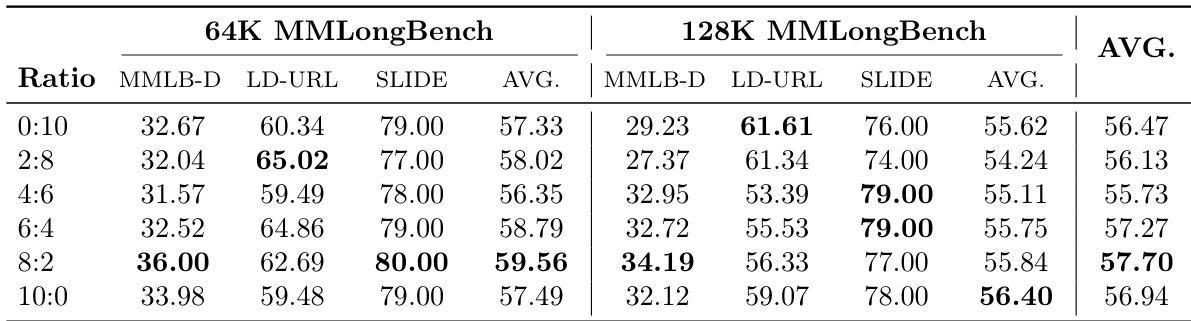
The evaluation compares MMProLong against baseline vision-language models across long-video comprehension and long-document question-answering benchmarks, while also examining the impact of short- versus long-context data mixing during training. Results demonstrate that the proposed method consistently surpasses baselines in video understanding and document-based retrieval, counting, and reasoning without requiring video-specific fine-tuning. Further analysis of training data composition reveals that pure long-context training maximizes long-document capabilities with minimal short-context degradation, whereas strategic data mixing provides a tunable trade-off for balanced performance across both short and long contexts.