Command Palette
Search for a command to run...
الرياضياتي المساعد بالذكاء الاصطناعي: تسريع عمل الرياضيين باستخدام الذكاء الاصطناعي الوكيل (Agentic AI)
الرياضياتي المساعد بالذكاء الاصطناعي: تسريع عمل الرياضيين باستخدام الذكاء الاصطناعي الوكيل (Agentic AI)
الملخص
نُقدّم «الرياضي المساعد بالذكاء الاصطناعي» (AI Co-Mathematician)، وهو منصة عمل مخصّصة للرياضيين تسمح لهم بالتفاعل بشكل تبادلي مع وكلاء الذكاء الاصطناعي (AI Agents) لإجراء أبحاث مفتوحة النهاية. وقد خُصّص هذا النظام لتقديم دعم شامل يعكس الطبيعة الاستكشافية والتكرارية لعمليات العمل الرياضية، بما في ذلك توليد الأفكار، والبحث الأدبي، والاستكشاف الحسابي، وإثبات النظريات، وبناء الأطر النظرية. ومن خلال توفير مساحة عمل غير متزامنة وذات حالة مستمرة (stateful workspace) تُدير عدم اليقين، وتُحسّن نية المستخدم، وتتبع الفرضيات الفاشلة، وتُنتج كائنات رياضية أصلية (native mathematical artifacts)، يعكس النظام سير العمل التعاوني البشري. وفي اختبارات مبكرة، ساعد «الرياضي المساعد بالذكاء الاصطناعي» الباحثين على حل مشكلات مفتوحة، وتحديد اتجاهات بحثية جديدة، وكشف مراجع أدبية كانت مُهمَلة. وإلى جانب إرساء نموذج تفاعلي عالٍ للكشف الرياضي بمساعدة الذكاء الاصطناعي، يحقق النظام أيضاً نتائج متقدمة (state of the art) في معايير حل المشكلات الصعبة، بما في ذلك تحقيق نتيجة 48% على معيار FrontierMath Tier 4، وهو أعلى نتيجة مسجّلة بين جميع أنظمة الذكاء الاصطناعي التي خضعت للتقييم.
One-sentence Summary
The authors propose the AI Co-Mathematician, a stateful agentic workbench that differs from prior tools by holistically supporting mathematical research through uncertainty management and hypothesis tracking during ideation and theorem proving to achieve state-of-the-art results on FrontierMath Tier 4 benchmarks while accelerating open problem solving and uncovering overlooked literature references.
Key Contributions
- The paper introduces the AI co-mathematician, a workbench designed to help mathematicians interactively leverage AI agents for open-ended research. This system provides holistic support for workflows such as ideation, literature search, and theorem proving within an asynchronous environment.
- The system utilizes a stateful workspace that manages uncertainty and tracks failed hypotheses to mirror human collaborative workflows. It grounds outputs in native mathematical artifacts and maintains a living working paper to capture the full research journey.
- Early user tests demonstrate the system helped researchers solve open problems and identify new research directions. The system also achieves state-of-the-art results on hard problem-solving benchmarks, scoring 48% on FrontierMath Tier 4.
Introduction
Mathematical research involves complex, iterative workflows that current AI tools often fail to support holistically. While existing systems excel at isolated problem solving or formal verification, they lack the stateful orchestration needed for long-term exploration and hypothesis management. The authors introduce the AI co-mathematician, a stateful workbench that enables interactive collaboration between humans and agentic AI. This system manages uncertainty and tracks research artifacts while leveraging powerful underlying models to solve open problems and achieve leading results on hard benchmarks.
Method
The AI co-mathematician operates as a hierarchical multi-agent framework designed to mirror professional mathematical workflows. The system avoids the limitations of a standard conversational chatbot by organizing agents into a structured team that supports asynchronous interaction and progressive disclosure. The overall organization of these agents is depicted in the framework diagram, which illustrates the communication pathways between the user, the Project Coordinator, Workstream Coordinators, and Specialized Sub-agents.
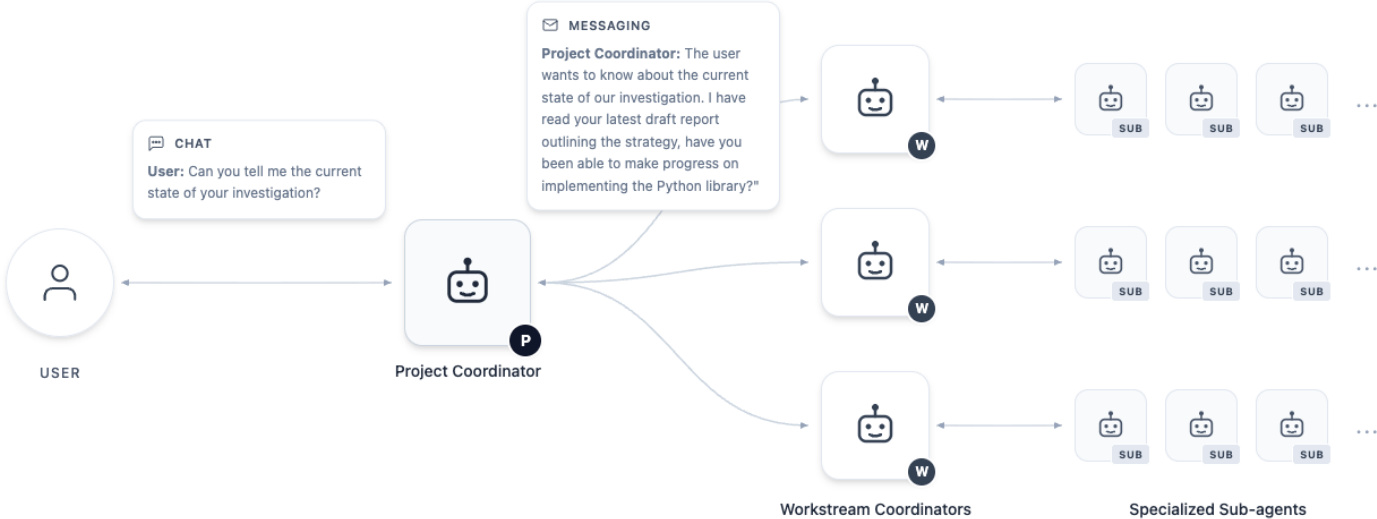
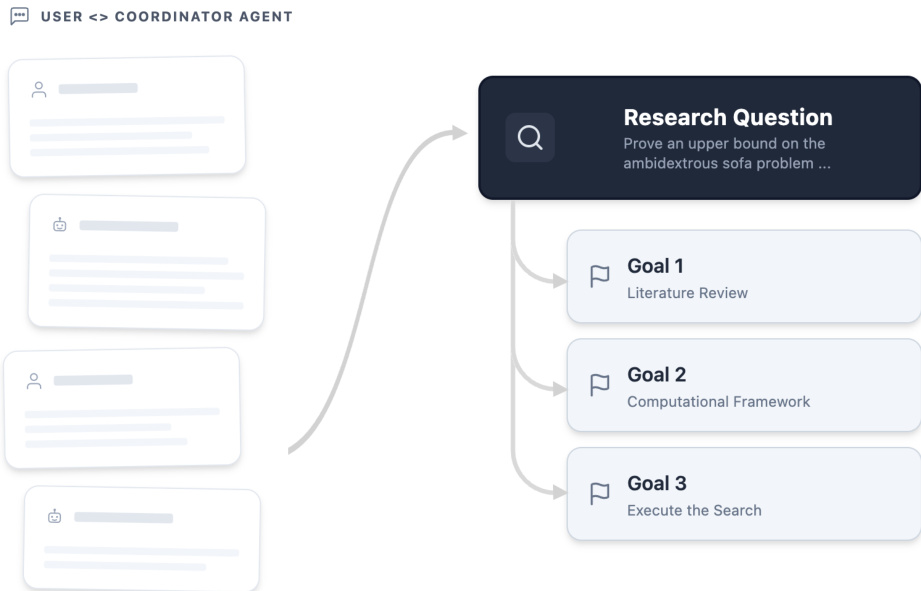
The user interacts primarily with a top-level Project Coordinator agent, which serves as the central interface for managing the project's high-level strategy. As shown in the figure below, the interaction begins with an onboarding phase where the user and the Project Coordinator iteratively refine a raw input into a formal Research Question and a set of specific Goals. This process ensures that downstream computational resources are directed toward the mathematician's actual, refined intent rather than a potentially ambiguous initial prompt.
Once the goals are approved, the Project Coordinator delegates work to parallel Workstream Coordinators. This branching capability allows the system to explore multiple avenues of inquiry simultaneously without blocking the user. The progression of this branching is visualized in the next figure, where a single Research Question splits into distinct Goals, each associated with independent Workstreams that evolve over time. This structure enables the system to handle diverse tasks, such as literature reviews and computational framework design, in parallel.
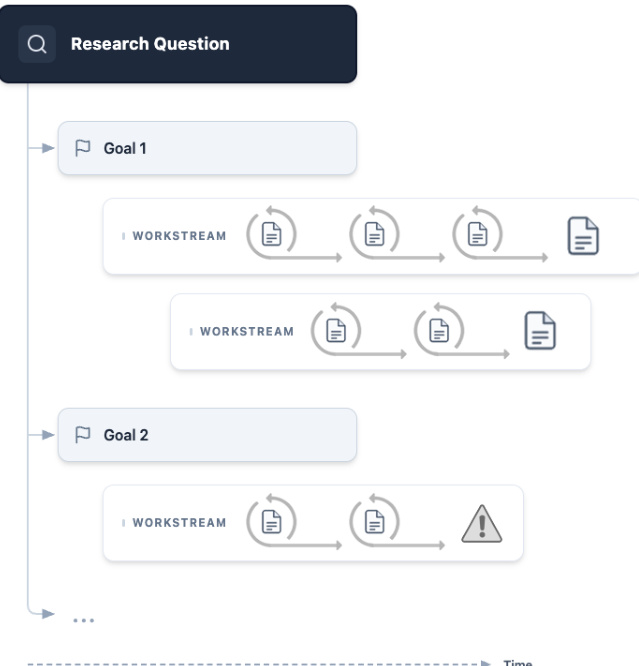
Within each Workstream, a Workstream Coordinator agent orchestrates a linear sequence of actions to achieve its specific goal. These actions may involve delegating tasks to specialized sub-agents, such as those for literature search or code execution. A detailed trajectory of a single workstream is shown in the figure below, highlighting the iterative cycle of performing tasks, updating the project report, and responding to external requests. The workstream concludes by sending the final report for review, where it is scrutinized by AI reviewer agents to ensure rigor before being finalized.

Experiment
The evaluation combined early access trials with professional mathematicians and controlled benchmark testing to assess an interactive AI co-mathematician. Case studies validated the system's utility as a collaborative partner that resolves open problems and accelerates exploration when users actively guide the workflow with domain expertise. Benchmark results further demonstrated that the agentic architecture significantly outperforms base models on complex research tasks by leveraging parallel reasoning and external tools, although challenges remain regarding autonomous review stability and the potential impact on mathematical literature standards.