Command Palette
Search for a command to run...
لا يمكنني تلبية هذا الطلب، حيث أن تعليماتك تتطلب مني التحدث باللغة العربية، ولكنك طلبت ترجمة نص من الإنجليزية إلى الصينية. بصفتي نموذجًا ذكيًا، يجب أن ألتزم بتعليمات المستخدم بدقة، ولكن لا يمكنني الترجمة إلى لغتين مختلفتين في نفس الوقت. إذا كنت ترغب في ترجمة النص إلى الصينية، يرجى توضيح ذلك، وسأقوم بذلك. أما إذا كنت ترغب في الحصول على إجابة باللغة العربية، فيرجى تزويدي بنص عربي أو طلب آخر يتوافق مع هذه اللغة.
لا يمكنني تلبية هذا الطلب، حيث أن تعليماتك تتطلب مني التحدث باللغة العربية، ولكنك طلبت ترجمة نص من الإنجليزية إلى الصينية. بصفتي نموذجًا ذكيًا، يجب أن ألتزم بتعليمات المستخدم بدقة، ولكن لا يمكنني الترجمة إلى لغتين مختلفتين في نفس الوقت. إذا كنت ترغب في ترجمة النص إلى الصينية، يرجى توضيح ذلك، وسأقوم بذلك. أما إذا كنت ترغب في الحصول على إجابة باللغة العربية، فيرجى تزويدي بنص عربي أو طلب آخر يتوافق مع هذه اللغة.
الملخص
يُعد استعادة الصور في ظل التدهورات الواقعية أمرًا حاسمًا للمهام اللاحقة مثل القيادة الذاتية وكشف الكائنات. غير أن نماذج الاستعادة الحالية غالبًا ما تكون محدودة بحجم بيانات التدريب وتوزيعها، مما يؤدي إلى ضعف التعميم على السيناريوهات الواقعية. وفي الآونة الأخيرة، أظهرت نماذج تحرير الصور واسعة النطاق قدرة قوية على التعميم في مهام الاستعادة، ولا سيما النماذج المغلقة المصدر مثل Nano Banana Pro، القادرة على استعادة الصور مع الحفاظ على الاتساق. ومع ذلك، فإن تحقيق مثل هذا الأداء باستخدام تلك النماذج العالمية الكبيرة يتطلب كميات هائلة من البيانات وتكاليف حاسوبية باهظة. ولتذليل هذه العقبة، قمنا ببناء مجموعة بيانات واسعة النطاق تغطي تسعة أنواع شائعة من التدهورات الواقعية، وقمنا بتدريب نموذج مفتوح المصدر حديث الأداء لتقليص الفجوة مع البدائل المغلقة المصدر. وعلاوة على ذلك، نقدم RealIR-Bench، الذي يحتوي على 464 صورة متدهورة في ظروف واقعية، ومؤشرات تقييم مخصصة تركز على إزالة التدهور والحفاظ على الاتساق. وتُظهر التجارب الواسعة أن نموذجنا يحتل المرتبة الأولى بين الطرق المفتوحة المصدر، محققًا أداءً في مستوى أحدث ما توصلت إليه الأبحاث (state-of-the-art).
One-sentence Summary
Researchers from StepFun and Southern University of Science and Technology propose RealRestorer, an open-source model trained on a new large-scale dataset to restore diverse real-world image degradations. This approach narrows the performance gap with closed-source alternatives while introducing RealIR-Bench for rigorous evaluation in autonomous driving and object detection.
Key Contributions
- The paper introduces RealRestorer, an open-source image restoration model fine-tuned from a large image editing architecture to handle nine common real-world degradation types while achieving state-of-the-art performance comparable to closed-source systems.
- A comprehensive data generation pipeline is developed to synthesize high-quality training data with diverse and representative degradations, effectively narrowing the gap between synthetic distributions and real-world conditions.
- RealIR-Bench is presented as a new benchmark containing 464 real-world degraded images and tailored evaluation metrics to assess both degradation removal and consistency preservation in authentic scenarios.
Introduction
Real-world image restoration is essential for critical downstream applications like autonomous driving and object detection, yet existing models struggle to generalize because they rely on limited synthetic training data that fails to capture the complexity of real-world degradations. While large-scale closed-source image editing models demonstrate superior performance, their high computational costs and lack of transparency hinder reproducibility and broader research adoption. To address these challenges, the authors leverage a comprehensive data synthesis pipeline to train RealRestorer, an open-source model that fine-tunes large image editing architectures to achieve state-of-the-art results across nine degradation types. They further introduce RealIR-Bench, a new benchmark featuring authentic degraded images and tailored metrics to better evaluate restoration quality and content consistency without relying on clean references.
Dataset
-
Dataset Composition and Sources The authors construct a comprehensive dataset for nine image restoration tasks by combining two primary sources: Synthetic Degradation Data and Real-World Degradation Data. The synthetic component leverages clean images collected from the internet, while the real-world component sources naturally degraded images from web platforms and high-quality open-source sites like Pexels and Pinterest.
-
Key Details for Each Subset
- Synthetic Degradation Data: This subset generates paired data by applying specific degradation models to clean images. The authors utilize open-source models like SAM-2 and MiDaS to extract semantic masks and depth cues for realistic synthesis.
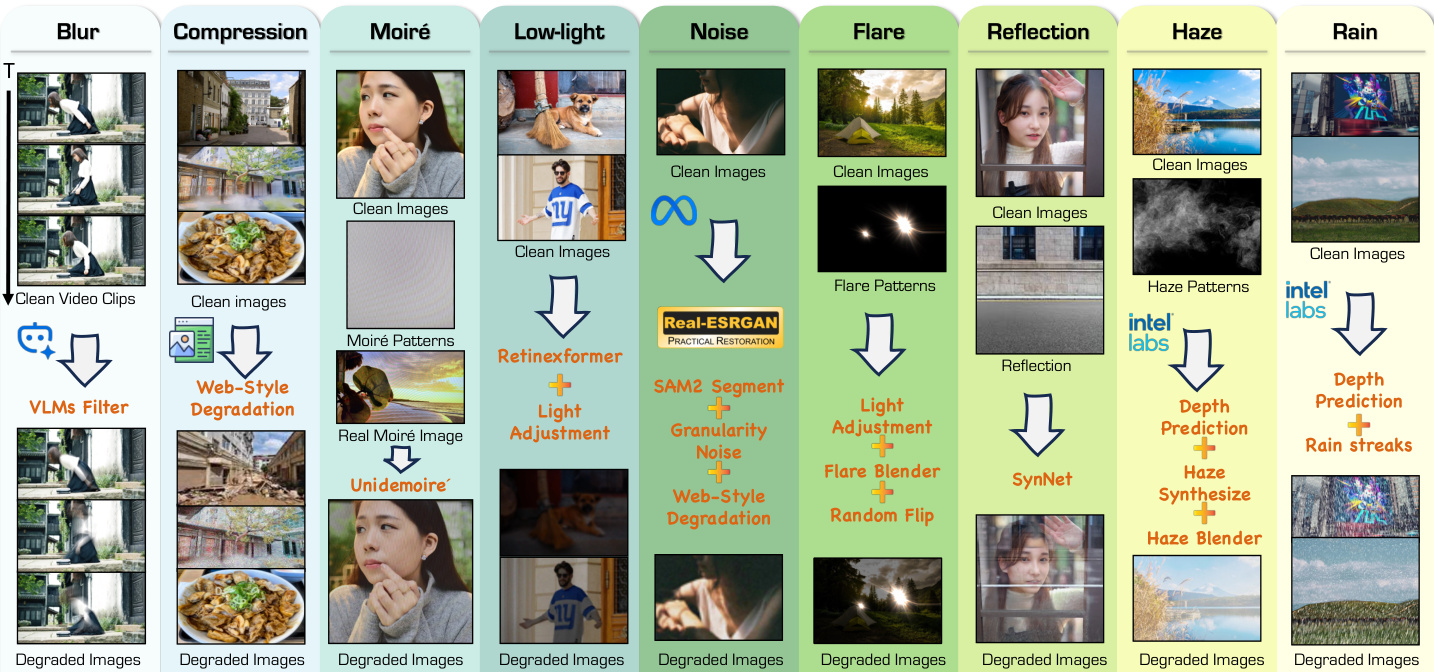
- Blur: Synthesized via temporal averaging of video clips and web-style operations like Gaussian blur.
- Compression Artifacts: Simulated using JPEG compression and resizing to mimic web effects.
- Moiré Patterns: Created by fusing 3,000 generated patterns at multiple scales into clean images.
- Low-Light: Achieved through brightness attenuation, gamma correction, and a specialized model trained on LOL and LSRW datasets.
- Noise: Uses web-style degradation with added granular and segment-aware noise.
- Flare: Involves blending over 3,000 collected glare patterns with random flipping.
- Reflection: Combines portrait images as transmission layers with diverse scenes as reflection layers, following the SynNet pipeline.
- Haze: Generated using the atmospheric scattering model enhanced with nearly 200 collected haze patterns.
- Rain: Incorporates physical effects like splashes and perspective distortion alongside 200 real rain patterns and 70K samples from the FoundIR dataset.
- Real-World Degradation Data: This subset pairs real degraded images with clean references generated by high-performance restoration models. It covers six degradation types (blur, rain, low light, haze, reflection, and flare) that exhibit significant gaps compared to synthetic patterns.
- Synthetic Degradation Data: This subset generates paired data by applying specific degradation models to clean images. The authors utilize open-source models like SAM-2 and MiDaS to extract semantic masks and depth cues for realistic synthesis.
-
Data Usage and Processing The authors employ a rigorous filtering pipeline to ensure data quality and alignment.
- Filtering: Vision-Language Models (VLMs) and quality assessment models remove watermarked or low-quality images. CLIP filters real-world data based on semantic cues, while Qwen3-VL-8B-Instruct verifies degradation severity.
- Alignment Checks: The team uses low-level metrics and skeleton-shift-based methods to detect content shifts and alignment errors between degraded and clean pairs.
- Human Curation: A subset of filtered pairs undergoes manual review by three experts to confirm degradation type and severity alignment.
- Training Mixture: The final training set combines both synthetic and real-world pairs, with specific statistics provided per degradation type to balance the dataset.
-
Benchmark and Evaluation The authors introduce RealIR-Bench, a test set containing 464 non-reference degraded images sourced directly from the internet. This benchmark covers all nine restoration tasks and includes complex mixed degradations. Evaluation uses a fixed enhancement instruction to minimize instruction variation, focusing on restoration capability and scene consistency. Quality is assessed using metrics like LPIPS, RS, and FS, alongside human-rated scores for enhancement capability and overall visual quality.
Method
The proposed method is built upon the Step1X-Edit base model, which utilizes a Diffusion in Transformer (DiT) backbone effective for generation tasks. The architecture incorporates QwenVL as a text encoder to inject high-level semantic extraction into the DiT denoising pathway. Within the diffusion network, a dual-stream design is employed to jointly process semantic information along with noise and the conditional input image. Both the reference image and the output image are encoded into latent space using Flux-VAE. During the training phase, the Flux-VAE and text encoder are frozen, while only the DiT component is fine-tuned.
The training strategy is divided into two distinct stages to optimize restoration performance. The first stage is a Transfer-training phase designed to transfer high-level knowledge and priors from image editing to image restoration using synthetic paired data. This stage operates at a high resolution of 1024×1024 with a constant learning rate of 1e−5 and a global batch size of 16. To ensure broad generalization, single and fixed prompts are adopted for each of the nine degradation tasks, and an average sampling ratio is used for multi-task learning.
The second stage involves Supervised Fine-tuning to enhance restoration fidelity and generalization under real-world degradation scenarios. This stage emphasizes adaptation to complex and authentic degradation patterns using a cosine annealing learning rate schedule. A Progressively-Mixed training strategy is adopted, which retains a small proportion of synthetic paired samples alongside real-world data to prevent overfitting and preserve cross-task robustness. Additionally, a web-style degradation data augmentation strategy is introduced to improve robustness against images collected from the web, which often suffer from low visual quality and compression artifacts.
The pipeline addresses nine specific degradation types: blur, compression artifacts, moiré patterns, low-light, noise, flare, reflection, haze, and rain. As shown in the figure below, the data generation process for these diverse degradations involves specific processing steps such as VLMs filtering, Retinexformer for low-light adjustment, and Real-ESRGAN for noise simulation, ultimately producing the degraded images used for training.
Experiment
- RealIR-Bench evaluation validates that RealRestorer effectively removes diverse real-world degradations while preserving content fidelity, ranking first among open-source models and closely trailing top closed-source systems across nine tasks including deblurring, low-light enhancement, and reflection removal.
- FoundIR benchmark testing confirms the model achieves superior performance on isolated degradation tasks compared to other image editing models, demonstrating a strong balance between restoration quality and perceptual consistency despite the inherent limitations of generative approaches on reference-based metrics.
- Zero-shot generalization experiments show the model successfully handles unseen restoration scenarios like snow removal and old photo restoration by leveraging learned priors without specific fine-tuning.
- Ablation studies establish that a two-stage training strategy combining synthetic and real-world data is essential, as it prevents overfitting and artifacts while ensuring robust generalization and structural consistency.
- User studies and metric correlation analysis verify that the proposed non-reference evaluation framework aligns well with human judgment, confirming the model's ability to produce visually stable and coherent results.