Command Palette
Search for a command to run...
OCRVerse: نحو رؤية شاملة لمعالجة التعرف البصري على النص في النماذج البصرية-اللغوية النهائية
OCRVerse: نحو رؤية شاملة لمعالجة التعرف البصري على النص في النماذج البصرية-اللغوية النهائية
Yufeng Zhong Lei Chen Xuanle Zhao Wenkang Han Liming Zheng Jing Huang Deyang Jiang Yilin Cao Lin Ma Zhixiong Zeng
الملخص
إن تطور نماذج الرؤية واللغة الكبيرة يُعزز الطلب على إدارة وتطبيق كميات هائلة من البيانات متعددة الوسائط، مما يجعل تقنية استخراج النصوص البصرية (OCR)، التي تستخرج المعلومات من الصور البصرية، شائعة بشكل متزايد. ومع ذلك، تركز الطرق الحالية لـ OCR بشكل رئيسي على التعرف على عناصر النص من الصور أو المستندات الممسوحة ضوئيًا (استخراج النصوص المتمحور حول النص – Text-centric OCR)، وتتجاهل التعرف على العناصر البصرية من المصادر البصرية الغنية بالمعلومات (استخراج النصوص المتمحور حول الرؤية – Vision-centric OCR)، مثل المخططات البيانية، وصفحات الويب، والرسوم العلمية. في الواقع، تنتشر هذه الصور الغنية بالبيانات البصرية على نطاق واسع عبر الإنترنت، ولها قيمة تطبيقية كبيرة في العالم الحقيقي، مثل تصور البيانات وتحليل صفحات الويب. في هذا التقرير التقني، نقدم OCRVerse، أول منهج شامل لتقنية OCR يعمل بطريقة متكاملة من البداية إلى النهاية، ويتيح دمجًا موحدًا بين استخراج النصوص المتمحور حول النص واستخراج النصوص المتمحور حول الرؤية. ولتحقيق ذلك، قمنا ببناء هندسة بيانات شاملة تغطي طيفًا واسعًا من المستندات المتمحورة حول النص، مثل الصحف والمجلات والكتب، بالإضافة إلى المركبات البصرية المُعَرَّضة (rendered composites) المتمحورة حول الرؤية، مثل المخططات البيانية وصفحات الويب والرسوم العلمية. علاوةً على ذلك، اقترحنا منهجًا تدريبيًا ثنائي المرحلة باستخدام SFT-RL (التدريب الموجه بالصيغة التصحيحية وتحسين التعلم التكراري) متعدد المجالات لـ OCRVerse. حيث يُستخدم SFT لخلط البيانات عبر المجالات مباشرةً لتدريب النموذج وبناء المعرفة الأولية لكل مجال، بينما يركز RL على تصميم استراتيجيات مكافأة مخصصة تتماشى مع خصائص كل مجال. وبشكل خاص، وبما أن كل مجال يتطلب تنسيقات مخرجات مختلفة ومخرجات متوقعة مختلفة، فإننا نوفر مرونة كافية في مرحلة RL لتمكين تخصيص إشارات مكافأة مرنة لكل مجال، مما يعزز التكامل بين المجالات ويقلل من تعارض البيانات. أظهرت النتائج التجريبية فعالية OCRVerse، حيث حققت نتائج تنافسية عبر أنواع البيانات المتمحورة حول النص والرؤية، وحتى تُقارن أحيانًا بالنماذج الكبيرة المفتوحة المصدر والمغلقة المصدر.
One-sentence Summary
Researchers from Meituan propose OCRVerse, the first end-to-end model unifying text-centric and vision-centric OCR via a two-stage SFT-RL training method, enabling flexible domain-specific rewards to handle diverse outputs from documents, charts, and web pages with performance rivaling major models.
Key Contributions
- OCRVerse introduces the first end-to-end holistic OCR framework that unifies text-centric and vision-centric recognition, addressing the gap in handling visually dense content like charts, web pages, and scientific plots that traditional OCR methods overlook.
- The method employs a two-stage SFT-RL training strategy: SFT mixes cross-domain data to build foundational knowledge, while RL customizes reward signals per domain to resolve output format conflicts and enhance domain-specific performance.
- Evaluated across diverse datasets, OCRVerse achieves competitive results on both text-centric and vision-centric tasks, matching performance of large open-source and closed-source models without domain-specific fine-tuning.
Introduction
The authors leverage the rise of vision-language models to tackle OCR as a unified, holistic task that spans both text-centric documents and vision-centric images like charts and web pages. Prior methods either focus narrowly on text extraction or handle visual elements in isolation, failing to capture semantic structures embedded in complex visuals or reconcile conflicting output formats across domains. OCRVerse addresses this by introducing a lightweight model trained via a two-stage SFT-RL method: supervised fine-tuning blends diverse data to build cross-domain foundations, while reinforcement learning applies domain-specific rewards to resolve conflicts and optimize structure-sensitive outputs like HTML or LaTeX. The result is a single end-to-end system that performs competitively across both OCR paradigms, enabling practical applications in data visualization and web analysis.
Dataset

The authors use OCRVerse, a unified dataset for holistic OCR, combining text-centric and vision-centric data types to support diverse real-world and professional scenarios.
-
Dataset Composition and Sources:
- Text-centric data covers 9 document types: natural scenes, books, magazines, papers, reports, slides, exam papers, notes, and newspapers — sourced from open datasets (LSVT, TextOCR, PDFA, DocStruct4M, DocGenome, IAM, ORAND-CAR, HME), real-world PDFs, and synthetic data (K12 to graduate exam questions, StackExchange math formulas).
- Vision-centric data covers 6 specialized domains: charts, webpages, icons, geometry, circuits, and molecules — sourced from MCD, MSRL, Web2M, Web2Code, UniSVG, DaTikZ-v3, Cosyn-400k, and text-to-mermaid datasets.
-
Key Details by Subset:
- Text-centric: Cleaned via quality checks, page splitting, regex extraction, and complexity categorization; annotated using VLMs (Qwen2.5-VL-72B, GOT), OCR tools, and synthetic HTML templates with MathJax/CSS rendering.
- Vision-centric: Cleaned by removing corrupted images and embedded visuals; self-annotated via bootstrapped domain-specific models (chart-to-code, webpage-to-HTML, image-to-SVG, image-to-LaTeX) to scale coverage.
-
Usage in Training:
- Training data is constructed via a multi-stage pipeline integrating both data types.
- For RL training, samples are selected via entropy-based filtering (text-centric) or quality refinement (vision-centric) to focus on challenging, high-complexity cases.
- Final training mix balances both data types to support holistic OCR capabilities.
-
Processing and Metadata:
- Text-centric annotations include bounding boxes, color-guided region parsing, LaTeX formulas, and HTML tables.
- Vision-centric annotations generate domain-specific code (SVG, HTML, LaTeX, mermaid) via rendering and structure extraction.
- No explicit cropping strategy is mentioned; focus is on full-page or element-level processing with structured output formats.
- Evaluated on OmniDocBench v1.5 (1,355 pages, bilingual, 9 document types) using Edit Distance, CDM, and TEDS metrics, aggregated into an Overall Score.
Method
The authors leverage a two-stage training methodology for OCRVerse, designed to first establish broad cross-domain knowledge and then refine domain-specific performance through personalized optimization. The overall framework, as illustrated in the figure below, consists of a Supervised Fine-Tuning (SFT) stage followed by a Reinforcement Learning (RL) stage, each addressing distinct aspects of the model's learning process.
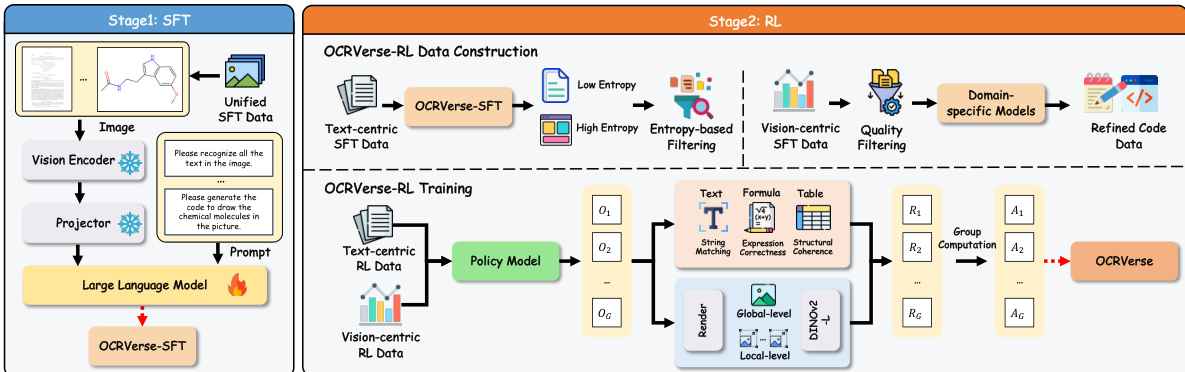
During the SFT stage, the model is fine-tuned on a unified dataset that combines data from all eight domains, including both text-centric (e.g., documents, tables, formulas) and vision-centric (e.g., charts, web pages, scientific plots) sources. This cross-domain data mixing enables the model to learn shared visual-semantic patterns across diverse data types while preserving domain-specific output capabilities. The training objective is formulated as standard autoregressive language modeling, where the model learns to predict the next token in the output sequence given the input image and previous tokens. The authors fine-tune the pre-trained Qwen3-VL-4B model, freezing the visual encoder and vision-language adapter to preserve strong visual representations, while updating only the language model parameters to focus on improving text generation and format compliance.
The RL stage addresses the limitations of SFT in handling domain-specific requirements and format-intensive content by introducing personalized reward mechanisms. The framework begins with domain-specific data construction, where data is filtered based on entropy to ensure high-quality inputs. For text-centric domains, rule-based reward functions are employed to evaluate different content types: one minus normalized edit distance for plain text, BLEU score for formulas after LaTeX normalization, and TEDS-S for tables after structural normalization. The overall text-centric reward is computed as a weighted average of these type-specific rewards. For vision-centric domains, visual fidelity rewards are designed to measure perceptual similarity between rendered outputs and ground truth images. This is achieved using a pre-trained DINOv2 encoder to extract visual features, with a multi-scale reward mechanism combining global-level similarity from downsampled thumbnails and local-level similarity from image patches. Additionally, format alignment rewards ensure generated code matches the expected programming language.
Policy optimization is performed using Group Relative Policy Optimization (GRPO). For each input, a group of responses is sampled from the current policy, and their rewards are computed. The group-normalized advantage for each response is calculated, and the policy is optimized by maximizing a clipped objective function that ensures training stability. This two-stage approach enables OCRVerse to effectively establish cross-domain knowledge during SFT and refine domain-specific capabilities during RL, achieving seamless fusion across diverse data types while avoiding conflicts that arise from naive multi-task learning.
Experiment
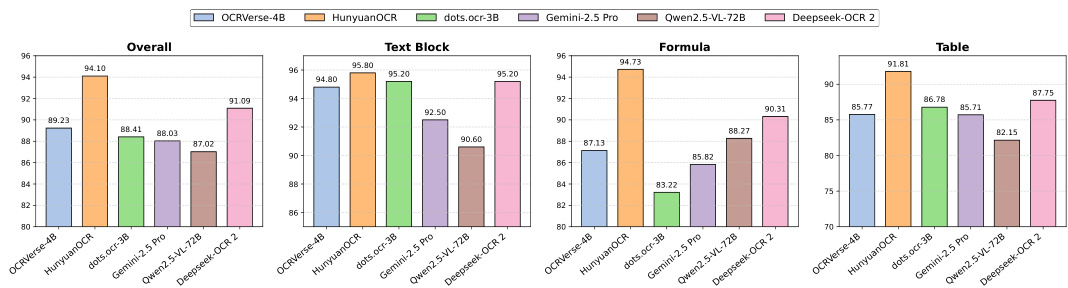
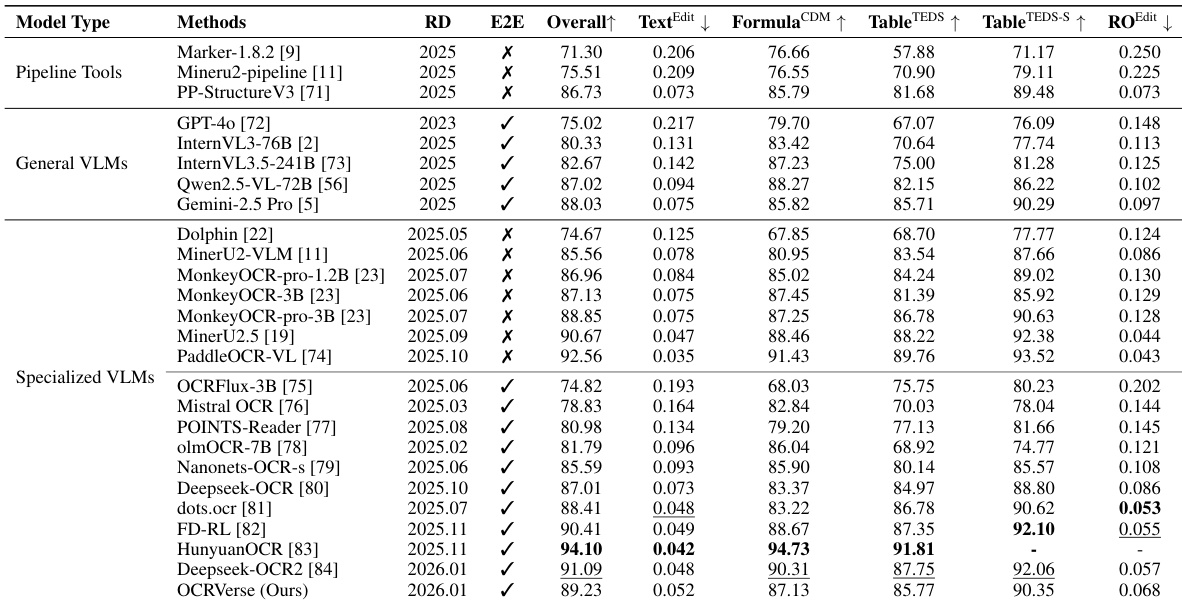
- OCRVerse evaluated on OmniDocBench v1.5 achieves 89.23 overall, outperforming Gemini-2.5 Pro (88.03) and Qwen2.5-VL-72B (87.02) despite fewer parameters, validating its holistic training approach.
- In formula recognition, OCRVerse scores 87.13 CDM, surpassing Deepseek-OCR (83.37) and olmOCR-7B (86.04), attributed to its synthetic formula data strategy spanning multiple disciplines and difficulty levels.
- For text and reading order, OCRVerse attains edit distances of 0.052 and 0.068, slightly behind layout-aware models like dots.ocr, indicating room for improvement via region-level OCR data integration.
- In table recognition, OCRVerse achieves TEDS 85.77 and TEDS-S 90.35, lagging behind Deepseek-OCR2 and HunyuanOCR; future work targets enriched table data for complex structures.
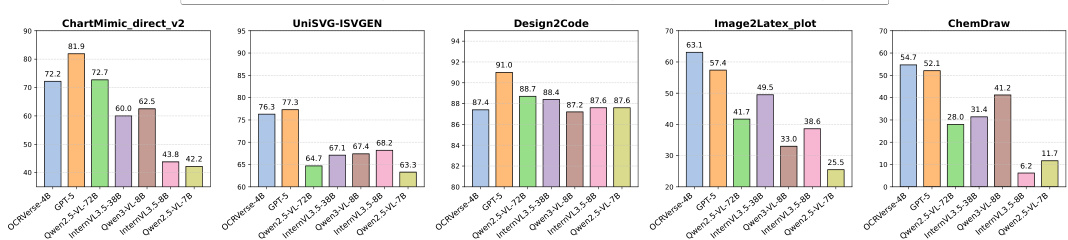
- On vision-centric tasks, OCRVerse (4B) outperforms larger models: 84.8% execution success on ChartMimic (vs. Qwen3-VL-8B’s 78.3%), ranks second on UniSVG (76.3, behind GPT-5’s 77.3), and leads Image2LaTeX-plot (88.7% rendering success, vs. GPT-5’s 78.7%) and ChemDraw (89.1% execution success).
- OCRVerse demonstrates strong parameter efficiency, matching or exceeding 70B models in multiple vision-to-code benchmarks, validating its multi-domain training and holistic OCR paradigm.
Results show that OCRVerse-4B achieves strong performance across multiple document parsing tasks, outperforming larger models like Gemini-2.5 Pro and Qwen2.5-VL-72B on OmniDocBench v1.5 with an overall score of 89.23, demonstrating its parameter efficiency and effectiveness in text-centric OCR. In vision-centric tasks, OCRVerse-4B surpasses significantly larger models on key benchmarks, achieving 84.8% execution success on ChartMimic and 88.7% rendering success on Image2LaTeX-plot, highlighting its superior fine-grained visual understanding and capability in structured code generation.
Results show that OCRVerse achieves competitive performance across vision-centric OCR tasks, outperforming larger models in several benchmarks. On ChartMimic, OCRVerse surpasses Qwen2.5-VL-72B in low-level and high-level scores despite being 18 times smaller, and on Image2LaTeX-plot, it significantly exceeds all baselines with a 88.7% rendering success rate. The model also achieves strong results on UniSVG and ChemDraw, demonstrating its ability to generate accurate code representations from complex visual inputs.
Results show that OCRVerse achieves an overall score of 89.23 on OmniDocBench v1.5, outperforming general-purpose models like Gemini-2.5 Pro and Qwen2.5-VL-72B despite having significantly fewer parameters. It demonstrates strong performance in formula recognition with a CDM score of 87.13 and competitive results in text and reading order tasks, though it lags behind layout-aware models in fine-grained spatial understanding.
Results show that OCRVerse achieves competitive performance across vision-centric OCR benchmarks, outperforming larger open-source models in several metrics. On ChartMimic, it surpasses Qwen2.5-VL-72B despite being 18 times smaller, and on Image2LaTeX-plot, it significantly exceeds all baselines with a 88.7% rendering success rate. The model also achieves strong results on UniSVG and ChemDraw, demonstrating its ability to generate accurate code representations from complex visual inputs.
