Command Palette
Search for a command to run...
TwinBrainVLA: إطلاق الإمكانات المُتَوَقَّعَة من نماذج VLM الشاملة المُتَعَمِّدة على المهام المُتَعَمِّدة من خلال مزيج غير متماثل من Transformers
TwinBrainVLA: إطلاق الإمكانات المُتَوَقَّعَة من نماذج VLM الشاملة المُتَعَمِّدة على المهام المُتَعَمِّدة من خلال مزيج غير متماثل من Transformers
الملخص
تُعدّ النماذج القياسية لرؤية-لغة-فعل (VLA) عادةً تدريبًا دقيقًا (fine-tuning) لعمود فقري نموذج رؤية-لغة (VLM) موحد صراحةً لتحكم الروبوتات. ومع ذلك، يؤدي هذا النهج إلى توتر حاسم بين الحفاظ على الفهم العام عالي المستوى للسياق الدلالي وتعلم المهارات الحسية-الحركية الدقيقة، مما يؤدي غالبًا إلى "نسيان كارثي" لقدرات النموذج في البيئة المفتوحة. ولحل هذا التناقض، نقدم TwinBrainVLA، وهي معمارية جديدة تُنسق بين نموذج VLM عام يحتفظ بفهم دلالي عالمي، ونموذج VLM متخصص مخصص لاستشعار الموضع الجسدي (proprioception) لتحكم مشترك في الروبوتات. يُعزز TwinBrainVLA تآزر "الدماغ الأيسر" الثابت (frozen)، الذي يحتفظ بقدرات تفكير بصري عام قوية، مع "الدماغ الأيمن" القابل للتدريب، المتخصص في الاستشعار الجسدي، من خلال آلية جديدة تُسمى "مزيج غير متماثل من المحولات" (Asymmetric Mixture-of-Transformers - AsyMoT). يسمح هذا التصميم للدماغ الأيمن بالاستعلام الديناميكي عن المعرفة الدلالية من الدماغ الأيسر الثابت، ودمجها مع حالات الاستشعار الجسدي، مما يوفر توجيهًا غنيًا لخبير إجراءات مطابقة التدفق (Flow-Matching Action Expert) لإنتاج تحكمات مستمرة دقيقة. تُظهر التجارب الواسعة على معايير SimplerEnv وRoboCasa أن TwinBrainVLA تحقق أداءً متفوقًا في التلاعب مقارنةً بالأساليب المتقدمة الحالية، مع الحفاظ الصريح على القدرات الشاملة للفهم البصري للنموذج المدرب مسبقًا، مما يُقدّم اتجاهًا واعدًا لبناء روبوتات متعددة الأغراض التي تحقق في آنٍ واحد فهماً عالي المستوى للسياق الدلالي ومهارة بدنية دقيقة على المستوى المنخفض.
One-sentence Summary
Researchers from HIT, ZGCA, and collaborators propose TwinBrainVLA, a dual-brain VLA architecture using AsyMoT to fuse frozen semantic understanding with trainable proprioception, enabling robots to master precise control without forgetting open-world vision, validated on SimplerEnv and RoboCasa.
Key Contributions
- TwinBrainVLA introduces a dual-stream VLA architecture that decouples general semantic understanding (frozen Left Brain) from embodied perception (trainable Right Brain), resolving the catastrophic forgetting caused by fine-tuning monolithic VLMs for robotic control.
- It employs an Asymmetric Mixture-of-Transformers (AsyMoT) mechanism to enable dynamic cross-stream attention between the two VLM pathways, allowing the Right Brain to fuse proprioceptive states with semantic knowledge from the Left Brain for precise action generation.
- Evaluated on SimplerEnv and RoboCasa, TwinBrainVLA outperforms state-of-the-art baselines in manipulation tasks while preserving the pre-trained VLM’s open-world visual understanding, validating its effectiveness for general-purpose robotic control.
Introduction
The authors leverage a dual-brain architecture to resolve the core conflict in Vision-Language-Action (VLA) models: the trade-off between preserving general semantic understanding and acquiring precise sensorimotor control. Prior VLA approaches fine-tune a single VLM backbone for robotics, which often causes catastrophic forgetting of open-world capabilities—undermining the very generalization they aim to exploit. TwinBrainVLA introduces an asymmetric design with a frozen “Left Brain” for semantic reasoning and a trainable “Right Brain” for embodied perception, fused via a novel Asymmetric Mixture-of-Transformers (AsyMoT) mechanism. This enables the system to generate accurate continuous actions while explicitly retaining the pre-trained VLM’s broad visual and linguistic understanding, validated across SimplerEnv and RoboCasa benchmarks.
Method
The authors leverage a dual-stream architecture to disentangle high-level semantic reasoning from fine-grained sensorimotor control, addressing the challenge of catastrophic forgetting in vision-language models for embodied tasks. The framework, named TwinBrainVLA, consists of two distinct pathways: a frozen "Left Brain" and a trainable "Right Brain," which interact through a novel Asymmetric Mixture-of-Transformers (AsyMoT) mechanism. The Left Brain functions as a generalist, preserving open-world visual-linguistic knowledge, while the Right Brain specializes in embodied motor control, integrating visual, textual, and proprioceptive inputs. This separation enables the model to maintain general semantic capabilities while allowing the control stream to adapt to specific robotic tasks without interference.
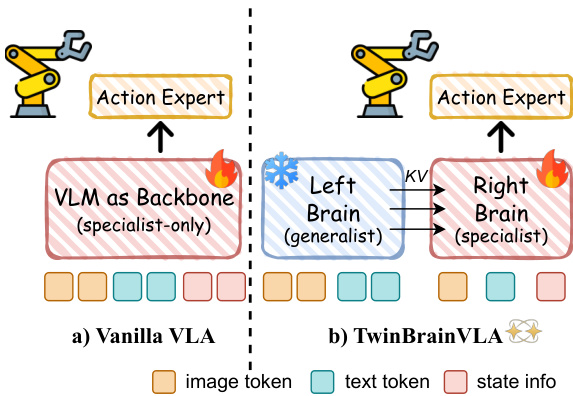
As shown in the figure below, the overall architecture of TwinBrainVLA features an asymmetric dual-stream design. The Left Brain processes only visual and textual inputs, receiving a sequence of image and text tokens derived from the vision encoder V(I) and text tokenizer T(T). This stream remains frozen during training, ensuring that its pre-trained semantic knowledge is preserved. In contrast, the Right Brain processes a multimodal input sequence that includes visual tokens, text tokens, and a projection of the robot's proprioceptive state s, encoded by a lightweight MLP state encoder ϕ. This design allows the Right Brain to ground its reasoning in the robot's physical configuration, a critical requirement for closed-loop control.
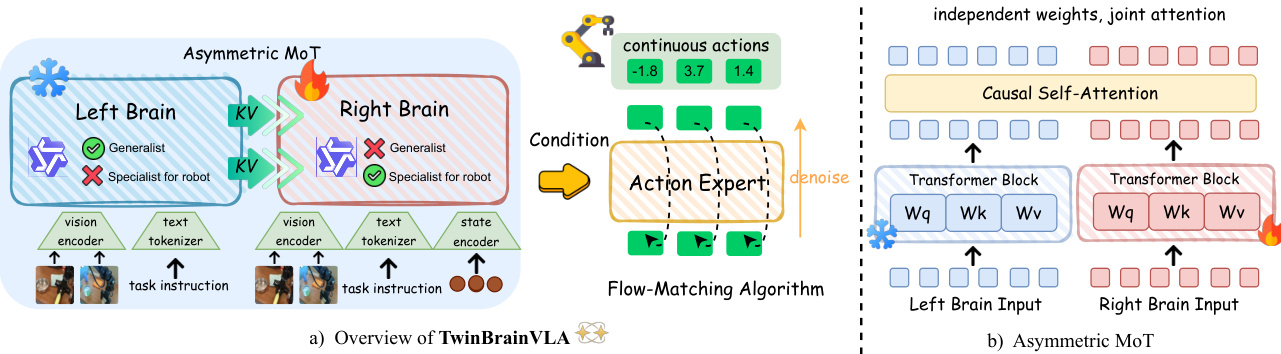
The core innovation lies in the AsyMoT mechanism, which enables the Right Brain to attend to the frozen key-value (KV) pairs of the Left Brain while maintaining its own trainable parameters. At each layer, the Left Brain computes its hidden states independently using its frozen self-attention mechanism. The Right Brain, however, employs an asymmetric joint attention mechanism where its query QR attends to a concatenated key and value set formed by the Left Brain's KV pairs (with stop-gradient applied) and its own KV pairs. This asymmetric flow ensures that the Right Brain can leverage high-level semantic features from the Left Brain without corrupting them, establishing a strict hierarchy where the Left Brain acts as a stable semantic anchor.
The final hidden states of the Right Brain, HRfinal, are passed to an Action Expert, which generates continuous robotic actions. The Action Expert is a Diffusion Transformer (DiT) architecture trained via a flow-matching objective. It operates as a conditional decoder that denoises a noisy action trajectory, conditioned on the Right Brain's representations. The flow-matching loss is defined as the expected squared error between the DiT's predicted vector field and the straight-line target vector field from a standard Gaussian prior to the ground-truth action distribution. During inference, actions are synthesized by solving the corresponding ordinary differential equation.
The training strategy is designed to preserve the generalist capabilities of the Left Brain. The total loss is solely the flow-matching loss, minimizing the discrepancy between the generated and ground-truth actions. The optimization is constrained by an asymmetric update rule: gradients are blocked at the AsyMoT fusion layer, preventing any backpropagation into the Left Brain's parameters. This ensures that the Right Brain and the state encoder can specialize in control dynamics, while the frozen Left Brain implicitly safeguards the model's general semantic priors.
Experiment
- Evaluated TwinBrainVLA on SimplerEnv and RoboCasa simulation benchmarks using 16× H100 GPUs under starVLA framework; training followed default protocols for fair comparison.
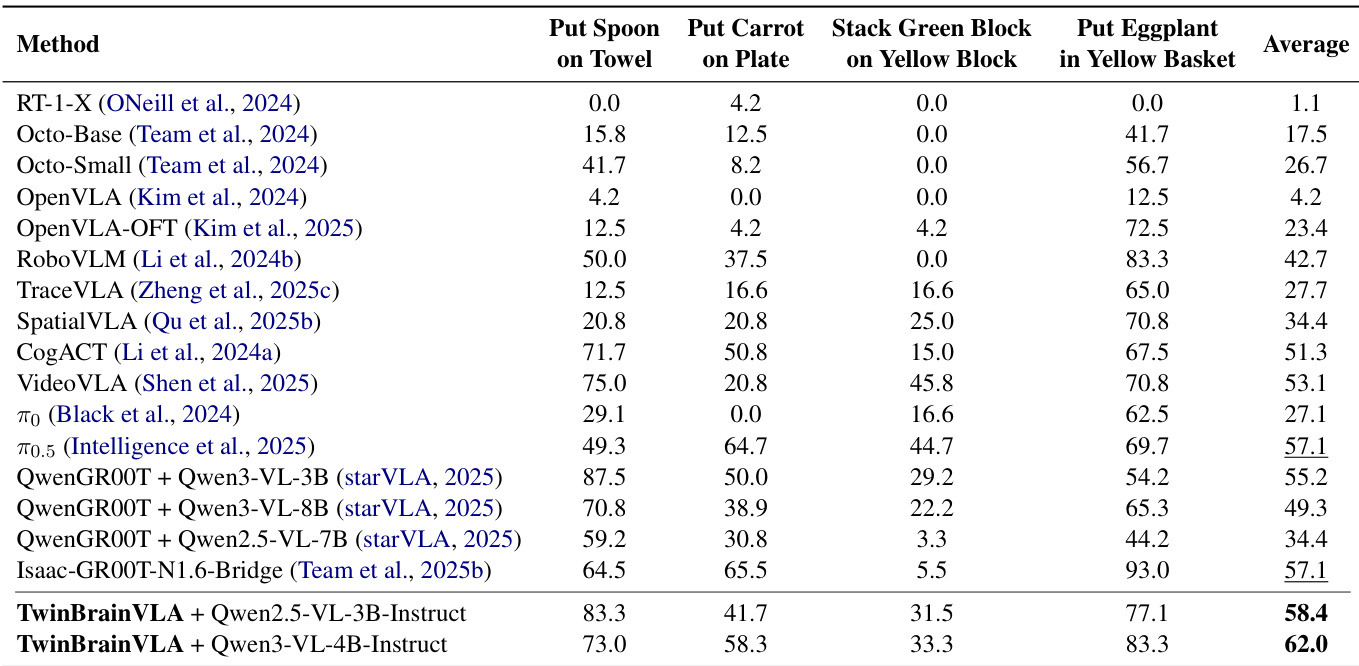
- On SimplerEnv with WidowX robot, TwinBrainVLA (Qwen3-VL-4B-Instruct) achieved 62.0% success rate across 4 tasks, surpassing Isaac-GR00T-N1.6 (57.1%) by +4.9%, validating asymmetric dual-brain design.
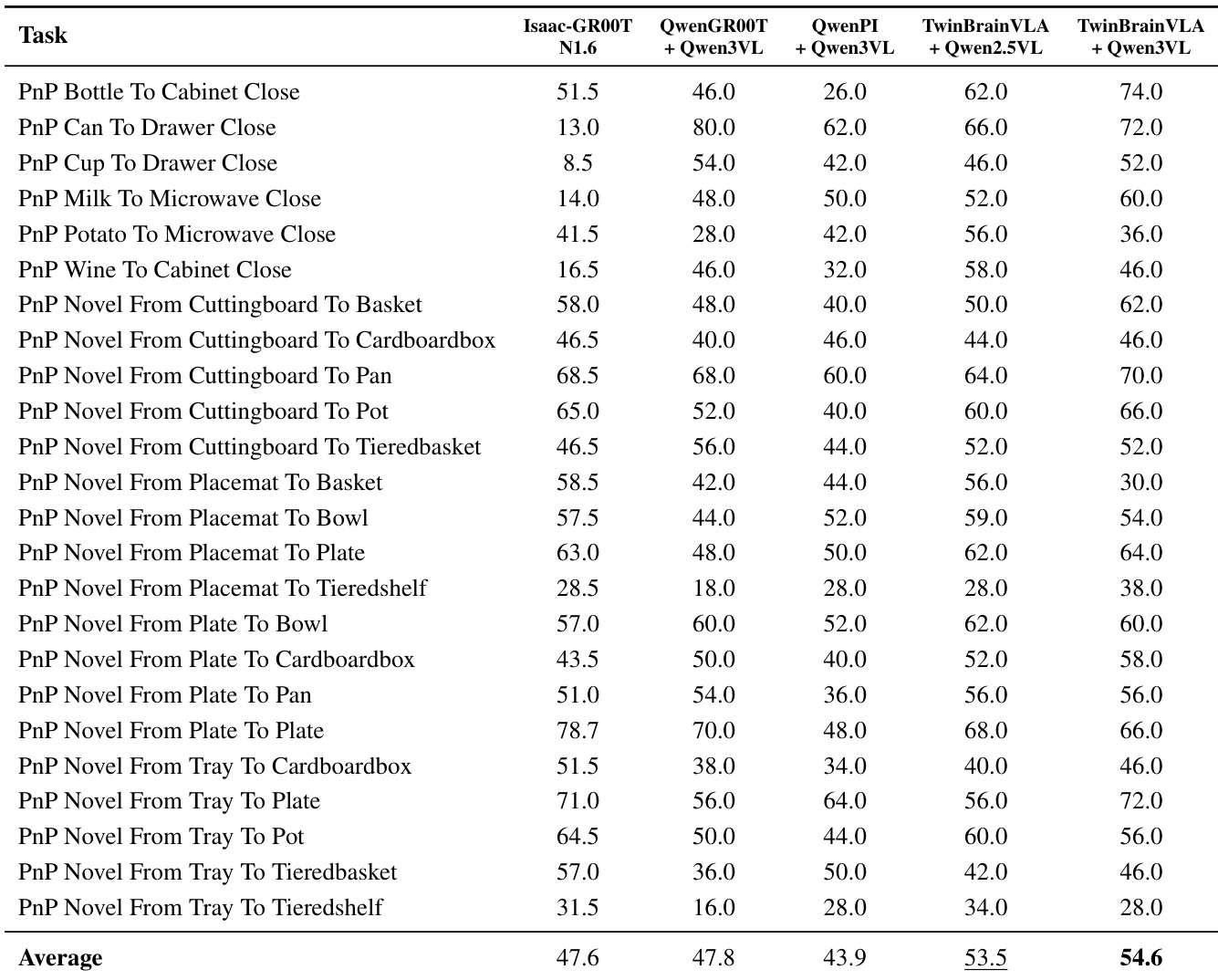
- On RoboCasa GR1 Tabletop Benchmark (24 tasks), TwinBrainVLA (Qwen3-VL-4B-Instruct) reached 54.6% Avg@50 success rate, outperforming Isaac-GR00T-N1.6 (47.6%) by +7.0%, QwenGR00T (47.8%) by +6.8%, and QwenPI (43.9%) by +10.7%.
- Model trained on Bridge-V2 and Fractal subsets of OXE dataset; uses AdamW, 40k steps, 1e-5 LR, DeepSpeed ZeRO-2, and gradient clipping; supports Qwen2.5-VL-3B and Qwen3-VL-4B backbones.
The authors use TwinBrainVLA with Qwen3-VL-4B-Instruct to achieve the highest average success rate of 54.6% on the RoboCasa GR1 Tabletop Benchmark, outperforming all baselines including Isaac-GR00T-N1.6 by 7.0 percentage points. Results show that the asymmetric dual-brain architecture enables superior performance in complex tabletop manipulation tasks compared to models trained with the same dataset and backbone.
The authors use TwinBrainVLA with Qwen2.5-VL-3B-Instruct and Qwen3-VL-4B-Instruct backbones to evaluate performance on SimplerEnv, achieving state-of-the-art results with success rates of 58.4% and 62.0% respectively. Results show that TwinBrainVLA surpasses the strongest baseline, Isaac-GR00T-N1.6, by +4.9% on average, demonstrating the effectiveness of its asymmetric dual-brain architecture in combining high-level semantic understanding with low-level robotic control.